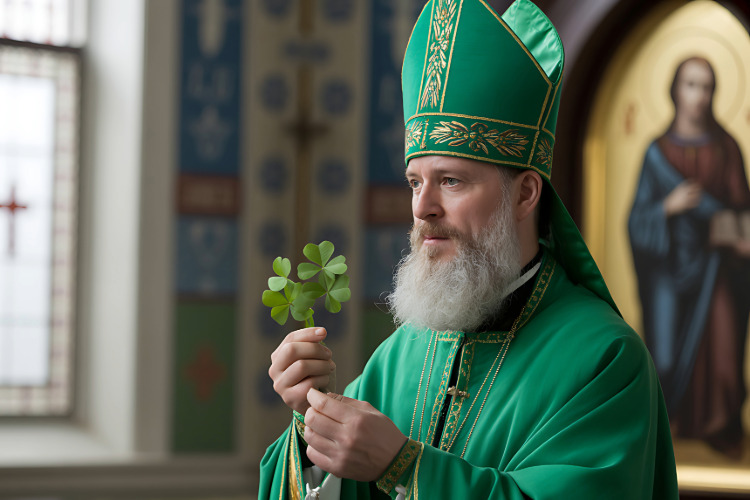
St Patrick and the Evangelisation of Ireland
St Patrick’s remarkable journey from Irish slave to missionary bishop transformed Ireland, establishing a vibrant Christian heritage that would send missionaries across Europe for generations.
A little-known chapter of Christian history is the missionary vitality of the church in Ireland in the sixth and seventh centuries.
The church in Ireland sent out missionaries to Scotland, northern England, France and even northern Italy. These missionaries, in their hundreds, were monks. The church in Ireland was predominantly monastic rather than diocesan in its structure, partly because Ireland had no towns.
This extraordinary flowering of Christian life had its roots in the embracing of the Christian Gospel in the previous century. The man associated with this evangelisation of the Irish people is St Patrick.
From Captivity to a Life-Changing Encounter with God
What we know of him comes largely from his own writings: the Confessio, an account of his life and a defence of his mission, and the Letter to the Soldiers of Coroticus. Many of the popular stories about St Patrick, such as driving the snakes from Ireland, belong to later legend.
Patrick begins the Confessio by stating: “I, Patrick, a sinner, most rustic, the least of all the faithful”. He was born of Romano-British stock in the late fourth or early fifth century, possibly on the west coast of Britain. He was raised a Christian; he tells us that his father was a deacon. He admits that he took his faith lightly in his younger years: “I did not know the true God”.
At the age of sixteen, he was captured by raiders and taken to Ireland, where he was forced to work as a slave.
Isolation and hardship, he tells us, led to a deep conversion. He turned to prayer: “Every day I had to tend sheep, and many times a day I prayed — the love of God and His fear came to me more and more, and my faith was strengthened”.
After six years of captivity, one night he heard a voice in his sleep saying, “It is well that you fast, soon you will go to your own country.” Then he heard, “See, your ship is ready.” He escaped and walked, he said, some two hundred miles, found a ship and made his way back to his family.
The Call to Return: Patrick’s Mission to Ireland
Back in Britain, he had a vision of a man bringing letters, one headed “The Voice of the Irish”, and heard the people begging him to come and walk among them again. He trained for the priesthood, was made a bishop, and returned to Ireland. The date of his return is traditionally given as 432.
Patrick was not the first to preach the Gospel in Ireland. In 431, Pope Celestine sent a bishop named Palladius, who was associated with preaching in the south-east of Ireland. Tradition links Patrick with the north and west of Ireland, where the Gospel had not yet been preached.
He was a successful preacher, baptising thousands. In the Confessio, he writes of his missionary efforts:
“In the light, therefore, of our faith in the Trinity, I must make this choice, regardless of danger I must make known the gift of God and everlasting consolation, without fear and frankly I must spread everywhere the name of God so that after my decease I may leave a bequest to my brethren and sons whom I have baptised in the Lord — so many thousands of people.”
With no towns, Ireland was a patchwork of small kingdoms. Patrick made contact with the local kings, offering them gifts so that he could have safe passage through their lands and access to their people.
Bold Preaching, Baptisms and the Birth of an Irish Church
His preaching bore fruit in consecrated life: sons of the Irish became monks, and daughters of chieftains became consecrated virgins. He also raised up local clergy, so he did not have to rely on imported clergy. This ensured that the church was embedded in the culture. It took on its own particular character.
Patrick acknowledged that he was not a great scholar, but his writings are rich in Scripture and shaped by a profound gratitude for God’s action in his life. Part of his credibility lay in the fact that he was a former slave returning to serve the people who had enslaved him.
He mentions being robbed, seized and held in chains for fourteen days, and expecting death more than once. He saw this as part of the cost of preaching the Gospel.
One story of Patrick’s boldness is set on the Hill of Slane in County Meath. According to tradition, recorded in Muirchú’s Life of Patrick some two centuries later, on the night of the Easter Vigil in 433 Patrick lit a Paschal fire in defiance of King Lóegaire at Tara. The king rode out to confront Patrick.
In the meeting that followed, the king eventually allowed Patrick to preach to his people, though he did not convert himself. One of those present, Erc, converted and later became the first bishop of Slane.
The story illustrates the courage tradition ascribed to Patrick. The hymn St Patrick’s Breastplate, though probably composed some centuries later, is linked by tradition to this episode. Its words capture Patrick’s faith and his reliance on Christ as he proclaimed the Gospel.
Tradition holds that Patrick established his episcopal see at Armagh, in present-day Northern Ireland. Armagh remains the ecclesiastical capital of Ireland and is the seat of both the Catholic and the Church of Ireland archbishops.
Patrick left a remarkable heritage in Ireland: a stable and thriving church with oversight from bishops, local priests serving the people, and a large number of monks and consecrated virgins witnessing to the supreme advantage of knowing Jesus Christ.
Patrick can have the final word: “So now I commend my soul to my faithful God, for whom I am an ambassador in all my wretchedness; but God accepts no person, and chose me for this office — to be, although among His least, one of His ministers.”
___
Image courtesy of Adobe.
Recent Articles:
13 November 2026
3.5 MINS
Joe Rogan has questioned why progressive ideology is infiltrating Christian churches, exposing how political slogans are filling the spiritual vacuum left by declining religious belief.
13 November 2026
4.4 MINS
A sobering new study reveals that two-thirds of American Christians fail a basic Bible knowledge test, exposing a crisis of biblical literacy within the Church.
13 November 2026
7.2 MINS
A fresh challenge to conventional climate change thinking examines ocean temperatures, atmospheric energy flows and historical climate patterns, questioning the science behind catastrophic warming predictions.
13 November 2026
3.5 MINS
Historian Christopher Dawson argued that religion is the spiritual foundation of civilisation. As Christianity retreats from public life, his warnings about cultural decline deserve renewed attention.
13 November 2026
9.1 MINS
Understanding Islam requires more than interfaith goodwill. Examining its theology, political ambitions, migration and Western alliances, we require vigilance without abandoning Christian compassion.

12 November 2026
3.9 MINS
Two free tools promise to transform Christian voting in Australia, helping believers identify pro-life candidates, understand preferential voting and rank every candidate with confidence. Let us vote well in the upcoming elections.
12 November 2026
3.9 MINS
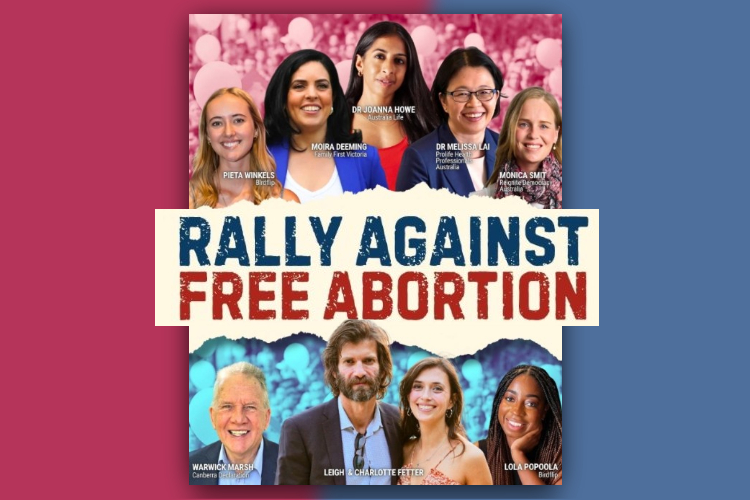
Victoria’s Presbyterian Church has condemned Labor’s promise of free abortions, with Moderator Rev Dr John Wilson urging political leaders to protect unborn children and support mothers.