



Time’s Ticking For Bowen to Secure Fuel Supply
Just five months ago, News Weekly asked, again, some critical questions about Australia’s liquid fuel insecurity. The acknowledgement of the problem by former Minister Angus Taylor in late 2020 and the Coalition government in general (in the “Australia’s Poor Energy Systems Resilience” report, October 2021) was a significant step but “too little, too late”.
Now, with a new Ministry sworn in, it is time voters heard what Minister for Energy Chris Bowen’s plan is to secure our supply. Does the Minister even have a plan?
Currently, Australia has only two liquid fuel refineries remaining, Ampol’s refinery in Brisbane and Viva Energy’s in Geelong.
Ampol and Viva Energy accepted subsidies from the Morrison government to remain open, whereas ExxonMobil (Geelong) and BP (Perth) closed their refineries despite the offer. Their closures were due to poor financial returns exacerbated by enormous losses incurred during the covid lockdown-induced slump in consumption.
Looming Crisis
Back in 2017 we had seven refineries around the country; in 2028, we may have none, as that is when the subsidy contract ends.
It may help highlight the urgency of the problem when voters understand that, no matter how strong Australia’s carbon-dioxide emissions reduction policies are, Australia will, for mere survival, need a majority of fossil fuels in the mix of transport energy for many decades.
According to RMIT research fellow Anthony Richardson in an article on The Conversation website in May 2018: “Currently, 51-53 per cent of our imported refined petrol comes from Singapore’s refineries, with 18 per cent from South Korea, 12 per cent from Japan and the rest from a range of other countries. Asian refineries, in particular, are extremely competitive in terms of production and transport costs.”
In 2021, around 28 per cent of Australian refinery feed stock (crude, condensate or LPG) was produced domestically. Australia exports about 75 per cent of the oil it produces – around 100 million barrels a year. Yet we depend on Asian refineries for an increasing proportion of refined products, according to the Office of the Chief Economist.
The graph below shows the growing dependence on imports as our domestic refinery production declines.
Australia imports around 90 per cent of all its liquid-fuel needs as either crude oil for our refineries or as refined product. These all arrive on foreign-owned ships that navigate through territories that are vulnerable to disruption, something Tony O’Brien warned of in the News Weekly of April 2, 2022 (“Defence preparation must be a priority”).
So, What To Do?
There is more than one way to resolve this insecurity, as pointed out in the October 2021 “Australia’s Poor Energy Systems Resilience” report (APESR).
Australia could reduce its demand by replacing imported liquid fossil fuels with domestically produced green or greener fuels. The APESR report mentions green hydrogen and green ammonia but leaves out a more readily available near net-zero option: green ethanol from sugar cane.
Ethanol production from sugar cane is highly efficient and is already mandated in Queensland to 4 per cent of total volume sold from retail fuel stations. In Brazil, the ethanol mandate is around 27 per cent.
The APESR report suggests transferring from high fuel intensity transport such as trucks to more efficient trains. Significant uptake of electric cars would reduce fuel demand but would place the struggling electricity market under greater strain.
Of course, the EV car option only makes sense for those seeking stronger “climate action” if a carbon-dioxide neutral baseload power supply were included in our electricity generation mix. No bonuses for guessing what that would be.
Additionally, the Government could incentivise the construction of more refineries and bigger storage facilities. Something aggressive would be required to compete with the Asian refineries, which are much larger and highly profitable. This could involve a government-owned initiative, or some private/government mixed venture.
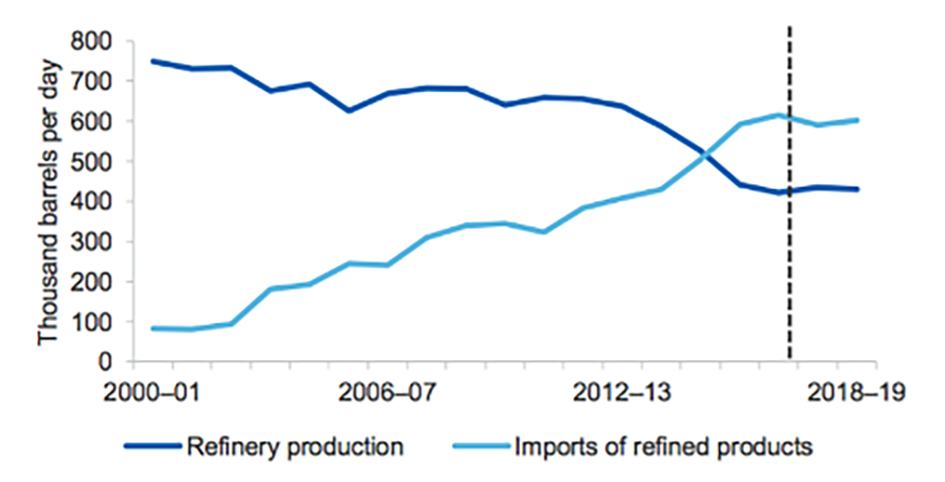
SOURCE: Australia’s imports and production of refinery products. Dept Environment and Energy/Dept Industry, Innovation and Science
Bare Minimum
It would certainly save face, and improve fuel security, if, at the very least, Australia met its 90-day supply-storage requirement for our membership of the International Energy Agency. Something we have failed to meet for over a decade.
Of course, Australia may need more offshore exploration to reduce its dependence on foreign oil. The Australian market has cooled for such projects, as the sector needs more assurance from government and lenders to take on such large risk-laden projects.
Another alternative is coal-to-liquids technology, that includes greener options like utilising the carbon-dioxide emissions to create biodiesel.
Our heavy reliance on foreign supply, along with growing political instability in our region, and the fragility of our supply chains as exposed during the covid pandemic, mean that it is urgent that Mr Bowen and other ministers deal with this fuel insecurity.
The Labor Federal Government has a chance to do what the Coalition failed to do in its three terms of Government. Labor cannot afford to ignore this elephant in the room for the sake of political expediency.
___
Originally published in News Weekly. Photo of Chris Bowen MP: Brett Crealy/Wikimedia Commons.
Recent Articles:

23 October 2026
6.8 MINS
Hillsong UNITED’s Joel Houston reflects on fame, faith and the burden of ministry, questioning performative Christianity as he seeks a more authentic walk with God.

23 October 2026
13.1 MINS
Tasmania’s proposed conversion practices legislation raises serious questions about religious freedom, pastoral care and whether Christians can freely pray with those seeking to live according to their faith.
23 October 2026
7.7 MINS
Melbourne Catholic Archbishop Peter Comensoli has spoken out clearly against the deadly promises by both major parties in Victoria ahead of the election, drawing a comparison between abortion and capital punishment.

23 October 2026
3.1 MINS
As Western societies grow more hostile, could abandoning Christianity’s moral foundations be contributing to the rise of ideological extremism, political intolerance and violence?

23 October 2026
5.1 MINS
France’s escalating riots expose the dangers of political extremism, antisemitism and radical alliances, offering America a stark warning about the future of Western democracy.

23 October 2026
3.1 MINS
The one who is worthy of it all is awakening his Church to be captivated by him, so that we will honour one another and share his gospel with humility and courage.

22 October 2026
2.9 MINS
Victoria Labor’s promise to fund free abortions has drawn a forceful response from Presbyterian leaders, raising profound questions about unborn life, government priorities and Australia’s moral direction.


