



Winning Gambit: Taiwan Deserves a Fair Go on the International Stage
The Republic of China, Taiwan, has been left out in the cold for far too long. It is high time that it is accepted back into the United Nations as a contributing member of the international community.
The intended role of the United Nations is to replace international anarchy with the rule of law.
English philosopher Thomas Hobbes, describing the “state of nature”, wrote:
“Life in the state of nature is solitary, poor, nasty, brutal and short.”
In his masterwork Leviathan, Hobbes proposed that citizens surrender some of their liberty in exchange for stable government. The purpose of the United Nations was to replace the law of nature with a permanent organisation that would maintain international peace and stability.
The United Nations (UN) Charter was signed by its 50 founding member states in San Francisco on June 26, 1945. At that same conference the International Court of Justice, intended to settle international legal disputes through a transparent legal process, was also established.
Among the UN’s founding members was the Republic of China (ROC). The government of the ROC was almost universally recognised as the government of all China. The ROC became one of the five Permanent Members of the UN Security Council, with the power of veto.
Equality
The intention of the UN’s founders was that membership of the UN General Assembly (UNGA) should be open to all states, large and small, and that the law of the jungle in international relations should be replaced by the rule of law.
This rules-based international system has special merit for small and middle-ranking powers, such as Australia, which rely on a stable international trading regime.
The ROC, or “Taiwan”, was thus a founding member of the United Nations and occupied the “China seat” on the UN Security Council.
As an ally of the United States and a member of the Western alliance, the ROC was a valued ally in the Korean War and during the war in Vietnam. General Douglas MacArthur was a close friend of Generalissimo Chiang Kai-shek; and while the ROC did not commit ground troops in Korea, the ROC’s support was invaluable, as was later the case in Vietnam.
We should not overlook the ROC’s role at that time as a diplomatically valuable developing democracy, in particular on account of the ROC’s membership of the UN Security Council, with the invaluable power of veto.
Indeterminate
As things developed, the ROC government was defeated militarily by the Chinese communists and went into exile across the Taiwan Strait in Taiwan. In 1949, the Communist Party of China declared itself the government of China, effectively usurping the role of the ROC.
Thereafter, the issue of who represented “China” at the UN could not be long suppressed. UNGA Resolution 2758 determined the “China Question” some 50 years ago in favour of the communist People’s Republic of China (PRC).
This Resolution did not state, however, that Taiwan was part of China, contrary to the repeated assertions of the PRC since then. Contrary to the PRC’s false claims, Resolution 2758 does not take a position on Taiwan, nor does it include the word “Taiwan”.
The long-term status quo is that the ROC (Taiwan) and PRC (Beijing) are separate jurisdictions; neither is subordinate to the other. The free citizens of Taiwan can be represented only by their freely elected government; the world’s only freely elected Chinese government.
The wrongful interpretation of UNGA Resolution 2758 has unjustly deprived Taiwan of the right to belong to the UN and its specialised agencies. And, despite Taiwan’s strenuous efforts to gain admission, it continues to be denied membership of the World Health Organisation (WHO) and International Civil Aviation Organisation (ICAO), among other UN agencies, because the communist PRC always vetoes its petitions to join.
Taiwan’s exclusion from the UN and its agencies, in the face of Beijing’s intransigent opposition, does not mean that Taiwan has not been active on the international scene.
Since the onset of the covid pandemic, Taiwan has provided medical supplies, including its home-grown vaccine, to allies around the world. It has sent more than 550 tonnes of relief supplies to the people of Ukraine since the Russian invasion, and has donated more than $50 million to help alleviate the suffering of Ukrainian refugees.
Taiwan is today, moreover, a key link in the global high-tech supply chain. Taiwan Semiconductor Manufacturing Corporation (TSMC), for example, is the world’s leading manufacturer of advanced semiconductors, also called computer chips.
Taiwan has a lot to offer. It is about time it was treated with justice in the organisation that was established to overcome the law of the jungle and protect the rule of law internationally.
___
Originally published at News Weekly. Photo by Timo Volz.
One Comment
Leave A Comment
Recent Articles:
14 October 2026
6.7 MINS
A national poll challenges claims that pro-life Australians are extremists, revealing broad support for abortion restrictions, protections for unborn babies and safeguards for vulnerable women.
14 October 2026
5.5 MINS
As Christianity fades from public life, Marxism or Communism offers a substitute faith built on oppression, liberation and political salvation — but at what cost?
14 October 2026
5.3 MINS
Marco Rubio’s Athens speech celebrates the Greek, Roman and Christian foundations of Western civilisation, warning that cultural self-loathing and radical ideologies threaten its future.

13 October 2026
3.9 MINS
Tasmania’s proposed conversion practices law raises serious concerns for churches, parents and faith-based schools, with broad definitions, severe penalties and uncertain protections for religious freedom.
13 October 2026
5.5 MINS
Stephen Baldwin’s journey from drug addiction to sobriety, Christian faith and family life reveals how surrender, daily discipline and renewed hope transformed his life.
12 October 2026
4.6 MINS
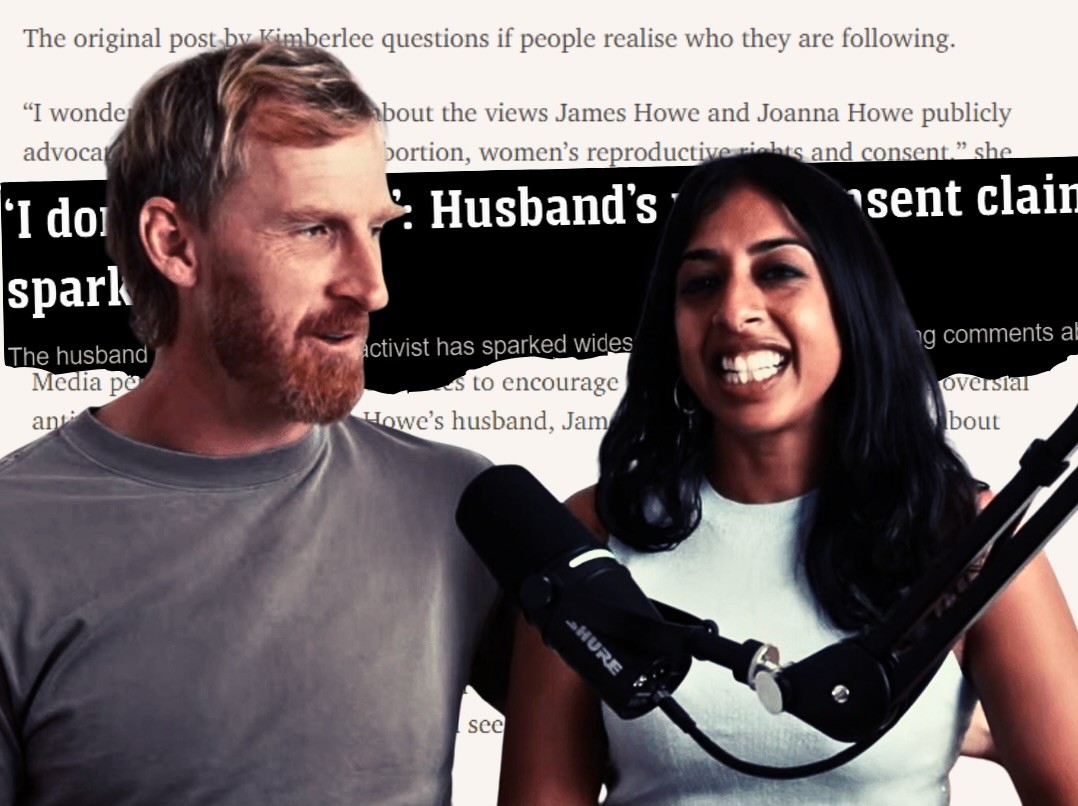
Learn how journalists use loaded language, selective quotes and misleading headlines to shape public opinion, using a controversial report about James and Joanna Howe as a case study.

12 October 2026
3.1 MINS
The proposed livestream of Nidal Hasan’s execution has reignited debate over justice, deterrence and public accountability, with critics comparing American justice to ISIS propaganda.



Thank you so much for taking the time to publish this. It’s wonderful to learn n understand even when that understanding is painful.