


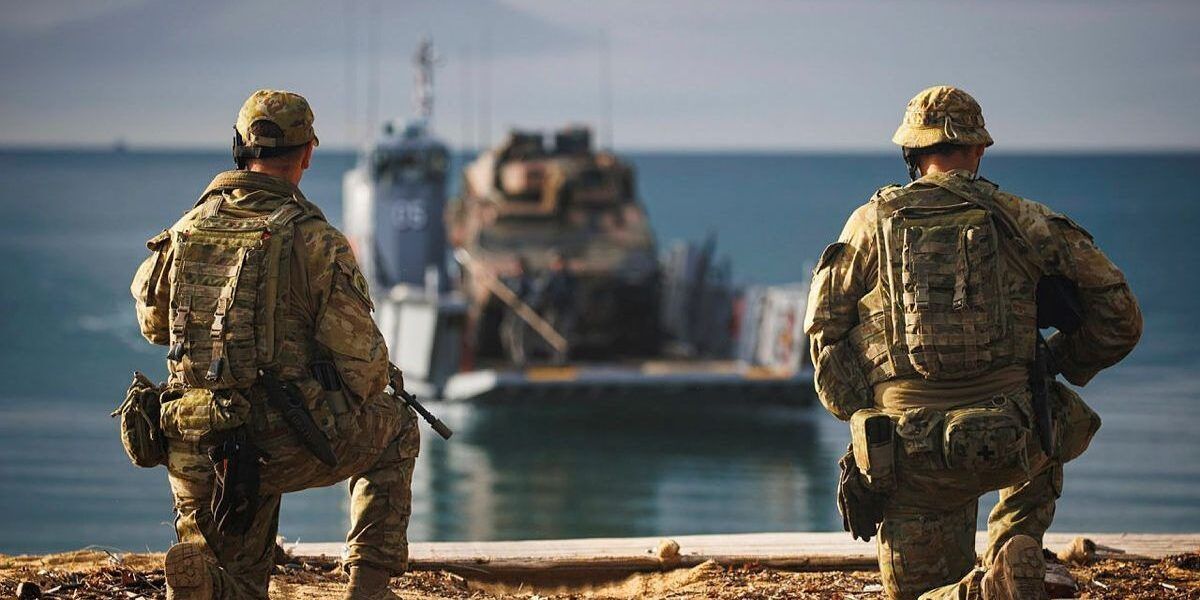
State-On-State Warfare Back in View
In Another Bloody Century, eminent strategist Colin S. Gray challenged the notion that state-on-state war was over.
Nowadays this seems obvious, with Russia invading Ukraine and Azerbaijan bombing Armenia; the People’s Republic of China (PRC) targeting Taiwan and India; and the interstate conflicts simmering beneath the surface in Africa and the Middle East.
However, when Gray’s book came out in 2012, it wasn’t so obvious. Most of the conflicts of that time were intrastate — they were internal inter-ethnic blood-sheddings, such as Rwanda and the Balkans. They were counterinsurgency operations, such as Afghanistan, and what quickly happened after the United States invaded Iraq.
Terrorism and transnational crime, along with societal breakdown in response to emergencies, were the priority. Australia focused on regional peacekeeping, such as in Timor and the Regional Assistance Mission to the Solomon Islands.
While some scholars, like Gray, emphasised the universality of war and its likelihood, others downplayed it and focused on other sources of conflict. This was aided by a military emphasis on small wars and a pundit emphasis on terrorism.
This understanding has lost ground greatly in the last few years.
Worldwide Developments
Russia’s destabilisation and eventual invasion of Ukraine created an environment where state-on-state conflict returns to the fore. Due to the big role Russia plays as a global arms supplier and security partner for many former Soviet and non-aligned nations, including India, its setbacks in Ukraine are encouraging not only new avenues of arms supply, but also lighting the fuse of long-simmering conflicts.
Armenia and Azerbaijan have been in conflict over the statelet of Artsakh for decades. However, strikes have usually targeted the province itself. Now, Azerbaijan is bombing Armenia proper.
To illustrate the complexity of global politics — Artsakh is a Russian-backed separatist region, unrecognised by the rest of the world. However, it is much more strongly connected through language, blood and belief to Oriental Orthodox Christian Armenia than to secular Islamic Azerbaijan.
The Armenians underwent their own genocide at the hands of the post-Ottoman Turks, and Turkey is supporting Azerbaijan. Lacking Western support, and with Russia less able to aid, Armenia is more likely to seek help from Iran or China. Israel and Turkey have security agreements, so Israel is unlikely to get involved.
This highlights the return of war in its bloody complexity and unpredictability.
Closer to Home
Turning to the Indo-Pacific, countries there are increasingly preparing for war.
A recent report from Macquarie University for the Defence Department highlights a rapid escalation in arms spending within the region. While most of this spending is due to the PRC’s military modernisation, the rest of the region is also accelerating weapons uptake, to symbolise their own growing power and to prepare for conflict. In addition, states are using these capabilities to crack down on internal challenges, such as in the case of Myanmar.
In his 1986 report, defence expert Paul Dibb said that Australia would have a ten-year warning time before attack, as it would take that long for regional powers to develop the forces needed for such an intensive and complex operation.
The Macquarie report refines this model by splitting warning time into distinct types of conflict:
- Attack — that is, artillery strikes and blockades;
- Invasion — troops making landfall; and
- Grayzone conflict — influence operations, sabotage and covert action.
The authors further identify two core concepts — “space” and “time” — as shaping the environment. They argue that the space — the geography and challenges it presents — has not changed. As such, invasion remains as unlikely as ever due to the vast resources required.
However, many “time”-related factors, such as procurement times, have accelerated. While major industrial powers such as the PRC, Japan and South Korea largely manufacture their own weapons systems, thanks to extensive investment and experience, most of the region now buys “off the shelf”, readily available platforms.
Australia tries to do both. However, this leads to the situation where Australia will have nuclear submarines by the time that NASA intends to have men on Mars. Singapore, on the other hand, will have submarines within five years.
It makes sense to have an indigenous defence industry. The Macquarie report, however, points out that, by the time Australia sets one up — and it will take time — Australia may have been attacked. One option is buying off the shelf now and establishing maintenance centres in country, thereby allowing industry to develop while still developing preparedness.
But this leads to the question of what to buy. While a lot of commentary focuses on the need for air/sea assets to fight a maritime war, the reality is that no one knows what the next war might require. The chaotic contagion of Russian action could spread any which way. Land war and tanks are not going away.
It is not only “fighting the last war” that leads to defeat. It is lacking the flexibility to fight in the war that happens. The Australian Defence Review could not be more important in this situation.
___
By Edward Gray
Originally published at News Weekly.
Recent Articles:

14 October 2026
6.7 MINS
A national poll challenges claims that pro-life Australians are extremists, revealing broad support for abortion restrictions, protections for unborn babies and safeguards for vulnerable women.

14 October 2026
2.8 MINS
Queensland recorded 1,082 assisted suicide and euthanasia deaths in 2025–26, as the review board called for consultation on potentially widening eligibility criteria.

14 October 2026
5.5 MINS
As Christianity fades from public life, Marxism or Communism offers a substitute faith built on oppression, liberation and political salvation — but at what cost?

14 October 2026
5.3 MINS
Marco Rubio’s Athens speech celebrates the Greek, Roman and Christian foundations of Western civilisation, warning that cultural self-loathing and radical ideologies threaten its future.
14 October 2026
2.8 MINS
Australia needs a courageous Church that never separates courage from Christian love — the courage of Peter and John, who, when ordered to cease speaking about Jesus, responded: “We can't stop.”

13 October 2026
2.6 MINS
Allegra Spender’s proposed bill reignites debate over discrimination protections, religious freedom and the right of faith-based schools to uphold their beliefs and values.

13 October 2026
3.9 MINS
Tasmania’s proposed conversion practices law raises serious concerns for churches, parents and faith-based schools, with broad definitions, severe penalties and uncertain protections for religious freedom.


