


Our World Has Gone Mad! – Part 5: Communication
Talking with an old friend, the topic of ‘communication’ came up, and the question of what is truth? What is the role of the media? How do we distribute, consume and process information?
He said something like this:
Ever since the explosion of social media, conspiracy theories flourish and that’s why communication is now such a contested, fraught space.
So, if this is true, will we ever find truth?
Thirteen years ago, we were told algorithms were taking over the world!
Simply put, algorithms take input and produce output… Algorithms have now evolved. We are no longer shaping algorithms, they are shaping us, they shape our culture, they shape what we see, what we hear, they shape how we live. (Christopher Steiner)
Do they? Are we taken over? Is this why we now find it so hard to communicate? Is this why debate and honest analysis of opposing views is almost an extinct species?
Let’s unpack the story so far.
No one would argue that social media has exploded in recent times. How many of us have noticed that social media has a bad rep in many quarters? Is this because we know that algorithms are now watching every move we make? Is this because we are honest enough to admit that everything, we post on social media is biased to make us look good?
Consequently, social media can’t be trusted, and everything an algorithm generates from our social media is also going to be untrustworthy.
Further, I contend that those who savage social media also heap ridicule on the prevalence of conspiracy theories, arguing that the oxygen supplied by social media has fanned the flames of conspiracy theories to fill our appetite for the sensational.
If this is all true, where do we find truth?
Mainstream media (MSM), sometimes called legacy media
In 2022, at 34%, Americans’ trust in the mass media to report the news “fully, accurately and fairly” is essentially unchanged from 2021 and just two points higher than the lowest that Gallup has recorded, in 2016 during the presidential campaign.
Just 7% of Americans have “a great deal” of trust and confidence in the media, and 27% have “a fair amount.” Meanwhile, 28% of U.S. adults say they do not have very much confidence and 38% have none at all in newspapers, TV and radio. (Megan Brenan, 2022)
Nearly 40% of Americans had no trust in legacy media in 2022, but look at the partisan divide of the 60% who do:
Americans’ trust in the media remains sharply polarized along partisan lines, with 70% of Democrats, 14% of Republicans and 27% of independents saying they have a great deal or fair amount of confidence. (Megan Brenan, 2022)
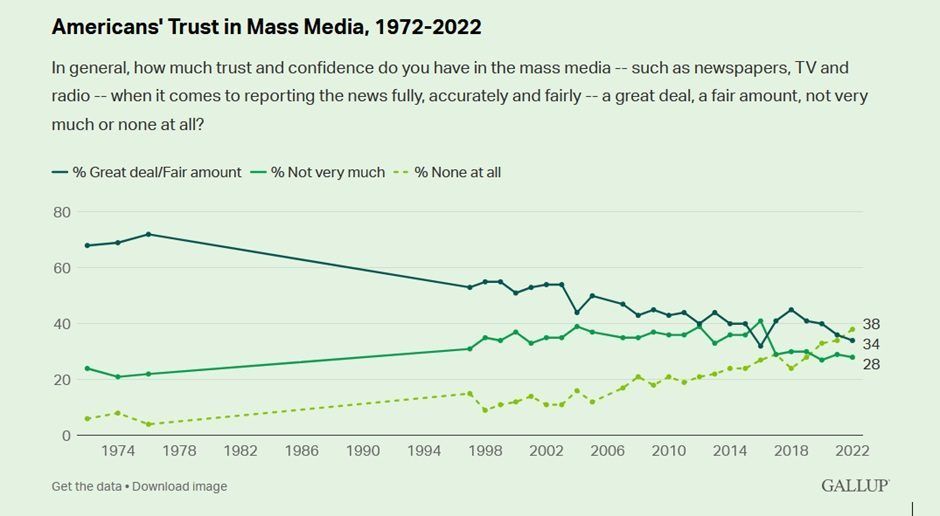
Sourcing data on trust in media was a challenge. Many studies focused on the revenue stream from advertising, others on the time spent watching, and others on the number of online views. All valid statistics, but I found this from Gallup the most helpful, as they made the questions in their survey crystal-clear.
Look at the trust divide between Left and Right, 70% to 14%! If this is true, it suggests that the Left generally trust MSM and the Right almost exclusively don’t! How much of this can be levelled at Trump’s frequent lament about fake news?
How then can we effectively communicate, considering our source of ‘truth’?
If we are Left leaning and tend to trust the MSM, or we are Right leaning and tend to trust alternative media (social media), we all need to be extremely cautious who we trust. Everyone has an agenda!
If our online reading, studying and viewing habits feed into algorithms then, yes, we will have our proclivities reinforced. Then would it be fair to say that this positive feedback has the effect of entrenching our attitudes and even our thinking?
Then, the result will be that we are much more confined, typecast and less inclined to consider alternatives. All this makes it harder for us to communicate outside our own echo chamber:
Social media sites foster confirmation bias because of their basic function. Regardless of the specific algorithm, social media sites like Facebook, Reddit, Twitter, Instagram, and even YouTube, serve the same basic function: to connect groups of like-minded users together based on shared content preferences. (University of Texas, Austin).
So, if the media is driving us further and further into our tribal groups of like minds, how then are we to break free and communicate beyond our comfortable territory?
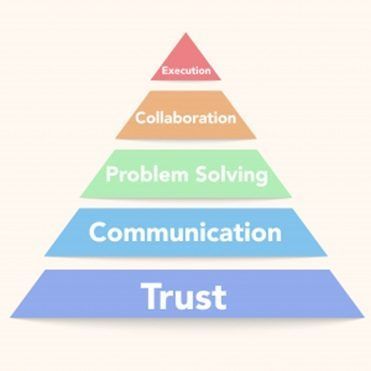
There are many models that help us intentionally build our relationships with others; I love this one:
Trust — for relationships, whether personal or professional, this means building a solid foundation of trust.
Communication — good communication, like trust, is learned. And, just as everyone is different, the way you communicate with everyone must be different as well.
Problem solving — we must be open to alternative ideas to effectively problem solve.
Collaboration — sharing the expertise and being able to leverage the experience of many people gives you diversity, and different views. It sums up to more than if you do it on your own.
Execution — you must have a plan that everyone understands, a plan that everyone agrees upon, a plan that everyone can support, and a plan that outlines ways to achieve your organization’s goals.
Now, more than ever, I think that our communication needs so much more intentional, and it demands great effort to make it effective. We should be prepared to challenge ourselves to get out of our comfort zone and seek to trust strangers again!
What is Truth?
I have sought to demonstrate that MSM and alternative media cannot be taken at face value; they both push their narrative.
Consider the nightly TV news. It is commercially driven to sell products and manipulate our thinking. During the Covid era, it was blatantly the instrument of government, operating the tools of the nudge units.
Take alternative media news. The boundary between commentary and news is blurred. Take the Israel–Hamas War; some are pro-Israel and some pro-Palestinian (Hamas).
So, if all we read, hear and see is tainted, biased, and consciously or subconsciously pushing a narrative, it is not the truth. At best, it is a reflection of some truth.
So, what is truth? I think we need to hold back more than we might like to. Be content to live in the theory realm for a long time. Take conspiracy theories for example; see them as someone’s conjecture, commentary, and perspective. Don’t necessarily dismiss them; they may prove true one day!
Take science for example. There is little in science that can be declared the truth, most is theory. I do accept the truth about gravity. I do accept the truth about life and death. But as soon as someone says that the science is settled, I immediately say, on principle, no it’s not!
Wisdom declares we should learn from history. Unless we learn the lessons from our mistakes, we are destined to repeat them. But what if history is being rewritten? Holocaust denial is well known. Today, there are countless voices seeking to change the past, and tragically many of the young are believing the new reality. George Orwell’s 1984 is centre-stage.
I think that all of us need to know and understand our absolutes, our own non-negotiables. For example, the truth about the sanctity of life, the saving work of Jesus Christ on the cross, God’s plan and purpose for His creation. As long as I hold to my non-negotiables, I believe I can communicate more effectively with others.
Confidence and Purpose
Low self-esteem and lack of self-confidence are a built-in negative feedback loop that constricts and diminishes effective communication.
These days when it is so hard to know what is true, what is false and what is propaganda, I believe it is an important first step to fight back with our own confidence.
All around us are uncertainty and insecurity. We can’t find much hope out there. Only in Jesus can we find hope and a future.
I am not advocating arrogance — rather, a conscious building of ourselves up in our faith (Jude 1:20-25). Let what God sees in us take root and flourish. Recognise that we are the temple of the Holy Spirit (1 Corinthians 6: 19). If this is true, we will be responsible with what we eat and drink, what exercise we take, and what sleep we get.
Feeling more confident about ourselves is bound to stimulate more positive communication, and before we know it, we have a positive feedback loop happening!
Finally, this leads me to purpose. I believe that we are all created with a God-given purpose. We are not created to merely exist, to be entrained, and for pleasure. Surely that’s a definition of narcissism. No, we are all called to reach out to others in some way.
I think that low self-esteem and lack of self-confidence short-circuits our ability to communicate with and think of others — that’s why it is so important to build ourselves up intentionally.
Then, from a position of strength, set out to discover our calling, our purpose. I find that many get the first step sorted, but trip up on the second. I confess it is hard.
Let me conclude with a story from my teacher training days. Early on in the course, I was always keen to have the students closely examine their calling to teach. I would ask them, in tutorial groups, to express how they knew they should be a teacher.
Some struggled to put this into words and, sometimes, these students were the ones who did not complete the course. Others would often say that someone else, a family member, a spouse, a church leader, had approached them and made the initial suggestion. That’s right, very often the teacher could not see that teaching was their calling! These students often turned out to be the best teachers! They ended up with the necessary resilience and, above all, the heart for teaching.
So, find a trusted other, and challenge them to help you find your purpose, or to confirm your purpose, if you believe you are on the right track.
From the position of confidence and purpose, I think we will have the necessary security to seek out the best for others while letting God take care of our own needs. Communication will be exciting, fulfilling and a joy, even in our mad world!
___
Photo by Caleb Oquendo.
4 Comments
Leave A Comment
Recent Articles:
28 October 2026
4 MINS
The assault on Helen Haines highlights Australia’s growing political hostility. Recovering civility requires personal accountability, respectful debate and a renewed commitment to Christian moral foundations.
28 October 2026
4.4 MINS
With biblical illiteracy on the rise, understanding why Jesus came is more important than ever. Fifteen New Testament passages reveal the heart of His mission.
28 October 2026
1.8 MINS
A candlelit performance of Mozart’s Requiem at Sydney Town Hall will honour 21 Australian Army nurses murdered in the Bangka Island massacre, along with generations of military nurses.

28 October 2026
3 MINS
When we live in God’s presence, anchored in his Word and secure in Christ, we can stand unshakeable amid life’s challenges.
27 October 2026
10.3 MINS
As Tasmania and Western Australia consider conversion therapy bans, a former LGBT+ ministry leader warns of threats to religious freedom, personal choice and Christian discipleship.
27 October 2026
4.9 MINS
Nine Christians have been killed in a terrorist attack on a Jordanian church, prompting fierce condemnation, demands for justice and renewed concerns about religious persecution.

27 October 2026
3.6 MINS
For 25 years, the Mount Moriah Trust has supported struggling Christians across the Holy Land, bringing practical assistance, encouragement and hope to believers facing hardship and persecution.



Hi Jim, thanks for your article. It is well researched and written. I like the fact that you raise the problem of media driving us further and further into our tribal groups of like minds, and hence not communicating well, and then provide a solution of communicating with intentionality and from a position of faith and knowing your God given purpose. Stephen
Stephen, thnaks for reading. The concept of the broken media landscape we all live in has disturbed me for some time. The cancel culture has also bemused me, why would you stop students at a university hearing an alternative view! It is so far from the point of a university.
The push back idea of ‘intentionally pushing against the tide’ seemed to be the most honest thing that we can do, especially if we are people of faith, and believe we are all players on God’s stage for such a time as this.
I only get the ABC which is so biased and has such stupid conversations and topics ( mostly from women professors and “experts “) that I switch it off after I hear a precis of the latest news. I dislike intensely listening to an ABC journalist trying to indoctrinate us via her political spin , so, I sometimes watch instead SBS Italian News to view the TRUTH, ie pictures of captured weapons which had been stored by Hamas in the Gaza hospital. This news is delivered factually without any commentary .
Countess, I am not surprised at your reaction to the ABC. A few years back, pre Covid era by a few years, I also ready reached the point when I could no longer listen to the ABC. I used to listen every Saturday morning in bed, but now I read my book! I am thrilled that the Italians are pushing back and giving you facts. Perhaps its the influence of your new PM?