


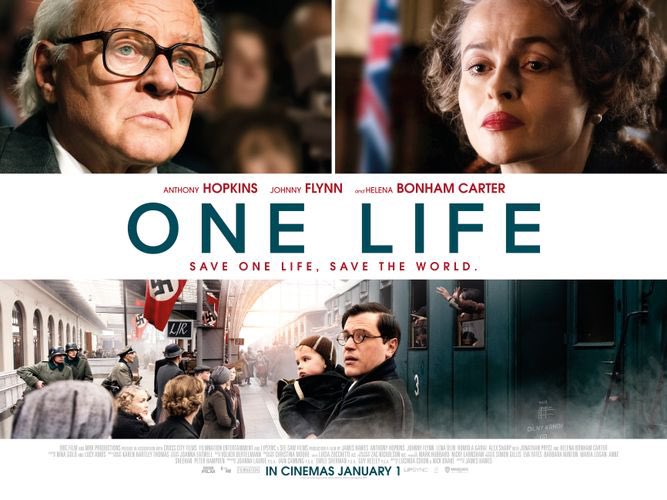
“One Life” Film Review by a Child of a Holocaust Survivor
The film One Life tells the relatively unknown, but powerful story of Nicholas Winton. Nicky is played by the brilliant Academy Award-winning Anthony Hopkins as the older retired Winton, and the wartime younger Nicky is played by the talented John Fynn.
The story centres on Winton, a former London stockbroker in a comfortable retirement in the 1980s who, after encouragement from his wife Grete (played by Lena Olin), clears out his study after many years of accumulated clutter. In the process, he reopens his painful yet incredibly amazing past. A past that he’s been yearning and yet dreading to re-examine.
It revolves around the source and the content of a scrapbook containing the documents, photos and details of the 669 Czech Jewish children he and other humanitarians saved. His team brought them to the relative safety of England on the cusp of the beginning of World War Two.
Born of German Jewish parents in 1909, Nicky emigrated to England with his parents, who changed their family name from Wertheim to Winton. However, he was raised as a Christian after his family converted to the Anglican faith. Yet, he exemplified and gave honour to the ancient Jewish Talmudic teaching that “whoever saves one life, saves the world entire”, certainly a tenet and moral truth held deeply within the Judeo-Christian ethos. He did indeed save more than one life, as the film beautifully, tragically and emotionally shows the viewer.
Calling themselves the British Committee for Refugees, Children’s Section, Winton led several others in a dangerous mission that involved raising money, petitioning government departments for visas and organising foster care for his young charges. This was, in effect, a private “Kindertransport”. Helena Bonham Carter plays young Nicky’s supportive and unrelenting mother, Babette, who runs his campaign from London.
The story time travels in the narrative, quite seamlessly, between the actions of Winton, against the darkness of a rising Nazi Germany in the late ’30s to his reconnection with his past, and through to his public recognition in the late 1980s.
Torn Apart
The film’s writers, using Winton’s scrapbook containing photos and documents, allow us to get to know some of the children and their backstories during the chaotic, frantic scenes that see them flee Czechoslovakia. The scenes depict the heartrending separation of children from their parents and older siblings as the Nazis mass on the borders of Czechoslovakia just before the outbreak of hostilities. This was the beginning period of what would later become known as the Holocaust of the Jews of Europe. Horrifically, 6 million Jewish people, including 1.5 million children, were brutally murdered.
Sir Nicholas Winton — BBC Programme “That’s Life” aired in 1988 (42 Million views)
We are taken to London in several interspersed scenes as the 665 children of the eight trainloads that made it through the maelstrom of hate arrived. They were embraced by Nicky, his mother and the rescue team, who found foster parents and homes for all the children, thereby saving their lives.
To give you a sense of the horror: of the 15,000 mostly Jewish-Czech children who were sent to Theresienstadt camp, fewer than 150 survived. This fact was reinforced at the end of the movie when it was confirmed in the final summary that of the thousands of Czech Jewish children who were sent to the death camps, fewer than 200 survived. So Nicky Winton and his team rescued over three times that number.
This was a statistic with a child’s face and drove home the reason why this uplifting act of love and kindness elevated this movie from just another wartime story to a must-see film full of human compassion, courage and love.
Legacy
In the film’s culmination, we learn that the scrapbook is given by Nicky to Elisabeth Maxwell, a Holocaust researcher and wife of media magnate Robert Maxwell, who located 80 of “Winton’s children” in Britain.
The world finally learned about his work in February 1988 during an episode of the BBC television programme That’s Life! Nicky Winton was in the audience, in the belief that he was just to be asked some questions about his scrapbook. The show’s host, Esther Rantzen, then unexpectedly asks whether anybody in the audience was among the children who were rescued by Nicky Winton.
It is then that more than two dozen people surrounding Winton rose. Rantzen then asked if anyone in the audience was the child or grandchild of one of the children Winton saved, and the entire rest of the audience stood. The outpouring of love for this unassuming, modest man permeates and projects through to the audience, and I confess to shedding tears as the impact of Winton’s deeds strongly impacted me.
It resonated deeply for me as a must-see film. The reason for this was my knowledge of one brave man, Jo Panke, a member of the Dutch resistance during the Second World War, who personally saved my Dutch Jewish parents’ lives. He arranged transport, false papers, finance and shelter and escorted them through Nazi-occupied Holland to Brussels.
There, they remained for almost a year before their capture and deportation to Auschwitz. A precious year that bought them time and was the fundamental reason for their survival. Jo was subsequently arrested, sent to a concentration camp, tortured and died of his injuries soon after the war ended. We later learned that he saved over 200 Jewish lives during the war years.
No knighthood or BBC show for Jo Panke, but he certainly saved my brother, sister and our immediate family’s world. Sadly, 82 other members of my family were not so lucky and perished in the Holocaust. It was, therefore, with this family history that I connected with Nicky Winton’s story and the fact that he chose to save Jewish children’s lives when he didn’t have to, and could have just chosen to be yet another bystander.
It is a film that holds a timely message in today’s fractured world, where we find it hard to see the human face of tragedy or the ugly face of hate. It is for this reason that this is an important film and a reminder that we are all each other’s brothers and sisters, and we too can save a world entire, if only we had the determination and courage of Nicky Winton.
Sir Nicholas Winton was eventually knighted for his selfless actions, as depicted in this marvellous film, by Her Majesty Queen Elizabeth II in 2005 for “services to humanity, in saving Jewish children from Nazi-occupied Czechoslovakia”.
Nicky Winton died in 2015 at the age of 106, leaving over 6,000 descendants and their families of the original 665 children to bear witness to the fact that this hero’s action indeed ‘saved the world entire.’
Such an amazing and inspiring story needs to be seen by many people. It is currently sitting at number 6 in the Australian box office. Go and see it yourself. Then tell your friends. Let’s make it number one, and we might just save the world in the process.
5 Comments
Leave A Comment
Recent Articles:

27 October 2026
1.5 MINS
Labor’s Digital Duty of Care Bill threatens free speech, empowers covert online surveillance, and imposes potentially burdensome regulations on Australian businesses.

27 October 2026
10.3 MINS
As Tasmania and Western Australia consider conversion therapy bans, a former LGBT+ ministry leader warns of threats to religious freedom, personal choice and Christian discipleship.

27 October 2026
4.9 MINS
Nine Christians have been killed in a terrorist attack on a Jordanian church, prompting fierce condemnation, demands for justice and renewed concerns about religious persecution.

27 October 2026
3.6 MINS
For 25 years, the Mount Moriah Trust has supported struggling Christians across the Holy Land, bringing practical assistance, encouragement and hope to believers facing hardship and persecution.
27 October 2026
3.1 MINS
As the disciples discovered through a huge haul of fish, we can trust Jesus for a net-breaking, boat-sinking catch of people.
26 October 2026
3.2 MINS
Following Paul's example in Ephesians 1, let us pray for the Father to open the eyes of our hearts so that we may grasp the hope of his calling, the riches of his glorious inheritance in the saints, and the greatness of his power towards us who believe.

25 October 2026
4 MINS
Prayer is active partnership with God, and he is awakening his body to prayer, not by might or by power, but by his Spirit.



Thank you Jerry for this well written article about Nicholas Winton’s life. Wonderful now too that a movie has been made to share the story of saving Jewish children more widely so that we as a society may not remain ignorant of what happened in WW2. Your story of survival against the odds brings the story home to our hearts and we are grateful to God and to those who sacrificed so that you and many others might live.
We recently visited Terezin and saw the transit camps and all the horrors that are shown there. The museum was heart wrenching. So this look like great film. especially now when the Jews are again facing the same horrors. Lets’ not forget that after Saturday comes Sunday.
I notice that Bill Muehlenberg asked this question in his article “What a large hole there would be” (CD 1/1/24) – “What would life have been like if I was never born?”
The “One Life” movie/story of Nicholas Winton highlights for me, the overwhelming value of one life, and what it can achieve, especially as a Christian, which Nicky was.
Thank you Jesus for your one life/death/life that changed the world, and for inspiring Nicky to be a world changer also.
Great work Jerry!!!!!!!
Jerry, thank you so much for bringing this marvelous positive story to our lives today. It is most encouraging to learn of this Jewish value – “whoever saves one life, saves the world entire”.