By Adam De Gree
The data is clear: the social justice fundamentalism that has dominated liberal circles on college campuses encourages students to adopt a depressing and anxiety-producing worldview.
In their universally acclaimed 2018 book The Coddling of the American Mind, Jonathan Haidt and Greg Lukianoff show that the youth mental health crisis has its origins in bad thinking on school campuses.
For example, schools and universities often encourage students to see life as a struggle between good and bad people. As a result, young people are unprepared to cope with the many tragedies that arise when people with good intentions make the world worse. Anxiety is a natural response to a world that does not make sense to you.
In the years since the book’s publication in 2018, the mental health of American youth has only worsened. According to the Substance Abuse and Mental Health Services Administration, nearly 20 percent of teens and young adults said they had a major depressive episode in 2023. That’s double the rate from 2012. And concerningly, it’s almost three times as high as the rate among adults over the age of 25.
Why are young people suffering from poor mental health at such high rates? Recently, Greg Lukianoff analyzed the results of FIRE’s (Foundation for Individual Rights and Expression) 2024 College Free Speech Rankings to see if the predictions made in The Coddling of the American Mind prove true.
Lukianoff is FIRE’s president and CEO, so he is directly involved in the organisation’s yearly college free speech rankings. For the 2024 rankings, FIRE surveyed over 55,000 college students at 254 schools. And interestingly enough, the survey included five questions about mental health. The results are shocking.
Social justice fundamentalism is making young people anxious, depressed, and unhappy. Here’s what the data show.
One would expect that students who identified at the political extremes might have equally poor mental health. After all, extreme positions can isolate you from friends and family. But the data don’t show equal results for very liberal and very conservative students. They don’t even show similar results.
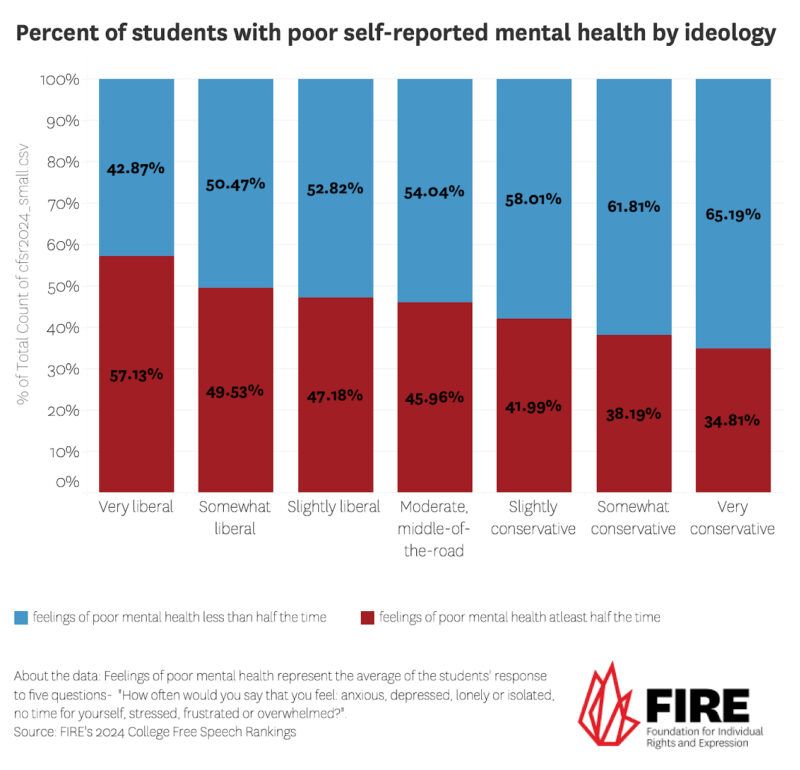
Instead, the data show an unmistakable correlation between left-wing political views and poor mental health. And the converse is also true: the more conservative students were, the better their self-reported mental health was. Even students who identified as politically moderate had worse self-reported mental health than students who identified as very conservative.
And it’s not even close. No less than 57 percent of very liberal students said they have poor mental health at least half the time. At the other side of the spectrum, 35 percent of very conservative students reported having poor mental health at least half the time. As the graph below shows, even slightly liberal students report having poor mental health at least half the time.
Lukianoff is far from being the only researcher to find a significant correlation between leftism and poor mental health. But what is equally interesting is that the burden of poor mental health does not fall equally on all people with similar ideologies.
In FIRE’s survey, students could identify as being male, female, or non-binary. The data show that while only 41 percent of very liberal males have poor mental health, 60 percent of very liberal females and 70 percent of very liberal non-binary students do. While women are more likely to suffer from depression than men, the disparity in the general population is significantly smaller than FIRE found in very liberal students.
What does this mean? According to Lukianoff, the data strongly support the thesis presented in The Coddling of the American Mind. He argues that the social justice fundamentalism that has dominated liberal circles on college campuses encourages students to adopt a “depressing and anxiety producing worldview.”
Lukianoff thinks social justice fundamentalists promote a perspective “in which the world is utterly dominated by impersonal forces, against which human beings are simply objects that are acted upon rather than people with agency. Within this framework, individuals understandably don’t really feel like they have an internalised locus of control—or an ability to guide the course of their own lives.”
The result? Profound suffering for tens of millions of left-wing Americans who have been cut off from joy in the flower of their youth.
___
Republished with thanks to Intellectual Takeout. Image courtesy of Unsplash.






Is Social Justice Ideology Bad for You?
25 June 2024
2.8 MINS
By Adam De Gree
The data is clear: the social justice fundamentalism that has dominated liberal circles on college campuses encourages students to adopt a depressing and anxiety-producing worldview.
In their universally acclaimed 2018 book The Coddling of the American Mind, Jonathan Haidt and Greg Lukianoff show that the youth mental health crisis has its origins in bad thinking on school campuses.
For example, schools and universities often encourage students to see life as a struggle between good and bad people. As a result, young people are unprepared to cope with the many tragedies that arise when people with good intentions make the world worse. Anxiety is a natural response to a world that does not make sense to you.
In the years since the book’s publication in 2018, the mental health of American youth has only worsened. According to the Substance Abuse and Mental Health Services Administration, nearly 20 percent of teens and young adults said they had a major depressive episode in 2023. That’s double the rate from 2012. And concerningly, it’s almost three times as high as the rate among adults over the age of 25.
Why are young people suffering from poor mental health at such high rates? Recently, Greg Lukianoff analyzed the results of FIRE’s (Foundation for Individual Rights and Expression) 2024 College Free Speech Rankings to see if the predictions made in The Coddling of the American Mind prove true.
Lukianoff is FIRE’s president and CEO, so he is directly involved in the organisation’s yearly college free speech rankings. For the 2024 rankings, FIRE surveyed over 55,000 college students at 254 schools. And interestingly enough, the survey included five questions about mental health. The results are shocking.
Social justice fundamentalism is making young people anxious, depressed, and unhappy. Here’s what the data show.
One would expect that students who identified at the political extremes might have equally poor mental health. After all, extreme positions can isolate you from friends and family. But the data don’t show equal results for very liberal and very conservative students. They don’t even show similar results.
Instead, the data show an unmistakable correlation between left-wing political views and poor mental health. And the converse is also true: the more conservative students were, the better their self-reported mental health was. Even students who identified as politically moderate had worse self-reported mental health than students who identified as very conservative.
And it’s not even close. No less than 57 percent of very liberal students said they have poor mental health at least half the time. At the other side of the spectrum, 35 percent of very conservative students reported having poor mental health at least half the time. As the graph below shows, even slightly liberal students report having poor mental health at least half the time.
Lukianoff is far from being the only researcher to find a significant correlation between leftism and poor mental health. But what is equally interesting is that the burden of poor mental health does not fall equally on all people with similar ideologies.
In FIRE’s survey, students could identify as being male, female, or non-binary. The data show that while only 41 percent of very liberal males have poor mental health, 60 percent of very liberal females and 70 percent of very liberal non-binary students do. While women are more likely to suffer from depression than men, the disparity in the general population is significantly smaller than FIRE found in very liberal students.
What does this mean? According to Lukianoff, the data strongly support the thesis presented in The Coddling of the American Mind. He argues that the social justice fundamentalism that has dominated liberal circles on college campuses encourages students to adopt a “depressing and anxiety producing worldview.”
Lukianoff thinks social justice fundamentalists promote a perspective “in which the world is utterly dominated by impersonal forces, against which human beings are simply objects that are acted upon rather than people with agency. Within this framework, individuals understandably don’t really feel like they have an internalised locus of control—or an ability to guide the course of their own lives.”
The result? Profound suffering for tens of millions of left-wing Americans who have been cut off from joy in the flower of their youth.
___
Republished with thanks to Intellectual Takeout. Image courtesy of Unsplash.
About the Author: Guest Writer
COMMENTARY / Faith / Identity Politics / Politics
SHARE >
We need your help. The continued existence of the Daily Declaration depends on the generosity of readers like you. Donate now. The Daily Declaration is committed to keeping our site free of advertising so we can stay independent and continue to stand for the truth.
Fake news and censorship make the work of the Canberra Declaration and our Christian news site the Daily Declaration more important than ever. Take a stand for family, faith, freedom, life, and truth. Support us as we shine a light in the darkness. Donate now.
Recent Articles:
‘Let Them Look Like Clowns’ Says Free-Speech Advocate on Digital Duty of Care Bill
5 October 2026
4.9 MINS
Free Speech Union co-founder Reuben Kirkham warns Australia’s proposed Digital Duty of Care could expand censorship powers, undermine free expression and bypass recent legal protections.
tyDi: The Prodigal DJ Returns
5 October 2026
7.3 MINS
DJ, composer and trance music icon, Tyson Illingworth aka tyDi shares his testimony in coming (back) to Christ in this exclusive interview with Aaron Duff from Australian Christian Records.
How Albo’s Saviour Complex Just Made My Coffee More Expensive
5 October 2026
3.7 MINS
The Albanese Government promised cheaper coffee by banning card surcharges. Instead, the costs simply moved into higher prices — leaving Australians paying for a saving that never existed.
When the Mind Becomes Reprobate: Candace Owens and the Terrifying Logic of Romans 1
5 October 2026
6.8 MINS
A closer examination of Candace Owens’ evolving arguments asks whether conspiracy thinking can distort our ability to process evidence, and what Romans 1 teaches Christians.
Day 5: Salt of the Earth
5 October 2026
3 MINS
The Church is the salt of the earth. But if salt becomes tasteless, it is useless — and thrown out.
Day 4: Children of the Day, Let’s Wake Up the Southlands!
4 October 2026
3.5 MINS
As children of the day, let us live freely out of our identity and awaken those around us from spiritual sleep. We carry more than faith for a great awakening — we are the awakeners.
Day 3: Called to Be Counter-Cultural
3 October 2026
3.7 MINS
The Church is called to be counter-cultural not to be merely contrarian, but because we love God and people. In this world, that will mean going against culture that is contrary to God.
Use your voice today to protect
Faith · Family · Freedom · Life
MOST POPULAR
ABOUT
The Daily Declaration is an Australian Christian news site dedicated to providing a voice for Christian values in the public square. Our vision is to see the revitalisation of our Judeo-Christian values for the common good. We are non-profit, independent, crowdfunded, and provide Christian news for a growing audience across Australia, Asia, and the South Pacific. The opinions of our contributors do not necessarily reflect the views of The Daily Declaration. Read More.
MOST COMMENTS
GOOD NEWS
HALL OF FAME
BROWSE TOPICS
BROWSE GENRES