


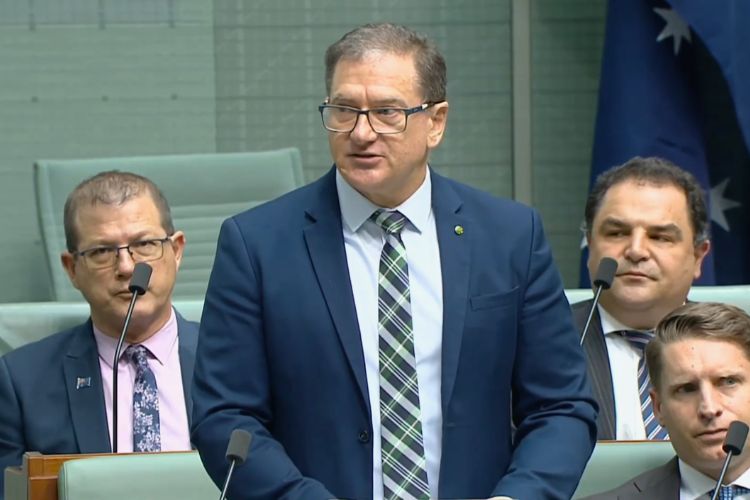
Llew O’Brien Introduces Children Born Alive Protection Bill into Federal Parliament
Editor’s note: The Hon. Llew O’Brien introduced the Human Rights (Children Born Alive Protection) Bill 2026 into the House of Representatives on Monday, 17 August 2026. Here is his full speech, which powerfully outlines the need for this bill and how babies born alive after an abortion are without national protection and denied the right to life.
Firstly, I acknowledge those who have previously contributed to this bill, particularly the former member for Dawson, George Christensen, and Senators Matt Canavan, the leader of the Nationals, and Senator Alex Antic.
Speaker, of the thousands of international treaties, conventions, and agreements to which Australia has committed itself, surely those that protect the most vulnerable amongst us deserve the highest priority.
Indeed, if every international obligation Australia had ever undertaken was swept away, and only one could remain, for me, it would be the one that protects the fundamental human rights of our children.
The Convention on the Rights of the Child is such an obligation. When Australia ratified the convention in 1990, it became obliged under international law to recognise that every child has an inherent right to life and to ensure, to the maximum extent possible, that child’s survival and development.
Article Six of the convention is not merely a prohibition against deliberately killing children. It imposes a positive obligation directed towards survival. Article 24 further commits us to recognising every child’s right to the highest attainable standard of health and to facilities for treatment rehabilitation. Under the convention, Australia must strive to ensure that no child is deprived of access to health care services.
Yet, tragically, when it comes to some of the most vulnerable children imaginable, that commitment can be disregarded. This private member’s bill seeks to remedy that terrible breach.
‘All Too Frequent’: Children Born Alive after an Abortion
It addresses the circumstances in which a child has been subjected to an attempted abortion and is born alive. And that is an all too frequent event. A 2023 Senate committee inquiry that examined legislation intended to protect children born alive following an abortion heard that 724 babies in Victoria and Queensland were recorded as born alive according to the World Health Organization’s definition over a 10-year period.
Medical professionals opposing the legislation did not dispute these figures, although they noted that the records provided limited information about the circumstances of the births.
I believe that when a procedure performed within our health system ends an independent person’s life without that person’s consent, information relating to that person and procedure should be thoroughly reported at a national level. And this bill seeks to address that failing.
All abortions are a tragedy and those that occur at or after 20 weeks’ gestation present a greater risk of live birth. A 2018 study of 241 abortions performed without foeticide between 20 and 24 weeks found that more than half resulted in live births. Median survival was 32 minutes with one baby surviving for 267 minutes.
During the Senate inquiry, abortions at or after 20 weeks’ were described as uncommon, accounting for approximately 1 to 2% of all abortions. But 1 to 2% of all abortions — approximately 88,000 each year in Australia — represents 900 to 1,700 late term abortions each year. This is not an uncommon occurrence and presents a great risk of babies being born alive after an attempted abortion.
In my home state of Queensland, the most recent available data reported that in 2023, 75 terminations of pregnancies resulted in live births. More than triple the 22 reported in 2013.
For medical professionals to play down and deny the frequency of babies being born alive after an attempted abortion is more than concerning. In these all too frequent cases, a baby’s reliance on her mother’s life sustaining biology transfers to the care of what is a world-leading health system dedicated to preserving life, relieving suffering, and restoring health.
Birth Inequality Varies by State/Territory
But not in the case of this little baby. That she was marked to die by abortion means that depending on the state or territory in which her little body lies, the treatment she may receive may be withheld.
In South Australia and New South Wales, state laws enshrine requirements to provide clinically safe care appropriate to her medical condition. These laws are sensible and exist for a reason.
But where a state or territory has not enshrined in law a medical professional’s duty to treat her like a patient and not a byproduct of an abortion, clinical guidelines can recommend the withholding of treatment. In the absence of clear statutory duty, clinical guidelines may substantially determine how a child born alive is treated in practice.
The current Northern Territory guidelines still direct that where a live birth occurs following termination, the baby is to be handled gently, kept warm and supported with family contact, but includes the direction: do not provide life sustaining treatment including gastric tubes, IV lines or oxygen therapy.
Clinical guidelines have an important place in medicine. But clinical guidelines should never determine whether one class of human being is entitled to a lesser standard of care.
Tragic Case of Jessica Jane: Born Alive, Left to Die
The death in the Northern Territory of baby Jessica Jane serves as a tragic reminder of what can occur when a baby is unexpectedly born alive. In the early hours of the 14th of July 1998 at Darwin Private Hospital, a procedure was undertaken with the express purpose of terminating a pregnancy. The expected outcome was the delivery of an aborted foetus.
That is not what happened. At 2:45 a.m., a baby girl was born alive. Her name was Jessica Jane. She weighed 515 grams. She cried, she moved, she breathed, her heart was beating. After initially being placed in a metal kidney dish, a midwife recognising those signs of life, wrapped her in a warm blanket and placed her in a cleanup area.
As Jessica’s cries continued, she had a sheet placed over her and she was checked every 10 to 15 minutes. The doctor responsible for the termination was contacted and told that Jessica was alive but did not attend and did not provide instructions for her medical care. 80 long minutes after being removed from her mother, Jessica’s little body could fight no more. Her cries gave way to silence and she died at 4:05 a.m.
Her death was reported to the Northern Territory coroner. Coroner Greg Kavanagh later observed that what had been expected was the delivery of an aborted foetus. What occurred instead was the unexpected delivery of a live baby human being.
Coroner Kavanagh recommended that protocols be put in place by statute, regulation or otherwise to ensure that a child who survives a termination is immediately medically assessed for gestational age and viability. In this report, Kavanagh cited another coronial inquest by the deputy state coroner at Westmead in Sydney where a baby had died under similar circumstances only two days before Jessica Jane.
This Bill: Birth Equality
The Human Rights Children Born Alive Protection Bill 2026 is founded on a simple principle: every child born alive is a person and deserves equal care and protection under the law. The bill makes clear that a child who survives an attempted termination is entitled to the same standard of medical care and treatment as any other child born alive. The circumstances of that child’s birth must not determine the value placed on their life or the care that they receive.
Importantly, the bill recognises that appropriate care will depend on the circumstances. It may involve life-saving emergency treatment or it may involve compassionate palliative care.
What cannot be considered is simply that the child was born as the result of a termination.
The bill also creates an offence where a health practitioner breaches a duty to provide appropriate care and requires live births following terminations to be reported so that for the first time meaningful national statistics can be produced. Those reports cannot identify either the mother or the child and the bill specifically protects the mother from prosecution under its offences provision.
Ultimately this bill is about birth equality before the law. Once a child is born alive that child deserves the same dignity, protection and care as any other Australian babies. And I commend this bill to the house.
___
Image via screenshot of YouTube.
9 Comments
Leave A Comment
Recent Articles:

23 October 2026
6.8 MINS
Hillsong UNITED’s Joel Houston reflects on fame, faith and the burden of ministry, questioning performative Christianity as he seeks a more authentic walk with God.
23 October 2026
13.1 MINS
Tasmania’s proposed conversion practices legislation raises serious questions about religious freedom, pastoral care and whether Christians can freely pray with those seeking to live according to their faith.
23 October 2026
7.7 MINS
Melbourne Catholic Archbishop Peter Comensoli has spoken out clearly against the deadly promises by both major parties in Victoria ahead of the election, drawing a comparison between abortion and capital punishment.
23 October 2026
3.1 MINS
As Western societies grow more hostile, could abandoning Christianity’s moral foundations be contributing to the rise of ideological extremism, political intolerance and violence?

23 October 2026
5.1 MINS
France’s escalating riots expose the dangers of political extremism, antisemitism and radical alliances, offering America a stark warning about the future of Western democracy.
23 October 2026
3.1 MINS
The one who is worthy of it all is awakening his Church to be captivated by him, so that we will honour one another and share his gospel with humility and courage.
22 October 2026
2.9 MINS
Victoria Labor’s promise to fund free abortions has drawn a forceful response from Presbyterian leaders, raising profound questions about unborn life, government priorities and Australia’s moral direction.



Thankful this Bill has been introduced into Federal Parliament
Such a good speech, but absolutely heartbreaking that this was not passed when first presented to parliament.
Our nation so deserves God’s judgement. Lord have mercy on us all.
Let us pray to God that the bill passes.
Wonderful speech. May these atrocities be outlawed by act of Government legislation.we must continue to speak about this in the Churches and to anyone who will listen. The truth must come out. May God open the eyes of the population to see how barbaric these practices are.
This Bill was moved to be read a second time.
Then for lack of time allocated, it was deferred to be discussed at the next sitting.
Do we know, the day and time, when this will be?
And can the Australian Parliament House Streaming Portal be made available for this?
Powerful speech. Thank you Llew.
How sad that in Australia we have to even fight for the sanctity of life!
Thank God for politicians such as Llew O’Brien.
Australia is sadly lacking in M.P.s with the moral fortitude of Llew, George , Alex and Matt to name a few of the most committed to standing up for the dignity and sanctity of human life.
Well said Liew.
You really laid it on the line.
Good ‘on ya mate.
Well said Llew.
Praise God for politicians like you.