


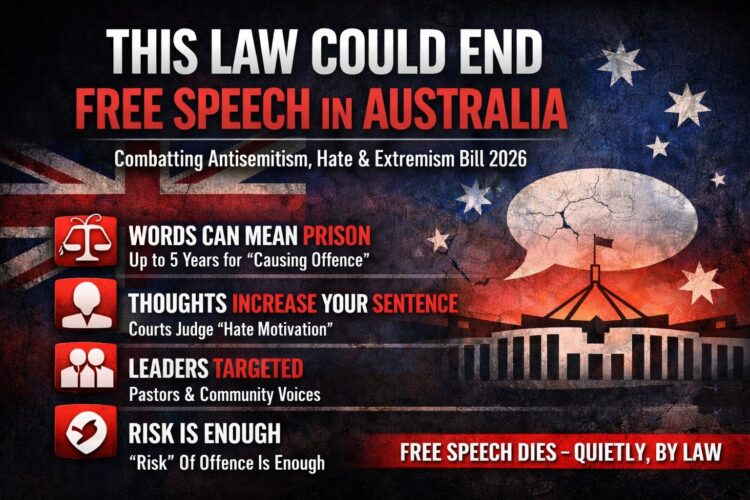
Inside Australia’s Most Dangerous Anti-Free Speech Law
Nation First looks into how the Combatting Antisemitism, Hate and Extremism Bill 2026 criminalises belief, punishes influence, and puts ordinary Australians at risk for speaking their minds.
If the latest anti-free speech law proposed by the Albanese Labor Government passes, you can be investigated, charged, and potentially imprisoned for speech that harms no one, threatens no one, and is lawful today.
Not for violence.
Not for incitement.
Not even for intimidation that anyone actually experienced.
For speech that a court later decides might have caused fear to a hypothetical person, judged through historical grievance and group identity.
That is not an exaggeration. That is what the Combatting Antisemitism, Hate and Extremism Bill 2026 does as drafted.
- This Combatting Antisemitism, Hate and Extremism Bill 2026 allows Australians to be investigated and jailed for speech that causes no harm and threatens no one.
- It punishes beliefs and motives, not just actions, and treats religious and community leaders as inherently dangerous speakers.
- It removes the need for real victims by criminalising hypothetical fear judged through historical grievance.
- It turns ordinary political and online speech on immigration, culture, and religion into legal risk.
- It replaces free expression with opaque censorship that scares people into silence.
The Bill: A Necessary Response to Bondi Terror?
The Government says this Bill is a necessary response to rising hatred and extremism following the Bondi Beach terror attack of 14 December 2025. That attack was real. The suffering was real. But the legal justification collapses the moment you read the Bill itself. Australia already had extensive criminal laws covering terrorism, threats, violence, harassment, intimidation, and incitement. This legislation does not fill a gap. It builds a new structure, one that reaches far beyond violence and directly into lawful speech, belief, and political expression.
The Combatting Antisemitism, Hate and Extremism Bill 2026 has been published and it is worse than you think. pic.twitter.com/4K5HDL1ucT
— Australians vs. The Agenda (@ausvstheagenda) January 13, 2026
This is not a single bad clause that can be fixed with a tweak. It is a cumulative legal architecture. Expanded hate offences. Motive-based punishment. Speaker-based penalty escalation. Strict liability fear standards. Heightened penalties for offensive communications. Risk-based enforcement replacing harm-based law. Together, they create a system where speaking plainly about religion, culture, immigration, or national identity becomes legally hazardous.
Spiritual Leaders: Targeted
One of the most dangerous features is the creation of aggravated offences targeting religious and spiritual leaders. Schedule 1 amends the Criminal Code so that multiple hate-related offences are aggravated where the conduct is engaged in by a religious official or spiritual leader (however described).
That phrase matters. “However described” is not narrow. It does not limit itself to radical Imams and crazy Sheiks. It can capture pastors, priests, rabbis, monks, nuns, church elders, lay preachers, chaplains, and informal community leaders who provide moral or spiritual guidance. Religious leadership itself becomes an aggravating factor.
The Explanatory Memorandum justifies this on the basis that leaders have influence. Influence is treated as inherently dangerous. The result is that the same words spoken by an ordinary citizen carry one level of risk, while the same words spoken from a pulpit can carry penalties of up to twelve years’ imprisonment.
This is not about coercion. It is not about violence. It is about controlling influential speech.
Shifting the Law from Actions to Internal Thoughts
Layered on top of this is the Bill’s reliance on hate motivation as a punishment multiplier. Courts are instructed to treat motive as an aggravating feature across multiple offences. This shifts criminal law away from what a person did and toward why they believe what they believe.
Motive is inferred from expression, sermons, articles, social media posts, speeches, associations, and prior statements. Speech becomes evidence not just of opinion, but of a criminal mindset. Two people can engage in identical conduct, yet the one whose views are characterised as hostile faces harsher punishment.
In practice, this opens the door to belief-based punishment. Mainstream right-wing positions on immigration levels, multiculturalism, cultural compatibility, religious doctrine, gender ideology, or national identity can be reframed as hateful when assessed through a politicised lens. Once motive aggravation exists, punishment is no longer neutral between ideas.
The most liberty-destroying element of the Bill is that it abandons any requirement to prove actual harm. Proposed section 80.2BF establishes criminal liability where conduct would cause a reasonable person who is the target, or a member of the target group, to be intimidated, to fear harassment or violence, or to fear for their safety. Strict liability applies.
The Explanatory Memorandum is explicit. The prosecution does not need to prove that anyone actually felt fear. There does not need to be an identified victim. It is immaterial whether the conduct resulted in any person being intimidated at all.
Liability is triggered by speculation.
Worse still, the reasonable person is not an ordinary objective standard. Courts are directed to assess fear through the perspective of a person with the lived experience of the target group, including historical oppression and marginalisation. Judges must also consider the cumulative effect of conduct by others, not just the accused.
Your words are judged against historical grievance and third-party behaviour you did not commit and do not control. Individual responsibility is diluted. Context becomes elastic. Lawful speech can be reinterpreted as threatening simply because of who is discussed and what history is invoked.
🔥🔥🔥🔥🔥🔥🔥🔥🔥🔥
I’m just reading through Albanese‘s proposed “Hate Speech Legislation” (144 pages of legislation and a 319 page Explanatory Memorandum).It seems that under this legislation an Australian risks being jailed for up 10 years if they argue against excessive…
— Craig Kelly:🇦🇺Foundation for Economic Education (@craigkellyAFEE) January 13, 2026
Craig’s absolutely right about the asymmetry, but the actual mechanisms in the Explanatory Memorandum reveal this is far more dangerous than most people realize. 👀
Here’s why:
The “Reasonable Person” Trap (Para 253):
The test explicitly requires courts to consider ‘the…— 𝘞𝘢𝘳𝘳𝘪𝘰𝘳 𝘚𝘢𝘨𝘦 🇦🇺 (@AussieSageSays) January 13, 2026
The Bill also creates unequal speech protections. Quoting religious texts is categorically exempt if done for religious teaching or discussion. There is no equivalent exemption for secular critique, political commentary, policy analysis, or journalistic examination of the same texts.
Identical words can be lawful or criminal depending on who says them and why. That is not content neutrality. It is the state privileging certain forms of expression and punishing others based on framing.
Online speech is almost entirely captured. Penalties for using a carriage service to cause offence are increased from two years to five years’ imprisonment. Public conduct is defined broadly to include social media, blogs, videos, and online platforms. In modern Australia, this means virtually all political debate.
The situation can be aggravated if a court believes that the offence also threatened the “peace, order and good government of the Commonwealth” (whatever that means). The penalty could then by 10 years’ imprisonment.
Offence is the basis of all of this, but offence is not harm. Offence is an unavoidable feature of democratic life. This Bill converts that reality into criminal exposure.
The Government frames all of this as prevention, stopping risk, radicalisation, and future harm. This replaces harm-based criminal law with risk-based enforcement. Speech becomes punishable not for what it does, but for what authorities believe it might lead to.
There is no meaningful protection for political communication in the Bill. No explicit safeguard. No proportionality analysis. No serious engagement with the implied freedom of political communication recognised by the High Court. The burden is shifted onto individuals to become constitutional test cases after enforcement has already occurred.
Even without convictions, the process itself is punitive. Investigations, complaints, platform moderation, employment consequences, reputational damage, and institutional over-compliance occur long before any court rules. Churches pull sermon recordings. Publishers decline controversial pieces. Platforms over-moderate. Ordinary Australians choose silence over risk.
How Free Speech Dies
That is how free speech dies in a country like ours. With opaque censorship of certain undefined discourse, and breaches of that censorship regime punishable with severe jail sentences. That inspires fear, which leads people to remain silent instead of saying what they want to say.
To understand how far this Bill reaches, consider six illustrative hypotheticals that expose its outer limits.
A Christian pastor delivers a sermon stating, “Islam is an ideology that is destructive, incompatible with Western civilisation, and must be resisted if Australia is to survive.” There are no threats and no incitement. Because the speech is delivered by a religious leader, aggravated provisions apply. Prosecutors could argue the language is hostile, infer hate motivation from theology, and rely on hypothetical fear. Twelve-year penalties become possible.
A political activist posts online, “Mass immigration has destroyed social trust. Non-European cultures are fundamentally incompatible with ours, and continuing the policy of mass migration from the Middle East, Africa and China will fracture the nation.” This is classic political communication. No violence. No threats. Yet it can be reframed as hostility toward groups defined by ethnicity or national origin, triggering online communications offences.
A journalist writes an opinion piece stating, “This Islamic religious worldview produces intolerance, misogyny, and social division. Australia must stop accommodating it.” This is opinion journalism. Under the Bill, hostile framing combined with historical grievance analysis could justify investigation and prosecution, chilling public debate.
An activist at a rally says, “The wearing of full-face coverings like the burqa and niqab should be banned in Australia because they undermine our values and social order.” This is advocacy for law reform. Yet it may be reframed as targeting people rather than conduct, particularly if the speaker is an organiser or community figure.
A social media user posts crime statistics showing that crime in Melbourne comes from the African community is wildly disproportionate compared to other ethnic groups and adds, “Ignoring who is responsible for this crime wave is destroying our country.” The post relies on data and interpretation. Prosecutors could infer hate motivation and argue the post creates fear, despite no threats and no actual harm.
A policy paper by a think tank argues, “Australia should prioritise migrants from culturally compatible nations such as the United Kingdom, the United States, Canada and Europe to preserve social cohesion.” This is immigration policy debate at the core of political communication. And yet distinctions by national origin could be characterised as discriminatory hostility under this proposed law.
None of these scenarios involve violence, threats, or conduct criminal under existing law. Yet all could plausibly trigger enforcement under this Bill.
If a law punishes you for your beliefs,
jails you for “causing offence” and lets the state decide what speech is “risky”… IS THAT STILL A FREE COUNTRY?
The Antisemitism, Combatting Antisemitism, Hate and Extremism Bill is how free speech ends in Australia.
Quietly. By law. 🇦🇺 pic.twitter.com/RnoSuNRLhR— George Christensen (@NationFirstAust) January 14, 2026
Confront This Bill
From a constitutional perspective, the problems compound. The Bill burdens political communication in its terms and effect. It criminalises speech without proof of harm, applies strict liability to fear, replaces objective standards with historically weighted ones, attributes third-party conduct to individual speakers, escalates penalties based on status, and expands offence-based online crimes.
Preventing violence is a legitimate aim. But criminalising hypothetical fear, belief, and offence fails necessity and proportionality. Less restrictive alternatives already exist. The balance struck is constitutionally fragile.
Individually, several provisions raise serious constitutional questions. Cumulatively, they present a profound threat to free political discourse.
The most bizarre and perverse thing about this proposed law, which has been crafted supposedly in response to the Bondi Beach terror attack, is that it will undoubtedly be used to clamp down on those who are critical of Islam and its anti-semitic and anti-Christian tendencies.
The Combatting Antisemitism, Hate and Extremism Bill 2026 does not abolish free speech outright. But it renders it conditional, unstable, and punishable by interpretation. Once that framework exists, the decisive question is no longer who uses those laws today, but whether any future government can resist using it against their political opponents.
If you value the right to speak openly about faith, culture, identity, and politics in Australia, this Bill must be confronted now. Read it. Share it. Challenge it. Because once speech is criminalised by perception rather than harm, reclaiming that freedom becomes extraordinarily difficult.
___
Republished from Nation First. Image by Nation First.
5 Comments
Leave A Comment
Recent Articles:

27 October 2026
1.5 MINS
Labor’s Digital Duty of Care Bill threatens free speech, empowers covert online surveillance, and imposes potentially burdensome regulations on Australian businesses.
27 October 2026
10.3 MINS
As Tasmania and Western Australia consider conversion therapy bans, a former LGBT+ ministry leader warns of threats to religious freedom, personal choice and Christian discipleship.

27 October 2026
4.9 MINS
Nine Christians have been killed in a terrorist attack on a Jordanian church, prompting fierce condemnation, demands for justice and renewed concerns about religious persecution.
27 October 2026
3.6 MINS
For 25 years, the Mount Moriah Trust has supported struggling Christians across the Holy Land, bringing practical assistance, encouragement and hope to believers facing hardship and persecution.

27 October 2026
1.3 MINS
Moira Deeming’s re-election campaign has energised Family First supporters, raising $90,000 as the party prepares for a crucial Victorian election and a potential breakthrough.

27 October 2026
3.1 MINS
As the disciples discovered through a huge haul of fish, we can trust Jesus for a net-breaking, boat-sinking catch of people.
26 October 2026
4.5 MINS
OECD chief Mathias Cormann warns Australia is losing its competitive edge, as excessive regulation, housing pressures, immigration challenges and declining public trust threaten national prosperity.



Brilliant analysis George of a seemingly good but very evil Hate Speech Bill!!!!
To prepare for the future, may I suggest 3 things 1. start reading your Bible so that you know it by heart. 2. Read “With God in Russia” by WalterJ. Ciszek an innocent priest who was arrested for an unknown reason in Soviet Russian and spent 15 years in Russia’s Gulag. and 3 -start praying!
I’m right on board with you George!
According to the EM a hate crime can be the possession of a hate symbol (however defined by the reasonable person test) punishable by up to 12 years imprisonment, where a person commits an offence and the conduct is engaged in by the offender in their capacity as a religious official or spiritual leader (however described) providing pastoral care or religious instruction.
Potentially someone (even a hypothetical person) could be offended by that cross that the preacher wears.
And lo and behold, seems that preacher will be giving their sermons in the slammer for the next 12 years.
Potentially.
If this Law is passed no peaceful citizen will be safe from jail , etc. Totalitarianism . Australian will be one of the worst repressive regimes in the World. Next is Whitlam’s dream –that all private property be compulsorily acquired by the State.
The sad thing about opposing this anti-semitism bill is that if it passes, the Zionists are going to be able to drag us all before the courts. So I’ll be careful what I say!!! (Gulp!)
Interesting that representatives of every single faith (bar one) have signed a letter condemning this bill.
We need to pray that this bill is not passed, because if it is, there is one faith that will then have the power to throw us all in prison.