



The Great Split: Algorithms, Identity, and the Fragmentation of a Generation
AI isn’t just changing technology — it’s reshaping young men and women into ideological rivals, weakening trust, family formation, and the relational foundations that healthy societies depend on.
Artificial intelligence is often discussed as a future threat — something looming on the horizon. In truth, its most damaging effects are already reshaping Western society. Not through robots or automation, but through algorithms that quietly form the political, relational, and moral instincts of a generation.
These algorithms are not neutral. They reward outrage, grievance, and fear because those emotions keep users engaged. Over time, they do more than influence opinions — they reshape identity. And according to the Brookings Institution, increasingly, they are pulling young men and women in opposite ideological directions.
A Digital Divide Between Young Men and Women
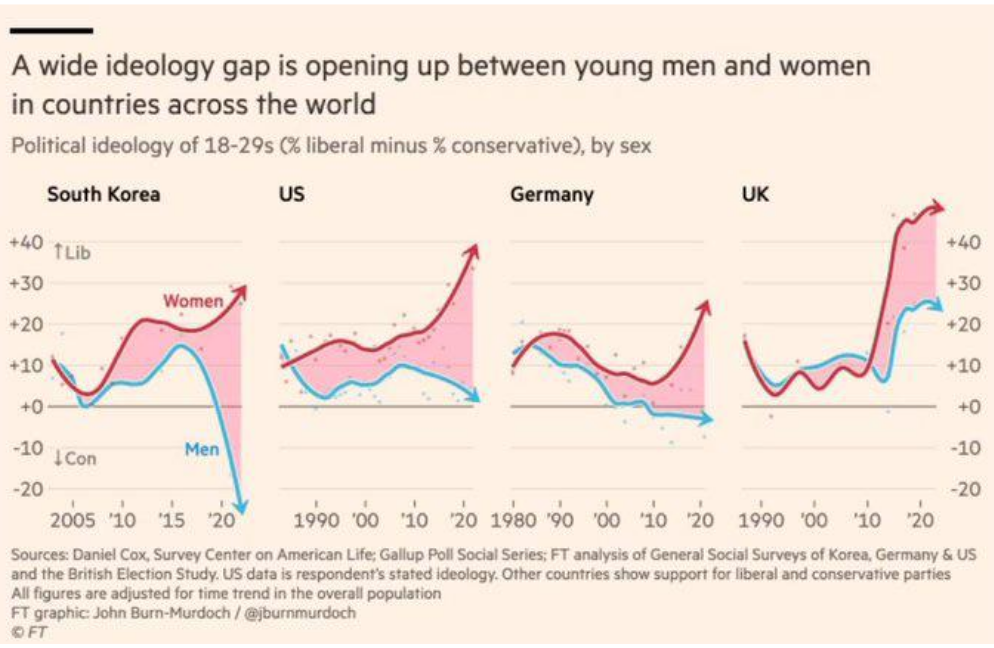
Among young men, algorithmic platforms have amplified content that frames women, marriage, and commitment as risks. Narratives warning that women are materialistic, financially exploitative, or aligned against men are pushed relentlessly.
While some of these messages begin with legitimate critiques of modern dating culture, algorithms escalate them into cynicism and withdrawal. Commitment is portrayed as foolish, marriage as dangerous, and singleness as self-preservation.
At the same time, young women are being shaped by a very different algorithmic current. Platforms such as TikTok and Instagram disproportionately push political and cultural content that frames traditional family structures as oppressive, promotes radical individualism, and blends feminist identity with socialist and left-wing ideology. Independence is framed not as responsibility, but as liberation from relational obligation. Power replaces partnership as the highest good.
The result is not balance, but polarisation.
This gendered ideological drift is measurable. Across the Western world, young men are trending more conservative, while young women trend more progressive.
These shifts are not primarily the result of reasoned debate or philosophical study, but of digital formation — repeated exposure to emotionally charged narratives that shape perception long before critical reflection takes place.
Algorithms do not care about truth. They care about attention. Thus, attention is most easily captured by telling each group that the other is the problem.
The consequences are profound. Rising rates of long-term singleness, delayed family formation, and declining birth rates are not merely economic phenomena. They are cultural and spiritual symptoms.
When young men are taught to distrust women, and young women are taught to distrust men — or the institution of family itself — the conditions necessary for stable societies erode.
Christian Anthropology vs Algorithmic Individualism
Christian theology offers a radically different anthropology.
Scripture teaches that men and women are not adversaries competing for power, but complementary bearers of the image of God, created for covenant, not consumption.
From Genesis onward, relational responsibility is not a burden but a blessing. “It is not good that the man should be alone” is not sentimentality; it is the moral truth about human flourishing. Yet algorithmic culture trains the opposite instinct: withdrawal over sacrifice, autonomy over commitment, grievance over reconciliation. This is not accidental.
The digital economy profits from fragmentation. Isolated individuals consume more, trust less, and rely increasingly on the state or the market to replace family and community. In this sense, the ideological drift of young women toward collectivist politics and young men toward alienated individualism serves the same end: the weakening of intermediary institutions that once grounded society.
Scripture warns that formation is unavoidable. “Do not be conformed to this world,” Paul writes, “but be transformed by the renewing of your mind” (Romans 12:2). The question is not whether young people are being discipled, but by whom.
Algorithms now disciple more consistently than churches, schools, or families often realise. As the American National Library of Medicine highlights, they catechise through repetition, shape moral intuition through emotion, and reward identity formation rooted in resentment. Over time, they replace wisdom with reactivity.
The Church Must Confront Digital Discipleship
The church cannot afford silence here. Despite some counterarguments saying that Christianity does not reject technology, Christianity distinctly rejects any system that claims authority over the human heart without reference to truth.
Psalm 127 reminds us that “unless the Lord builds the house, those who build it labour in vain.” A society that undermines trust between men and women, dissolves families, and trains its young to see one another as threats will not endure — no matter how advanced its technology becomes.
The task for Christians is not to pick ideological sides, but to name what is happening and offer an alternative. That alternative affirms responsibility over resentment, covenant over consumption, and truth over algorithmic manipulation. It calls young men to courage rather than withdrawal, and young women to wisdom rather than ideological capture.
AI did not invent these problems. But it is accelerating them at a scale never before seen. If Christians fail to respond with clarity, compassion, and conviction, the algorithms will continue to form the next generation in their image.
And a society trained to distrust love will not survive for long.
___
This article was originally published on the Young Conservatives for Christ Substack.
One Comment
Leave A Comment
Recent Articles:
14 October 2026
6.7 MINS
A national poll challenges claims that pro-life Australians are extremists, revealing broad support for abortion restrictions, protections for unborn babies and safeguards for vulnerable women.

14 October 2026
2.8 MINS
Queensland recorded 1,082 assisted suicide and euthanasia deaths in 2025–26, as the review board called for consultation on potentially widening eligibility criteria.
14 October 2026
5.5 MINS
As Christianity fades from public life, Marxism or Communism offers a substitute faith built on oppression, liberation and political salvation — but at what cost?

14 October 2026
5.3 MINS
Marco Rubio’s Athens speech celebrates the Greek, Roman and Christian foundations of Western civilisation, warning that cultural self-loathing and radical ideologies threaten its future.

13 October 2026
2.6 MINS
Allegra Spender’s proposed bill reignites debate over discrimination protections, religious freedom and the right of faith-based schools to uphold their beliefs and values.

13 October 2026
3.9 MINS
Tasmania’s proposed conversion practices law raises serious concerns for churches, parents and faith-based schools, with broad definitions, severe penalties and uncertain protections for religious freedom.

13 October 2026
2.1 MINS
Victoria’s assisted dying deaths have surged by 300 per cent since legalisation, while a disturbing case involving a patient’s partner raises urgent questions about safeguards.



I have a Platonic friend , young enough to be my son.He is divorced and has lived for years alone. He confides in me his disappointment with the women he meets because all of them (I have met them briefly ) support Woke ideas, in fact , are fanatics. Arguments over politics end very quickly every nascent relationship. He finds life a bit lonely but more peaceful with his cat and dog ! I have the same trouble with being accepted by women because I am Christian and conservative, ie I do not “hunt with the herd “. I accidently came across 2 sites which said that being an individual is good even if it means rejection and isolation. Integrity is more important than being part of a group –take note Hastie MP and others.