


Bible Society Stands by ‘Quiet Revival’ Despite YouGov Poll Error, Citing Surge in Bibles and Baptisms
The UK Bible Society’s landmark Quiet Revival report has been significantly undermined by a major polling error. Yet despite the setback, the organisation insists the broader story of spiritual renewal remains compelling.
YouGov, one of the world’s leading polling firms, has admitted to a serious methodological failure in the 2024 survey underpinning Bible Society UK’s widely discussed Quiet Revival report — a study that challenged assumptions about Christianity’s decline in Britain.
The error, disclosed in early March 2026, means the 2024 poll can no longer be considered a reliable measure of religious belief and practice in England and Wales.
Media outlets — including The Daily Declaration — had widely reported the report’s findings. Among them was a claimed 50% rise in church attendance since 2018, largely driven by young adults. Monthly attendance among those aged 18–24 was said to have increased from 4% in 2018 to 16% in 2024. These conclusions were based on the now-discarded survey.
Bible Society acknowledged the disappointment, stating it recognised “that this news may feel discouraging and we share that sense of disappointment.”
Even so, it maintains that the overall direction of the findings — particularly signs of renewed interest among younger generations — reflects a genuine trend.
What Went Wrong with the Poll
Published in April 2025, the Quiet Revival report drew on two large-scale YouGov surveys conducted in 2018 and 2024. The latter included more than 13,000 respondents, making it unusually large.
However, a YouGov Data Science review, released at the beginning of March 2026, found that key quality-control measures had not been activated due to human error. These safeguards are designed to filter out respondents outside the UK, repeat submissions, and inattentive or random answers.
Without them, the integrity of the data cannot be verified. As Bible Society noted, “it is impossible now to establish after the fact how many and which respondents should have been excluded.”
YouGov CEO Stephan Shakespeare issued a personal apology, accepting full responsibility:
“YouGov take full responsibility for the outputs of the original 2024 research, and we apologise for what has happened. We would like to stress that Bible Society has at all times accurately and responsibly reported the data we supplied to them.”
Bible Society’s Response
Bible Society CEO Paul Williams said the organisation was deeply disappointed — not only by the error, but by how long it took to uncover.
“Over a 15-month period, Bible Society repeatedly sought and received assurances from YouGov regarding both the robustness of the methodology and the reliability of the report’s conclusions,” he said.
“It was only at the beginning of March that YouGov confirmed that it failed to activate key quality control technologies that protect the sample from a wide range of errors, and this undermines the reliability of the results.”
Williams said the error had been “invisible to Bible Society and mistakenly overlooked by YouGov,” while expressing gratitude for the CEO’s apology.
The organisation has committed to commissioning a new survey with YouGov, again sampling around 13,000 respondents, in April or May this year. It also plans to conduct additional research with other firms to build a more accurate picture of Christianity in England and Wales.
A revised report is expected later in 2026.
Despite the polling failure, Williams remains cautiously confident:
“YouGov’s error does not mean that all of the findings were wrong — it means that we cannot reliably support those findings on the basis of this survey.”
A Bible Boom with Hard Numbers
Perhaps the most striking independent evidence comes from Bible sales data.
Analysis of NielsenIQ figures by UK Christian publisher SPCK shows Bible sales rose by 106% in volume between 2019 and 2025. By value, sales increased 134% — far outpacing the 11% growth recorded across the previous 11 years from 2008 to 2019. In the past year alone, sales value rose a further 19%.
These figures reflect retail sales only and exclude bulk purchases by churches and ministries.
Digital engagement is also rising. The Independent reports that the YouVersion Bible app has seen “double-digit growth” in UK users engaging with the app at least four days per week.
Google Trends data tells a similar story. Searches for “the Bible” in the UK have surpassed their pandemic-era peak and now exceed searches for Harry Potter, one of the most dominant cultural franchises of recent decades.
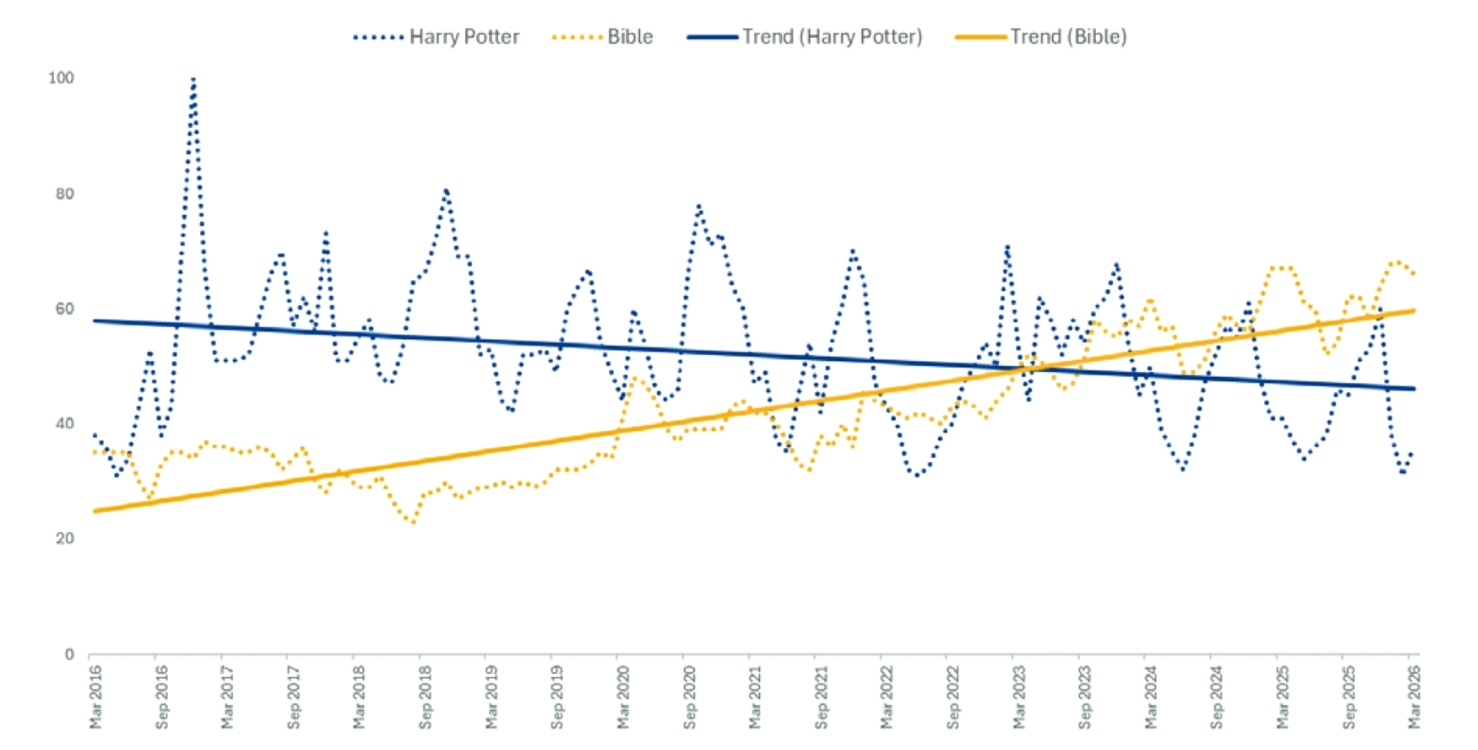
Searches for “the Bible” (orange) in the UK have steadily increased from 2016 to 2026. Searches for “Harry Potter” are shown in blue. Source: Google Trends.
That physical Bible sales are increasing in an age of free digital access makes the trend all the more noteworthy.
Aude Pasquier, Retail Sales Director at Church House Bookshop, described what she is seeing:
“We’ve seen an increase in people coming to the Bible from scratch… they have no Christian background whatsoever. They have no grounding from their parents or from their school, whereas most people in prior generations would have. It’s definitely younger people who are seeking some sort of spirituality — they want to understand the world and themselves better.”
On social media, Rev. David Sims — known as “The TikTok Vicar” — has given away thousands of Bibles, largely to young adults with no church background. The response has stunned him:
“People have turned up at our church already wanting to be baptised having read the Bible… I’ve never seen evangelism be this easy… It must be a work of God, which is really exciting.”
— Revd David Sims, Vicar of St Thomas’s, Aldridge
Baptisms and Conversions on the Rise
Church data — often more reliable than survey-based attendance estimates — also points to growth.
In the Catholic Church, baptisms of those over seven rose by 21% in 2024, reaching their highest level in 11 years. First Holy Communion among adults increased by 44%.
In the Diocese of Westminster, adult candidates for the Sacraments of Initiation in 2026 have reached a 15-year high — a 60% increase on 2025.
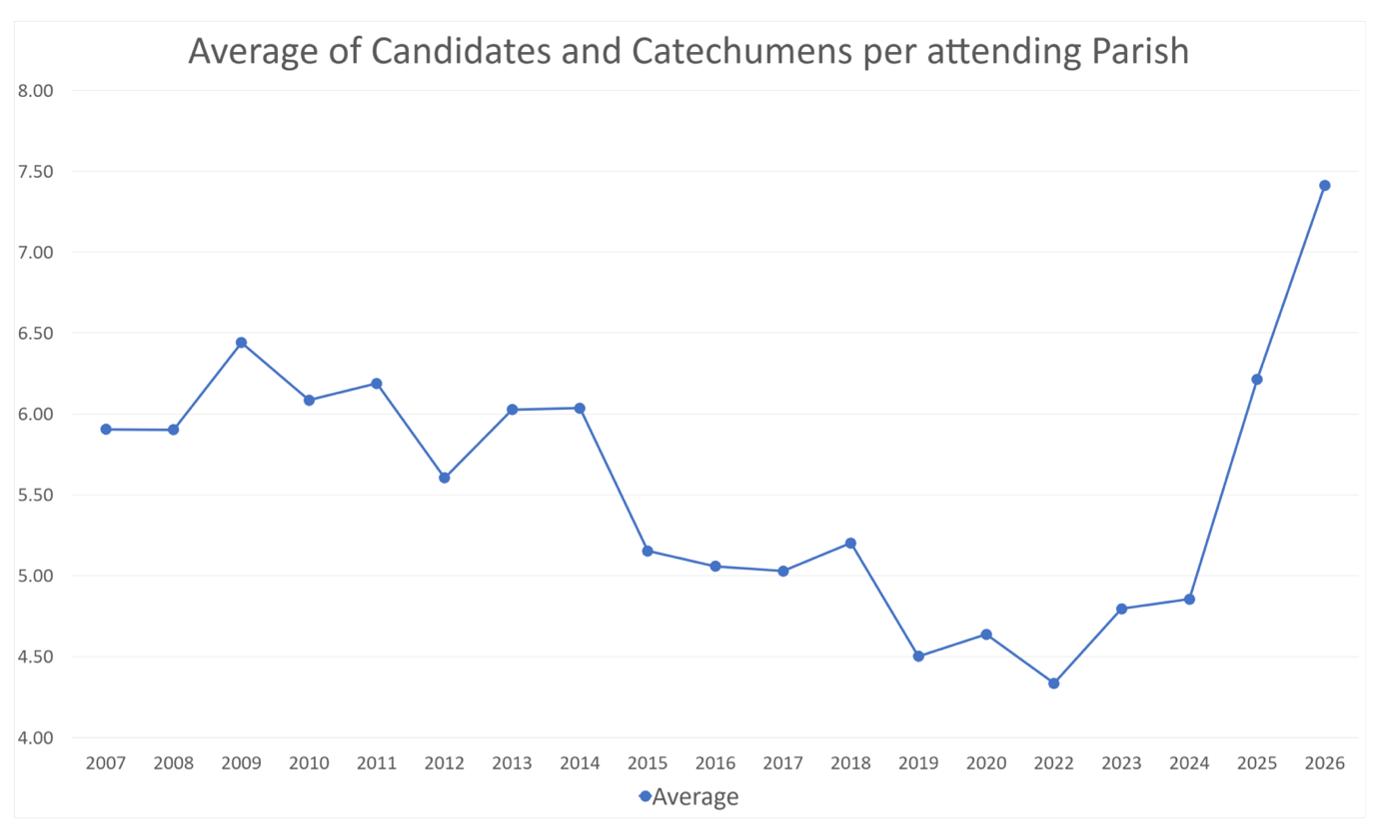
Graph: The Diocese of Westminster has seen an increase in the number of people seeking to join the Church. Source: Diocese of Westminster.
The Baptist Union of Great Britain recorded 800 more baptisms in 2024 than in 2023, the highest total in a decade. Meanwhile, 57% of member churches reported net growth between 2022 and 2024, driven largely by younger people.
A 2025 survey by the Evangelical Alliance found average church attendance had risen by 13% since before the pandemic, with twice as many people committing to the Christian faith compared to 2021.
Pentecostal churches remain the fastest-growing segment of UK Christianity, with the number of congregations increasing by an estimated 68% between 2000 and 2020.
The Alpha course also reports strong growth, with UK attendance up 35% in 2025 compared to 2024, and the number of groups rising from 8,000 to 10,000.
Openness with Cautious Optimism
Bible Society has acknowledged that the polling error requires caution. It can no longer claim the same statistical confidence in the scale of the trends described in the original report.
However, it maintains that the broader pattern remains intact.
Alongside new surveys planned for 2026, the organisation is gathering first-hand accounts of faith and renewal through its Quiet Revival Story Bank, inviting UK church and ministry leaders to contribute (via email here).
For readers of Scripture, the the broader pattern may remind them of the words of Isaiah: “Behold, I am doing a new thing; now it springs forth, do you not perceive it?” (Isaiah 43:19).
The extent of any Christian renewal in the UK remains to be fully measured. But the growing body of evidence suggests it may be more than wishful thinking.
___
Image courtesy of Adobe.
2 Comments
Leave A Comment
Recent Articles:
15 October 2026
3.6 MINS
An 80,000-strong gathering in Texas signals a hunger for revival, as Pastor Philip Anthony Mitchell warns that Christian indifference could leave future generations without the faith.

15 October 2026
4.2 MINS
Many Australian Christians don’t know a single Aboriginal person. Robyn Murray argues that reconciliation begins with honest history, prayer and a shared life in Christ.

15 October 2026
6.1 MINS
Historian Frank Furedi warns that the West is waging a war against its own past, censoring books, rewriting history and severing future generations from their heritage.

15 October 2026
7.2 MINS
A man’s death in a tiger enclosure sparks chilling online reactions, exposing a growing willingness to judge human worth by usefulness, behaviour and ideology.
15 October 2026
3.9 MINS
Canada plans to legalise euthanasia through advance requests, raising concerns about consent, dementia patients’ rights and whether earlier decisions should determine the circumstances of death.
15 October 2026
2.6 MINS
Before anything else, we must make prayer central. I urge the Church in Australia to awaken to, first of all, prayer.

14 October 2026
2.8 MINS
Queensland recorded 1,082 assisted suicide and euthanasia deaths in 2025–26, as the review board called for consultation on potentially widening eligibility criteria.



Really well researched and written Sam. Sad about YouGov’s error but I look forward to seeing what the new report brings to light,
Great article!!!!