


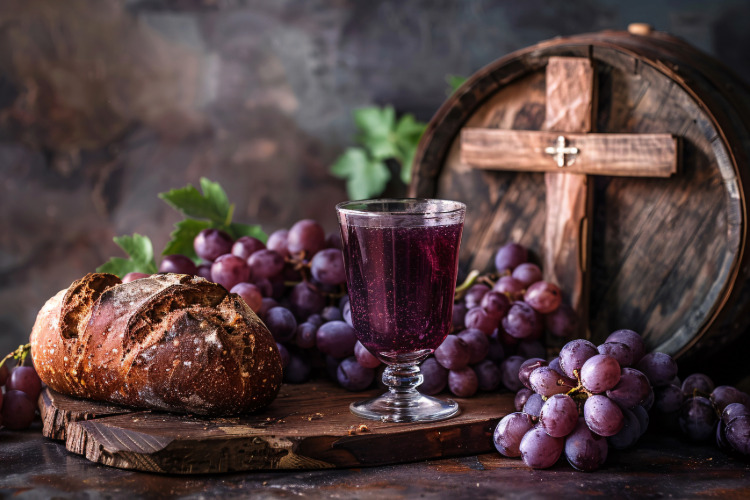
Breakthrough Power of the Blood of Christ — The Core of the Easter Message
Editor’s Note: Today is Good Friday. This is the day we celebrate Christ’s death on the cross. If we want to be particular, it was not the cross that saved us, but it was the Blood of Jesus Christ that saved us. Medical analyses indicate Jesus likely died from a combination of hypovolemic shock (extreme blood loss) and exhaustion asphyxia, rather than blood loss alone. Whatever the case, blood loss played a significant part in Jesus’ death. Leviticus 17:11, “The life is in the blood.” So, Easter is about the mystery and redemptive power of the Blood of Christ. Below is an excerpt from my book called Break Through – 15 Keys for Supernatural Breakthrough that highlights the amazing power of the blood of Jesus for us all.
___
“Let us look steadfastly to the blood of Christ, and see how precious that blood is to God, which, having been shed for our salvation, has set the grace of repentance before the whole world.”
The Ancient Practice of Blood Covenants
Blood covenants are a strange concept for us today, but they were very familiar to people in non-Western cultures throughout much of history.
As told by John Osteen in his book Unravelling the Mystery of the Blood Covenant (1987), the great Welsh-American explorer Sir Henry Stanley (1841–1904) became party to many blood covenants on his expeditions through Africa. Osteen documents one such occasion at length, which is worthy of our reflection:
David Livingstone, the famous explorer, was the first great missionary to Africa. He stayed in the jungles so long that England, fearing he was dead, sent another explorer, Sir Henry Stanley, on an expedition to search for him. A young African man, educated in England, accompanied Stanley and his party as their interpreter.
In his books, Stanley tells how he set out through the rugged wilds in his search for Livingstone. The country was filled with uncivilised tribes, and Stanley’s party was plagued with disease, starvation, and cannibals.
On one occasion, the expedition came to an impasse when they encountered a powerful, hostile equatorial tribe that had no desire to let them through. Stanley’s party was outnumbered, and he didn’t know what he was going to do.
Finally, Stanley’s young interpreter told him, “You’re going to have to cut a strong covenant with these people.”
What do you mean, ‘cut a covenant’ with them? Stanley asked. He didn’t understand what the term meant.
The interpreter explained, “This is what you’re going to have to do: First, the chieftain of the tribe will choose a substitute to represent him, and you’ll choose a substitute to represent you. The two substitutes will come together before a priest, who will cut the wrist of each one just enough to drip a few drops of their blood into a glass of wine. The wine will then be stirred and the bloods mixed. The cup will be handed to one man who will drink part of it. Then he will hand the cup to the second man, who will drink the remainder of the mixture, thereby uniting the parties in a blood covenant…
“After drinking the blood mixture, often the two parties will rub gunpowder in the wound on their wrists so they will be forever marked like a tattoo as a blood-covenant man.”
The idea of a blood covenant was revolting to Stanley, but he knew their situation was desperate. So he agreed. After several days of negotiations, arrangements were made for the blood-covenant ritual. Stanley chose his interpreter to be his substitute, and the chief chose a prince as his substitute.
The two substitutes went through the blood-covenant rite while Stanley and the chief looked on. Both substitutes drank the blood mixture. Now, Stanley and the chief were blood brothers.
As soon as they finished, Stanley said, the priest stepped forward and pronounced the many blessings and good things the chief would now do for Stanley. “Oh, that sounded good!” he said. Then, all of a sudden, the priest began pronouncing terrible curses upon Stanley.
“What is he doing now?” Stanley asked his interpreter. “Why is he cursing me?”
“He is pronouncing the curses that will come upon you if you ever dare break this covenant,” he answered.
Stanley’s interpreter then took his part and pronounced blessings upon the chieftain and his family and curses if he ever broke the covenant.
After the covenant was sealed in their blood, Stanley said a marvellous thing happened. The chief stood up and said, “Now, buy and sell with Mr Stanley. He is our blood brother!”
“I never had to worry one moment about my goods anymore,” the explorer said, “Nobody would dare steal from me because I was in a covenant relationship with the chief and his tribe. Stealing from a blood brother carried a death penalty.”
Stanley said he never knew a blood covenant to be broken in Africa. No man dared to break the covenant. If he did, his own family would turn him over to the hands of the avenger to be killed.
So sacred was the blood covenant that it was revered and kept by succeeding generations. It was a perpetual covenant that could not be broken or dissolved.[1]
Blood Covenants in Aboriginal Australia
Aboriginal people, in central Australia particularly, had their own blood covenant rituals that were aimed at addressing grievances in the community, and restoring justice and social harmony. When a serious wrong such as murder was committed, the perpetrator could choose to be killed or to face “payback”, in which they were tied to a tree and speared in the thigh by the dead person’s relative.
No vital organs were to be touched. A bowl at the base of the tree was used to collect the flowing blood. Then the relatives of the deceased would smear blood all over the body of the perpetrator as a token of atonement and forgiveness for the wrong that had been committed.
These ceremonies—from Africa and Australia respectively—are, of course, very confronting by civilised standards. But they also suggest that the entire human race shares a single origin, and a shared memory of blood covenants that goes back to the beginning of time.
The Blood Covenant Runs Through Scripture
Reading between the lines in the earliest pages of the Bible, we see the first glimmer of a blood covenant in Genesis 3:21, when “God made clothing from animal skins for Adam and his wife.”
Moments earlier, the first couple had sinned against God and brought a horrible curse on all creation, part of which was the introduction of death into our originally perfect world.[2] By rights, God could have killed Adam and Eve on the spot for their rebellion, but in His mercy, he provided a sacrifice: the death of the animals whose skin was used to clothe them.
In the following chapter, Cain and Abel brought sacrifices to God, and famously, only Abel’s sacrifice pleased the Lord (Genesis 4:3-5). On reading this account, many people assume God was showing favouritism to Abel. In fact, it appears that the Lord had previously set the requirement of a blood sacrifice.
Abel was obedient, but Cain, trusting in his own wisdom and performance rather than God’s, brought a sacrifice from his crops instead. Then, in rage, Cain killed his brother Abel—the first murder recorded in Scripture, and a reminder of the crying need for divine justice.
God’s blood covenant continued with Noah after he and his family stepped off the ark:
Then Noah built an altar to the Lord, and there he sacrificed as burnt offerings the animals and birds that had been approved for that purpose. And the Lord was pleased with the aroma of the sacrifice and said to himself, “I will never again curse the ground because of the human race, even though everything they think or imagine is bent toward evil from childhood. I will never again destroy all living things. As long as the earth remains, there will be planting and harvest, cold and heat, summer and winter, day and night.” (Genesis 8:20-22)
It is during the life of Abram that God’s blood covenant became much more explicit. After promising Abram his descendants would be as numerous as the stars in the sky, a special parcel of land, and His perpetual blessing and protection, God sealed these promises with a dramatic blood covenant:
The Lord told him, “Bring me a three-year-old heifer, a three-year-old female goat, a three-year-old ram, a turtledove, and a young pigeon.” So Abram presented all these to him and killed them. Then he cut each animal down the middle and laid the halves side by side… As the sun was going down, Abram fell into a deep sleep… [and] saw a smoking firepot and a flaming torch pass between the halves of the carcasses. So the Lord made a covenant with Abram that day and said, “I have given this land to your descendants…” (Genesis 15:9-18)
According to ancient custom, normally, both parties would walk between the animal carcasses as a pledge of their commitment to the covenant. The fact that only God passed through while Abram slept provided a powerful sign that this covenant was unilateral and unconditional—and that it was initiated by God, not humanity.
Later on, God instituted the practice of circumcision in Genesis 17:10-11. Circumcision involved a cutting of the flesh for every newborn baby boy—another iteration of the blood covenant God had cut with His chosen people.
In Genesis 22, we read of Abraham’s willingness to sacrifice his son Isaac in obedience to God. Many of the key details in this account suggest that it was a prophetic act foreshadowing Jesus—whether the identity of Isaac as Abram’s “only son”, Isaac carrying the wood (in anticipation of the cross) up the hill, the mention of “the third day”, or Abram’s declaration that “God himself will provide a lamb”. Abram even called the place Jehovah-Jireh or “the Lord will provide”—and indeed, 2,000 years later, God did provide a Lamb to take away the sins of the world on the very same mountain range.
The Passover: Blood as Protection and Deliverance
The Passover was the next grand instalment of God’s blood covenant. Having been held as slaves in Egypt for 430 years, the Hebrew people were finally going to be set free. The Lord raised up Moses as their deliverer. Moses announced to Pharaoh that ten plagues would come upon Egypt until and unless Pharaoh let God’s people go. The final plague was the death of every firstborn.
However, God provided a way for His people to be spared from this plague—by each family killing a lamb, smearing its blood on their doorposts, and consuming the lamb along with unleavened bread and bitter herbs before daybreak (Exodus 11-12). When the destroyer saw the blood on a Hebrew home, it knew to “pass over” the house and spare any firstborn sons inside. The Passover, as it was called, was God’s way of protecting His people from His judgment and ultimately delivering them from slavery.
Several months later, God revealed His law to the Israelites on Mount Sinai, in which He laid out very detailed instructions for the sacrificial system that would govern their national worship for centuries to come. The Jewish sacrificial system was complex, but at its heart was a single, powerful principle that had been implicit in God’s blood covenant since the start of time and was now being made explicit: “For the life of the flesh is in the blood, and I have given it to you upon the altar to make atonement for your souls; for it is the blood that makes atonement for the soul.” (Leviticus 17:11).[3] Summarising the law of Moses, the author of Hebrews wrote, “almost all things are purified with blood, and without shedding of blood there is no remission” of sin (Hebrews 9:22).[4]
The Lord’s Supper: Where All the Threads Converge
All of this serves as an essential backdrop to God’s final instalment of His blood covenant: the death of Christ, whose broken body and shed blood was to be celebrated perpetually in the Lord’s Supper, also known as communion or the eucharist. The night before Jesus was crucified, He celebrated the Passover meal with His disciples. Luke recounts:
When the time came, Jesus and the apostles sat down together at the table. Jesus said, “I have been very eager to eat this Passover meal with you before my suffering begins…”
Then he took a cup of wine and gave thanks to God for it. Then he said, “Take this and share it among yourselves. For I will not drink wine again until the Kingdom of God has come.”
He took some bread and gave thanks to God for it. Then he broke it in pieces and gave it to the disciples, saying, “This is my body, which is given for you. Do this in remembrance of me.”
After supper, he took another cup of wine and said, “This cup is the new covenant between God and his people—an agreement confirmed with my blood, which is poured out as a sacrifice for you. (Luke 22:14-20).
Here, embodied in a single meal, was a gathering together of all the loose threads of God’s blood covenant—from Adam and Eve, to Cain and Abel, to Noah and Abraham, to the Passover and God’s law given on Mount Sinai. Jesus Christ was the final fulfilment of all of God’s promises, and the act of communion is the ongoing declaration of His finished work at Calvary.
Jesus Himself called it the “new covenant”—or in other versions, the New Testament, from which we get our name for the second major part of the biblical canon, whose central character is Jesus Christ. The institution of the Lord’s Supper brought into sharp relief a teaching Jesus gave as recorded by the apostle John:
“I tell you the truth, unless you eat the flesh of the Son of Man and drink his blood, you cannot have eternal life within you. But anyone who eats my flesh and drinks my blood has eternal life, and I will raise that person at the last day. For my flesh is true food, and my blood is true drink. Anyone who eats my flesh and drinks my blood remains in me, and I in him.” (John 6:53-56).
Thousands of years later, different denominations have various takes on the exact mechanics of communion. I don’t profess to know the answer to this mystery, but it is clear to me that this meal is not just a symbol. In some profound way, Jesus is present with us when we take communion.
Again and again, the authors of the New Testament highlight the importance of the Lord’s Supper. “You have come to Jesus, the one who mediates the new covenant between God and people, and to the sprinkled blood, which speaks of forgiveness instead of crying out for vengeance like the blood of Abel,” the author of Hebrews writes (Hebrews 12:24). The apostle Paul likewise says in 1 Corinthians 10:16, “The cup of blessing which we bless, is it not the communion of the blood of Christ? The bread which we break, is it not the communion of the body of Christ?”[5] In the following chapter, Paul provides a longer section of teaching about this important meal, and then explains that “whenever you eat this bread and drink this cup, you proclaim the Lord’s death until he comes” (1 Corinthians 11:23-26).[6]
Communion as Proclamation and Spiritual Warfare
Communion, then, is an act of proclamation. It’s not a soft announcement. To take the Lord’s supper is to preach, declare, and shout the truth from the rooftops: Jesus has died, He has given up His life for us, and He has risen again in victory. When we take this meal, we are proclaiming Jesus’ death and resurrection to the rulers, the authorities, the powers of this dark world, and the spiritual forces of evil in the heavenly realms (Ephesians 6:12).
According to some traditions, communion is only celebrated in church and conducted by an ordained minister. Personally, when I read the book of Acts, I see something different. I believe the New Living Translation gets Acts 2:42 right: “All the believers devoted themselves to the apostles’ teaching, and to fellowship, and to sharing in meals (including the Lord’s Supper), and to prayer.” The inference, in this version at least, is that they took communion regularly, possibly even daily.
I’m an advocate of daily communion, and I will explain more about this below. Suffice it to say that, since every follower of Jesus is an equal member of the priesthood of all believers,[7] we can take communion in private, whether alone or with a small group of other believers in informal settings, as well as with the gathered church. You do not need a priest to preside over communion because we are all called to be priests unto God.[8]
A Daily Practice That Changed Our Lives
Years ago, our family was forced to move house. With five children and a missionary’s budget, our options were limited. We ended up moving into a home that was a stone’s throw from the largest Buddhist temple in the Southern Hemisphere. We were happy with the place, but unsettled by its location near a pagan place of worship. Some of our friends warned us about the possibility of spiritual attack. I politely disagreed. I felt confident that I could resist any spiritual confrontation, having experienced plenty of encounters with demonic entities while preaching Christ in China, Africa and remote parts of Australia. So, we moved into our new rental.
As time went on, unusual things started happening in our family. My wife and I began to argue over inconsequential matters. We struggled financially. Whenever I returned from ministry trips, I would be depressed and discouraged. None of this was normal. It really puzzled us—until we remembered the earlier warnings from our friends. Maybe they were right, we reasoned. Perhaps this was some kind of demonic attack.
We spoke about our situation with a good friend in ministry, Ps Joy Berglund, who was also the daughter of Ps Bill Beard, my spiritual father in the faith. Ps Joy had far more experience in spiritual warfare than us. She explained that the best defence was a good offence and suggested that we go to the four points of our property to pray and take communion, and submit our home, ministry and family to Christ.
She also encouraged us to share communion together each day as husband and wife, taking a few minutes in prayer and reflection over bread and grape juice, in celebration of Jesus’ death and resurrection. Ps Joy encouraged us to affirm the promises of God, and specifically, the blessings of Deuteronomy chapter 28.
So we did. Each day, we affirmed the blood of Christ and the blessings of God over our family and submitted ourselves afresh to the Lordship of Christ. We resisted the devil, declared the promises of God and prayed for our loved ones. We affirmed that it was no longer us who lived but Christ in us.
Immediately, we began to see a change. The oppression lifted. We began to flourish. Now, more than two decades down the road, Alison and I continue to celebrate communion every morning. It is one of the most consequential decisions we have ever made. I don’t believe we would still be in ministry otherwise. It has become an anchor point for our marriage and for our ministry.
Most importantly, having communion each day has helped us focus more and more on the cross of Christ and keep Jesus at the centre of our lives. We now recommend this spiritual discipline to every believer we meet.[9] To that end, let me briefly explain our routine to motivate you.
I begin by declaring, “This is the day the Lord has made; we will rejoice and be glad in it.” (Psalm 118:24). I then pray for revival, repentance and reformation for my nation Australia, before extending this prayer to the United States, New Zealand, Canada, the United Kingdom, and Israel. Following this, I pray for the nations of the world as a collective, claiming God’s promise in Joel 2:28: “I will pour out my Spirit on all flesh…”
Alison then prays for all of our family members, including our children, their spouses, and each of our grandchildren by name, in addition to various friends, their marriages, and their desire to conceive or receive healing. Alison prays for dozens of people, then I pray for dozens more, whether for healing, deliverance or blessing. I also pray for my wife and lay hands on her, and sometimes she does the same for me. We then finish by eating a small cracker and drinking wine, declaring the Lord’s death and resurrection, affirming that it is no longer we who live but Christ who lives in us.
Sometimes we read a Scripture together or recite one from memory. We declare that Jesus is the source of our life, our victory, our deliverance and our breakthrough. Though this may sound long, it only takes us around five minutes each morning. What I have described is merely a template. How we pray varies from morning to morning. You don’t have to follow our pattern verbatim. You can make up your own.
I encourage everyone to consider taking communion daily. I believe you will see spiritual attacks reduced, and your life and ministry blessed. In fact, I guarantee that as you persist morning by morning, month by month, and year by year, you will see many breakthroughs.
Communion is powerful because as we take it, we elevate the blood of Christ over our lives and declare the plans and promises of God. It is the blood of Christ that forgives us and sets us free to enjoy the liberty God has purchased for us (Galatians 5:1). Such is the power of Christ’s blood and communion for breakthrough.
Prayer
Thank You, Jesus, for Your blood. Without the shedding of blood, there is no remission of sins, because the life is in the blood. Help me to see and understand these profound truths. Help me to live them. And may the Lamb who was slain receive the reward for His suffering. I pray this prayer in Jesus’ name. Amen!
___
[1] John Osteen, Unravelling the Mystery of the Blood Covenant (Texas: John Osteen Publishing, 1987), 14-17.
[2] See 1 Corinthians 15:21-22.
[3] NKJV.
[4] NKJV.
[5] NKJV.
[6] NIV.
[7] See 1 Peter 2:5-9, Revelation 1:5-6.
[8] 1 Peter 2:5, 1 Peter 2:9, Revelation 1:6, Revelation 5:10.
[9] Kurt Mahlburg and Warwick Marsh, Jesus: The Centre of It All (Unanderra: Australian Heart Publishing, 2023), 170-171.
___
Image courtesy of Adobe.
3 Comments
Leave A Comment
Recent Articles:
15 October 2026
3.6 MINS
An 80,000-strong gathering in Texas signals a hunger for revival, as Pastor Philip Anthony Mitchell warns that Christian indifference could leave future generations without the faith.
15 October 2026
4.2 MINS
Many Australian Christians don’t know a single Aboriginal person. Robyn Murray argues that reconciliation begins with honest history, prayer and a shared life in Christ.
15 October 2026
6.1 MINS
Historian Frank Furedi warns that the West is waging a war against its own past, censoring books, rewriting history and severing future generations from their heritage.

15 October 2026
7.2 MINS
A man’s death in a tiger enclosure sparks chilling online reactions, exposing a growing willingness to judge human worth by usefulness, behaviour and ideology.
15 October 2026
3.9 MINS
Canada plans to legalise euthanasia through advance requests, raising concerns about consent, dementia patients’ rights and whether earlier decisions should determine the circumstances of death.
15 October 2026
2.6 MINS
Before anything else, we must make prayer central. I urge the Church in Australia to awaken to, first of all, prayer.
14 October 2026
6.7 MINS
A national poll challenges claims that pro-life Australians are extremists, revealing broad support for abortion restrictions, protections for unborn babies and safeguards for vulnerable women.



Precious!
This is core truth to our faith. Thanks Warwick.
Hi Warwick, I loved learning about the ancient covenants. You are a excellent writer/storyteller – May Yeshua bless and use you more and more. Shalom Nel Farnik