


Magnifica Humanitas: On Safeguarding the Human Person in the Time of Artificial Intelligence
Pope Leo XIV’s first encyclical confronts the promises and perils of artificial intelligence, urging humanity to defend human dignity in an increasingly dehumanised age.
I have written quite a few pieces over the past few years on AI, transhumanism, and related issues. I have shared my scepticism of where all this is heading, but I have not claimed that it is all bad – just as it is not all good. It is somewhere in between, but surely great caution is nonetheless needed.
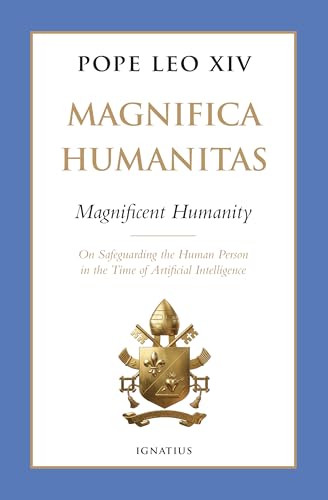 Pope Leo XIV had just weighed into these matters with his first papal encyclical, Magnifica Humanitas (“Magnificent Humanity”). Like me, he is somewhere in between, and like me, his concerns might outweigh his praise for all things AI. His purpose is not to condemn AI as much as it is to affirm who we are as creatures made in God’s image. Indeed, that is clearly stated in its subtitle: On Safeguarding the Human Person in the Time of Artificial Intelligence.
That our humanity is always being warred against is a major theme of history. So too is the corollary of the ongoing war against God. The two go together, and the former flows out of the latter. As we shake our fists at God, we invariably end up harming humans. The counterfeit religion of Marxism is just one of the more obvious examples of this.
Man against machine has also long been a theme of human development. Harnessing technology for the good while keeping at bay its pernicious uses and proclivities is a constant struggle. We can celebrate the goods of the new technologies, but we must never be naïve about the potential dangers.
So to see the new pontiff being neither naïve about AI, nor just demonising it, is where we should all stand. And to see him championing what it is to be human in an age in which both God and people are under sustained assault is a welcome development.
It should be pointed out that one need not be a Catholic or even religious to appreciate some of the concerns being raised here. In some of my reading lists that sound the alarm on AI, the new technologies, transhumanism and our post-human future, many volumes are penned by secular writers. They, too, are concerned about what happens to ‘we the people’ in this rather brave new world. See here for example.
Humanity Under Assault in the Digital Age
Simply sharing some of the document’s 245 paragraphs will give you a feel for where he is taking us in this matter. The very first one uses a famous biblical image that is often appealed to in such discussions:
Humanity, created by God in all its grandeur, is today facing a pivotal choice: either to construct a new Tower of Babel or to build the city in which God and humanity dwell together. Each generation inherits the task of shaping its own era, of guiding history to become a place where the dignity of every person is safeguarded, justice is promoted and fraternity is made possible.
Yet every era also runs the risk of creating an inhumane and more unjust world. Whenever humanity is in danger of marring its true identity, we Christians lift our eyes to the Incarnate God, knowing that it is “only in the mystery of the Word made flesh that the mystery of humanity truly becomes clear.” In Jesus Christ, this humanity in its grandeur becomes the Way, the Truth and the Life, opening the path for each of us to grow toward fullness.
These two paragraphs let us know the sort of ethical and anthropological concerns the Pope is dealing with (99 & 100):
It is not possible to provide a single, comprehensive definition of AI. What can be stated, however, is that we must avoid the misconception of equating this type of “intelligence” with that of human beings. These systems merely imitate certain functions of human intelligence. In doing so, they often surpass human intelligence in speed and computational capacity, offering tangible benefits across many fields. Yet this power remains entirely tied to data processing.
So-called artificial intelligences do not undergo experiences, do not possess a body, do not feel joy or pain, do not mature through relationships and do not know from within what love, work, friendship or responsibility mean. Nor do they have a moral conscience, since they do not judge good and evil, grasp the ultimate meaning of situations, or bear responsibility for consequences. They may imitate language, behavior and analytical skills, or even simulate empathy and understanding, but they do not understand what they produce, for they lack the affective, relational and spiritual perspective through which human beings grow in wisdom.
Even when these tools are described as capable of “learning”, their way of doing so is different from that of a human person. It is not the experience of those who allow themselves to be shaped by life and grow over time through choices, mistakes, forgiveness and fidelity. Rather, it is a form of statistical adaptation based on data and feedback, which can be very effective, but does not imply inner growth.
A valuable tool that requires vigilance
In light of what has been said, we can better understand why AI can be a valuable tool and, at the same time, why it calls for a measured and vigilant approach. In recent years, its private use has expanded significantly, prompting growing reflection on both the opportunities it offers and the risks tied to its rapid spread. In personal use, three aspects in particular deserve careful consideration: the ease with which results are obtained, the impression of objectivity and the simulation of human communication.
The speed and simplicity with which information, complex analyses, media content and practical assistance can be accessed undoubtedly makes life easier. Yet they can also encourage excessive reliance and the search for ready-made answers, and weaken personal creativity and judgment. The apparent objectivity of the responses and suggestions these systems provide can lead us to overlook the fact that they reflect the cultural assumptions of those who designed and trained them, with all their strengths and limitations.
The artificial imitation of positive human communication — words of advice, empathy, friendship and even love — can be engaging and at times genuinely helpful. However, for less discerning users, it can also be misleading, creating the illusion of a relationship with a real personal subject. When words are simulated, they do not build genuine relationships, but only their appearance.
The artificial imitation of care or support can become particularly risky when it enters contexts where real relationships and emotional bonds are lacking. Here, the danger is not so much that a person may believe they are communicating with another person, but rather that they may gradually lose the very desire to form genuine human connections.
Two paragraphs that appear near the end of this encyclical are also worth posting here (241 & 242):
As we look to the future, I would like to recall the image of Nehemiah whom we chose as our companion and guide at the outset. Nehemiah heard the cry of a devastated city, brought that pain to prayer, discerned before God, asked for help, received permission to return, organised the work, confronted internal and external resistance and rebuilt the walls of Jerusalem with the assistance of the people, brick by brick.
In this era of digital transformation, I see in him a striking parable of our own vocation, which is not to be passive spectators of social and cultural fractures, nor mere commentators on what is crumbling, but men and women prepared to enter the construction sites of history — research laboratories, technology companies, schools, the media, institutions and local communities — in order to rebuild what has collapsed and protect what is threatened. Like Nehemiah, we too are called to unite listening and courage, prayer and responsibility, so that, even when a technocratic mentality or partisan interests seem to prevail, the human city may become a more fitting place to live.
The image of rebuilding Jerusalem evokes the New Testament promise of the holy city, which is given to us first and foremost as a gift. In the Book of Revelation, the new Jerusalem descends as a gift for all God’s people, “prepared as a bride adorned for her husband” (Rev 21:2). The walls of Jerusalem are no longer defensive fortifications, but the precious adornments of the Bride of the Lamb. Its gates, which Nehemiah guarded so diligently, remain permanently open to all nations. God’s presence offers light and life to all. The city is a new Eden, with its living water offered to the thirsty, and its tree of life whose leaves “are for the healing of the nations” (Rev 22:2). As we await its fulfilment, this vision is set before us as an encouragement — a call to overcome our divisions and to work together — for this is the way of Jesus Christ, yesterday, today and forever.
One may not agree with everything found in this document. For example, conservatives such as myself will not like all of his criticisms of the free market (although some are deserved), and many will bristle at how he still assumes much of the climate hysteria narrative.
But generally speaking, this encyclical offers a sensible, rational, and morally rich way to assess where AI and these new technologies are taking us. And it stands in line with the past two thousand years of Christian thought on what it means to be human, and where we need to be on our guard against that which would rob us of our humanity – or replace it altogether.
The full document can be found here.
___
Republished with thanks to CultureWatch. Image courtesy of Adobe.
6 Comments
Leave A Comment
Recent Articles:

24 October 2026
3.3 MINS
When we ask God, "What is in my hand?", and see our possessions, money and time as seed that God asks us to sow, life becomes simpler.
23 October 2026
6.8 MINS
Hillsong UNITED’s Joel Houston reflects on fame, faith and the burden of ministry, questioning performative Christianity as he seeks a more authentic walk with God.

23 October 2026
13.1 MINS
Tasmania’s proposed conversion practices legislation raises serious questions about religious freedom, pastoral care and whether Christians can freely pray with those seeking to live according to their faith.

23 October 2026
7.7 MINS
Melbourne Catholic Archbishop Peter Comensoli has spoken out clearly against the deadly promises by both major parties in Victoria ahead of the election, drawing a comparison between abortion and capital punishment.

23 October 2026
3.1 MINS
As Western societies grow more hostile, could abandoning Christianity’s moral foundations be contributing to the rise of ideological extremism, political intolerance and violence?
23 October 2026
5.1 MINS
France’s escalating riots expose the dangers of political extremism, antisemitism and radical alliances, offering America a stark warning about the future of Western democracy.
23 October 2026
3.1 MINS
The one who is worthy of it all is awakening his Church to be captivated by him, so that we will honour one another and share his gospel with humility and courage.



I think the accent should be on the word ARTIFICIAL.
The Pope might be right on his assessment of AI, but the Pope or any Pope thereof has to me not any legitimacy to speak on anything spiritual, physical or scientific. There are far more qualified people speaking on this subject. The Pope is not a Christian, can’t say it any nicer & besides has proven himself to be complete woke hypocrite, trying to create a “One World Religion”
https://www.harvestministriesnz.com/post/can-we-survive-ai
https://www.harvestministriesnz.com/post/john-lennox-on-ai-revelation
https://www.harvestministriesnz.com/post/is-the-pope-the-false-prophet
https://www.harvestministriesnz.com/post/come-out-of-her-my-people
I am a Catholic who is not a fan of this Pope because like most of his recent predecessors he seeks to curry favour with Islam , instead of opposing it head on as the brave medieval Popes, but, I support him in this . He is right to warn the World of the dangers of AI, how it replaces people and, especially that WW3 could be started by AI. I supported only frail Pope John Paul 1 who died one month into his Papacy (he was trying to end the financial abuses of the Vatican Bank ) and poor , old, frail Pope Benedict 16 who was no fan of Islam, whose ” parting shot ” was to declare the ” 800 Martyrs of Otranto “, who were beheaded in one day by the Muslims for refusing to convert to Islam , “saints”. He left the official ceremony to Pope Francis who hated doing it, but, had no option as his hands were tied by Benedict’s pronouncement they were “saints. Benedict 16 gave us our one and only Australian saint, Mary Mac Killop. My ex- Protestant husband (then an Atheist ) was proud to have her a saint as she was Clan MacDonald like himself. Pope Benedict did much to revive Christianity amongst Australian youth. My husband had long renounced Christianity but when Pope Benedict had a World Youth program, Ian helped to carry a large, heavy cross , and he is photographed raising the crucifix at the Port Arthur World Heritage Site. A senior member of the staff there said to me :–“Your husband’s photos of that day are part of our official records ” .Ian died long ago , but, his memory will live as long as Port Arthur World Heritage Site exists. Ian McLellan chose a Christian funeral and we will be together in the same grave. My message is –please have Christian Unity with all people whether Coptic, or Syrian or Greek Orthodox, Lutheran, Evangelicals, Baptists, etc to meet the many Foes in today’s evil World.
Thank you for this article. I agree that it’s very encouraging that the Pope’s encyclical on AI acknowledges its dangers without dismissing it as a potentially valuable tool for humanity.
We are in the very early stages of AI, and we don’t fully understand it or how to use it properly or control it.
I believe it’s crucial that we all make an effort to understand AI as soon as possible. AI can only process information that can be captured in binary form (1s and 0s).
On the other hand, humans are spiritual beings who can process experiences that can never be translated into binary code. Over time, these experiences can lead to understanding, which may eventually become wisdom. A computer can never have experiences, understanding, or wisdom.
Neither can a computer care. However, malicious actors can program AI to “pretend to care” and deceive people, often for financial gain or power. This explains the current tension between researchers who are cautious and hesitant and business and finance executives who are concerned about returns on investment in AI.
We all need to learn about and understand AI as soon as possible. By doing so, we can use our wisdom to help our children and grandchildren avoid potentially disastrous mistakes. This has been the role of elders throughout history.
Pope Leo offers ethical guidance without replacing the technical decisions of states, respecting the legitimate autonomy of earthly realities and the competence of politics. Politics is considered the highest form of charity and the “art of encounter.” The Pontiff encourages multilateralism and international cooperation, opposing fragmentation and individualism, and hatred in all its forms.
It is a good thing that such an authoritative voice exists to promote understanding between communities and peoples.
I agree with Pope Leo that artificial intelligence needs to be disarmed especially if it is being used to human beings as guinea pigs experiments such as “Targeted Individuals(TIs)” that has been going on for many years now. “Targeted Individuals (TIs)” are victims of gov’ts AI experiments. The Pope must be aware of that.