


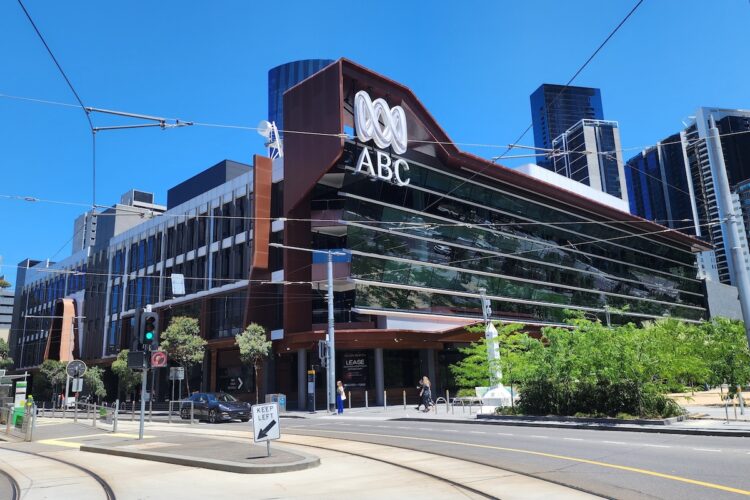
ABC Opinion Desk Breaks Ranks on Giggle v Tickle Ruling
The ABC has at long last published a legal critique of the Giggle v Tickle ruling after years of biased coverage that included calling Roxanne Tickle a “transgender woman”.
The ABC has published a legal academic’s critique of the Federal Court’s Giggle v Tickle ruling in its opinion section, three days after rejecting a similarly argued piece from Sall Grover, the case’s losing appellant.
Neil Foster, an Associate Professor of Law at the University of Newcastle, wrote in the ABC’s Religion & Ethics section over the weekend that under the ruling, “any place or activity that is meant to be provided for ‘women’ will have to be open to biological males identifying as such.”
The Full Federal Court dismissed Sall Grover’s appeal in May, ruling that her women-only app, Giggle for Girls, unlawfully discriminated against Roxanne Tickle, a man who holds a Queensland birth certificate that states he is female. The court doubled damages against Grover to $20,000 and found the discrimination was direct rather than indirect.
News and Opinion Diverge: Giggle v Tickle
The ABC’s own news report on the case described it as a “landmark” ruling and referred to Tickle throughout as a “transgender woman”. In the report, Tickle was quoted as saying the outcome would help “trans and gender diverse people and their loved ones to heal”.
The ABC had earlier declined to publish an opinion piece from Grover after 37 email exchanges and two redrafts, objecting to her use of phrases such as “biological reality” and “truth”. Grover’s piece, later published in The Australian, argued the ruling eroded women’s sex-based rights.
The rejection followed the ABC’s publication of an article by law academic Paula Gerber describing the Giggle v Tickle ruling as “good for trans rights and women’s rights”.
A 2025 study cited by The Daily Declaration found that of 540 ABC News articles on gender identity published between January 2020 and June 2025, only one discussed the Cass Review into youth gender medicine. None reported on the more than 100 Australian clinicians who called for a halt to youth transition procedures.
Foster’s Legal Argument
Foster’s critique centres on section 7D of the Sex Discrimination Act 1984. This provision lets someone set up a “special measure” — a women-only space or service — to help achieve equality between men and women, without that measure itself being ruled unlawful discrimination.
Grover argued the Giggle app was exactly this kind of measure: a space where women could interact online without men present. The Full Court rejected the defence. It found the exemption protects a women-only space from a sex discrimination claim, but not from a gender identity discrimination claim — the ground on which Tickle sued.
Foster argued the court read the provision too narrowly. It was written to cover both grounds together, he said, not split them apart.
He also argued the Full Court had no basis for treating this as new or unsettled ground. He pointed to two earlier cases where the same defence was accepted without being split apart by discrimination type: a women-only gym class, and a union that reserved leadership roles for women. In neither case did a court limit the exemption to just one kind of discrimination claim, he wrote — which is what the Full Court did for the first time in Giggle’s case.
Foster noted the judges essentially conceded as much. Justice Melissa Perry acknowledged a literal reading of section 7D “is an available one”. Justices Wendy Abraham and Geoffrey Kennett went further, finding the same reading “works grammatically” and “does not strain the language” of the provision. All three adopted the narrower interpretation anyway.
A Question of Definition
Foster also disputed the majority’s finding that the word “woman” in the Act shouldn’t be tied to any “narrow or rigid conception of femaleness”. He argued the Act exists to implement a well-known 1979 international treaty aimed at ending discrimination against women, which assumes throughout that it’s protecting biological women, given its provisions on pregnancy, maternity leave and breastfeeding.
He also contrasted the ruling with the UK Supreme Court’s 2025 decision which ruled that “sex” in British discrimination law means biological sex.
Grover has applied to the High Court of Australia for special leave to appeal.
Foster wrote the case raises “questions of law of public importance” affecting women’s refuges, sporting teams and prisons, and warned that religious groups relying on section 37 of the Act to operate according to their doctrines face similar legal risk.
The High Court has not yet decided whether to grant leave.
___
Image courtesy of Wikimedia Commons.
5 Comments
Leave A Comment
Recent Articles:

18 October 2026
2.7 MINS
Every season of life belongs to Christ, and we don't retire from discipleship as we grow older. In fact, our older years hold unique gifts for the younger generations.

17 October 2026
3.4 MINS
Seeking the face of God means surrender, laying aside our agenda and wants. Revival begins when we want God himself more than we want the outcome.

16 October 2026
4 MINS
A desperate Victorian Labor Party is peddling taxpayer-funded abortions as free “healthcare”. In a shameless attempt to stay in power, they're willing to do anything — including killing the unborn and forcing taxpayers to pay for it.

16 October 2026
4 MINS
Katie Zacharia’s first days as White House Press Secretary have sparked fierce media criticism, but her remarkable testimony of surviving an abortion attempt tells a deeper story.

16 October 2026
3.4 MINS
Australia’s proposed digital duty of care laws promise greater online safety and increased user control by switching off algorithms, but critics warn they could give ministers sweeping powers to restrict lawful content and threaten free speech.

16 October 2026
2.6 MINS
Euthanasia accounted for 4% of all deaths in Belgium in 2025, with growing numbers involving people who were not terminally ill, dementia patients and psychiatric conditions.

16 October 2026
5.2 MINS
Christa Pike’s botched execution has sparked outrage across America, but critics argue that the same concern for human dignity is denied to abortion survivors.



Somebody once said “The Law is an Ass”.
I believe this case proves it.
Agreed, the Law is an Ass. It no longer protects the weak, but, has lost all sense of reality and commonsense. It, and its lawyers and judges deserve to be despised and the Woke teachings in Law Schools should be abolished. We need Parliamentary Debate in the Senate on the Private Members’ Bills belonging to senators Michaelia Cash and Pauline Hanson. The Blocking of Debate on them by a Coalition of Labor + Greens shows we have NO real Democracy in Australia, just as Tommy Robinson said , a “Phoney Democracy ” because the majority of Australians do not support Woke Gender Legislation.
Countess: you are so right. This is an issue of truth versus lies and unreality. Even small children know their correct biological sex.
Kurt: another excellent article. Thank you
Modern psychiatry needs to be held accountable too! This “affirming” agenda has taken over… even here in NSW hospitals. The mental rehabilitation unit in Orange offers care for “individual needs” with the influence of The Gender Centre in Sydney (another publicly funded organisation).
All of this needs to be exposed. What used to be considered “mental illness” (ie, gender dysphoria) is no longer being TREATED… it is being AFFIRMED. Try that with, say, anorexia. I’d be really interested to find out what The Gender Centre would respond if someone approached them seeking therapy for their gender confusion … not affirmation, but proper therapy.
And it has no place in public mental hospitals.
Great article Kurt!!!!!