


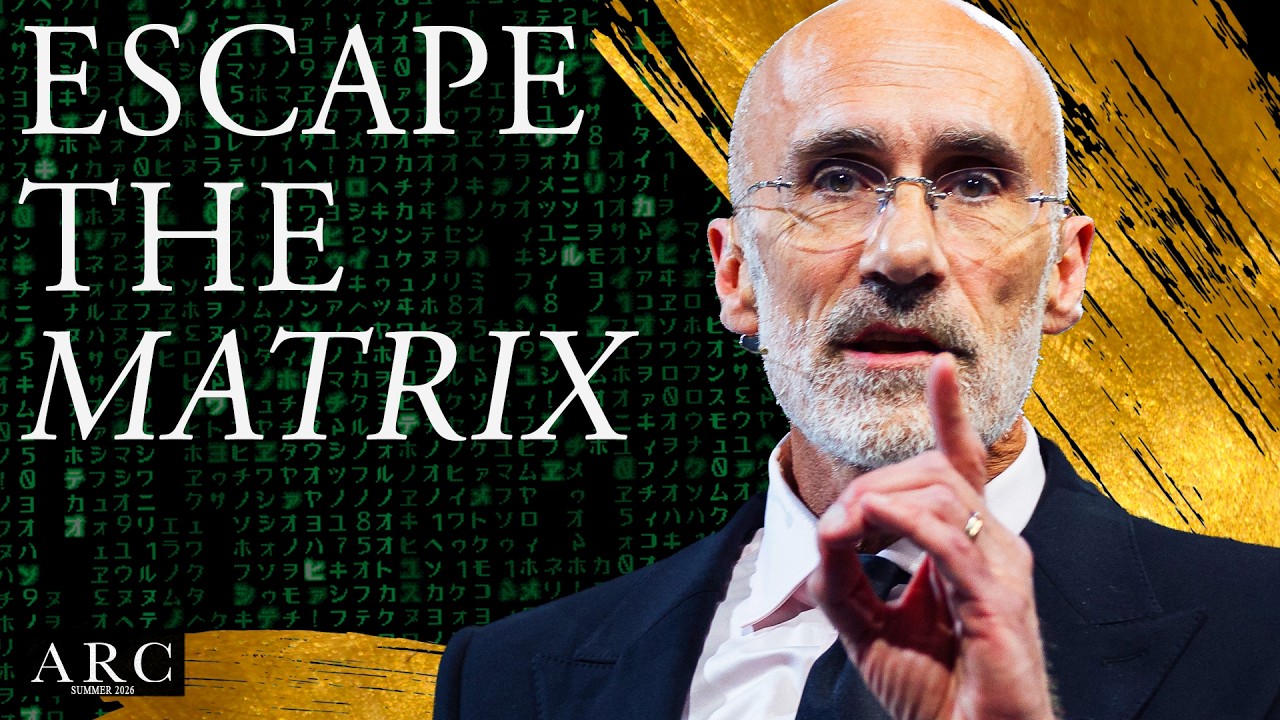
Harvard Professor: We Are Living in a Digital Simulation (ARC Address)
In a powerful address, Harvard professor Arthur C. Brooks has warned that smartphones have trapped Western civilisation — especially Generation Z — in a “left-brain simulation”. This digital shift starves humanity of the right-brain complex experiences essential for purpose, love, and faith. He articulated three actionable steps to escape this technology trap, rebuild real human connection, and reclaim a truly meaningful life.
Speaking to thousands of world leaders at this year’s Alliance for Responsible Citizenship (ARC) Conference in London, Arthur C. Brooks challenged the idea that the crisis facing Western civilisation was primarily one of politics, society, or values.
The West’s Crisis of Meaning
He argued that the “deep, underlying” crisis was one of meaning, and suggested that we already have the answer to that crisis.
A respected author of thirteen books, including the #1 New York Times bestseller Build the Life You Want, Brooks teaches university courses in what he calls the “science of human happiness”. He holds a PhD in public policy analysis and served as a military operations research analyst for Project Air Force.
Currently, Brooks serves as the Parker Gilbert Montgomery Professor of the Practice of Nonprofit and Public Leadership at the prestigious Harvard Kennedy School and Professor of Management Practice and Faculty Fellow at the Harvard Business School.
You can watch his full address at ARC via YouTube. In it, Brooks highlighted the acute and well-documented decline since 2008–9 in people’s sense of meaning and purpose — a phenomenon observable across generations, but most obvious in Generation Z.
He called this loss of meaning a “psychogenic epidemic” — “an epidemic that creates misery with no biological origin”.
“Around 2008–9, something happened. It’s almost like some diabolical force entered the lives of young adults, possessed their souls, sucked the meaning out of their lives…”
This drastic rise in the percentage of young adults who see their lives as meaningless has a simple explanation.
Right-Brain, Left-Brain and Digital Technology
Drawing on the work of British psychiatrist, philosopher and neuroscientist Iain McGilchrist, whom he referred to as “one of the great figures of our time”, Brooks explained the concept of “hemispheric lateralisation,” which distinguishes between the functions of the left (complicated) and right (complex) hemispheres of the human brain.
According to Brooks, the left hemisphere of the brain is devoted to the complicated problems of life, while the right hemisphere deals with the complex problems.
“Life needs both hemispheres. You need to know why you’re doing things, and then you need to know how to do them. You need to know why you love the people that you do, and then you need to go out and figure out how to support your family. That’s how the brain is supposed to work.”
When an individual looks at a smartphone, however, they push their brain’s activity to the left side of the brain: “away from mystery and meaning and to information and things”. This is having an impact on meaning that is difficult to quantify.
Says Brooks, “We are living a left-hemispheric existence, but we crave right-hemispheric meaning — and it’s ruining our lives.” While people crave the meaning and mystery that is so fundamental to human existence, we are forced to live within a “left-hemispheric simulation” of that meaning.
Whereas people long for love and connection with other people and — most importantly, with the divine — digital technology represses our cognitive ability to engage in and enjoy such relationships, which rely on the right-hemisphere of the brain. In our digitally-saturated, left-hemispheric world, young people are being taught that the formula for life is: “Love things”, “Use people”, and “Worship yourself”.
Yet this is not the way humans were designed to function.
3 Practical Steps to Push Back
So what can we do about it?
In his speech, Brooks outlined three steps we can take to “escape the Matrix”.
Firstly, we must “rage against the machine” both individually and at a policy level. Individually, this means that in our own lives, we must radically rethink our relationship to technology — especially smartphones.
“I promise you: you — I mean every one of you — are addicted to your devices. It’s almost impossible that you’re not, unless you’re a Carthusian monk.”
At a policy level, Brooks urged us to do “something”. One way to start would be to completely ban phones in schools — from kindergarten to the doctoral level. Thankfully, Australia has made good progress on this score.
Secondly, he argues that people must “go deeper”, emphasising the most significant questions of life. We need to grapple with fundamental questions like “Why am I alive?” and “For what would I give my life?”
“You know the essence of humanity? It’s not answering questions. It’s not information. It’s asking questions. What makes you human is asking questions. That’s the difference. When you ask a question that you can’t Google, that’s a right-hemispheric experience.”
Finally, he said that we need to replace the “counterfeit formula” that the world is teaching our young people with the true formula. Instead of loving things, we must use things. Instead of using people, we need to love people. And instead of worshipping ourselves, we must worship God alone.
It is only when our relationships are so ordered that we can break the stranglehold of digital technology and experience genuine meaning and purpose in life.
4 Comments
Leave A Comment
Recent Articles:

18 October 2026
2.7 MINS
Every season of life belongs to Christ, and we don't retire from discipleship as we grow older. In fact, our older years hold unique gifts for the younger generations.

17 October 2026
3.4 MINS
Seeking the face of God means surrender, laying aside our agenda and wants. Revival begins when we want God himself more than we want the outcome.

16 October 2026
4 MINS
A desperate Victorian Labor Party is peddling taxpayer-funded abortions as free “healthcare”. In a shameless attempt to stay in power, they're willing to do anything — including killing the unborn and forcing taxpayers to pay for it.

16 October 2026
4 MINS
Katie Zacharia’s first days as White House Press Secretary have sparked fierce media criticism, but her remarkable testimony of surviving an abortion attempt tells a deeper story.

16 October 2026
3.4 MINS
Australia’s proposed digital duty of care laws promise greater online safety and increased user control by switching off algorithms, but critics warn they could give ministers sweeping powers to restrict lawful content and threaten free speech.
A Million Women Movement Marks Second Anniversary: “Look What the Lord Has Done! Ishtar Has Fallen!”

16 October 2026
2.8 MINS
Two years after A Million Women gathered in Washington for ten hours of prayer and fasting, organisers point to victories they believe reflect God’s answers to intercession.

16 October 2026
2.6 MINS
Euthanasia accounted for 4% of all deaths in Belgium in 2025, with growing numbers involving people who were not terminally ill, dementia patients and psychiatric conditions.



Wow this is an amazing article about an amazing man who love his amazing God!!! Great work Cody. We need more!!!!!!!!!!!!!!!!!!!!!!!!!
Madness of A1. While I am injured, because there is no public bus service, I am driven by a charity to my doctor over 100 km away.This charity has since July 1 implemented AI to fix my pick up time which it has calculated as 1 hour + 22 minutes, taking no account I must walk to the bus, climb its steps, put my seat belt on, and, on arrival have to alight down a couple of steps , walk a short distance to the surgery , wait for a Lift, on arrival at the Floor , walk some way to the surgery desk—all of this done by me slowly because the left side of my body is so badly injured, I can only walk very, very slowly ! Plus , no allowance for the pick up of other passengers and their set down –all causing delays , in some cases of as much as 30 minutes or an hour ! No account is taken for any comfort stops for any feeble , sick passengers , no account is taken of road conditions –wet, slippery roads, or, snow, constant road works , bridge occasionally closed in summer to allow yachts and fishing boats to pass. The staff taking my booking are prevented by the new system from any deviation from 1 hour and 22 minutes. This is a problem to me and to my doctor as she runs her appointments strictly on time . and, am bound to be late! The other day my trip to town to go shopping, because it had to pick up to other passengers took 2 hours 14 minutes to get to the city, not 1hour + 22 minutes! I pay over $43 dollars to this Charity which uses a mix of Volunteer Drivers and paid by the hour. Depending on the day, some Drivers are worked to a punishing schedule with no time for a break . We are already short of Drivers. I suspect some Volunteers will now give the job away , and , what will I and others , do then ?
Arthur Brooks is onto it. Life is about finding why we are here and serving the purpose that God has created us for. That makes for a life of worth. Loving God above all, and loving our neighbour as ourselves. It is simple and as humanity we are drifting so far from this.
Thank you for a great article explaining a real problem in our society and a real foundational answer.