


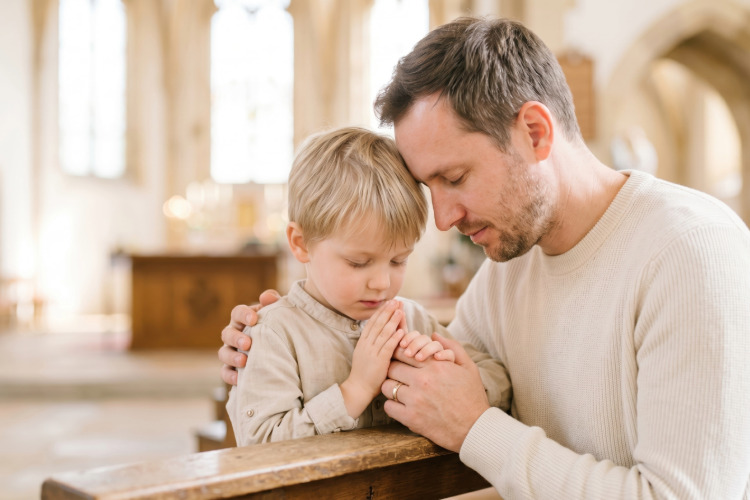
What I Learned From My Imperfect Dad and My Perfect Father
A father’s influence reaches far beyond childhood, shaping identity, character and faith. One man reflects on his earthly father and discovering God as his Heavenly Father.
Lessons From an Imperfect Dad
I recall that nearly 60 years ago, my dad took me aside as a 12-year-old and gave me “the sex talk” one Sunday morning. Mum and the girls were nowhere in sight. It was pretty interesting, but I think that I thought I knew all about that stuff.
I told my mates at school the next day and asked how their dads had handled this download of essential knowledge. None of the boys had had an official dad-to-son sex talk. So, I was quite impressed that my dad had taken the time to explain the birds and the bees to me. In fact, I was proud that Dad had gone to the trouble to do so, and I felt a little special about this in a quiet sort of way.
Another time, while Dad was washing up at the sink, and I was drying the dishes, he went into great detail to explain the parts of the atom to me – the protons, electrons, and of course those pesky neutrons. This experience is still clear in my memory, and it helped me to somehow briefly look smart in a couple of my Year 6 science lessons. Dad was not overtly a conversationalist, nor was he a scientist, he was a storeman; but he was, on those days, unbeknown to him, my teacher.
He used to pick me up from scouts on Friday nights back in the ’60s and then we’d watch the TV fights in black and white till late. Mum had no idea, snoozing blissfully in bed.
“Tony Mundine’s got a glass Jaw! … He can’t take a decent right hook!” declared the ringside TV commentators. But we never believed them. “I wouldn’t feed those palookas!” Dad would exclaim. “Mundine’s the Australian champion! What would they know?” My education in the art of boxing was also growing.
I loved that Dad drove me to my footy games. He watched from the car. He wouldn’t say much about my ordinary sporting performances, and I didn’t pay much attention to his sporting suggestions anyway, but he was there, on the spot. He taught me lots. I learned that struggling to get the old 2-stroke mower started and swearing a lot was integral to a satisfying Saturday morning, and the resultant smell of the newly cut grass across the back yard was worth all the trouble.
I guess Dad taught me, without many words — that a man can teach his kids in different ways.
Dad wasn’t religious. He was what you may call a lapsed Anglican, so when I told him at the age of twenty that I had become a Christian and that I was going to follow Jesus, he said I was wasting my life. I decided that I was right and that he was wrong, and I was soon married and off to start life’s new adventures with the girl of my dreams.
Diane and I had some of our children in Tasmania in the early ’80s. We were a long way from our families in Sydney. We were jubilant that one of our sons was born on Dad’s birthday, so when I returned from the hospital that day, I gave Dad a combined new-baby-and-happy birthday phone call.
During the call, I sensed that Dad was a little distant and discouraged. This may sound strange, but I am sure that the Holy Spirit was prompting me, so after our newsy small talk, I said to him, “Dad, is there something wrong? You sound like you have nothing to live for?”
The phone went silent on the other end for several painstaking seconds. Then he slowly answered, “Son, I’ve never had that.”
I was stunned, too shocked to reply appropriately. I don’t remember any more of the conversation. We said our cordial goodbyes, the call was done, and so was I.
Alone at home, I started to pray for Dad. That turned to crying. I had never cried for my father before. But it struck me that he was my source, the roots from which I had sprung, and now, on his birthday, he tells me that he did not have anything to live for! His pessimistic response hit me like a bombshell! My roots had no meaning or purpose!
Lessons From a Perfect Father
It was during that time of prayer that God spoke to my heart in a way I had never previously experienced. He assured me in my spirit, “I am your Father.” Waves of comfort washed over me, and I spent some important quiet moments thanking God my Father, that he was my Father — my Heavenly Father.
This assurance from God Himself that He is my Father has so strengthened me in many ways since that special day.
I have often contemplated: what is so important about fathers, and about having a father? What is this phenomenon called fatherhood? I found that the Holy Bible has given me greater insight into the hidden treasure trove of the riches and the mysteries of fatherhood.
A father reproduces himself at the birth of his son or daughter. Essentially, just about any man can reproduce himself in the physical, biological sense. The resultant child may look like the dad and have close physical resemblances to his or her father. Over the years, the child may adopt mannerisms and sayings typical of the father. The child may walk in the same way, talk the same way, and even laugh in the same way, as they do life together.
However, this reproduction does not stop with physical characteristics and mannerisms. The child will also learn many deeply embedded attitudes from his or her father, such as the difference between right and wrong, the importance of honesty, respect for others, good manners, hard work, and a commitment to what is good or otherwise. Fathers reproduce facets of their own characters, both the good features and the bad ones, in their children over the many years of their relationship. A father’s lived life reproduces his character in his child throughout those formative years.
Whilst my dad taught me many things, both positive and negative, he had rejected God as an eleven-year-old boy. His beautiful mother, Ethel, died, aged 37, in Sydney’s tuberculosis epidemic, during the Great Depression of the 1930s. At the same time, one of Sydney’s most notorious armed bank robbers was released from prison.
Dad said that he couldn’t believe in a God who was so cruel and unfair in taking his mother away from their young family, yet He allowed a dangerous criminal to return to the community. Dad applied his form of “logic” and decided that God was responsible for this gross injustice, declaring to me, “From that time on, I was finished with God.”
Because he had rejected the Creator of the universe, he had refused to believe that there is a God who had created everything, including himself. Dad had no answers to the most basic questions of life – How did everything get here? Why are we here? What is the meaning of life? What is the purpose of our existence? So, my father, my teacher, the source of my life, couldn’t explain to me the most basic issues of the meaning of life.
During my childhood, Mum took us kids off to a church every Sunday, but the churchiness made little sense to me, and like my father, I strayed a long way from the ceremonies, and the bells and smells of formal religion.
Thankfully, years later, as a twenty-year-old university student, I discovered the secrets of life, the universe, and everything else, when I came to know and follow the Lord Jesus Christ. I was a very raw, new Christian, but I was hungry for truth, meaning, and purpose, so I relished learning about God, His creation, and His plan for humanity, a plan which included me.
So, Dad had not been the perfect father, and I certainly was not the perfect son. But on the day that God made clear to me that He was my Heavenly Father, I realised that I had both an earthly father and I also had a Heavenly Father. I have two fathers.
My Heavenly Father said that He would never let me down. He has been true to His Word as He has all my deep needs covered. My Heavenly Father gave me His name when I became a Christian, and He has provided for me and protected me repeatedly throughout my life, as a father should do. He has more than made up for my earthly father’s deficiencies. I guess my two fathers have been a good combination in my life.
I certainly wanted my earthly father to meet my Heavenly Father. I wanted Dad to be able to say, “Our Father”.
Dad died a few years ago, aged 98. During his final years, I had the privilege of introducing him to my Heavenly Father.
Following in Dad’s footsteps, I too became a father. I have had the privilege of being the father of four sons and a daughter. I am sure that I have unwittingly projected many of both Dad’s and my characteristics, habits, and mannerisms into their childhood and their development. However, there is one key difference between my fathering and my dad’s fathering. I have been very clear about teaching my children about God, Our Father, and His purpose for life and His purpose for their lives.
Along with my wife, we have not only given our children our name, protection, and provision; we have been explicit to the best of our ability about teaching them the eternal truths of God and the meaning of life.
As a father, my children have my name. They belong in the Harding family. They know their identity in life. They have been protected, as my wife and I have tried, as best we could, to make our home a safe haven for them. We have exposed them to much of what is simple and good in this world and have provided them with the tools of identity, faith and certainty to assist them to navigate the many dangers, lusts and ideologies that this world has to offer, that usually end in shipwreck.
So, I learned from my relationship with Dad that fathers are educators. We are educators both by how we live our lives in the presence of our children and by what we explicitly teach our children from day to day.
When a young man marries, his status changes instantly. As a single man, he was focussed on “I”, “me”, and “mine”. Once married, the two have become one, and their new, unified focus is now “we”, “us” and “ours”. The young man is no longer “a boy who shaves”; he now has embraced new adult responsibilities, and then, when children come along, those responsibilities increase even further. The young father is in the process of forming a “house” or a family with his wife and children.
The Bible presents some fundamental educational principles that are the responsibility of earthly fathers.
- We are commanded to train up children in the way that they should go (Proverbs 22:6).
- Fathers are specifically told to educate, train, and admonish their children and to avoid frustrating them in that process (Ephesians 6:4).
- We are commanded to love God with all of our hearts and to be with our children in order to diligently and daily teach them the truths, words, principles and commands of God (Deuteronomy 6:1-7).
This requirement to teach one’s children goes with the responsibility of being a father. It is not an option. It is not a calling. It is a commandment from God our Father.
God has created people for spiritual purposes. In this sense, a child’s education is inescapably a spiritual enterprise. Children are not merely material creatures. They are composed of body, soul, and spirit. Thus, the spiritual dimension must be included in the child’s education and development. It is the father’s responsibility to see that this spiritual component of his child’s education is fulfilled. To deny one’s child the spiritual dimension of his or her upbringing is, in God’s eyes, an act of neglect.
Whilst fathers and mothers are co-equal in their responsibilities for raising their children, their roles are different. Fathers bring masculine differences as they raise and nurture their children into adulthood. They view and approach their children in a vastly different manner to the way that mothers view and deal with their children. God our Father provided both fathers and mothers for children on earth, to demonstrate to them the two most important and different aspects of His personality and His divine, Heavenly Fatherhood.
The Apostle Paul distinguishes the role of fathers from the role of mothers in the New Testament, in 1 Thessalonians 2:7-12. Whilst mothers highlight gentleness, nurture and love, fathers present exhortation, comfort, and direction to their children.
Fathers bring:
- A different approach than what mothers bring to parenting;
- A different type of accountability to their children;
- A different form of provision for their children;
- A different form of protection for their children and
- A different role model for their children.
As an imperfect father, I decided that I needed to be proactive as a dad, as best as I could, in the fathering of our five children. I wanted the children to see that Christianity, knowing the Bible, exercising faith, and praying was not just for women. This was men’s business too. So, here are a few suggestions that helped me in my not-so-perfect efforts at fathering, that may prompt other fathers as they father their children.
I wanted the kids to see that I was committed to loving Jesus and that I was committed to loving their mother. I believed that this would help them to feel secure in their spiritual growth and in our physical family.
I let them catch me praying or reading the Scriptures in my study early in the mornings. I led a short Bible reading and prayer time after dinner. I wanted them to see that the Bible was vitally important and that we could enjoy discussing and debating the deepest things in life in the safety of our lounge room. It wasn’t hard to do. I just had to read out a simple Bible verse or two, and we would chew on it for a while. Any man can do this with his family.
We attended church as a family. My wife and I looked for a Bible-believing church that would encourage our children; a church that had older kids that our kids could look up to, and where they could enjoy making Christian friends. We wanted them to love going to church.
We homeschooled our children, with the help of Christian curriculum and lots of fun. Whilst not all families can do that, I was operating on the simple idea that God held me responsible for what philosophies, ideas, and attitudes that our children were exposed to during their academic years. Whatever form of schooling parents choose for their children, fathers need to be engaged in what their children are learning, reading, seeing, hearing, and watching.
Like all fathers, I was not a perfect father, but I was determined to be more engaged with my kids’ intellectual, social and spiritual growth than my dad was with me.
It’s a fact of life that we fathers all make mistakes. Many of us are divorced, separated, remarried, or establishing blended families. For those of us in disrupted families, times like Father’s Days, birthdays and Christmas can deliver some sadness.
Despite our failings, if our Heavenly Father has provided redemption to the world, and forgiveness of sin through the sacrifice of His Son, Jesus, He can certainly help us dads who need assistance in repairing our fathering relationships. This truth is applicable to fathers who are in dual-parent families, single-parent families, separated families, blended families, foster families, and adoptive families.
Our Heavenly Father is the God of the second chance. He can help earthly fathers to get back in the caring and nurturing game of fathering despite their current less-than-optimal circumstances, and to do the best they can in each unique situation.
Unlike the brief act of conceiving a baby, the act of fathering is a long-distance event. I am very grateful for all that I learned from my quiet, noisy, faithful, not-so-perfect, earthly father. I miss him very much. His absence sometimes now feels like a hole in my soul. But I am also immensely grateful to my Heavenly Father for His love and faithfulness; He is the repairer and healer of my soul – my remaining Father.
My own fathering continues even though my kids are now all adults. In addition, I am now a grandfather, and I am learning about that new role and my many new responsibilities towards my eleven grandchildren.
In conclusion, I have to give credit where credit is due. I will always be grateful to my dad, my earthly father, for all that he did for me. And I am eternally grateful to my Heavenly Father, for His ongoing perfect fathering of me throughout my life.
I love the fact that I have two fathers.
8 Comments
Leave A Comment
Recent Articles:

17 October 2026
3.4 MINS
Seeking the face of God means surrender, laying aside our agenda and wants. Revival begins when we want God himself more than we want the outcome.

16 October 2026
4 MINS
A desperate Victorian Labor Party is peddling taxpayer-funded abortions as free “healthcare”. In a shameless attempt to stay in power, they're willing to do anything — including killing the unborn and forcing taxpayers to pay for it.

16 October 2026
3.4 MINS
Australia’s proposed digital duty of care laws promise greater online safety and increased user control by switching off algorithms, but critics warn they could give ministers sweeping powers to restrict lawful content and threaten free speech.
A Million Women Movement Marks Second Anniversary: “Look What the Lord Has Done! Ishtar Has Fallen!”
16 October 2026
2.8 MINS
Two years after A Million Women gathered in Washington for ten hours of prayer and fasting, organisers point to victories they believe reflect God’s answers to intercession.
16 October 2026
3.3 MINS
Jesus is calling us to love one another “just as I have loved you”. And if the Church does awaken to that agape (love), the world will see a great and powerful witness to Christ and his kingdom.
15 October 2026
3.6 MINS
An 80,000-strong gathering in Texas signals a hunger for revival, as Pastor Philip Anthony Mitchell warns that Christian indifference could leave future generations without the faith.

15 October 2026
4.2 MINS
Many Australian Christians don’t know a single Aboriginal person. Robyn Murray argues that reconciliation begins with honest history, prayer and a shared life in Christ.



So good to read! Bless Terry hugely! And a beautiful photo.
Amen to that.
Thankyou Terry,a beautiful testimony of Gods enduring love and faithfulness
Many continued Blessings for you and your family
I am a friend of your daughter (I don’t know your sons) and I must say you and Diane have done a wonderful job of fathering and mothering her.
Well spoken Terry
Thank you for an encouraging and thoughtful article.
Thankyou Terry for such a beautiful loving testimony of the two Fathers both of whom I have known and loved.
Terry, thank you for this piece, powerful! I particularly resonated with your mathematical equation, explaining how your Heavenly Father filled the gaps left by your earthly father.
Yes we dwell on Fathers on Father’s Day, but oh how important fathers are every day. I remember my own father who died 92 years old I think. I was so blessed to have had a wonderful role model of parenting that I can best describe as ‘teamwork’. My heart goes out to all those in our world that only have a father or a mother and not both. Oh how they need their Heavenly Father.