


New Policies to Fix the Disastrous Murray-Darling Basin Plan
The Murray-Darling Basin faces mounting food, water and environmental pressures, prompting calls to replace flawed policies with practical engineering and strategic planning.
There are far better ways to deliver environmental, social and economic outcomes in the Murray-Darling Basin (MDB) than the scientifically flawed, seriously misguided and disastrous Water Act 2007 and subsequent Basin Plan.
The new book Caught in the Current puts these failures in context, exposing how, over the past 30 years, population growth has far outstripped agricultural production.
Subsequently, both Nationals Leader Matt Canavan and new One Nation member for Farrer David Farley have warned in The Australian that this country is on the road to becoming a net importer of food in the near future.
From analysis in Caught in the Current, and by the National Irrigators Council, it can be calculated that about 40 per cent of the water previously available for irrigation farming has been acquired by governments, mainly the Commonwealth.
These buybacks are for “additional” environmental flows, over and above the pre-Water Act 50 per cent share of average flows to the environment, down the Murray River to lakes Alexandrina and Albert in South Australia.
As a result, the worst decline in Australia’s food production has been in the irrigation areas of the MDB, following huge water buybacks that started in 2014-15. Subsequently, the real value of Basin irrigation production per head of population fell 29 per cent in the six years up to 2020-21.
Yet the output of a Basin irrigation farm is about 42 times that of the average Australian farm. This high output is because of water for irrigation from the huge dams, locks, weirs and irrigation channel infrastructure built in the 20th century to make the Basin Australia’s major food bowl.
Why the huge buybacks of irrigation water for additional environmental flows?
The Water Act says buybacks are needed to keep open the Murray Mouth and to flush the hypersaline, environmentally degraded Coorong Lagoon. Yet, as documented in Caught in the Current, huge water flows down the Murray and through Lake Alexandrina have been futile. They don’t keep the Murray Mouth open, and bypass the Coorong, going straight out to sea.
Also, the Basin Plan claims the Lower Lakes have to be kept “fresh” for migrating water birds under international environmental conventions, yet most of these birds feed on estuarine or saltwater flats and beaches, not in freshwater lakes.
Far Better Ways
Both the Water Act and Basin Plan need rewriting to reflect environmental realities and to achieve balanced environmental and social outcomes.
First, the Water Act needs to allow for Lakes Alexandrina and Albert to be restored to their natural estuarine states. That is critical for all intended outcomes, including the safeguarding of estuarine wetlands for migrating birds under the international agreements invoked in the Act.
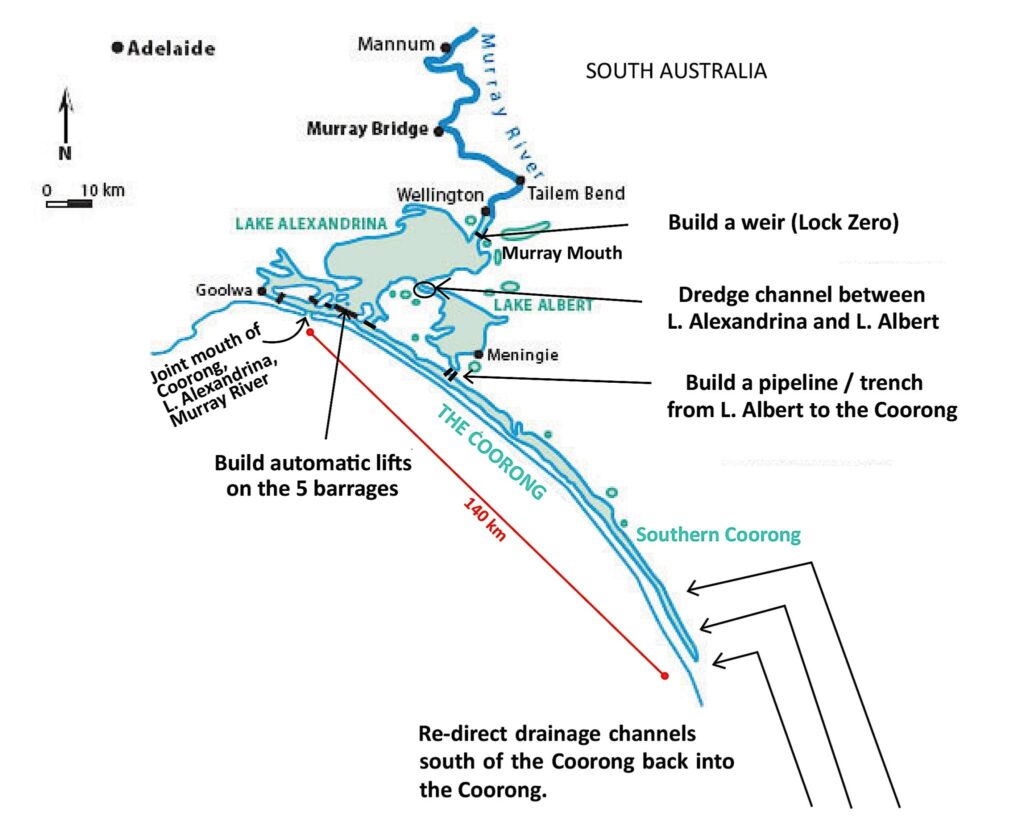
Second, alternative engineering works can deliver key objectives of the Water Act, which current Basin Plan policies cannot deliver. As illustrated in Figure 1 (above), these include:
- Building Lock Zero near the end of the Murray River would provide much better management of the Lower Lakes, the Coorong and Murray Mouth, and most importantly, to permanently guarantee fresh water from the lower Murray for Adelaide’s water supply.
- Automating the lifting gates on the Lake Alexandrina barrages would readily allow the necessary inflows and outflows of water between Lake Alexandrina and the ocean to:
- scour the Murray Mouth channel and keep it open for extended periods;
- maintain water levels in the Lower Lakes to prevent the lake beds from being exposed to the atmosphere, which can turn the lake beds into toxic acid sulphate soils;
- return the Lower Lakes to their natural estuarine state, greatly improving native fish migrations and to provide appropriate feeding grounds for migrating water birds.
- Some of the huge, river-sized drainage channels, to the south-east of the Lower Lakes region, need to be reconnected to the Coorong. Built since the 1800s, these drainage channels have starved the Coorong Lagoon of fresh water, turning it into one of the most environmentally degraded, hypersaline waterways in Australia.
Third, there is an urgent need to build new dams. The last major dam in the Basin was Dartmouth. Finished in 1979, with its huge dam wall standing 180 metres high, Dartmouth has a holding capacity of 4,000 gigalitres (eight Sydney Harbours). Since then, Australia’s demand for food has greatly expanded as the population doubled over the next 47 years.
Caught in the Current lists numerous proposals for new dams in the Basin to store more water in high/extreme rainfall periods.
The book calls for the Murray-Darling Basin Authority (MDBA) to release the study on possible new dam storages that were assessed during the 1960s’ debate over whether to build a new water storage at Chowilla or Dartmouth.
Fourth, notably, if these engineering works were undertaken, far less water would be needed for futile environmental targets down the Murray. Selling some of this valuable water back to farmers, industries and cities would likely pay for the cost of building new dams and improving the infrastructure and environment of the Lower Lakes.
Fifth, Caught in the Current calls for the federal and MDB state governments to restore the cooperative, consultation management system developed by MDB authorities when they had to deal with all Basin stakeholders to address rising salinity problems in the 1960s.
Not only did this management system become recognised by the World Bank and other development agencies as the world’s best practice in large basin management, but this Australian-developed management model is now being used to manage large river systems around the world.
Yet, the Water Act replaced this world’s best practice system with a top-down Murray Darling Basin Authority, which conducts only token consultation with MDB stakeholders.
Call for Strategic Planning
Sixth, it would be regarded as a gross failure of responsibilities if governments failed to undertake strategic planning for future education, health, transport, energy and welfare needs.
Caught in the Current exposes the gross failure by federal, state and territory governments to do strategic planning for future water needs of all sectors.
It calls for urgent water planning that includes new dams for cities, industries, farming and the environment.
Caught in the Current is timely as both the Water Act and Basin Plan are under review by separate inquiries.
___
Republished with thanks to News Weekly. Image courtesy of Adobe.
One Comment
Leave A Comment
Recent Articles:

19 October 2026
6.7 MINS
Europe’s escalating unrest raises urgent questions about immigration, national identity, secularism and the decline of Christian influence, prompting calls for repentance, prayer and renewed leadership.

19 October 2026
7 MINS
Western Australia’s euthanasia deaths have surged, prompting calls for an urgent inquiry amid concerns about doctor shopping, waived safeguards, limited palliative care and proposed legal expansion.

19 October 2026
12.4 MINS
Greta Gerwig’s "Narnia: The Magician’s Nephew" trailer raises questions about C. S. Lewis’s Christian vision and the faithfulness of the new Netflix adaptation. Here are my initial impressions and concerns.

19 October 2026
2.7 MINS
The UK Greens’ vote to define Zionism as racism has exposed deep divisions within the party, raising questions about its future leadership and political direction.

19 October 2026
3.3 MINS
Discover why dads make a unique difference in their children’s lives, and how the Dads4Kids Fun Camp creates lasting memories through adventure, connection and fun.

19 October 2026
3 MINS
Paul prayed that we would be awakened to a deeper revelation of the Father and who we are in Christ, so that we will make Jesus known to others more passionately.

18 October 2026
2.7 MINS
Every season of life belongs to Christ, and we don't retire from discipleship as we grow older. In fact, our older years hold unique gifts for the younger generations.



Very good review.
My grandfather helped pioneer irrigation on the Murray River when he was President of his Riding and then Mayor of Swan Hill in the 1890’s , early 1900’s. One of his son’s Louis did the initial feasibility study of the future Ord River Scheme and were very concerned about water security. Louis on graduation in agriculture stated his dream was to have irrigation from the Darling to the East for hundreds of miles!
The Bradfield Scheme was to fulfill this by building dams with catchment from the huge rainfalls in Qld.
Seems we don’t have pioneers anymore but raising socialist bureaucrats who haven’t got a clue! Lack of nuclear power is another fiasco.