


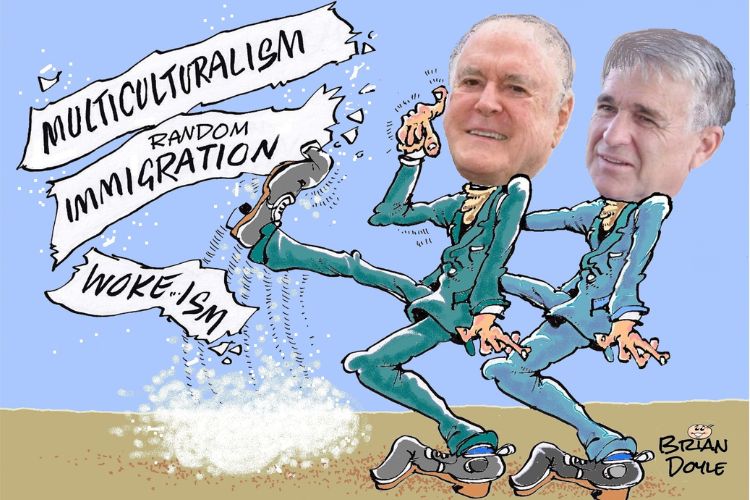
Anderson and Cleese Challenge the Multiculturalism Myth
John Cleese’s views on multiculturalism, Christianity and criticism are resurfacing, offering a provocative challenge to assumptions about immigration, cultural identity and the West’s Christian foundations.
A three-year-old clip featuring John Anderson talking with John Cleese is re-entering the multiculturalism debate.
The two-minute segment covers Cleese’s thoughts on immigration, assimilation and the preservation of culture.
Cleese sees multicultural ideology as problematic because there are core differences between cultures.
These differences create difficulties when it comes to imported cultures coexisting with the host country. Some are even too difficult to resolve.
Cleese told Anderson, “The trouble with multiculturalism is you want to have a core of things that people agree on, and then all the details can be fixed.”
Multiculturalism, Immigration and Integration
Offering an example, Cleese said, “If you believe that, say, allegiance to a god is effectively in the real world more powerful than allegiance to the constitution of a country, then that’s a conflict.
“I don’t know how you resolve that. I would say if you feel that, then don’t come to a country that has a completely opposite view, because there are many countries that have your view.”
Cleese said he would then ask this person, “Wouldn’t you feel more comfortable there?”
In agreement, Anderson replied, “And maybe if you destroy the culture of the country that you’ve come to, everyone loses.
“Not just the people who have enjoyed that culture, but the very people who have come to it looking for something better. You can undo it.”
“Yes,” Cleese said, “you can be too critical of it because you want to change something before you’ve really had time to absorb what the real feeling and truth about the country is. I do think that’s right.
“I do think it’s fair to say to people,” he added, “well, if you really don’t like so many aspects of this country, wouldn’t you be happier finding another country that agrees with your views more.
“Rather than coming to one that agrees less, which you want to change, although it’s not what the history of that country has led to.”
For Cleese, who was raised on “when in Rome, do as the Romans do,” immigration is about integration.
Looking back on history, immigration was defined by people searching for a better life somewhere else.
As Cleese argued, “Immigrants usually immigrated because they weren’t doing that well in the country they came from. Most of them came out of desperation.”
Christianity vs Bureaucratic Religion
Anderson’s wider chat with the Monty Python star also dove into Christianity and Western culture.
Here, Cleese said, “Christianity is too difficult. I mean, what Christianity asks of its followers is enormously difficult, and I think most people can’t take it quite seriously.”
Quoting G.K. Chesterton, Cleese said, “‘It’s not that Christianity has failed. It’s just that it’s never been tried.’ And I think that’s the problem about it.
“The other problem is if you’re around Jesus and the disciples, you’re getting something from them which is transforming.
“If 600 years later, you’re getting the power seekers in the church running it like a bureaucracy, you’re not getting anything like that at all.”
Responding to Chesterton’s claim that the abandonment of God creates a vacuum where humanity believes in anything, Cleese said, “It depends on what you mean by God.”
The actor and comedian didn’t dismiss God. Cleese simply stated, “I believe there is something out there. I like the Alcoholics Anonymous people who call it a higher power.”
On Christianity and the current state of the Western world, Cleese remarked: “I think once you lose a religious underpinning, then you’ve got to go to something else.
“I have this nasty feeling that people go to money. The money becomes the meaning of life, and that’s such a joke when you consider Christ did not say ‘blessed are the rich’, right?”
Cleese rightly criticised prosperity teaching and, on brand, thought literal-mindedness makes Christianity ridiculous.
He is as sceptical about the Puritans as he is critical of today’s modern-day Marxian Woke circus.
Perpetually Offended
The Anderson-Cleese conversation included an insightful take on how culture has replaced the ability to listen to criticism with an inability to laugh at itself, and a readiness to take offence.
If criticised, we have two ways to respond.
First, claim victimhood and cancel the critic. Second, ask whether there’s any truth in the criticism.
Anderson framed the options in a question, adding that he would choose option 2. Cleese responded, “Well, that’s what a real Christian would do.
“Instead of immediately batting the criticism away, he would think, is that true? Is that true of me? How true is it?
“Not: is it true, black or white, true or untrue; to what extent is that truth? People find it very, very difficult to do. They don’t really want to be criticised.
“The mistake Woke people make is to say that all humour is critical, not puns; they’re not critical, but any kind of Fawlty Towers humour. Any kind of film or stage humour, because you don’t laugh at perfect people.”
“If someone is kind and wise in general,” Cleese explained, “there’s nothing funny about them; it’s when they fall below that and become greedy or lustful or spiteful, that’s when they become funny.”
“So,” he asserted, “all humour is critical, but the question is, how is the criticism conveyed?”
Thank you FSU
I’m glad to say that they backed off
But their arrogance is astounding
Perhaps it’s to mask their fear of criticism https://t.co/Uk35rSUO3J
— John Cleese (@JohnCleese) September 28, 2026
Cleese’s Warning About Britain’s Christian Heritage
At 86, the British comedian still isn’t afraid to speak his mind.
On X, Cleese has been relentless in his opposition to mass immigration, the dechristianisation and apparent Islamification of Britain. (See here, here, and here).
As he posted on 16 March, “The UK has always been based at the deepest level on Christian values, regardless of dogma.
“Despite the many mistakes made by churches, for centuries, British people have been influenced by Christ’s teaching.
“If these values are replaced by Islamic ones, this will not be Britain any more.”
Cleese restated something very similar again in August.
Affirming that Britain is a Christian country, he wrote, “At the deepest level it has Christian values, not so much in theology, but in fundamental behaviour. Decency.
“These values do not have the underlying authoritarianism of Islam, which threatens to force people to convert.”
The Anderson-Cleese interview took place in 2023 when the Monty Python legend was on his “An Evening with the Late John Cleese” tour of Australia.
8 Comments
Leave A Comment
Recent Articles:

24 October 2026
3.3 MINS
When we ask God, "What is in my hand?", and see our possessions, money and time as seed that God asks us to sow, life becomes simpler.
23 October 2026
6.8 MINS
Hillsong UNITED’s Joel Houston reflects on fame, faith and the burden of ministry, questioning performative Christianity as he seeks a more authentic walk with God.

23 October 2026
13.1 MINS
Tasmania’s proposed conversion practices legislation raises serious questions about religious freedom, pastoral care and whether Christians can freely pray with those seeking to live according to their faith.

23 October 2026
7.7 MINS
Melbourne Catholic Archbishop Peter Comensoli has spoken out clearly against the deadly promises by both major parties in Victoria ahead of the election, drawing a comparison between abortion and capital punishment.

23 October 2026
3.1 MINS
As Western societies grow more hostile, could abandoning Christianity’s moral foundations be contributing to the rise of ideological extremism, political intolerance and violence?

23 October 2026
5.1 MINS
France’s escalating riots expose the dangers of political extremism, antisemitism and radical alliances, offering America a stark warning about the future of Western democracy.
23 October 2026
3.1 MINS
The one who is worthy of it all is awakening his Church to be captivated by him, so that we will honour one another and share his gospel with humility and courage.



I do understand that Daniel and his three friends were taken from Jerusalem into Babylon as slaves.
But I am very thankful that they did not attempt to assimilate with that religion.
Otherwise we would not have the account of how great and powerful YHWH is.
Whatever society a believer in Jesus Christ lives in, the ability to remain faithful releases God to prove His Almighty power power all other gods.
Salient point.
Critical to keep sight of the fact that we’re simply being confronted by a political/religious situation that parallels what Christ Himself was born into.
As it’s become very obvious where it’s headed, your reference to Daniel is spot-on
A, quote “contemporary view of what some of this could mean and how some of it could work out” tabled here:
https://www.youtube.com/watch?v=wl-ISlIavQo
q
Salient point.
Critical to keep sight of the fact that we’re simply being confronted by a political/religious situation that parallels what Christ Himself was born into.
As it’s become very obvious where it’s headed, your reference to Daniel is spot-on
A, quote “contemporary view of what some of this could mean and how some of it could work out” tabled here:
https://www.youtube.com/watch?v=wl-ISlIavQo
The bottom line is there’s not, and never has been, any such thing as “multiculturalism”: the term was invented by politicians who were clueless about what culture is and how it becomes established
Unfortunately John Anderson’s purported pushback remains critically compromised by his belief that Nyadol Nyuon is a representative of said phantom; when in fact she’s a die-hard humanist – just like the vast bulk of 3rd, 4th and 5th generation Aussies of Euro extraction.
That’s actually THE disease and it has nothing to do with immigration per se. The fact that it’s allowed a primary precept of Islam to get a firm political foothold is a mere symptom
o
The bottom line is there’s not, and never has been, any such thing as “multiculturalism”: the term was invented by politicians who were clueless about what culture is and how it becomes established
Unfortunately John Anderson’s purported pushback remains critically compromised by his belief that Nyadol Nyuon is a representative of said phantom; when in fact she’s a die-hard humanist – just like the vast bulk of 3rd, 4th and 5th generation Aussies of Euro extraction.
That’s actually THE disease and it has nothing to do with immigration per se. The fact that it’s allowed a primary precept of Islam to get a firm political foothold is a mere symptom
Rod, a great piece thank you. the phrase that hit home most powerfully for me was:
“As Cleese argued, “Immigrants usually immigrated because they weren’t doing that well in the country they came from. Most of them came out of desperation.””
I am an immigrant myself. This comment hit home! Did I leave England because ‘I weren’t doing that well in England’? I thought I was.
I simply saw Australia as being a ‘more optimistic, entrepreneurial and energetic country, less bound by petty bureaucracy.’
However, I spoke the language and held firmly to the same faith as ‘most’ at the time, adhered to. I had no desire, or plan to ‘hold to the morays of my homeland’. I wanted to leave them firmly behind and embrace the new.