



Gain-of-function: Responsibility
The term ‘gain-of-function’ (GoF) research has come into everyday language since the revelations from the World Health Organisation (WHO) about the Wuhan Institute of Virology and the University of North Carolina, Chapel Hill, collaboration with their work on an infectious disease caused by the SARS-CoV-2 virus.
Virologists define GoF as giving an organism a new property or enhancing an existing one. The organism can be a virus, bacterium, fungus, rodent, bird, fish or anything that can be experimentally manipulated. They go on to say that many have the impression that GoF research involves making an organism more deadly — for example, increasing the capacity of a virus to cause disease. Certainly, GoF research might lead to a more dangerous organism, but most of the time that is not the goal.
My objective in this essay is not to debate the whys and wherefores of GoF, although I do find the very idea of manipulating any living organism abhorrent. As the virologist admits, their research might lead to a more deadly organism. Rather I want to propose that we all might voluntarily, purpose in our hearts, to have a ‘gain-of-function’ for our own lives, without any experimental manipulation, that of the characteristic ‘responsibility’.
Primary healthcare
Before I explore the focus of this essay, responsibility, let me build a stage for my discussion. The idea of primary healthcare was first developed back in 1978 at the Alma-Ata conference in Russia pioneered by the WHO. 134 nations were signed up at that time. The concept was that the main health problems in a community, should, ideally be addressed first with health education and disease prevention. If you think of the third world in the twentieth century, most of those nations were working extremely hard at measures to improve sanitation, drinking water supply and education systems. All these developments fell right out of the primary healthcare playbook, this was brilliant. These nations saw the immediate fruit of primary healthcare, they were taking ‘responsibility’ on a national, community and personal level for their own health outcomes.
So, we can see, back in the late 1970s the WHO was doing a great job at promoting healthy communities around the third world with the main investments from the western world targeting industrial start-ups for water treatment plants and distribution systems, well construction and the establishment of education systems. All these initiatives were catalysts for local communities to run on their own and take personal responsibility for their own prosperity. I would say this was the WHO at its best.
Today, we don’t hear much about primary healthcare. Rather the WHO’s agenda seems to have been taken over by global pharmaceutical giants focused on the development of new drugs for treatment or better still, for immunization against new diseases as they emerge. When it comes to the third world, the west is no longer the catalyst for sustainable development, rather they are focused on the exploitation of vulnerable communities with only basic levels of education, sending massive profits back to their shareholders.
Child development
Come with me on my journey first as a parent and then as a teacher. As parents we are so delighted at our child’s first step on their own, then their first walk and then their first run. Later we are delighted when we take the training wheels off their bicycle, and we finally let go of their saddle and they are off riding on their own!
What is this? We are training them for independence, for separation from us and for personal responsibility. When they have taken that step, they are so thrilled, so excited. The process continues throughout their development. A child who does not take up personal responsibility, at an age-appropriate level, is diagnosed with ‘special needs’ and may be assigned specific therapy to get them to take the next step and not fall ‘too far behind’.
Turning to my experience as a teacher. I taught professionally for 46 years, predominantly in high schools, I have been a school principal in three schools and trained teachers for over ten years. I would argue that the most important thing a teacher should do for their students, is to make their role as a teacher as redundant as possible. It’s not about what they teach. It’s not about who they teach. It’s not about how they teach, although all these things are vitally important. It’s about inspiring the student to believe in themselves sufficiently that they will no longer need their teacher, they can now learn on their own — they can take up personal responsibility for their own learning.
So, at the heart of the teacher, is the intangible amalgam of having faith in the student’s capacity, usually much stronger than the student’s own faith in themselves, with an excitement and seemingly inexhaustible energy to inspire their students with the joy of learning and of discovery. Coupled with these, an ability to nurture a genuine one-on-one relationship with everyone in their care, until it is time to release them into their personal responsibility for their own future of service of others. Thus, a never-ending chain reaction or a relay race is established, as the baton is passed on to the next generation.
Self-discipline and self-control
One of the greatest joys for any parent is to be able to lift the pedal of discipline as their child develops self-discipline. Paul’s letter to the Galatians talks about this:
Until the time when we were mature enough to respond freely in faith to the living God, we were carefully surrounded and protected by the Mosaic law. The law was like those Greek tutors, with which you are familiar, who escort children to school and protect them from danger or distraction, making sure the children will really get to the place they set out for.
~ Galatians 3: 23-24 (MSG)
James Allen in his book The Mystery of Destiny (1909) has a chapter entitled ‘The Science of Self-Control’. It is from Allen’s work that I have adapted these next ideas as a platform for the gain-of-function-responsibility.
Think of the study of conventional science as a quest to understand, and perhaps tame, the external world of mankind, hence the term natural sciences. But the science of self-control seeks to understand the internal forces of our minds.
Allen proposed five steps for the science of self-control.
- Introspection, the equivalent of ‘observation’ for the natural scientist. It seems sensible to try to find a way of examining our own behaviour as objectively as we can. Though this is Allen’s first step it is probably the hardest, as it requires strong will-power to take this step out of life’s demands and out of our natural inclination to act impulsively.
- Self-analysis takes the observations of the first stage towards more concrete outcomes. Here we can test ourselves and prove the effects of various behaviours. Taking the example of a child seeking to develop self-discipline, they may try leaving their room untidy on purpose, to see what the outcome might be. How many times does it result in negative feedback from their parents?
- Adjustment is the exciting stage. If we have reached this stage, we are beginning to consider the wisdom in seeking to change our behaviour but only because we have begun to see ourselves as others see us. We might even progress further than this at this stage, not only seeing ourselves as others see us but seeing ourselves as we really are. This stage may result in some adjusting, weeding, sifting and cleansing.
- Allen now introduces the Great Central Law, which he also calls The Law of Justice and Righteousness. At this stage we are able to deny our actions that are a blind reaction to external stimuli, we no longer act from the self but we do what is right. We are no longer a slave to nature but can rise above sin, sorrow, ignorance and doubt and stay strong, calm and peaceful.
- Pure knowledge. This stage is reached when we have mastered the science of self-control. We not only have knowledge of ourselves, but we can embrace knowledge of all lives. Allen goes on to describe that within this fifth stage there can be an even higher level, he calls wisdom, the application of the knowledge acquired for the uplifting of humanity.
How often have we reflected on these processes? I guess we might know roughly how self-disciplined we are (stage 1). Take our diet for example. When we set a goal to shed five kilograms, how disciplined are we in that quest? And then if we achieve our objective, do the five kilos come back in the next five months?
But what about even more important issues, such as our how self-control, or lack of, might impact our loved ones, our community, and our world? Notice how Allen’s crescendo is the pinnacle of wisdom and not our own aggrandisement, rather, the uplifting of humanity. That’s huge, but just imagine if all of us gained a function of self-discipline we had not had before. How might that influence our world?
Law and grace
For my last plank in the construction of the stage for gain-of-function-responsibility, let’s explore the balance between law and grace.
As we saw from Galatians 3: 23-24, law is designed to bring us to the place of learning. The law is sacred and vital for the health of any individual, community and society. Imagine a scenario where there were no rules and no rule enforcers. Sadly, society would soon decay into anarchy — William Golding (1954) Lord of the Flies.
Golding’s children lost the rule of law traumatically with a shipwreck, yes while they were still children. They had not developed much personal responsibility, little self-discipline and scarcely any self-control.
Now imagine a society that is simply managed by rules and by laws. Every aspect of everyone’s life controlled by rules and laws. No-one need ever think again, no-one would ever have to make a value judgment. Every decision, every action would be decided for us. I can’t think of anything worse! In fact, in my mind, wall-to-wall rules and laws would be equally bad as no rules and no laws.
The definitions of grace are many. For example, from a Biblical, Christian, perspective:
- unmerited divine assistance given to humans for their regeneration or sanctification or
- a state of sanctification enjoyed through divine assistance
Or, if viewed from a secular perspective:
- disposition to or an act or instance of kindness, courtesy, or clemency or
- a temporary exemption: reprieve or
- a charming or attractive trait or characteristic
Think for a moment of the keys of a piano. Let the black keys represent the law and the white keys grace. There can be no melody without both law and grace. Every single law has a grace right alongside it. That’s not to say, we can break every law so that grace can come into play and forgive us, but grace gives a balance to what would otherwise be blind law.
I like to think of the young ones’ need to bump into the law a few times as they learn the rhythms and melodies of grace. I like to think that older people who have had a lifetime of experiences and are now managing their lives under the echoes of grace. If there was no grace there would be no opportunity for us to develop individual responsibility, self-discipline, and self-control. Essentially, we would remain extremely selfish individuals unable to think of or bless anyone else other than ourselves. We would be managed like an extremely tight ship but with no heart or soul whatsoever.
The curtain opens on the stage play, ‘gain-of-function-responsibility’
Setting the scene before us. I believe that for each of us to flourish and for society at large to know peace and harmony allowing for each individual to rise to their maximum potential, we all need to revel in and excel in personal responsibility. I believe that if we abdicate our responsibility to the state, to their rules with the exclusion of grace; if we are unable to learn self-discipline and self-control; and if we remain untrained, immature children and take no responsibility for our own health, we will spiral downwards to anarchy, extremely quickly.
Unfortunately, I believe the signs are there that each of these planks on the stage are shaking. Primary healthcare has been usurped by germ theory and big pharma. Children’s rights have slowly but surely grown so much that they have eaten away at parents’ and teachers’ responsibility and authority so that in many settings, parents are afraid to discipline for fear of being reported to the state. In many schools, teachers are not allowed to teach because ninety percent of their time and energy is expended on discipline issues. Postmodern humanism and the woke left have infected families and education to the extent that, ironically, they preach complete freedom from any rules but bind their adherents to narrower and narrower positions of correctness. The result is that generations are now growing up with extremely low levels of self-discipline and self-control. And finally, grace has trumped law, and now anything goes, we even see demonstrations in favour of defunding the police. We can’t question anyone’s motives, we can’t even suggest that a particular agenda might not bring peace and harmony as their authors profess but rather discrimination, suffering and ultimately war.
Act 1 — The Agenda
On to the stage strut the extremely privileged. Their ideology is rooted and grounded in postmodernism and humanism. There is no acknowledgement of God, the creator and sustainer of the universe and everything in it. Men and women are merely animals, consumer unites, to be monitored, fed, and ultimately buried. The extremely privileged plan everything and provide everything, men and women no longer have any need to mature, to make judgments and to act with justice and with mercy. For everything is pre-ordained and pre-planned with all the necessary infrastructure at their command.
The backdrop to this first Act is pretty much business-as-usual; there are only subtle differences, not seen by the majority. But the ‘business-as-usual’ backdrop is all part of the plan. The people carry on their lives oblivious to The Agenda. The sun still shines, the sea levels don’t rise and in fact, some of the deserts now bloom with new life, thanks to the predictability of La Niña.
The people run their political elections and roll out the democratic red carpet for the winners, but the people don’t register that their vote has nothing to do with what will actually come to pass on the earth; that is dictated by the extremely privileged, it’s all set out in their agenda.
Finally, in Act 1, we see a minority who put their heads up like the proverbial meerkats, but their voices are largely unheard as their vocal cords have been removed, and the people, the majority, have been blinded and deafened by The Agenda, so that they can’t see and hear anything new or different.
Act 2 — The Great Awakening
The minority, we saw at the end of Act 1, now retreat into their burrows where they forge new alliances, underground, with their own unique networks out of sight, for now, from the mainstream of information sharing and the extremely privileged.
The majority, the people, carry on business-as-usual, bestowing more and more trust in governments to look after them. They are now accustomed to measures that need to be implemented from time to time, for the greater good, to save the people from the coming devastation caused by climate change and from the next deadly pandemic. They believe that while some mistakes may have been made with the covid-19 episode, governments will be much more on the ball next time and have the courage they lacked with covid-19, and lockdown sooner and harder. They may look to the way China is responding in 2022 and realise some of their mistakes.
The fuel for these attitudes is the fear of the unknown. These events are so ‘unprecedented’ and ‘global’ in their reach that naturally, the people conclude that there needs to be a global response to tackle them.
The mainstream information outlets never question the agenda, they simply broadcast the agenda with no questions asked. The people no longer expect to hear an alternative perspective or to question ‘the consensus’. If they do hear something that does not fit the narrative, they easily dismiss it as conspiracy theory, like the idea that man never walked on the moon conspiracy.
You might expect the Christian church to be alert to the ‘things coming on the earth’. But the majority of Christians appear to believe the narrative. They believe the mainstream information outlets and look to the state to look after them, rather than God. For example, I heard recently a Christian speaker describing the covid-19 issue as being a ‘one in 100-year pandemic’. I find this an extraordinary perspective as the planning of covid-19 by the extreme privileged was simply a rebranding of the flu, with the same causality rates, supercharged by the ‘manufactured real pandemic of fear’ to fuel the narrative.
Finally, the minority surface again. This time with their network much more effective and robust. They arise with a new confidence and a new courage. They have a clear vision, to bring about The Great Awakening. They spread out amongst the people and at every opportunity, they question the narrative, the agenda of the extremely privileged and point any people who will listen to the prospect of an alternative future. A future for each of us to flourish and for society at large to know peace and harmony allowing for everyone to rise to their maximum potential, as we revel in and excel in personal responsibility.
Adapting the metaphor of the frog being poached in ever-increasing hot water on the stovetop. (I heard recently that this experiment is in fact apocryphal. If you repeat this experiment yourself, you will witness the frog jumping out well before the water gets too hot, but it is still a great metaphor!). The people are the frogs, and they can’t sense the danger as personal responsibility has been programmed out of them. They are programmed to trust in the measures for the greater good coming down from the state. Meanwhile, the minority, the meerkats’, mission is to lend a hand to any frog they can engage and help them jump out of the pot, offering them their Great Awakening.
Act 3 — Gain-of-Function-Responsibility
The final act opens with the backdrop of a tug-of-war match being fought in a stadium near you. The stands are jampacked with the people, the majority. The two teams are, on the one hand, let’s say on the left, the extreme privileged and on the other hand, on the right, the minority, the meerkats.
The people have come out to watch a spectacular routing of the minority by the extreme privileged. They have applauded over the years the altruistic philanthropy of the extremely privileged as they have invested billions into healthcare in the third world. The people have applauded the desire to bring about equality between the nations of the earth and the lifting out of poverty of the most desperate, oppressed people groups.
The people have applauded the push to encourage greater numbers to turn to vegetarianism and veganism as they understand that too much red meat is bad for us and it is extremely wasteful of scare agricultural resources, to say nothing of the methane produced that is destroying our planet.
So, the people naturally support the egalitarian flavour of the extremely privileged and are so proud of them using their wealth for the common good. Following their agenda does not demand any effort at all, it simply requires submission. These extreme privileged have naturally got the people’s best interest at heart, their common good and could never mean any harm. For example, they are already working on the best way to defeat the next pandemic.
Now turning to the right, let’s look at the minority, the meerkats. All of them are out on the field of play in the centre of the stadium. There are no meerkats in the stands! The minority are out there with their gain-of-function-responsibility.
They have taken a stand against the spread of germ theory and big pharma that has been fueled by fear. They have taken responsibility for their own health and the health of their communities. The minority have said enough of child rights; we will love them enough to discipline them and see them grow up into strong young men and women with self-discipline and self-control.
The minority has taken a stand against the insidious growth of postmodern humanism and the woke left. They have taken a stand against lawlessness that seeks to excuse any failure as someone else’s fault, or they simply can’t help themselves because that’s who they are.
They have questioned everything, and specifically the extremely privileged’s agenda. Yes, some of the goals for global equality are laudable, but do their means justify their ends?
The gain-of-function-responsibility team certainly have the odds stacked against them. The resources of the extremely privileged are immense and the stands are full of people applauding them, but that does not stop them from getting out there and taking a stand.
Who will win?
You might say, it’s obvious, there is no contest, it will be a landslide victory for the extremely privileged. Yes, it points that way in the natural, but does that mean that the gain-of-function-responsibility team should walk away and lay down their rope without a fight? That would hardly be a demonstration of personal responsibility.
Let me conclude this essay with two pictures from Victor E. Frankle’s Man’s Search for Meaning (1959). Frankle was a Polish Jewish neurologist and psychiatrist, who survived the Nazi genocide in World War II.
The first picture is where Frankle considers why some of his fellow prisoners ‘gave up’ and died. He was not discussing the millions herded into the gas chambers, no, in this picture he was describing his comrades who refused to get up one morning. It was as if a light switch was turned off inside of them, and while they were still alive, they simply looked like death.
All the inmates were suffering extreme malnutrition and the prospect each day was often an extremely punishing hard labour in subzero temperatures. You can imagine there would be a reluctance to get up in the morning, but this was different. Frankle described how men who refused to get up in the morning were actually dead in hours; they had not been killed directly but their will to live had been turned off, so they died.
Frankle continues:
We who lived in the concentration camps can remember the men who walked through the huts comforting others, giving away their last piece of bread. They may have been few in number, but they offer sufficient proof that everything can be taken away from a man but one thing: the last of the human freedoms — to choose one’s attitude in any given set of circumstances, to choose one’s own way. (p. 66)
Frankle was one of these men. He explained that adopting this attitude, to live for others, gave him meaning. That’s what kept him alive in the concentration camps. I use this picture as an illustration of gain-of-function-responsibility. Frankle took the responsibility upon himself to comfort others and in so doing, he saved himself. He didn’t have to, he chose to. He calculated the odds that he would be gassed. He said that only 1 in 25 lived by not being sent to the chambers, so you might say only chance kept him alive. Perhaps, but the fact is he was not one of those who died in his bed.
My second picture, from the second part of his book, Frankle, sought to summarise his theory of Logotherapy which he was working on prior to his incarceration and which he refined upon release. It is based on the premise that the primary motivational force of an individual is to find a meaning in life. This resonates clearly with his deduction that thinking of others gives meaning even in the direst circumstances.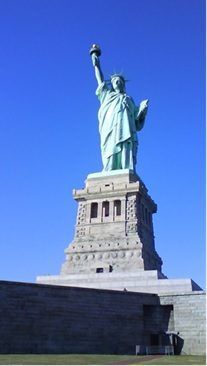
Frankle went on to discuss the concept of freedom. He said that freedom was only part of the story, it can’t exist in isolation. He said it is only half the truth, the negative aspect of a whole phenomenon, whose balance was the positive of responsibility:
This is why I recommend that the Statue of Liberty on the East Coast be supplemented by a Statue of Responsibility on the West Coast. (p. 132)
Brilliant! The United States has always been characterised as the land of the free and the home of the brave with freedom being the hallmark of much of their culture. So, what more fitting than the French gift of the Statue of Liberty marking the entrance to New York’s harbour, seen by every new migrant arriving from Europe, celebrating their newfound freedom.
But as Frankle noted, there was no Statue of Responsibility on the West Coast. Perhaps the most natural place for it would be at the entrance to San Francisco’s harbour, already graced by the Golden Gate Bridge.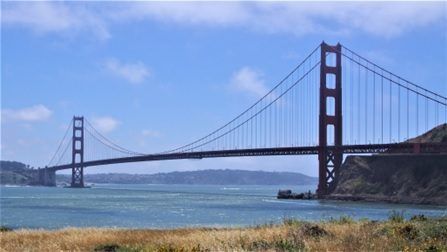
Taking up Frankle’s challenge, let’s never give in and melt into the crowd, the silent majority who simply submit but rather gain-a-function of responsibility, caring for the needs of others, even if our own circumstances look impossible.
I have a dream
I believe that for each of us to flourish and for society at large to know peace and harmony allowing for each individual to rise to their maximum potential, we all need to revel in and excel in personal responsibility.
I reject the extremely privileged agenda of globalism at any cost. Yes, many of their aspirations are laudable but their means are deplorable and their motivation mercenary. Their premise completely denies the spiritual and rejects the existence and supremacy of God.
I believe that all of us have been charged with the responsibility of looking after the planet and stewarding her resources with wisdom. I believe in the sovereignty of every nation and that the people in every nation are accountable for their part of creation.
Fair-minded people, who genuinely care for others, are well able to cooperate with others in the leadership and management of nations for the mutual benefit of all. We don’t need multinational corporations running the world, acting as an unelected one-world government.
A world with real sovereignty for every nation would in my view, be the most beneficial and harmonious of conditions for the spread of the gospel and for the building up of the body of Christ.
I would like to build into this kind of world, knowing that my passion, my commitment, and my responsibility could be united with men and women of like minds and hearts while taking an immovable stand for Jesus.
Recent Articles:
11 October 2026
2.6 MINS
Jesus offers us intimate friendship, which produces great joy as we walk closely with him.
10 October 2026
4.1 MINS
When Jesus rebuked the Laodicean church, this was not a sign of his lack of love, but proof of it and how greatly he longs to reward and bless us. He is knocking — will we answer?
9 October 2026
1.3 MINS
Season 6 of The Chosen is releasing next month, and until 15 November, your church has the opportunity to host a free pre-release screening of Episode 1. Here's how.
9 October 2026
2.9 MINS
Angus Buchan’s remarkable journey from farmer to evangelist is brought to life in a new documentary now streaming, revealing the faith, family and challenges behind his public ministry.

9 October 2026
3.3 MINS
New South Wales healthcare workers who object to abortion and voluntary assisted dying face growing pressure, raising serious questions about conscience rights, employment and moral injury.
9 October 2026
2.9 MINS
God is intensely relational, and he puts us into a community of believers so we can use our gifts in service of Christ's body.
8 October 2026
3.6 MINS
John Anderson warns that Australia’s decline is rooted in spiritual and cultural disintegration, calling for a recovery of Christian foundations, social cohesion and national purpose.


