



A Memo to the Voice’s ‘Yes’ Campaign: You Lost
by Timothy Cootes
The triumph of an anti-elite, anti-progressive movement in the American elections came as no surprise to many Australians. A year before, on 14 October, the country voted on a proposed amendment to the country’s constitution to create a council of Aboriginal advisors. This was an attempt to give First Australians greater dignity and autonomy, but it was badly designed and highly divisive.
In the end, about 60 percent of the country voted No. Even some prominent Aboriginal leaders opposed it. It was a knock-out blow.
During the bitter and deeply emotional campaign for the Voice to Parliament, the most effective get-out-the-No-vote strategy came from an unlikely source. Professor Marcia Langton, a leading progressive Aboriginal activist, warned that the failure of the referendum might prompt the cancellation of “welcome to country” ceremonies. Langton’s threat, I suspect, nudged quite a few undecided voters into the No camp.
In the year since the defeat of the Voice, however, her prediction failed to materialise. If anything, Welcome to Country rituals have become more frequent – and less welcome. This was certainly the case at a recent AFL preliminary finals match in Sydney, where fans endured a welcome from local elder Brendan Kerin.
Kerin delivered the standard bluster and lecturing. He also claimed that Welcome to Country has been performed for over 250,000 years. A good deal of chiacking and fact-checking ensued, but Kerin was unperturbed. “If I was going to do it again,” he later told an interviewer, “I would go a little longer.”
That isn’t exactly a cheering prospect, but it does serve as a useful snapshot of where post-referendum politics has arrived. Despite the overwhelming rejection of the Voice, Australian political and cultural elites are carrying on as if the loss never really happened. The Yes advocates continue wagging their fingers at the 60 percent of the electorate who voted No.
Deep Denial
Thomas Mayo, a leading figure in the Yes campaign, has just published Always Was, Always Will Be, a reflection on the post-referendum state of Aboriginal affairs. (For overseas readers, the title refers to a slogan of the Voice lobby – that Australia always was and always will be sovereign Aboriginal land.) 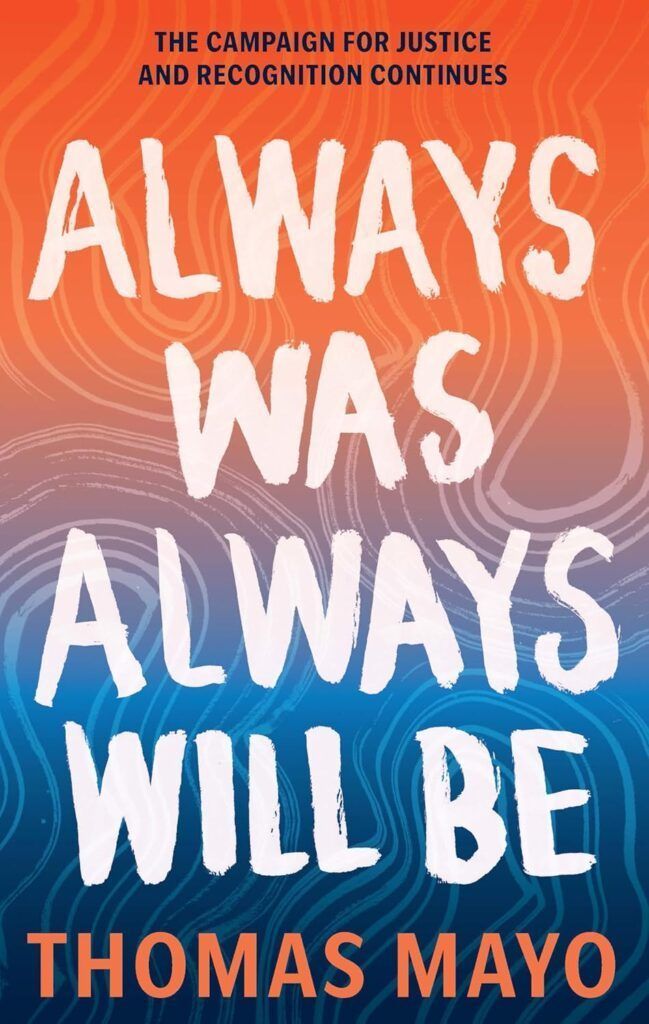
Mayo’s model of the Voice to Parliament would have been “a black institution, a black political force to be reckoned with.” Its to-do list, he giddily told rallygoers and social media followers, would have included the “abolishment of the old colonial institutions” and the punishment of politicians unwilling to cooperate with treaty-making and truth-telling.
That was before the referendum. One would have thought that he would have revised his vision. Not at all.
Mayo continues to take pride in his “passionate advocacy”. He continues to criticise the tactics of the “No” campaign – which often consisted in quoting Mayo’s own words back to him.
Still smouldering with resentment, Mayo divides Australians into “Bad Actors” (yeah, that’s me) and “the rest of us”. Sending out the call for recruits, Mayo writes:
“The more of us who are in this group, and who are well-informed, organised and active, the more power we will have.”
“The Uluru Statement,” Mayo declares, “is no less true because of the referendum result.” If that sentence doesn’t elicit groaning, his follow-up certainly will: “It also remains the most powerful public document that anyone in this nation has ever produced.”
Sure, a few readers might swoon at sentiments like these, but those are the kinds of people who call Melbourne Naarm, wear pronoun badges, and are besotted with “Welcome to Country” ceremonies. I suspect there’s not enough of these lemmings — not even in Melbourne — to build a mass movement.
Historical Revisionism
To educate the new recruits, if any should turn up, Mayo offers the Always Was section of the book, a tour d’horizon of pre-contact Aboriginal history. “Our country has much more than a mere two and a half centuries of human history — civilisation on this continent stretches back more than 65,000 years. This statement is a core truth and should not be regarded as contentious.”
Bad Actor that I am, I feel obliged to quibble with the choice of the word “civilisation”, instead of cultures or societies or tribes. A few pages later, Mayo revises his categories and writes of “an advanced civilisation with hundreds of First Nations cultures”.
Mayo suggests taking some time to feel the “peaceful and abundant life Aboriginal and Torres Strait Islander people lived.” This brushes aside debates over the existence of violent Aboriginal warfare, ritualised physical punishments, sorcery, infanticide, polygamy, and other non-woke practices.
In his Always Will Be chapter, Mayo contrasts enlightened Aborigines with the real savages and barbarians, who turn out to be — go on, have a guess — the British colonisers. The contemptible white men who settled Australia and framed its Constitution compare unfavourably with the likes of Pemulwuy and other heroes of the “Frontier Wars”. In what I suspect is a rehearsal line for upcoming Anzac Day ceremonies, Mayo intones, “Lest we forget the warriors of the resistance.”
With the history lesson complete and an activist readership sufficiently miseducated, Mayo turns to the work that lies ahead: countering disinformation (ideally via censorship laws), taking on the Bad Actors (fighting them with truth and kindness, thankfully), and pretending that the Voice defeat didn’t happen and didn’t matter. “A superficial ‘No’,” Mayo submits, “cannot override such heartfelt hope.”
Own Goal
What else?
“Your front fence,” he suggests, “is the perfect place to put up an Acknowledgement of Country sign.” If that isn’t cringeworthy enough, he also encourages the re-purposing of “Yes” detritus — old T-shirts, corflutes, etc — in order to keep the campaign goals alive.
None of those have been edited after the loss, so it’s full steam ahead on treaties, Makarrata, and the Aboriginal re-naming of your town and just about everything else. Mayo can’t resist adding reparations to this list, and he saves one of his most impassioned laments for the way it has become a “dirty word”.
Finally, on every 14 October going forward, readers should post photos of their time on the campaign to social media: “Share them proudly. You were there – on the right side of history.”
Well, Tom, you were on the wrong side of the voting tally.
As post-referendum politics rolls on, the Bad Actors should accept all the help they can get. So, thank you, Thomas Mayo. He is still doing the heavy lifting of making progressive activism unpalatable to as many voters as possible.
As a secret weapon for the “No” campaign, he was the best. He always was. And, as his latest book shows, he always will be.
___
Timothy Cootes has written for Quadrant, Quillette, and The Spectator Australia. He lives in Sydney. Follow him on X/Twitter @timothycootes.
Republished with thanks to Mercator. Image courtesy of Wikimedia Commons.
One Comment
Leave A Comment
Recent Articles:

6 October 2026
6.7 MINS
Fresh revelations about the foiled FlyDubai terror plot expose the attacker’s alleged extremist history, while a courageous pilot’s actions prevented an unthinkable catastrophe.
6 October 2026
6.2 MINS
Britain’s grooming gang scandal exposes a devastating failure to protect vulnerable children, raising urgent questions about political correctness, accountability, immigration and the loss of moral courage.

6 October 2026
3.3 MINS
We often talk about church renewal as though we need more people, more programmes, more energy and more resources. But Jesus seems to start somewhere much smaller. With two or three.

5 October 2026
4.9 MINS
Free Speech Union co-founder Reuben Kirkham warns Australia’s proposed Digital Duty of Care could expand censorship powers, undermine free expression and bypass recent legal protections.
5 October 2026
7.3 MINS
DJ, composer and trance music icon, Tyson Illingworth aka tyDi shares his testimony in coming (back) to Christ in this exclusive interview with Aaron Duff from Australian Christian Records.

5 October 2026
3.7 MINS
The Albanese Government promised cheaper coffee by banning card surcharges. Instead, the costs simply moved into higher prices — leaving Australians paying for a saving that never existed.
5 October 2026
6.8 MINS
A closer examination of Candace Owens’ evolving arguments asks whether conspiracy thinking can distort our ability to process evidence, and what Romans 1 teaches Christians.



Aboriginal author, Rodney Rivers , has published that Smoking Ceremonies have satanic origins and let Evil enter into our souls to make havoc in our lives. That, that is true I do not know.! However , Aboriginal religion is about witchcraft and “Pointing the Bone “, ie curses, etc . I am glad, that like Pauline Hanson, it has been my practice to turn my back on Smoking Ceremonies. I am offended by the sight of 3 flags beside Albanese and other politicians. I am offended by the sight of the so-called Aboriginal Flag in our local medical centre and the sign telling me I must respect their witchcraft “culture ” which is against my Christian beliefs.