


The History and Symbolism of the NSW Flag and Coat of Arms
Did you know the New South Wales flag features more crosses than the Australian national flag? Explore the rich Christian symbolism and British history behind the NSW Badge and Coat of Arms.
The New South Wales flag and arms are rich with symbolism that attests to our state’s heritage and character — including its Christian founding. This article explores the history and significance of both the state flag and the corresponding Coat of Arms.
The Naval Necessity
In 1865, the British Parliament adopted the Colonial Naval Defence Act, which allowed British colonies (including NSW) to raise and train their own maritime defence forces. For practical reasons, this meant that each colony needed to display a unique flag so that its vessels could be easily distinguished.
Although all of the colonial vessels’ flags were based on the British Blue Ensign, which designated vessels used for government service, the Royal Naval Reserve, or authorised colonial vessels, each needed to be customised in some way.
In the case of the then colony of NSW, the earliest iteration (1867–1870) included simply the letters “NSW” to differentiate NSW vessels from other colonies’ ships.
In an effort to consolidate the governor’s flag and the state ensign, two men — James Barnet, a local colonial government architect, and Captain Francis Hixson, the Marine Board president — collaborated to design the flag that remains in use today.
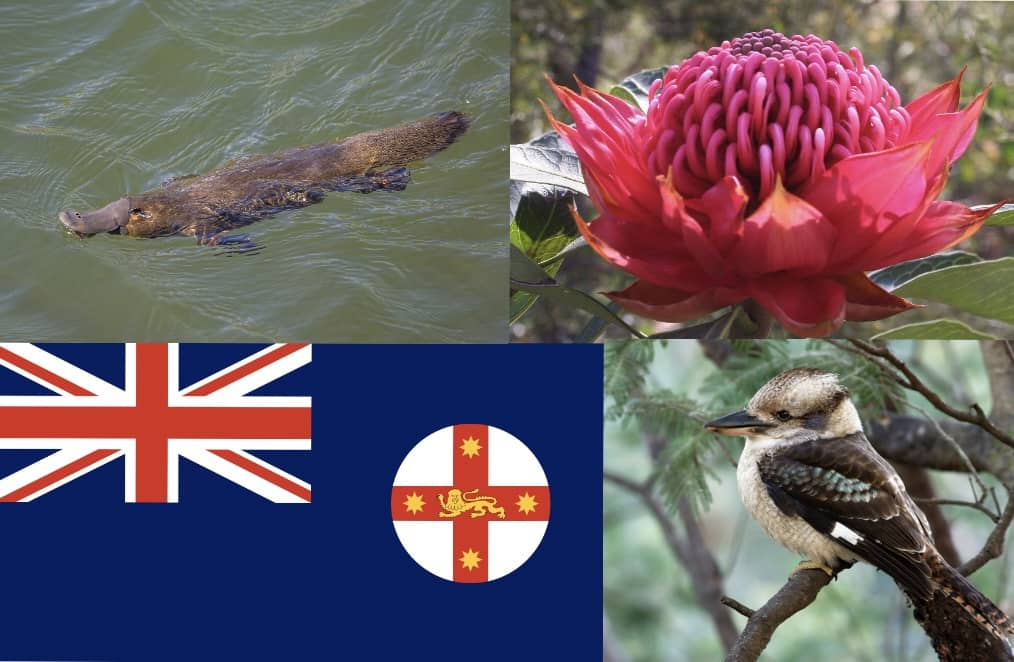
Instead of the letters “NSW”, the newly designed flag displayed the new NSW Badge on the right-hand side of the Blue Ensign.
The NSW Badge had been announced by Sir Hercules George Robert Robinson, then Governor of the State, on 15 February 1876. Three days later, it was proclaimed as official in the New South Wales Gazette. It has been used ever since.
The Badge comprises a red cross — the cross of St George, used on the ensign of the British Royal Navy and the flag of England — within a white circle. On each arm of the cross is a golden, eight-pointed star, representing the Southern Cross.
The Lion of the South
Right in the centre of the Badge, in the middle of St George’s cross, stands a golden lion — “the Lion of the South” — taken from the Coat of Arms of England. The lion symbolises the sovereignty of the new state (New South Wales) with its institutional roots in an ancient country (Britain, or more specifically, England). It also acknowledges the British heritage of the earliest European settlers.
Alongside the “Lion of the South”, the presence of the cross of St George reinforces this British heritage. It is, after all, the flag of England. However, it also testifies to the maritime origins of NSW as a state. The early colony was settled by sea and relied on the might of the British Royal Navy to defend its borders.
Of course, the cross of St George has its own story, testifying to England’s long Christian heritage. It is the cross of England’s patron saint, Saint George, the patron saint of soldiers. According to tradition, George was a Roman soldier tortured and decapitated for his Christian faith under the persecution of 303 by Emperor Diocletian. He is venerated by the Roman Catholic Church as one of the fourteen Auxiliary Saints (or Holy Helpers).
The association of St George’s cross with England can be traced back to at least the eleventh and twelfth centuries, when it was flown by English crusaders.
The Southern Cross on the New South Wales flag further reinforces the seagoing heritage of New South Wales (as Australia’s first European colony). Early European seafarers would have relied on the Southern Cross for navigation across unknown waters.
The Five-Cross Flag
Interestingly, the NSW flag contains one more cross than even the Australian national flag.
As is often noted, the design of the Australian flag incorporates the three flags on the Union Jack — the crosses of St Andrew (Scotland) and St Patrick (Ireland), alongside that of St George (England) — as well as the Southern Cross. Whereas the Union Jack features three crosses, the Australian flag has four.
This is a fact often highlighted for its religious significance. However, if you think about it, the New South Wales flag actually goes one step further.
Besides the three crosses in the Union Jack, and the Southern Cross (which appears on the NSW Badge), the NSW flag features a second cross of St George — also on the Badge. While the Australian flag has four crosses, the New South Wales flag features a total of five.
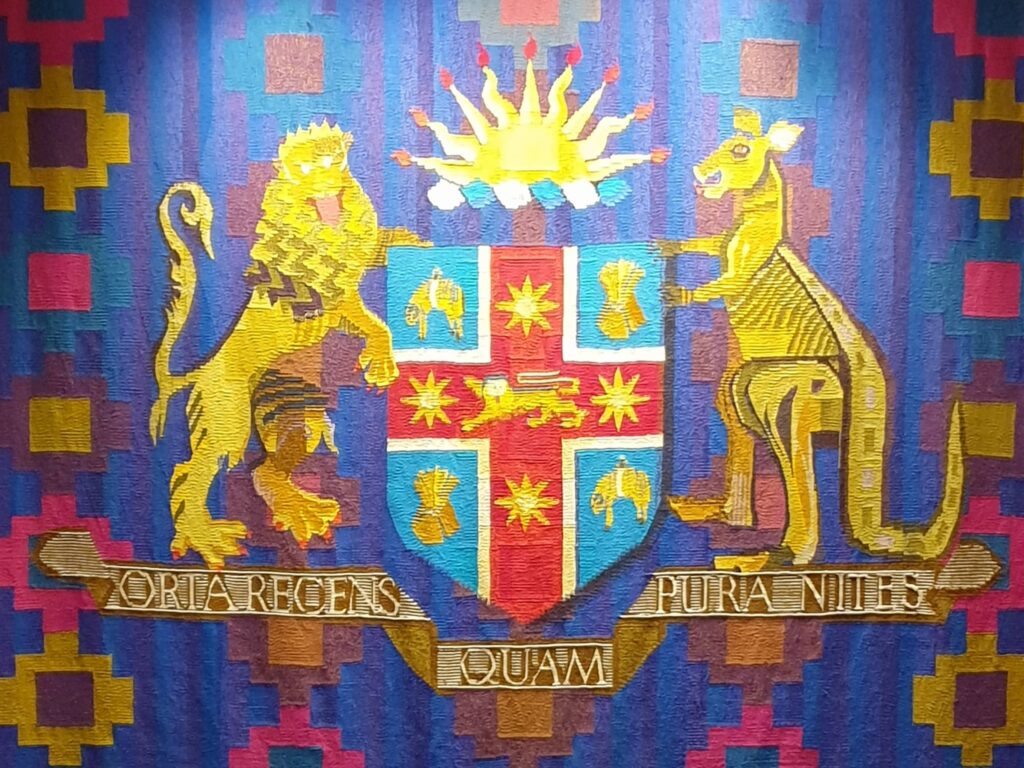
In 1906, King Edward VII granted NSW the right to use its own Coat of Arms. Those Arms feature a lion and kangaroo supporting a shield, which bears the state’s badge — with the lion of England (and NSW) in the centre of the design.
As noted by the Parliament of New South Wales, the appearance of the lion and the kangaroo represents both “older ties and new beginnings”. The lion appears twice on the Coat of Arms: firstly, in the centre of the design, and secondly, alongside the kangaroo supporting the shield. Both lions are guardant, facing the viewer, although one is passant (walking or striding) and the other is rampant (rearing).
In contrast to the two lions, which represent the link to Great Britain, the kangaroo symbolises the state’s local Australian identity.
In the four spaces around the cross of St George appear two golden fleeces and two sheaves of wheat, representing the state’s agricultural character and achievements. Above the shield is a crest — showing a rising sun above the NSW livery colours (blue or azure and argent, silver, or white). The rising sun symbolises the youth of the newly federated state.
Beneath the crest, the animals, and the shield, stands the state’s Latin motto: “Orta recens quam pura nites”. The motto reflects in words the sentiment that is expressed symbolically in the crest’s rising sun: “Newly risen how brightly you shine”.
The symbolism of the flag, the badge, and the Coat of Arms of New South Wales all reflect a message of youthful optimism — an optimism that reflects the state’s rugged, maritime foundation, its Christian and British spirit and heritage, its Australian identity, and its agrarian character.
Further Reading
- “State flag”, NSW Government.
- “New South Wales Coat of Arms”, NSW Parliament.
- “Australian Symbols booklet”, Department of the Prime Minister and Cabinet.
- The Colonial Naval Defence Act (1865).
- Whitney Smith, “flag of New South Wales”, Encyclopedia Britannica.
- Whitney Smith, “flag of England“, Encyclopedia Britannica.
- Britannica Editors, “St. George“, Encyclopedia Britannica.
Main image courtesy of Wikimedia Commons. Inline image also via Wikimedia Commons.
One Comment
Leave A Comment
Recent Articles:

20 October 2026
4 MINS
Olympic champion Stephanie Rice has faced a wave of online ridicule after revealing she resigned from her dream job following what she believes was God’s direction.

20 October 2026
4.6 MINS
As rioters burn cars and historical buildings, celebrating the destruction of France’s inheritance, the West confronts an uncomfortable question: what happens when a civilisation loses the will to defend itself?

20 October 2026
4.9 MINS
James McAuley’s legacy reaches far beyond Australia’s Catholic hymnals. Poet, convert and cultural warrior, he defended beauty, truth and faith in an age of changing values.

20 October 2026
3 MINS
Scripture teaches us to pray the "prayer of faith", because without faith it is impossible to please God.

19 October 2026
7 MINS
Western Australia’s euthanasia deaths have surged, prompting calls for an urgent inquiry amid concerns about doctor shopping, waived safeguards, limited palliative care and proposed legal expansion.

19 October 2026
12.4 MINS
Greta Gerwig’s "Narnia: The Magician’s Nephew" trailer raises questions about C. S. Lewis’s Christian vision and the faithfulness of the new Netflix adaptation. Here are my initial impressions and concerns.

19 October 2026
3.3 MINS
Discover why dads make a unique difference in their children’s lives, and how the Dads4Kids Fun Camp creates lasting memories through adventure, connection and fun.



As a Dalmatian I support the Christian Australian flag . Yes, St George is the symbol of England and was adopted by its Crusaders. However, it’s origin is far older than that and originates in Eastern Europe where St George, a Roman soldier who was martyred in the reign of Emperor Diocletian, was the patron saint of we Dalmatians and the early Christian kingdom of Georgia in the Caucasus and of the Republic of Genoa, long before it was adopted by the English Crusaders. St George is , also, a patron saint of Russia and many other countries. The international Christian Order of Templars (warrior monks ) wore it ( the red cross on a white background ) over their armour. In Venice there is the museum of St George of the Dalmatians , a charity for Seamen from 1451 until 1797 when Napoleon dissolved it . Several of my ancestors were Grand Guardians of the charity and 2 portraits of my ancestors hang there. Originally , a church, the museum is famous for its series of paintings of St George by Carpaccio. In 1913 the British Royal Family offered a fabulous sum for the paintings which it was going to transport to the UK in a war ship. The offer was refused ! In the 1960s Catholicism underwent a “revolution ” in which a number of saints , including St George , were labelled medieval legends. The story of him and the dragon was ridiculed as implausible. However , early reputable writers refer to many strange beasts that inhabited parts of Eastern Europe, eg the huge dragon -like snakes on the Greek island of Chios, so, it is very likely St George DID kill a dragon -like creature which was terrorising the local population. I became a Life Member of The Monarchist Assoc. of Australia because I support our Constitution and respect our flag. I am , also, a Legacy Widow. This Anzac Day we had the best commemoration ever with a vehicle carrying huge Australian flags with a Vietnam Veteran taking the salute .