


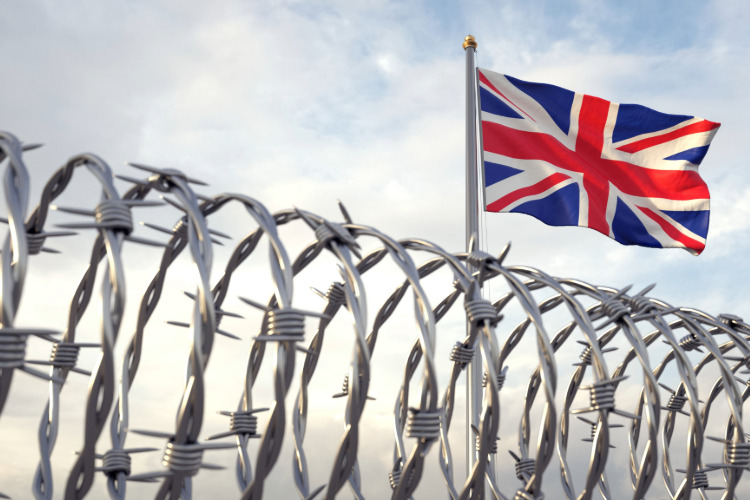
The Progressive and the Problem of Inconvenient Truth
Douglas Murray argues that progressive political and media elites in the UK increasingly condemn those who highlight terrorism and immigration-related crime, while deflecting attention from the perpetrators and deeper societal causes.
Spectator journalist Douglas Murray notes that every time an immigration-related outrage happens on the streets of the United Kingdom — or indeed new information emerges about the scandal of thousands of children being abused, disproportionately by those of Pakistani origin — the left-liberal progressive classes direct their ire not at the perpetrator, but at those who draw attention to the crime.
Media commentators like Katie Hopkins are lambasted for their frank commentary on such outrages; in fact, he says, a ‘pattern’ has ‘emerged whereby, within 24 hours of any atrocity on the streets of Britain, the political and media class’ are ‘talking about how inappropriate Hopkins’s comments were and how forcefully we must all condemn them.’ These comments are ‘generally said to be “divisive”, “hateful” and “have no place in public life”.’ He adds that this is ‘a comfortable place to be, because everyone could then avoid talking about the atrocity itself’.
Deflecting Anger Away from the Crime
Having identified the emergence of such ‘far right’ bogeymen and women, Mr Murray notes that to ‘some extent’ Reform UK leader Nigel Farage ‘appears to have filled the deep need for such a figure’, especially after the conviction of a Sikh, Vickrum Digwa, for the murder of a white youth, Henry Nowak. News coverage of the trial revealed that Digwa had complained of being racially harassed and assaulted, but instead of arresting Digwa for fatally stabbing Henry, ‘the release of police bodycam footage’ showed ‘officers handcuffing the victim as he lay dying’.
And yet Mr Farage was criticised for saying ‘we should feel “pure, cold rage’”, giving Prime Minister Sir Keir Starmer ‘the opportunity to berate Mr Farage, describing his ‘words as “unforgivable”’ and declaring ‘that this is “a time for serious work, not rage’; meanwhile, ‘the BBC and other media focused their discussion on the question of whether Farage should have spoken at all – and promptly also misrepresented his words.’
Notably, Sir Keir’s ‘work’ seems not to include addressing the problem of ‘open door’ immigration, which puts society at risk of such outrages; indeed, the left-liberal progressive may well see this policy as merely ‘atonement’ for the ‘sin’ of British imperialism, although those paying the highest price are children.
Asking ‘Are we allowed to feel angry yet?’ Mr Murray concludes that ‘generations of politicians and pundits have given us a problem that they do not know how to solve. But people have noticed the problem. And no amount of pretended bewilderment or deflection will cover that fact over for ever’.
He is right — the British public is becoming increasingly aware of this phenomenon of deflected anger. But, despite our governing classes’ warnings against angry responses, in the aftermath of ‘just another isolated incident’, their own anger is directed not at the perpetrator, but at those who have the temerity to see such incidents as the latest evidence of a longstanding problem of terrorism.
The same governing classes no longer see the problem as the problem, but as those who see the problem for what it is. But the bogeyman or bogeywoman so beloved of the progressive mindset may be nearing the end of their use-by date.
Sadly, however, this failure to identify — let alone address — the origin and open expression of anti-Western hatred, persists. Neither is it confined to the UK, but seems to be a common feature of the democratic world wherever the ‘wokeing classes’ predominate.
In the UK, but also in Australia, where the anti-Semitic atrocity at Bondi Beach is still starkly present to the public mind, regular pro-Palestinian marches continue to call for what would amount to the destruction of the world’s only Jewish state.
From Terrorism to Thought Policing
As the woke police might say, ‘Move along there, nothing to see’. But the ‘bystanders’ have not, it would seem, had the decency to overlook such outrages. Interestingly, in the UK, the terror attacks (including many failed or thwarted attempts) of the twentieth century were related to Northern Irish politics, while increasingly, in the twenty-first century, Islamism has become the dominant threat.
Notably, however, the IRA/UDF attackers were never treated with kid gloves, with information about their atrocities carefully curated to avoid public discontent and (it is implied) prevent public retaliation. Perhaps most crucially, the cultural Marxist view of terrorists as ‘poor victims of the capitalist system’ who are ‘driven to strike back’, had not taken hold; they were simply treated as the worst kind of criminals. Back then, it was terrorism that was treated as the problem; now, the problem is seen as those who see terrorism as the problem.
Consequently, the progressive classes direct their unrighteous indignation not at the murderous activities – not at the action, but at the reaction. And they persist in intoning their mantra ‘diversity is our strength’ even when certain kinds of ‘diverse behaviour’ are not desirable but deadly.
Most glaringly, their embrace of ‘diversity’ does not include diversity of opinion, especially when it concerns the vital matter of what constitutes good and evil; even more so when ‘diverse’ opinions are based on the Judeo-Christian understanding of virtue and vice.
The new ‘woke’ religion insists that we should ‘be kind’ – and so we should; but the wokeists are not very kind to their critics. And as Christians, we also believe that it is far from kind to the victims of such atrocities to sweep them under the collective carpet simply because the progressive approach of treating terrorists with kindness has gone horribly wrong.
Neither is it kind to those placed in deadly danger from terrorist attacks, but most especially, perhaps, to the terrorists or potential terrorists themselves. For the typical progressive, this is an inconvenient truth, but as Christians we believe that sooner or later we will all have to answer to a higher and much more severe justice than that which the modern, ‘enlightened’ state has to offer; that rather than ‘my truth’ and ‘your truth’, we will have to face Jesus – the Way, the Truth and the Life.
___
Image courtesy of Adobe.
3 Comments
Leave A Comment
Recent Articles:

27 October 2026
1.5 MINS
Labor’s Digital Duty of Care Bill threatens free speech, empowers covert online surveillance, and imposes potentially burdensome regulations on Australian businesses.
27 October 2026
10.3 MINS
As Tasmania and Western Australia consider conversion therapy bans, a former LGBT+ ministry leader warns of threats to religious freedom, personal choice and Christian discipleship.

27 October 2026
4.9 MINS
Nine Christians have been killed in a terrorist attack on a Jordanian church, prompting fierce condemnation, demands for justice and renewed concerns about religious persecution.
27 October 2026
3.6 MINS
For 25 years, the Mount Moriah Trust has supported struggling Christians across the Holy Land, bringing practical assistance, encouragement and hope to believers facing hardship and persecution.

27 October 2026
1.3 MINS
Moira Deeming’s re-election campaign has energised Family First supporters, raising $90,000 as the party prepares for a crucial Victorian election and a potential breakthrough.
27 October 2026
3.1 MINS
As the disciples discovered through a huge haul of fish, we can trust Jesus for a net-breaking, boat-sinking catch of people.
26 October 2026
4.5 MINS
OECD chief Mathias Cormann warns Australia is losing its competitive edge, as excessive regulation, housing pressures, immigration challenges and declining public trust threaten national prosperity.



Micah6:8
He has told you, mortal one, what is good;
And what does the LORD require of you
But to do justice, to love kindness,
And to walk humbly with your God?
The word kindness in this context means loyalty. Therefore loyalty must be to God’s commands, not to virtue-signalling faux kindness that actually protects evil.
How many of us are being spied on by ASIO instead of the ones preaching Hate against Aussies who are just trying to live a peaceful life without harming any one with machetes, etc ?
Interesting, that it’s the political pundits & the media who condemn commentators such as Katie Hopkins, do either of those two categories promote Truth & reality? Do they live even remotely in the spaces of the 250,000 victims?