


Is the Murray-Darling Basin Getting Drier? BOM Data Says ‘No’!
This is an edited extract from Patrick J. Byrne’s new book, Caught in the Current: The Dire Consequences of Politics Driving the Murray-Darling Basin Plan, Wilkinson Publishing, 2026, $39.99+P&P
The Millennium Drought (1997-2010) was the political justification for the Water Act 2007 and $13 billion Basin Plan to acquire at least 3,200 gigalitres of water from irrigation regions for environmental flows in the Basin’s rivers.
While the Drought ended, today it is being argued that “climate change” has led to lower Basin river inflows.
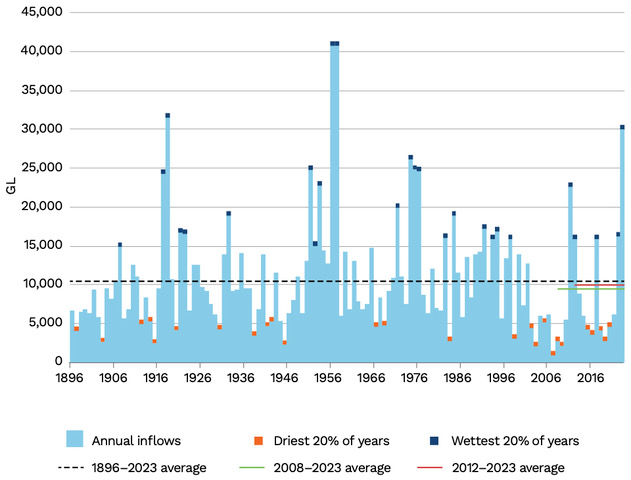
Figure 1: Murray River Inflows, 1896 to 2023.(6)
(Source: Murray-Darling Basin Authority CC BY 4.0)
Science the MDBA Ignored
1. Expansion of farm dams: What the MDBA doesn’t say is that most of the 12 lowest inflows in the Murray River over 97 years from 1900 to 1997 were over the long period of major water infrastructure building, culminating in a big expansion of farming in the latter decades of the 20th century.
As farming expanded, so did the number of farm dams. Indeed, for decades, farmers were encouraged to adopt measures to hold rainfall on their farms.
As a 2016 BoM comprehensive research study found, today, “there are over 650,000 farm dams … holding approximately 2,168,000 ML … or 9 per cent of the total surface water storage capacity in the Murray–Darling Basin region. The majority of the region’s farm dams are filled by rainfall-runoff capture.”7
The MDBA’s low inflow claims are not evidence of the Basin drying, but of the MDBA’s failure to recognise the role of farm dams holding significant volumes of water in the Basin.
2. Rainfall is increasing: The MDBA climate assessment also ignored long-term rainfall data readily available on the BoM’s “Australian climate variability & change – Time series graphs”.
Its dedicated Basin data shows that over the 125 years to 2024, the Basin’s long-term average annual rainfall has increased by about 43 millimetres, that is, over 9 per cent (Figure 2 below).
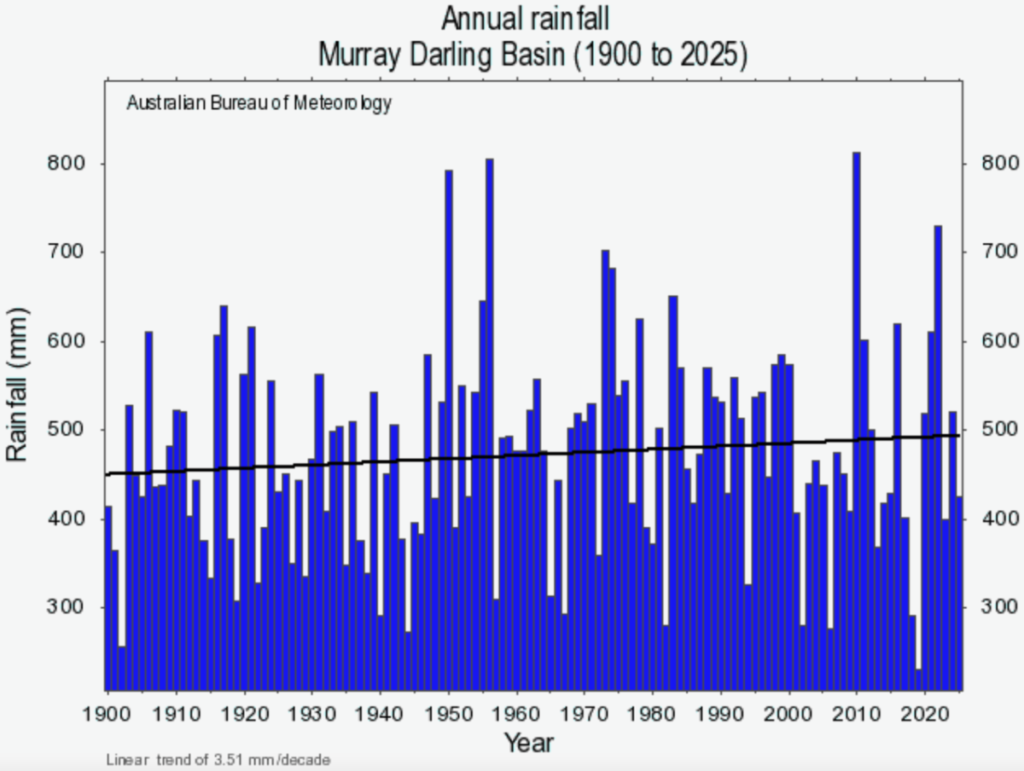
Figure 2: Annual Rainfall Murray-Darling Basin 1900 to 2024 and long-term average.(8) Linear trend of 3.51mm/decade. (Source: Bureau of Meteorology CC BY 4.0)
3. Evaporation rates falling: The same BoM Basin page also shows that, between 1975 and 2017, annual evaporation rates declined by about 35.5 millimetres, or about 1.8 per cent (Figure 3 below).
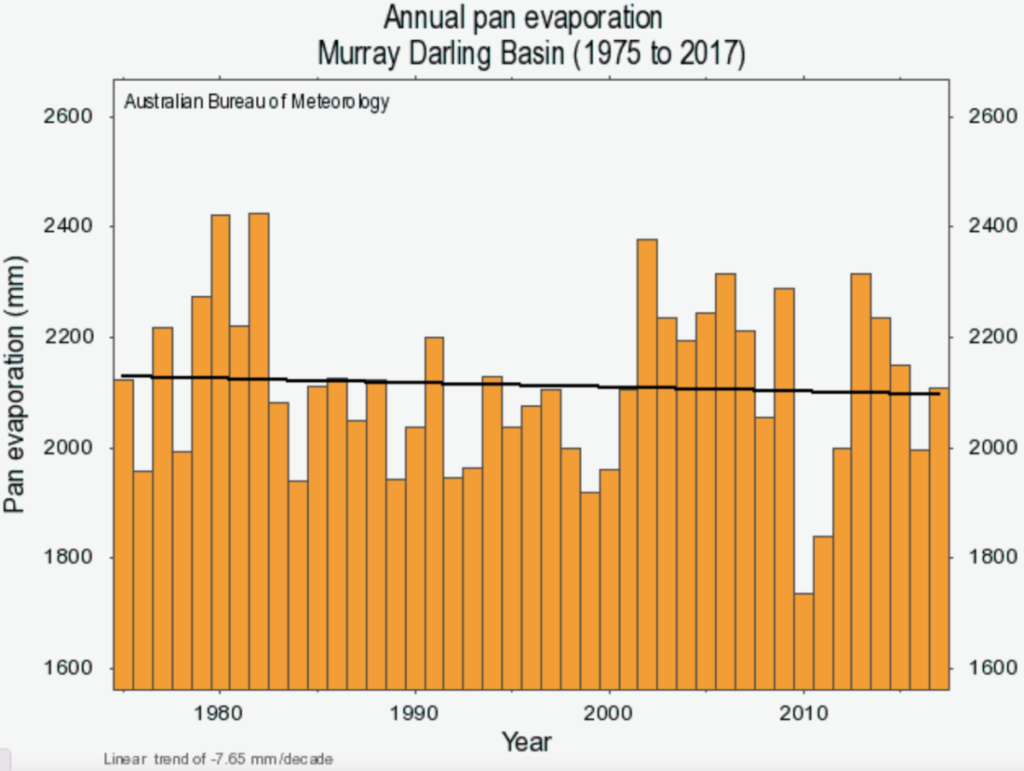
Figure 3: Annual pan evaporation, Murray-Darling Basin, 1975 to 2017.(9) Linear trend of -7.65 millimetres per decade. (Source: Bureau of Meteorology CC BY 4.0)
4. The Basin’s regular climate variations: The Howard/Turnbull government, when passing the Water Act, subsequent Labor governments, and the MDBA Basin Plan Review have all failed to understand (or have ignored) the scientific evidence going back four centuries of the Basin naturally swinging sharply between extensive wet and dry periods.10
Figure 4 (below) graphically shows the interdecadal climate variations experienced in eastern Australia, including the Murray-Darling Basin, between 1660 and 2007. Hydroclimatologists have found that these long wet and dry periods can last upwards of 30 years.11
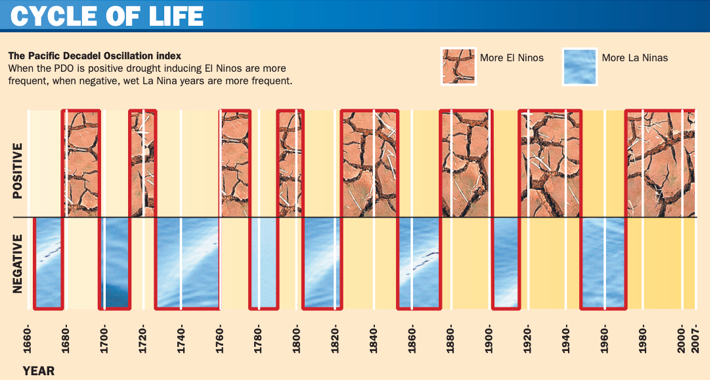
Figure 4: Climate variation: wet and dry periods affecting eastern Australia 1660-2007(12) (from newspaper)
(Source: Weekly Times, 26/12/2007, News Ltd/Newspix, University of Newcastle)
The long dry periods typically culminate in severe droughts, followed by prolonged heavy rain.
The Millennium Drought was the worst in a century, ending in 2010 with one of the biggest wet seasons recorded in the Basin.
The Basin’s huge storage dams were constructed to mitigate droughts and extended dry periods. Its ingenious, custom-designed water infrastructure and water-management arrangements earned Australia the highest accolade from world-renowned water authority the late Professor John Briscoe.
Professor Briscoe characterised the exceptional management of the Basin in the huge Millennium Drought as an “extraordinary achievement … something which no other country could conceivably have managed”.
Despite “a 70 per cent reduction in water availability”, the Drought “had very little aggregate economic impact” on Australia’s food production.13
The MDBA is making climate change the overriding Basin Plan Review issue without properly accounting for the Basin’s sharp natural climate variations, and for average rainfall increasing steadily over the past century.
Questions
The Water Act (s 120) tasked the BoM with collecting water data for “providing regular forecasts on the future availability of Australia’s water resources”.
How did the MDBA’s climate modelling conclude that there is a 90 per cent chance that the Basin will get much hotter and dryer, when rainfall data shows that Basin rainfall has been steadily increasing and evaporation rates falling?
Why have policymakers failed to recognise that the Basin’s environment is attuned to natural wet and dry cycles, to huge floods and droughts, great booms and busts of flora and fauna?
How serious is the MDBA’s commitment to an Adaptive Management Framework, said to be based on evidence-based science and local knowledge, when most important long-term Basin rainfall data is simply ignored?
RESTORING AUSTRALIA’S FOOD BOWL
“The Basin is getting wetter: so, why does the Basin Review say it’s drying?” is the first of four articles dedicated to key topics relevant to the Murray-Darling Basin and the nation’s agriculture, mostly adapted from Patrick J. Byrne’s book Caught in the Current.
Future News Weekly editions will cover:
– Rural Australia has lost faith – Farm output is falling per capita and we are fast on the way to importing more food and fibre than we export.
– Australia’s energy wreck – We export three times as much energy as we use. Yet, we have soaring electricity prices and we are over 90 per cent dependent on importing liquid fuels across vulnerable supply chains instead of being oil self-reliant.
– Policies to remedy the disastrous Murray-Darling Basin Plan and reverse the stagnation of agricultural production to stop the nation losing its food security.
GET THREE EDITIONS OF NEWS WEEKLY FOR JUST $15.00
The Water Act 2007 and the Murray-Darling Basin Plan have been a disaster for Basin rural communities and Australia in general. We have fallen on every metric possible – from water allocation to land under irrigation, from imports rising at twice the rate of exports, to rational environmental care for Basin environments.
GET CAUGHT IN THE CURRENT FOR $39.99
Patrick J. Byrne’s book is an alarm going off that we ignore solely to our own hurt. Read the other side of the story about the Basin Plan and how to save our rivers, save our farmers and feed the nation.
Take advantage of our great three issues offer of News Weekly for $15 and buy Caught in the Current here.
___
Footnotes:
1 Murray–Darling Basin Authority (November 2025), ‘The future of climate and water availability in the Murray–Darling Basin Sustainable yields report’, MDBA, p. iv. © Murray–Darling Basin Authority 2025.
2 Ibid., p. 10.
3 Murray–Darling Basin Authority (2026), ‘2026 Murray‒Darling Basin Plan Review: Discussion Paper’, MDBA, Canberra, p. 14. © Murray–Darling Basin Authority 2026.
4 Ibid. p. 34.
5 Murray–Darling Basin Authority (2025), Basin Plan’s ‘Early Insights Review’ (2025), p. 13.
6 Murray–Darling Basin Authority (2025), ‘2025 Basin Plan Evaluation’, Canberra, p. 21. © Murray–Darling Basin Authority 2025.
7 Bureau of Meteorology (2016), ‘Murray–Darling Basin: Geographic information’, National Water Account, BOM.
8 Bureau of Meteorology, ‘Annual Rainfall Murray Darling Basin 1900-2024, Australian climate variability & change – Time series graphs’. Bureau of Meteorology, © Commonwealth of Australia, CC BY 4.0.
9 Bureau of Meteorology, ‘Annual pan evaporation 1975-2017, Murray Darling Basin, Australian climate variability & change – Time series graphs’. Bureau of Meteorology, © Commonwealth of Australia, CC BY 4.0.
10 Hunt P. (December 26, 2007), ‘Greenhouse not to blame for drought’, Weekly Times.
Data from hydroclimatologist Anthony Keim. See, Vance T.R. Kiem A.S. Jong L.M. et al. (2022), ‘Pacific decadal variability over the last 2000 years and implications for climatic risk’, Commun Earth Environ 3, 33.
11 Hunt P. (December 26, 2007), ‘Greenhouse not to blame for drought’, Weekly Times.
Data from hydroclimatologist Anthony Keim. See, Vance T.R. Kiem A.S. Jong L.M. et al. (2022), ‘Pacific decadal variability over the last 2000 years and implications for climatic risk’, Commun Earth Environ 3, 33.
12 Hunt P. (December 26, 2007), ‘Greenhouse not to blame for drought’, Weekly Times. Figure News Ltd / Newspix.
13 Briscoe, Professor J., Submission No 2 (February 24, 2011), to the Senate Legal and Constitutional Affairs References Committee inquiry, ‘A Balancing Act: provisions of the Water Act 2007’.
___
Republished with thanks to News Weekly. Image courtesy of Adobe.
2 Comments
Leave A Comment
Recent Articles:

6 October 2026
3.4 MINS
Christians cannot afford to let headlines and social media shape their view of Israel. Scripture provides a foundation for understanding Israel, God’s promises and our response.
6 October 2026
6.7 MINS
Fresh revelations about the foiled FlyDubai terror plot expose the attacker’s alleged extremist history, while a courageous pilot’s actions prevented an unthinkable catastrophe.

6 October 2026
6.2 MINS
Britain’s grooming gang scandal exposes a devastating failure to protect vulnerable children, raising urgent questions about political correctness, accountability, immigration and the loss of moral courage.

6 October 2026
3.3 MINS
We often talk about church renewal as though we need more people, more programmes, more energy and more resources. But Jesus seems to start somewhere much smaller. With two or three.

5 October 2026
4.9 MINS
Free Speech Union co-founder Reuben Kirkham warns Australia’s proposed Digital Duty of Care could expand censorship powers, undermine free expression and bypass recent legal protections.

5 October 2026
7.3 MINS
DJ, composer and trance music icon, Tyson Illingworth aka tyDi shares his testimony in coming (back) to Christ in this exclusive interview with Aaron Duff from Australian Christian Records.

5 October 2026
3.7 MINS
The Albanese Government promised cheaper coffee by banning card surcharges. Instead, the costs simply moved into higher prices — leaving Australians paying for a saving that never existed.



What is the water quality ? Agriculture should be encouraged and supported , but, what pesticides, banned in many countries , are still approved for use in Australia ? It has been proven that one causes Parkinsons Disease in farmers who use it .What about the people who ingest that food ?The Murray supplies drinking water to Adelaide and discharges at the Murray Mouth near Goolwa in SA. Many people, rightly or wrongly, believe that the agricultural pesticides used were one of the reasons why South Australian sea and beaches for a year were covered in foam which killed almost every thing that existed in the sea. During that year people could not swim in the sea, and commercial fishing was banned with dire results while Tourism Operators went out of business. What are those pesticides doing to people drinking Murray River water ? I also remember Australian Govt. Policy, whereby the ATO gave credits to farmers who cleared land, not leaving one tree or bush for hundreds of km. That is Vandalism ! Trees, etc act as a filter to create clean water, including the River Murray . A SA farmer on Eyre Peninsula whom I knew , as early as 1970, was contour -farming his wheat farm , and, leaving some trees and bushes to prevent Soil Erosion.
Just another lie, not unlike Covid-19 lockdowns.
Be really, really, really careful who you vote into power.