


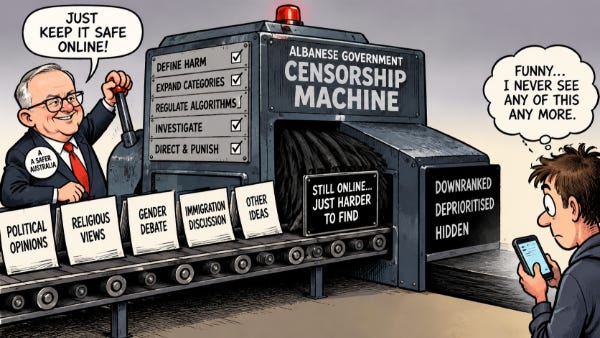
The Censorship Machine Hiding in Plain Sight: Albo’s Digital Duty of Care
The Albanese Government is building a censorship machine, and the most important thing to understand is that it doesn’t look anything like the censorship machine most people have in their heads.
There’s no Department of Censorship. There’s no miserable bureaucrat sitting in Canberra reading your Facebook posts and stamping APPROVED or BANNED across them. Anthony Albanese doesn’t need to telephone Mark Zuckerberg and dictate which political opinions Australians are permitted to read. That would be crude, obvious and politically explosive.
This is much smarter.
The Government’s proposed Digital Duty of Care creates a legal concept called a “safe online environment”. It requires online services to protect Australians from specified categories of harm and makes those companies legally responsible for managing the risks.
That sounds perfectly reasonable until you ask the question sitting underneath the entire scheme: Who decides what is harmful?
Bullet Point Summary
- The Digital Duty of Care would create an expandable system for determining what Australians can safely encounter online.
- Ministers could add new categories of supposedly harmful material without Parliament rewriting the entire law.
- Vague concepts such as harmful “attitudes” open the door to ideological judgements about otherwise lawful speech.
- eSafety would be explicitly tasked with identifying and advising government about “emerging categories of harm”.
- Big Tech would face powerful incentives to restrict controversial content rather than risk enormous regulatory penalties.
- Algorithmic suppression could cripple the reach of lawful speech without requiring the offending post to be formally banned.
- Canberra would gain greater influence over recommender systems that determine what Australians actually see online.
- eSafety would receive an expanded arsenal including remedial directions, information-gathering powers and undercover “sock puppet” identities.
- The bill explicitly protects certain lawful private adult communications but provides no equivalent ironclad protection for lawful public political speech.
- Once this machinery exists, future governments will inherit a powerful system capable of being expanded far beyond its original boundaries.
Problems with the Bill
Start with proposed section 25C of the Online Safety Act, which would define “seriously harmful material and conduct”. A lot of what’s there is exactly what you’d expect: child sexual abuse and exploitation, grooming, material encouraging sexual or extreme violence, explicit threats of rape or death, material encouraging suicide or self-harm, terrorist material and material encouraging criminal offences. All that is well enough, even if it is already covered by existing law which makes it illegal.
If the legislation stopped with clearly defined criminal and seriously dangerous conduct, this would be a very different debate. But it doesn’t.
Keep reading until paragraph 25C(1)(m). There, you find a catch-all covering “any other material or conduct” determined under the next subsection.
Then read subsection 25C(2). The Minister may, by legislative instrument, determine additional material or conduct that the Minister is satisfied “may cause serious harm”.
There it is.
Parliament isn’t creating a single closed list and locking it into an Act. It is building an expandable system in which additional categories can be fed into the machinery later.
And notice what the test isn’t. It doesn’t say the additional material must first be made criminal by Parliament. It doesn’t say a court must first declare it unlawful. The Minister must be satisfied that it “may cause serious harm”.
Think about how much can eventually be squeezed into a concept like that. We are talking about the internet, the principal communications system of modern Australia, and Canberra is proposing legislation under which a minister can expand categories of regulated harmful material through delegated legislation.
The politician administering this law, Communications Minister Anika Wells, is bad enough. But there could be worse. Wells will eventually leave office. Governments will change. Ministers will change. Political fashions will change. Ideas regarded as ordinary today may be treated as socially dangerous 20 years from now.
Politicians change. Powers remain.
Then you reach proposed section 25D, and the problem becomes even clearer. This section deals specifically with material and conduct considered harmful to children. Again, some categories are unsurprising: pornography, material encouraging disordered eating, abuse, harassment and bullying.
Then paragraph 25D(1)(c) captures material or conduct that “encourages or promotes hostile attitudes towards women or gender equality”.
Huh?
We’re no longer simply talking about child pornography, grooming, threats or criminal conduct. We’re talking about attitudes.
What exactly constitutes a “hostile attitude” towards gender equality?
Suppose somebody publishes a blistering attack on modern feminism. Suppose a Christian preacher teaches that husbands and wives have different responsibilities within marriage. Suppose somebody campaigns against gender quotas. Suppose somebody argues that biological males shouldn’t compete in women’s sport.
Which of those crosses the line?
Who knows? But that’s precisely the point. The boundary is no longer something obvious like “don’t threaten to kill somebody”. We’re entering territory involving social attitudes and ideological judgement. Once government moves from policing objectively unlawful conduct into regulating broader concepts involving attitudes and harm, politics inevitably enters the equation.
Section 25D also contains further catch-all provisions dealing with other material or conduct capable of inflicting serious harm on a child, along with another power for the Minister to determine additional categories.
There it is again. The system can grow.
Keep reading until proposed section 27A. The legislation expressly authorises the eSafety Commissioner to advise the Minister about “emerging categories of harm arising from the use of online services”.
Those words deserve attention: emerging categories of harm.
The Commissioner can also advise the Minister about the need to make or amend legislative instruments under this part of the Act. Section 27B then connects these provisions together. Before exercising certain powers to make legislative instruments, the Minister must seek advice from the eSafety Commissioner. Those powers include ones dealing with additional categories of seriously harmful material, additional material harmful to children and additional design features deemed to have negative behavioural impacts.
Now stand back and look at what they’ve constructed.
The legislation establishes categories of harm. The regulator watches for emerging categories of harm. The regulator advises the Minister. The Minister has mechanisms for expanding parts of the regulatory system.
That is a regulatory ratchet.
Today, the categories look one way. Tomorrow, some new social panic erupts. A new form of supposed harm is identified. The bureaucracy examines it. The Minister responds. Another category enters the system.
And every turn of that ratchet will have its own reasonable-sounding label. It’s only a minor amendment. It’s only about safety. It’s only addressing a new threat. It’s only protecting vulnerable people. Won’t somebody think of the children!
Click.
Then another problem emerges.
Click.
Then another.
Nobody announces the creation of a censorship regime with a brass band marching down Commonwealth Avenue. Government power usually grows by accumulation, one apparently sensible expansion at a time. And, as it grows, it eats into freedom, particularly freedom of speech, which is the cornerstone of any true democracy.
For years, we’ve watched political disagreement increasingly described using the vocabulary of danger: misinformation, disinformation, extremism, radicalisation, division, unsafe speech, hate and threats to social cohesion. During COVID, people challenging lockdowns and vaccine mandates weren’t merely accused of being wrong. Their speech was described as dangerous and harmful.
In the gender debate, traditional Christian teaching is routinely accused of causing harm. Women objecting to biological males entering female sports are accused of making others unsafe. Arguments over immigration quickly become arguments about extremism, division and social cohesion.
Politics itself is increasingly translated into the language of harm.
And now Canberra wants an expandable online regulatory system built around that very concept.
But defining harm is only the first part of the machine.
The most sophisticated feature of the Digital Duty of Care is that Canberra doesn’t need to censor you itself. It can make censorship somebody else’s problem.
Under the proposed law, online services would be legally responsible for providing a “safe online environment”. They would have to identify foreseeable risks, assess them, document what they’re doing about them and take measures to mitigate them. Substantial penalties sit behind those obligations.
Proposed section 26A requires providers to conduct written risk assessments. These assessments must identify all reasonably foreseeable risks posed by the service, including content giving rise to those risks, design features, other systems or processes and the people who may be affected.
The company then has to consider the likelihood and potential severity of the risk. It must identify measures it has implemented or proposes to implement and assess how effective those measures are expected to be. The assessments must be reviewed, and the eSafety Commissioner can impose additional requirements concerning how they’re done.
Now imagine you’re running compliance for a giant technology company.
You aren’t merely asking whether a particular Facebook post is illegal. You’re asking whether your entire service is adequately identifying and mitigating foreseeable risks under a statutory duty enforced by a powerful regulator.
Your lawyers are involved. Your engineers are involved. Your trust-and-safety people are involved. Your executives know that getting this wrong can expose the company to enormous penalties.
Then somebody brings you a controversial piece of lawful content sitting somewhere near the edge of a regulatory category. Perhaps it’s fine. Perhaps the regulator eventually sees things differently.
What does the corporate lawyer say?
Why take the risk?
That’s the mechanism.
The government creates the regulatory incentive to censor. Big Tech responds rationally to that incentive. And your speech becomes somebody else’s compliance risk.
Censorship in the digital age doesn’t require deleting anything. That’s the old model.
Imagine that I publish a political argument to my 140,000 followers. Facebook doesn’t delete it. Technically, I’m completely free to speak. However, the recommendation system stops recommending the post. It disappears from suggested content. Its distribution is throttled. The account’s reach falls through the floor.
The post remains sitting there on my profile. The Government says it never ordered the post removed. The regulator says it never banned my political opinion. The platform says its independent systems determined distribution.
Wonderful. Everybody’s hands are clean.
The post survived. But the audience didn’t.
It’s kind of like letting you speak your mind from the middle of the town square, as long as it’s done within a soundproof booth.
This is where the bill’s provisions dealing with the design of online services become important. Proposed section 25F expressly addresses features such as recommender systems, logged-in features, endless feeds, feedback features and time-limited features.
The bill defines a recommender feature as one that selects material using information associated with a user’s account and displays it to the user.
In ordinary English, we’re talking about the machinery deciding what appears in your feed.
Section 25G treats various features, including recommender features and endless feeds, as having negative behavioural impacts for the purposes of protections involving children. Once again, the Minister is given power to determine additional design features by legislative instrument.
Most Australians don’t manually choose everything they encounter online. They open an app. Then the algorithm takes over.
It decides which political story appears first. Which video gets recommended. Which controversy explodes. Which argument reaches millions. Which account suddenly finds a massive audience.
And which one quietly disappears.
Algorithms have become the invisible editors of modern society. The ability to influence those systems is therefore the ability to influence attention, and attention is political power.
A controversial political movement doesn’t need to be formally outlawed to be crippled online. It merely needs to become risky: risky to recommend, risky to promote, risky to expose children to, risky to leave unrestricted when a regulator may later ask why the platform’s mitigation systems didn’t act.
Then the incentives do the rest.
Section 26 goes further by allowing the Minister, through a legislative instrument, to require specified online services to provide specified “user empowerment tools”. The legislation expressly contemplates those tools affecting “the kind of content that is recommended for the user”.
Canberra is claiming a statutory role inside the architecture of private recommendation systems.
Once that principle is established, the future argument is no longer about whether government belongs there. It becomes an argument about degree. Which systems? Which recommendations? Which categories? Which risks? Which controls? How far should the government go?
Then come the enforcement powers.
Proposed section 26D allows the eSafety Commissioner to issue a written remedial direction where the Commissioner reasonably believes a provider has failed, or is failing, to comply with the Digital Duty of Care. The Commissioner can require “specified action” directed towards ensuring future compliance.
The legislation expressly says that a remedial direction is not a legislative instrument. The regulator can make compliance decisions involving particular providers and direct action towards getting them back into line.
Failure to comply carries a civil penalty of 60,000 penalty units.
That gives eSafety real leverage.
Now put yourself back in that corporate boardroom. On one side sits free expression. On the other sits regulatory exposure. If you under-moderate, the government can punish you. But if you over-moderate, what does it really cost the company?
A post gets buried. An account loses reach. A controversial argument disappears from people’s feeds.
The real cost is borne by the person whose speech has been restricted, while the company has protected itself from regulatory risk.
The incentives aren’t balanced. They lean towards restriction.
And that is how modern censorship can become extraordinarily difficult to see. Nobody bans your political opinion. Nobody prosecutes you. Nobody knocks on your door. You can still type whatever you want. Your account remains online. Your post remains online. You remain gloriously “free”.
It’s just that fewer and fewer people ever encounter what you said.
Algorithmic suppression achieves much of the practical effect of censorship without producing the political spectacle of an actual ban, while giving everyone involved plausible deniability.
The Government tells Big Tech what risks it must control. Big Tech knows the consequences if Canberra decides it hasn’t done enough. So Big Tech protects itself.
Big Tech does the Government’s dirty work. And you get restricted.
And eSafety’s role goes considerably further than enforcing risk assessments.
Keep reading until proposed sections 205G onwards, and you’ll encounter something most Australians probably never imagined would appear in an online-safety law: sock puppets.
That’s not my sarcastic description. That’s the terminology used by the bill.
A “sock puppet identity” is essentially a false or fictitious identity assumed while conducting activity in relation to an online service. Approved researchers can use them for specified online-safety research. More significantly, proposed section 205J allows the eSafety Commissioner to assume sock puppet identities for the purpose of performing the Commissioner’s functions or exercising powers under the Act.
Then section 205K tells us what that can involve.
Accounts can be created using those identities. Material can be observed and recorded. The regulator can engage with online services, test features and test how a service responds to particular actions.
The Commissioner can even generate material using an online service, including through artificial intelligence, subject to the criminal-law restrictions contained in the provision.
Think about what we’re creating here: a government regulator with authority to enter digital services under fictitious identities and test how those services behave.
The bill also creates a formal system for “approved researchers” to gain access to platform data for online-safety research. These aren’t simply researchers whom a platform independently decides to assist. The legislation provides for government-made rules establishing data-access schemes, determining who qualifies as an approved researcher and requiring providers to give those researchers access to specified kinds of data.
That adds another arm to the system: government-approved researchers examining the online environment, producing research about supposed harms and feeding knowledge into a regulatory apparatus already empowered to identify “emerging categories of harm”.
Then there are the Commissioner’s information-gathering powers. The legislation strengthens a regulator that can compel information and documents relevant to its functions and require people to answer questions.
Its enforcement architecture isn’t decorative. Canberra wants a regulator capable of finding out what’s happening inside these companies and compelling cooperation.
Schedule 1 also strengthens parts of the existing takedown machinery. Various existing 48-hour periods are reduced to 24 hours.
In specified circumstances, the Commissioner can waive the ordinary requirement that somebody first complain to a service provider where requiring that step could create a reasonably foreseeable risk of further harm.
The bill also deals with reposted material. Where material has previously been subject to a removal notice and is reposted within the relevant period, another notice can be issued without requiring another complaint to the provider.
And “reposted” doesn’t necessarily mean an identical copy. The bill contemplates altered versions, including screenshots, cropping, additions, shortening or lengthening and changes to text, dialogue or commentary.
The bill also strengthens the machinery for making material harder to find. In specified circumstances under the existing online-safety scheme, search services can be ordered to stop providing links to particular material, with the compliance period cut to just 24 hours.
Censorship in the digital age isn’t only about deleting something at its source. Controlling whether people can find it, reach it or have it put before them can be almost as effective as removing it altogether.
Put all of this together and the direction of travel is unmistakable.
An office that already possesses substantial powers over online content is being handed an even larger role. Platforms face a new risk-based duty of care. Recommendation systems are brought deeper into the regulatory net. Parts of the removal system become faster. eSafety gets stronger tools for dealing with material that reappears. Search services can be required to stop linking to material in specified circumstances.
Then add investigative powers, remedial directions, enormous penalties, compulsory information gathering, approved researchers and undercover regulatory accounts.
At some point, Australians are entitled to ask how much power over their digital lives one regulator actually needs.
One further provision is particularly revealing. It shows that when the Government wants to explicitly protect a category of communication, it knows exactly how to do so.
Proposed section 26(7) says the Digital Duty of Care doesn’t require action regarding lawful communications occurring privately solely between consenting adults.
So where is the equivalent ironclad protection for lawful public political speech?
Where is the clause declaring that nothing in the Digital Duty of Care can require the suppression, demotion or reduced distribution of lawful political communication?
Where is the explicit protection for lawful religious teaching? Where is the guarantee that a platform won’t be penalised merely because it refuses to restrict controversial but lawful public debate?
If Canberra is absolutely certain that its new machinery can never become a mechanism for suppressing legitimate political speech, write that protection into the law.
Don’t give us a press conference. Give us a clause.
Political speech is where the danger becomes most serious because political disagreement is increasingly conceptualised through the language of harm. Extremism. Radicalisation. Hate. Division. Misinformation. Social cohesion.
Once political disagreement becomes conceptualised as a potential harm, a regulator built around mitigating online harm inevitably sits close to political expression.
And regulatory power accumulates.
Precedents accumulate.
Institutional missions expand.
A regulator dealing with one category of harm identifies another. Governments respond to scandals. Ministers demand action. Newspapers scream that platforms aren’t doing enough.
The ratchet turns.
Strip away the soothing language of “safety” and “duty of care” and look at the power itself. Look at what the state will be able to compel, investigate, restrict and punish. Look at how much further this bill extends the reach of eSafety.
Then remember the most important rule when governments demand new powers: never judge those powers by the people asking for them today.
Imagine the Australian politician you distrust most.
Make that person Prime Minister. Give their party government. Give them a Communications Minister. Give their government responsibility for this system.
Now imagine their definition of extremism. Their definition of hate. Their view of dangerous political speech. Their understanding of social cohesion. Their idea of what Australians need protecting from.
Then put technology companies underneath a regulator armed with investigative powers, compliance directions and enormous financial penalties.
Would you still be comfortable?
This isn’t merely about nasty content appearing on Facebook. It is about power over the infrastructure through which Australians communicate: power to investigate, power to demand, power to direct, power to punish and power affecting the removal, distribution and discoverability of material.
How far can the powers expand? What protects lawful political speech? What happens when regulatory definitions change? What incentives do the penalties create? What prevents tomorrow’s government using today’s machinery much more aggressively than today’s ministers promise?
Those questions aren’t paranoia. They’re the questions free people are supposed to ask before handing government more control over the systems through which they speak to one another.
Because once that machinery exists, the argument will no longer be about whether to create it.
It will be about who gets to control it.
___
Republished with thanks to Nation First. Image via Nation First.
Recent Articles:
15 September 2026
5.1 MINS
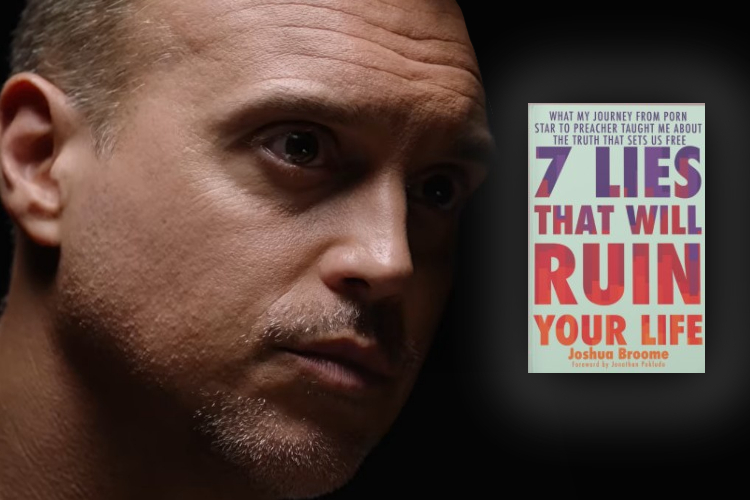
Joshua Broome was a porn star with fame, money, and a drug overdose planned. Trapped in deep shame and guilt, he found forgiveness and his true identity in Jesus Christ, and is now a husband, father, author and pastor.

15 September 2026
3.2 MINS
Many Christians avoid J. K. Rowling's Harry Potter series due to a perceived conflict between its themes and Biblical Christianity. Yet according to the author of a recent biography of J. K. Rowling, there is much more to the picture. Listen to our full conversation.

15 September 2026
1.7 MINS
The temptation to believe we have special knowledge others don’t is as old as Eden. But Christians must pursue what's true, and stop mistaking suspicion for wisdom and conspiracy for courage.

15 September 2026
4.8 MINS
"We've been lied to for a quarter century about Islam." So says a leading critic of Muslim political ideology on the 25th anniversary of 9/11 — and he argues that deception will cost America dearly.
14 September 2026
4.5 MINS
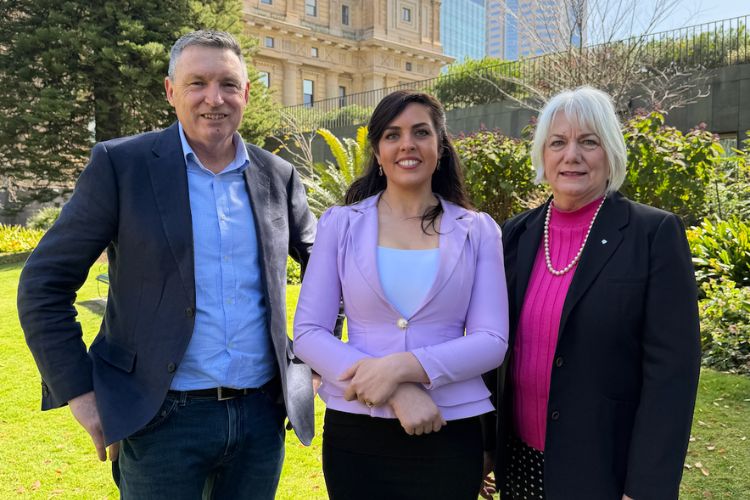
Moira Deeming says the public hasn't heard the full story of what happened to her inside the Victorian Liberal Party — and now, after joining Family First, she's ready to tell it.

14 September 2026
9.7 MINS
The word of God is living and active, and Christians across history have taken that seriously. A new Melbourne Bible Reading initiative is joining a global movement to read Scripture publicly — and you can be part of it.
14 September 2026
4.9 MINS
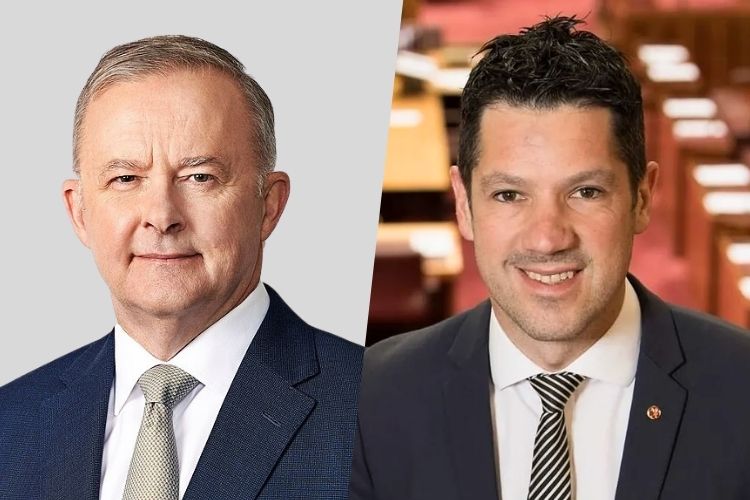
The Albanese Government Digital Duty of Care Bill could give an unelected commissioner the power to suppress free speech online — and Senator Alex Antic is leading the fight to stop it.


