


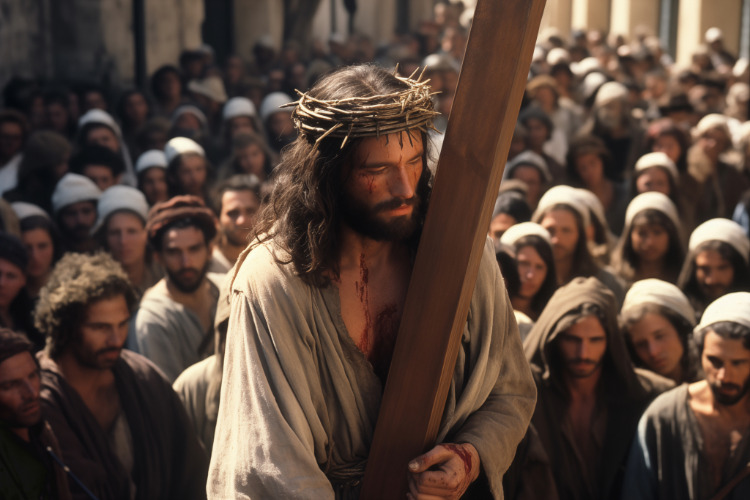
Why Did Jesus Come?
Challenging our biblical illiteracy.
We live in an age — here in the West, at least — in which far too many folks know very little about anything of real importance. They might know all about their favourite pop star or movie star or some influencer, but they know almost nothing about history, about their own heritage, about the greatness of the West, and so on.
Young people have certainly been dumbed down — and deliberately. Our schools used to actually teach students and even teach them how to think. Now, much of our education system is devoted to proselytising and indoctrination. Leftist narratives and woke dogmas are being crammed down the throats of the young, and much of the surrounding culture, including the mainstream media, is reinforcing that.
So an entire generation has grown up knowing next to nothing about what really matters. That includes knowledge of the Bible and who Jesus actually was. Their biblical illiteracy is telling, and if asked to tell us who Jesus was and why he came, many would flounder and stumble as they attempted any sort of an answer.
In an effort to offset the woeful biblical illiteracy that so many people have (certainly most young people), let me very simply lay out some key texts which tell us exactly why Jesus came. In the four Gospels, Jesus often tells us just why He came, and just what He intended to do.
Other parts of the New Testament supplement these texts. We can break these passages up into seven sections. They are all related, of course, but they express different aspects of the saving work of Jesus Christ.
To die on the cross to save sinners
“But whoever would be great among you must be your servant, and whoever would be first among you must be your slave, even as the Son of Man came not to be served but to serve, and to give his life as a ransom for many.” (Matthew 20:27-28)
“For even the Son of Man did not come to be served, but to serve, and to give His life as a ransom for many.” (Mark 10:45)
“For the Son of Man came to seek and to save the lost.” (Luke 19:10)
“For God so loved the world that He gave His one and only Son, that whoever believes in Him shall not perish but have eternal life.” (John 3:16)
“Now is my soul troubled. And what shall I say? ‘Father, save me from this hour’? But for this purpose I have come to this hour.” (John 12:27 )
Here is a trustworthy saying that deserves full acceptance: Christ Jesus came into the world to save sinners. (1 Timothy 1:15)
“He himself bore our sins” in His body on the cross, so that we might die to sins and live for righteousness; “by His wounds you have been healed.” (1 Peter 2:24)
But you know that He appeared so that He might take away our sins. (1 John 3:5)
To call sinners to repentance
“I have not come to call the righteous but sinners to repentance.” (Luke 5:32)
To proclaim the good news
But He said, “I must proclaim the good news of the kingdom of God to the other towns also, because that is why I was sent.” (Luke 4:43)
To proclaim the truth
“You are a king, then!” said Pilate. Jesus answered, “You are right in saying I am a king. In fact, for this reason I was born, and for this I came into the world, to testify to the truth. Everyone on the side of truth listens to Me.” (John 18:37)
To judge the world
Do not suppose that I have come to bring peace on the earth. I did not come to bring peace, but a sword. (Matthew 10:34)
Jesus said, “For judgment I came into this world, that those who do not see may see, and those who see may become blind.” Some of the Pharisees near him heard these things, and said to Him, “Are we also blind?” Jesus said to them, “If you were blind, you would have no guilt; but now that you say, ‘We see,’ your guilt remains. (John 9:39-41)
To be a light in a dark world
“I have come into the world as a light, so that no one who believes in Me should stay in darkness.” (John 12:46)
To defeat the work of Satan
The one who does what is sinful is of the devil, because the devil has been sinning from the beginning. The reason the Son of God appeared was to destroy the devil’s work. (1 John 3:8)
Needless to say, this does not exhaust all the reasons why Jesus came. Many other things could be said about the Incarnation. As but one example, theologian Thomas Oden put it this way in his 1992 book, Classic Christianity (p. 271):
- To reveal God to humanity (John 1:8; 1:7-11)
- To provide a high priest interceding for us able to sympathise with human weaknesses (Heb. 4:14-16)
- To offer a pattern of the fullness of human life (1 Pet. 2:21; 1 John 2:6)
- To provide a substitutionary sacrifice for the sins of all humanity (Heb. 10:1-10)
- To bind up the demonic powers (1 John 3:8)
But the 15 declarations from Jesus and others that I shared here do make it clear as to why He did come to planet Earth. These reasons help us see that plenty of dodgy reasons for his coming must be rejected. For example, Jesus did not come so that we can all feel good or have a nice time.
He did not come just as some moral teacher (recall how C. S. Lewis handily dismissed that nonsense). He did not come as just one of many paths to God. He did not come to tell us that we are all great chaps and He is happy with us the way we are.
No, He came to save lost sinners. And that is every single one of us. We are all under the wrath of God and headed to a lost eternity. We cannot save ourselves, and only the God/Man Jesus Christ could deliver us from our hopeless predicament.
All of the Old Testament is, of course, also taken up with this work of redemption that had to occur. The earliest promise of a deliverer found in the Bible comes in the opening chapters of Genesis:
And I will put enmity between you and the woman, and between your offspring and hers; he will crush your head, and you will strike his heel. (Genesis 3:15)
Just after the serpent led the first humans into sin and rebellion, God made that important promise. The offspring of the woman would defeat the offspring of the serpent. Jesus the Messiah would defeat Satan, demons and those who follow in that line. That is the grand promise of this passage.
So many more texts from the OT could be offered here as well. But the 15 New Testament texts make it pretty clear what His mission was all about. It is up to us how we respond to the life and work of Jesus. Choose wisely.
___
Republished with thanks to CultureWatch. Image courtesy of Adobe.
Recent Articles:

28 October 2026
4 MINS
The assault on Helen Haines highlights Australia’s growing political hostility. Recovering civility requires personal accountability, respectful debate and a renewed commitment to Christian moral foundations.

28 October 2026
1.8 MINS
A candlelit performance of Mozart’s Requiem at Sydney Town Hall will honour 21 Australian Army nurses murdered in the Bangka Island massacre, along with generations of military nurses.

28 October 2026
3 MINS
When we live in God’s presence, anchored in his Word and secure in Christ, we can stand unshakeable amid life’s challenges.

27 October 2026
10.3 MINS
As Tasmania and Western Australia consider conversion therapy bans, a former LGBT+ ministry leader warns of threats to religious freedom, personal choice and Christian discipleship.

27 October 2026
4.9 MINS
Nine Christians have been killed in a terrorist attack on a Jordanian church, prompting fierce condemnation, demands for justice and renewed concerns about religious persecution.

27 October 2026
3.6 MINS
For 25 years, the Mount Moriah Trust has supported struggling Christians across the Holy Land, bringing practical assistance, encouragement and hope to believers facing hardship and persecution.

27 October 2026
3.1 MINS
As the disciples discovered through a huge haul of fish, we can trust Jesus for a net-breaking, boat-sinking catch of people.


