



Pride Month Goes Out With a Whimper
Pride Month isn’t what it used to be — and we’re all better off for it.
It’s been a long time since Americans could sit back and actually enjoy the month of June. It was always an insufferable four weeks, breathing in the rainbow-saturated air that fell heaviest across our favourite sports, stores, shows, and social media. But the most remarkable thing about this year’s Pride Month may be just how unremarkable it was. Sure, there were still parades, over-the-top political pronouncements, and colourful flags billowing from too many government buildings, but the characteristic dread and fatigue from Pride is gone — replaced by a quiet confidence that maybe, just maybe, we’ve been heard.
For the conservatives in the movement fighting this battle the longest, 2024 didn’t just feel different. It was different. Heading into these final days of June, the biggest story across the mainstream media isn’t who’s celebrating Pride, but where did it go? The Associated Press, NBC News, Vox, and others have talked to countless experts, who all have the same thing to say: Executives are too worried about rocking the consumer boat.
“They’ve been rattled,” Drexel University Marketing Professor Daniel Korschun insists of CEOs and other industry heads. “There’s been a definite scaling back in both big and small ways,” Joanna Schwartz, another professor at Georgia College & State University, agreed. “I had expected some brand caution, but this year seems [to be] a near full-scale retreat.”
For people whose livelihoods are actually tied to the LGBT activism that June represents, “bad” doesn’t begin to describe the year they’re having. For Tim Bennett, co-founder of a firm called Tribury that specialises in reaching gay- and trans-identifying audiences, business has been a bust. A lot fewer clients are “reaching out for Pride Month collaborations,” Bennett admitted to Vox. “In speaking with my peers,” he said, “most of us are experiencing the same pullback or wait-and-see approach.” Brand sponsorships are especially low.
Rob Smith, who sells gender-neutral clothing, told the AP that he’s seen a 25% drop in the number of stores carrying his line just over the last several months. That jives with what Alysse Dalessandro has experienced as an LGBTQ content creator. She went from 35 clients who hired her as a model for their Pride Month campaigns in 2022 to nine in 2023 — and just five this year. Even The Trevor Project, an extreme trans-affirming youth nonprofit, conceded to Marketing Brew that it’s seen “a decline in corporate giving in the last couple of years.”
Maybe this is just a “natural progression,” some have tried to spin it. If “transgender and queer people are regarded as part of the norm, there’s no point in making a big statement,” Barbara Kahn, of the University of Pennsylvania’s Wharton School, argued.
But in a country where corporate America is routinely blackmailed by LGBT pressure groups, any hint of moderating that message would be seen as betrayal. Stephen Soukup, an expert in woke capital, who’s tracked the progression of corporate activism for decades, pointed out that for the last 15 years, businesses have tried “very hard to please one specific [activist] group, the Human Rights Campaign, which is an LGBTQ interest group.” And every year, [HRC] puts out its Corporate Equality Index — and every year, corporations are expected to do different types of things … in order to receive a 100% rating.”
Lately, that’s included everything from offering health care coverage for gender reassignment surgery to giving a certain amount of dollars and time to LGBT advocacy. If HRC doesn’t like the level of support they receive from a business, then, as “Outstanding” podcast host Joseph Backholm pointed out, they’re “going to try to destroy your reputation and make it hard for you to do business. So the companies feel an obligation.”
Frankly, Joseph argued, “I see this as a kind of extortion, where unless you do the things the [activists] want you to do, they are going to affirmatively try to harm you. Because in the marketplace, of course, your reputation is a big part of what your brand is.” He compared it to a gangster showing up at a store, “tapping their nightstick on their palms saying, ‘You know, it’s a great business you have here. It’d be terrible if something happened to it.’”
The difference now is, American consumers have managed to collectively hurt brands’ bottom lines more than HRC’s ostracisation ever could. After Dylan Mulvaney’s beer cans and Target’s “tuck-friendly” swimwear, the backlash was so explosive and so sustained that companies had no choice but to recalibrate. These were billion-dollar mistakes that sent plenty of boardrooms into desperate PR tailspins — and everyone else on a year-long soul search.
This whole grassroots sea change that’s taken hold in sports, business, and other industries has been an astounding thing for longtime conservatives to witness, especially those like Soukup, who’ve been fighting the corporate beast virtually alone for the better part of two decades. “There’s definitely been a retreat,” he agreed. “When I sat down to write the book ‘The Dictatorship of Woke Capitol’ four years ago this summer,” he admits, “I was pretty pessimistic. I didn’t think that there was a whole lot we could do to push back against ESG, to push back against the broader stakeholder movement, to push back against all of this politicisation of American corporations. … Even after the book came out, the following spring, I did interview after interview [and] I was asked, ‘What do you think is going to happen?’ I was still pretty dour. I [was] still pretty pessimistic about what our prospects were to get … capital markets back to neutral.”
Now, he looks around at this nationwide movement to roll back LGBT activism and can hardly believe it. “Over the past three years, there’s been really an explosion in the pushback. And there are a lot of people who’ve been involved in this, a lot of people who deserve a lot of credit for this.”
It was almost like a great awakening for everyday Americans, who finally got fed up and realised the amount of power they wield. “We’ve seen a lot of people say, ‘You know what? This is not right. This is not the way that American capitalism is supposed to function. This is not the way American democracy is supposed to function. And it’s important for us to get this right, because if we don’t, then we lose everything.’ … I’m so much more optimistic now than I was three or four years ago about how effective we can be in halting this ideological, political takeover of business and capital markets.”
___
Republished with thanks to The Washington Stand. Image courtesy of Unsplash.
One Comment
Leave A Comment
Recent Articles:
19 October 2026
6.7 MINS
Europe’s escalating unrest raises urgent questions about immigration, national identity, secularism and the decline of Christian influence, prompting calls for repentance, prayer and renewed leadership.

19 October 2026
7 MINS
Western Australia’s euthanasia deaths have surged, prompting calls for an urgent inquiry amid concerns about doctor shopping, waived safeguards, limited palliative care and proposed legal expansion.

19 October 2026
12.4 MINS
Greta Gerwig’s "Narnia: The Magician’s Nephew" trailer raises questions about C. S. Lewis’s Christian vision and the faithfulness of the new Netflix adaptation. Here are my initial impressions and concerns.
19 October 2026
2.7 MINS
The UK Greens’ vote to define Zionism as racism has exposed deep divisions within the party, raising questions about its future leadership and political direction.
16 October 2026
4 MINS
A desperate Victorian Labor Party is peddling taxpayer-funded abortions as free “healthcare”. In a shameless attempt to stay in power, they're willing to do anything — including killing the unborn and forcing taxpayers to pay for it.
16 October 2026
4 MINS
Katie Zacharia’s first days as White House Press Secretary have sparked fierce media criticism, but her remarkable testimony of surviving an abortion attempt tells a deeper story.
16 October 2026
3.4 MINS
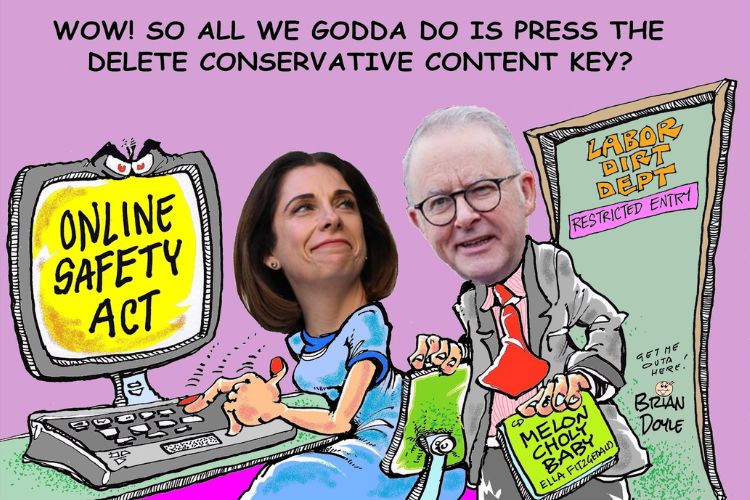
Australia’s proposed digital duty of care laws promise greater online safety and increased user control by switching off algorithms, but critics warn they could give ministers sweeping powers to restrict lawful content and threaten free speech.



The Vice Chancellor and the functionaries at the University of Sydney could do well to read this and try joining a few dots; grow a spine even.