National Forgiveness Week could offer Australia a fresh pathway to genuine reconciliation, bringing Aboriginal voices, churches and communities together to rediscover the transformative power of forgiveness.
Referring to The Apology and Sorry Day, Warren Mundine said in his 2023 address, “We talk a lot about the SORRY part, but we never talk about the FORGIVENESS part. And for real RECONCILIATION, it’s not enough that Australia as a nation says SORRY, but that Indigenous people also need to FORGIVE Australia as a nation.”
It’s not only for Aboriginals to forgive; we all need to move past veiled manners and political correctness to practise heartfelt forgiveness in all our daily encounters… and National Forgiveness Week can take us there.
The concept of National Forgiveness Week emerged from an African tribe that regularly held a Forgiveness Week sometime in the late 1800s. The name and location of the tribe have been lost with the passing of time. But it was a week where every man and woman pledged themselves to forgive any hurt or harm, any offence, whether real or imagined, that may have caused misunderstanding, quarrel or coldness. The week ended with a festival of rejoicing amongst the participants. Why not blow on the embers of this bygone event to introduce it Australia-wide?
The Voice of Aboriginals Who Forgive
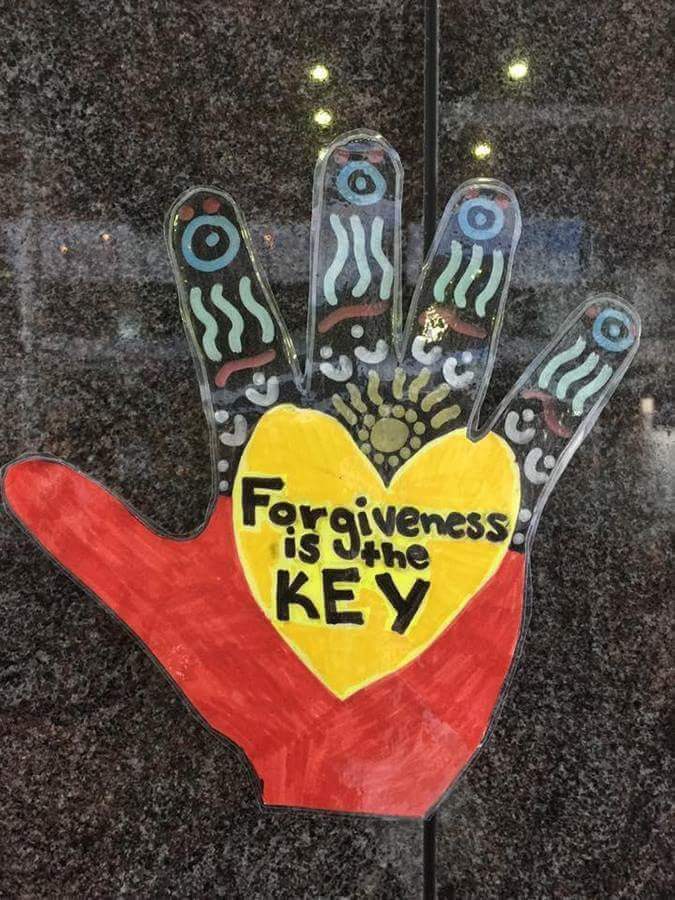 Many Aboriginals from the community of Beswick in Arnhem Land (also known as Wugularr) have embraced forgiveness as a lifestyle. Like their African counterparts, they hold National Forgiveness Week (NFW) every year and apply it to their daily life situations. Through their example, the message of one-on-one forgiveness is gradually seeping out into other Aboriginal communities to replace payback.
The practice of payback within First Nations communities is their traditional response to crimes and offences. Put simply, payback is eye-for-an-eye revenge.
Relational forgiveness, framed within NFW and carried by the Aboriginal people, is part of the solution to friction within all our homes and communities across Australia.
The goal of NFW is to bring the forgiveness message to all Australia as a truly national event, giving Aboriginals the microphone to speak to our nation on the power of forgiveness. Much controversy arose during the Voice Referendum, but here is an opportunity for Aboriginals to carry The Voice of Forgiveness and real reconciliation to our nation.
NFW could be organised by individual churches, denominations, or through a partnership between government, First Nations people and churches. Ideally, government involvement would provide valuable organisational support and funding to promote NFW nationwide. And church participation is essential, while Aboriginal people who practise forgiveness can lead Australia in observing National Forgiveness Week each year.
The Importance of Interpersonal Forgiveness
The theme is simple: one-on-one forgiveness reaching hearts and homes to affect the atmosphere over relationships and communities at all levels.
National Forgiveness Week can be a response to SORRY DAY, and most certainly represents a step towards Closing the Gap. But the call to forgiveness runs deeper than just a formal response to SORRY DAY; it goes to the very heart of our existence, irrespective of race and creed.
Forgiveness should be a way of life that we apply to all our relationships and interactions. We are prone to think it only applies to traumatic and tragic events, but it is much more than that. We are to forgive the little things that offend, minor spats, unspoken grudges, petty offences — the big things and the small things that plague our daily encounters.
Our Motivation to Forgive
Jesus revealed the serious impact of our unforgiveness like this: “If you forgive men their trespasses, your heavenly Father will also forgive you. But if you do not forgive men their trespasses, neither will your Father forgive you.” (Matthew 6:14-15)
What does He mean? Is God’s forgiveness transactional — will He forgive us only if we first forgive others? Of course not.
Forgiving others expresses our heartfelt gratitude for God’s forgiveness of our sins through the Cross of Christ. It is our loving response to His loving initiative. It is evidence of our salvation, and a humble act of worship and thanksgiving. If that evidence is absent, the implications are not insignificant.
Jesus develops this point in the Parable of the Unforgiving Servant (Matthew Chapter 18): if we refuse to forgive those who offend or hurt us, neither is God’s life-giving forgiveness functioning as it should in our lives! This sobering truth calls for honest self-examination: if no godly life flows from us, we must ask whether godly life truly dwells within us.
Impacting Australia
Raising the issue of forgiveness in an Australia-wide context will bring some to realise their desperate need for Jesus. In that way, the call for interpersonal forgiveness becomes the backdoor to the Gospel.
National Forgiveness Week, with its theme of relational forgiveness, is only one piece in the jigsaw puzzle of national redemption, but it is a foundational piece. The widespread practice of forgiveness has the potential to change hearts, focusing many on godly righteousness which will exalt our nation. Isn’t it time?
For more information, see NationalForgivenessWeek.com.






National Forgiveness Week and “Sorry Day”
11 November 2026
3.2 MINS
National Forgiveness Week could offer Australia a fresh pathway to genuine reconciliation, bringing Aboriginal voices, churches and communities together to rediscover the transformative power of forgiveness.
Referring to The Apology and Sorry Day, Warren Mundine said in his 2023 address, “We talk a lot about the SORRY part, but we never talk about the FORGIVENESS part. And for real RECONCILIATION, it’s not enough that Australia as a nation says SORRY, but that Indigenous people also need to FORGIVE Australia as a nation.”
It’s not only for Aboriginals to forgive; we all need to move past veiled manners and political correctness to practise heartfelt forgiveness in all our daily encounters… and National Forgiveness Week can take us there.
The concept of National Forgiveness Week emerged from an African tribe that regularly held a Forgiveness Week sometime in the late 1800s. The name and location of the tribe have been lost with the passing of time. But it was a week where every man and woman pledged themselves to forgive any hurt or harm, any offence, whether real or imagined, that may have caused misunderstanding, quarrel or coldness. The week ended with a festival of rejoicing amongst the participants. Why not blow on the embers of this bygone event to introduce it Australia-wide?
The Voice of Aboriginals Who Forgive
The practice of payback within First Nations communities is their traditional response to crimes and offences. Put simply, payback is eye-for-an-eye revenge.
Relational forgiveness, framed within NFW and carried by the Aboriginal people, is part of the solution to friction within all our homes and communities across Australia.
The goal of NFW is to bring the forgiveness message to all Australia as a truly national event, giving Aboriginals the microphone to speak to our nation on the power of forgiveness. Much controversy arose during the Voice Referendum, but here is an opportunity for Aboriginals to carry The Voice of Forgiveness and real reconciliation to our nation.
NFW could be organised by individual churches, denominations, or through a partnership between government, First Nations people and churches. Ideally, government involvement would provide valuable organisational support and funding to promote NFW nationwide. And church participation is essential, while Aboriginal people who practise forgiveness can lead Australia in observing National Forgiveness Week each year.
The Importance of Interpersonal Forgiveness
The theme is simple: one-on-one forgiveness reaching hearts and homes to affect the atmosphere over relationships and communities at all levels.
National Forgiveness Week can be a response to SORRY DAY, and most certainly represents a step towards Closing the Gap. But the call to forgiveness runs deeper than just a formal response to SORRY DAY; it goes to the very heart of our existence, irrespective of race and creed.
Forgiveness should be a way of life that we apply to all our relationships and interactions. We are prone to think it only applies to traumatic and tragic events, but it is much more than that. We are to forgive the little things that offend, minor spats, unspoken grudges, petty offences — the big things and the small things that plague our daily encounters.
Our Motivation to Forgive
Jesus revealed the serious impact of our unforgiveness like this: “If you forgive men their trespasses, your heavenly Father will also forgive you. But if you do not forgive men their trespasses, neither will your Father forgive you.” (Matthew 6:14-15)
What does He mean? Is God’s forgiveness transactional — will He forgive us only if we first forgive others? Of course not.
Forgiving others expresses our heartfelt gratitude for God’s forgiveness of our sins through the Cross of Christ. It is our loving response to His loving initiative. It is evidence of our salvation, and a humble act of worship and thanksgiving. If that evidence is absent, the implications are not insignificant.
Jesus develops this point in the Parable of the Unforgiving Servant (Matthew Chapter 18): if we refuse to forgive those who offend or hurt us, neither is God’s life-giving forgiveness functioning as it should in our lives! This sobering truth calls for honest self-examination: if no godly life flows from us, we must ask whether godly life truly dwells within us.
Impacting Australia
Raising the issue of forgiveness in an Australia-wide context will bring some to realise their desperate need for Jesus. In that way, the call for interpersonal forgiveness becomes the backdoor to the Gospel.
National Forgiveness Week, with its theme of relational forgiveness, is only one piece in the jigsaw puzzle of national redemption, but it is a foundational piece. The widespread practice of forgiveness has the potential to change hearts, focusing many on godly righteousness which will exalt our nation. Isn’t it time?
For more information, see NationalForgivenessWeek.com.
About the Author: Robert Warren
Australia / COMMENTARY / Identity Politics / Indigenous
SHARE >
We need your help. The continued existence of the Daily Declaration depends on the generosity of readers like you. Donate now. The Daily Declaration is committed to keeping our site free of advertising so we can stay independent and continue to stand for the truth.
Fake news and censorship make the work of the Canberra Declaration and our Christian news site the Daily Declaration more important than ever. Take a stand for family, faith, freedom, life, and truth. Support us as we shine a light in the darkness. Donate now.
Recent Articles:
Victorian Election: Your Christian Values Checklist Is Here
11 November 2026
1.9 MINS
The Australian Christian Values Checklist for the 2026 Victorian State Election is now available. This simple, practical resource compares political parties on issues of particular concern to Christians, including life, faith, family and religious freedom.
Antisemitism Is Not a Left or Right-Wing Issue, But a Human Rights Issue
11 November 2026
3.3 MINS
Indigenous Friends of Israel International warns that antisemitism must be confronted across the political spectrum, defending Jewish Australians while protecting legitimate criticism and freedom of expression.
Trump Tells 60 Minutes He Doesn’t Want to Go to Hell; Franklin Graham Points Him to the Cross
11 November 2026
4.6 MINS
Donald Trump’s candid admission that he struggles to forgive his enemies has sparked debate, but Franklin Graham’s response points to a far more important question: salvation.
Vital Vote in Victoria: A Guide to the Victorian Election
10 November 2026
14.4 MINS
As Victorians prepare to vote on 28 November, this election guide examines Labor’s record and the competing policies on the economy, infrastructure, housing, crime, agriculture and social issues.
Stop the Abuse: Redress Must Deliver Justice for Survivors and Fairness for Institutions
10 November 2026
3.4 MINS
Questions surround the National Redress Scheme’s assessment process, with credible institutional evidence being ignored, undermining trust and fairness.
I’m Leaving Australia
10 November 2026
6.1 MINS
After selling their Perth home, one family is relocating from Australia to Bali, seeking a more affordable lifestyle, greater freedom, values-aligned childcare and more time together.
‘She’ll Be Right’ Is Killing Us: Anderson Calls for Courage Over Complacency
9 November 2026
3.1 MINS
John Anderson has repeatedly called for Australians to confront our cultural and moral decline and put courage over complacency.
Use your voice today to protect
Faith · Family · Freedom · Life
MOST POPULAR
ABOUT
The Daily Declaration is an Australian Christian news site dedicated to providing a voice for Christian values in the public square. Our vision is to see the revitalisation of our Judeo-Christian values for the common good. We are non-profit, independent, crowdfunded, and provide Christian news for a growing audience across Australia, Asia, and the South Pacific. The opinions of our contributors do not necessarily reflect the views of The Daily Declaration. Read More.
MOST COMMENTS
GOOD NEWS
HALL OF FAME
BROWSE TOPICS
BROWSE GENRES