


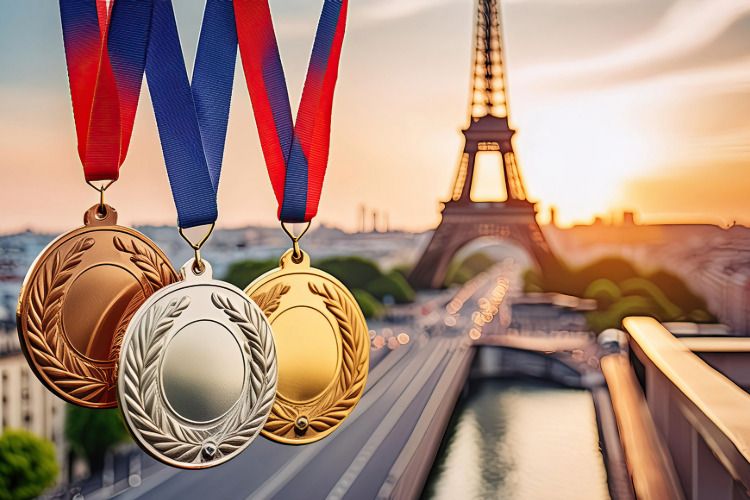
Olympic Controversies: Triumph of Biology and Common Sense
Emotions always run wild at the Olympics, with the highs and lows of the human spirit on show to the whole world. Australia had its share of excitement, scoring an amazing number of medals for its small population.
And with the Olympics, there is always controversy.
In Paris, the first controversy hit on day one, with a highly sexualised scene imitating Leonardo da Vinci’s sacred painting of the Last Supper of Christ featured as part of the opening ceremony.
After this scurrilous and offensive scene was roundly condemned by outraged Christians and non-Christians alike, the ceremony’s choreographer, Thomas Jolly, claimed it was intended to be a “big pagan party linked to the gods of Olympus”. He said it was intended to be about diversity and inclusion of different sexual and gender identities.
If Jolly intended to endorse the inclusion of males who identify as females in the women’s Olympic competitions, then ironically the international sporting federations had already decided to the contrary.
In the female sports, there was a natal female who identified as male in soccer and another in athletics. Neither had undergone any male hormone treatment. Further, in contrast to the Tokyo games, where several male-to-female athletes competed in female events, by all accounts there were no such athletes in any Paris female competitions.
Over recent decades, the International Olympic Committee (IOC) had wrestled with the troubling issue of transgenders competing in the Games.
In 2003, the IOC required all male-to-females to have undergone sex-change surgery and lowered their testosterone levels. Later, the rules changed several times, in essence requiring natal males to lower and maintain their testosterone levels for one year (and later two years) prior to the Olympics, but not requiring them to have undergone sex-reassignment surgery.
Then in 2021, new guidelines were issued, the “IOC Framework on Fairness, Inclusion and Non-Discrimination on the Basis of Gender Identity and Sex Variations”. These guidelines advocated inclusion, non-discrimination, fairness and prevention of harm (that is, safety). At the same time, the IOC put the decision-making back onto each international sporting federation. The IOC was no longer going to have a set rule for all sporting codes.
Clearly, this gave natal female athletes a major say in the policies of their respective international federations, especially as, for the first time in Paris, there were going to be as many medals for women as for men.
The rules introduced by the various federations varied. Some required natal males to have transitioned with hormonal treatments prior to puberty, so that they had not experienced high levels of male sex hormones, and that they had maintained low levels of testosterone for a set period prior to competition.
Some international federations required that these testosterone levels be below five nanomoles/litres of blood, while others required it below 2.5 nanomoles/litre. Some said that these low levels must be maintained for two years prior to competition, others four years.
Some sports had two competition categories – a female-only category for natal females, and an “open” category for all other competitors. Others addressed the issue on a case-by-case basis.
Effectively, the rules set by the various international sporting federations meant that natal males were not competing in Olympic women’s sports. This contrasts with Australia’s 2019 “Guidelines for the inclusion of transgender and gender diverse people in sport” produced by the Australian Human Rights Commission and the Coalition of Major Professional and Participation Sports. The Guidelines sought to have females in many codes accept natal males in their competitions.
Intersex, Not Transgender
A second Olympic controversy erupted in women’s boxing. Algeria’s Imane Khelif and Taiwan’s Lin Yu-ting deserved compassion, not the abuse and vilification they received on social media. Both were identified as female at birth and raised as female. Also, they are intersex.
Medically, intersex is a broad term for many disorders (or differences) of sexual development. The chromosomes of these two boxers are XY, which in nearly all cases determines a person as male. However, to put a complex matter simply, in rare cases the section of the Y chromosome that normally determines a person as male is malfunctional. In such cases, the embryo “defaults” to female anatomy.
Then there are questions. Does such a person develop with male testosterone or not? Do other parts of the Y chromosome push them in a male or female direction? Where is the line between the person being male or female, or having an “unfair” “male” advantage? Given that most elite athletes are in some way “freaks of nature”, should a particular intersex person be included or excluded from a sport?
Such determinations involve many complex (unresolved) biological considerations. To understand more on intersex, read here, and here.
Neither Khelif nor Yu-ting identify as transgender. Intersex is neither a third sex nor a form of transgender. Indeed, as political philosopher at the University of Warwick Rebecca Reilly-Cooper has explained:
“The fact that some humans are intersex in no way diminishes the truth of sexual dimorphism, any more than the fact that some humans are born missing lower limbs diminishes the truth of the statement that humans are bipedal .”
Greatly complicating the intersex boxing controversy were IOC charges of serious corruption against the International Boxing Association (IBA). This was to the point of the IOC banning the IBA from Paris, appointing an ad hoc committee for the duration of the games and declaring that there would be no boxing at the next Olympics unless a new, credible international body came forward.
In this highly charged environment, the ad hoc committee had no rules to decide one way or the other on the participation of Khelif and Yu-ting. Last year, the IBA banned both from the female competition, but would not release their limited medical tests for privacy reasons, while further testing of the two boxers did not happen.
There is a positive out of this controversy. Just as the transgender issues are being resolved by major sporting federations, now intersex athletes have high global visibility, and their issues in sport seek resolutions.
Ironies Abound
A third observation. France has banned conspicuous public displays of religious symbols, the opening ceremony was to be sexually inclusive, and the Olympic Village was said to be environmentally friendly, with athletes having no air-conditioning, cardboard beds and vegan food.
Yet, it was noticeable how many athletes offered prayers or religious signs (like the sign of the cross), bought their own non-vegan meals and aircons, booked other accommodation (one slept outside on the grass) rather than not sleep on a hard bed, all while the international federations effectively banned natal males from women’s competitions.
All ironic triumphs for common sense.
___
Republished with thanks to News Weekly. Image courtesy of Adobe.
Recent Articles:
10 October 2026
4.1 MINS
When Jesus rebuked the Laodicean church, this was not a sign of his lack of love, but proof of it and how greatly he longs to reward and bless us. He is knocking — will we answer?
9 October 2026
5 MINS
During a recent dialogue between high profile legal experts, a top Australian constitutional law expert was asked if Australia should have a Bill of Rights. His answer may surprise you.
9 October 2026
1.3 MINS
Season 6 of The Chosen is releasing next month, and until 15 November, your church has the opportunity to host a free pre-release screening of Episode 1. Here's how.
9 October 2026
2.9 MINS
Angus Buchan’s remarkable journey from farmer to evangelist is brought to life in a new documentary now streaming, revealing the faith, family and challenges behind his public ministry.

9 October 2026
3.3 MINS
New South Wales healthcare workers who object to abortion and voluntary assisted dying face growing pressure, raising serious questions about conscience rights, employment and moral injury.
9 October 2026
2.9 MINS
God is intensely relational, and he puts us into a community of believers so we can use our gifts in service of Christ's body.
8 October 2026
3.6 MINS
John Anderson warns that Australia’s decline is rooted in spiritual and cultural disintegration, calling for a recovery of Christian foundations, social cohesion and national purpose.


