



Up to 5 Years in Prison for Hate Speech Under Victorian Government’s Proposed Anti-Vilification Laws
And, a new federal hate speech bill.
Victorians could go to prison for up to five years for hate speech under new anti-vilification laws proposed by the Victorian Government.
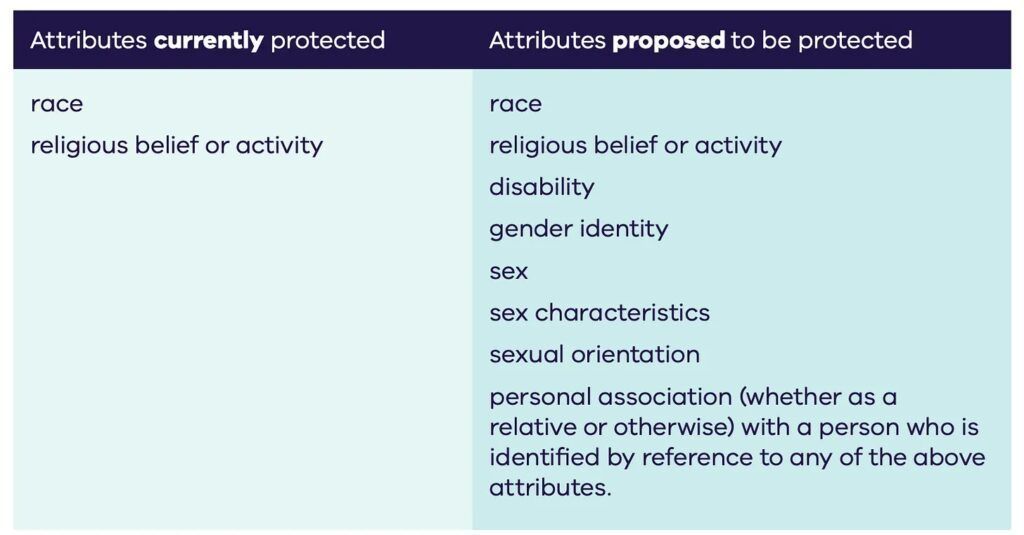
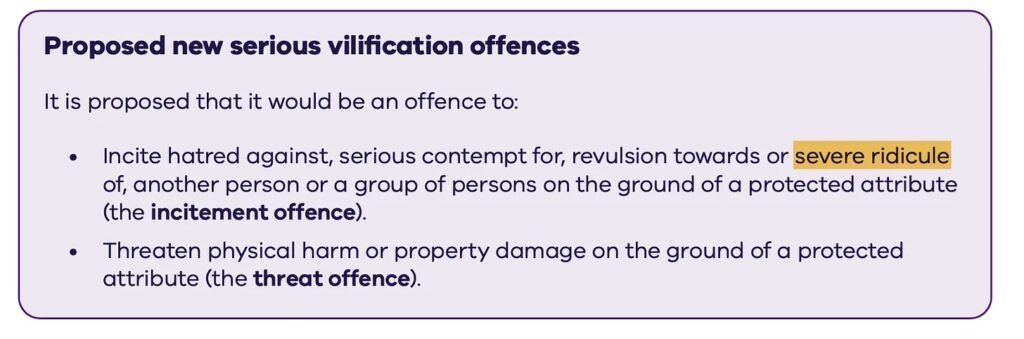
Under the proposed laws, it would be an offence to “incite hatred against, serious contempt for, revulsion towards or severe ridicule” of a person or group based on their sex, gender identity, or race.
It would also be illegal to “threaten physical harm or property damage on the ground of a protected attribute.”
The new laws would lower the legal threshold for prosecuting people for vilification and would add gender identity, sex, sex characteristics, sexual orientation and disability to the list of protected attributes alongside race and religion, which are already protected.
Online, these laws will apply to anyone, anywhere who vilifies a person in Victoria, although the government acknowledges that this may be difficult to enforce.
Offline, these laws will apply to both public and private interactions.
The changes, which amount to a heavy rewrite of the Racial and Religious Tolerance Act, are intended to “reduce the harm caused by vilification, protect more people, reflect the seriousness of hateful conduct, and ensure those who experience vilification can easily seek help.”
Hate speech laws welcomed by human rights, law and special interest groups
The Sun Herald reports that the original motivation for the legislation was “due to fears of Islamophobia after women were getting spat on for what they were wearing, but it has “since expanded to address rising anti-Semitism, as well as other attributes including to protect people with disabilities and members of the LGBTIQ+ community.”
The proposed hate speech laws have been welcomed by human rights groups including the Victorian Equal Opportunity and Human Rights Commission.
“We need to shift the burden of responding to hate from individual victims and instead create a system that can drive change,” said the Commission, which has played an active role in advocating for stronger legal protections to protect Victorians from hate conduct.
A parliamentary inquiry into anti-vilification protections in 2020 drew strong expressions of support for expanding the anti-vilification legal framework from diverse groups, including the Australia/Israel & Jewish Affairs Council, the Islamic Council of Victoria, the Law Institute of Victoria, the Online Hate Prevention Institute, Victoria Legal Aid, Equality Australia and the Victorian Pride Lobby.
In its response to the inquiry report, the government committed to strengthening the state’s anti-vilification laws, acknowledging the “profound” impacts of hate conduct and vilification on the physical and psychological wellbeing of individuals and communities, and on “the very core of Victoria’s social cohesion through its inherent divisiveness and unequal distribution of power.”
Since the inquiry wrapped up in 2021, the Victorian Government has undertaken several rounds of consultation, with the final consultation phase open until this Friday, 11 October.
Prison time for ridicule
However, the proposed anti-vilification laws have not been welcomed in all corners.
“Victoria has a new fight on its hands,” said Victorian MP David Limbrick in a video posted to X. The Libertarian and free speech advocate shared his concerns and called on followers to voice their dissent.
You may have heard about the Federal Government’s misinformation bill, but did you know there’s a new free speech fight brewing right here in Victoria? #springst pic.twitter.com/iyWrQvCMVF
— David Limbrick MP 🌸 (@_davidlimbrick) October 1, 2024
“This is really serious stuff. You can go to jail for three years for ridicule!” he said.
“The government’s definition of public conduct is so broad that it includes private property — does that include your backyard barbeque?
“And how weird is this – they want to include behaviour that incites hatred or other serious emotions. But the government’s actions incite serious emotions in me all the time!”
Indeed, under the proposed reforms, you could be criminally prosecuted for incitement of “severe ridicule” on the ground of a protected attribute, with a maximum penalty of three years prison time.
Threatening physical harm or property damage would carry a maximum penalty of five years imprisonment.
Currently, the threshold for prosecution is higher, and the maximum penalty is lower — both incitement and threat must be proven to prosecute for vilification, and the maximum penalty is six months imprisonment, a fine of up to $11,855.40, or both.
And, it is certainly possible that Victorians could be prosecuted or sued for things said at a backyard barbeque. The proposed criminal incitement offences apply to both public and private conduct, which means that, “regardless of whether hate speech or conduct occurs in public or in private, it can be a crime.”
An additional set of civil protections applies only to public conduct, but as pointed out by Limbrick, “conduct might be considered public even if it occurs on private property or at a place not open to the general public,” such as neighbours calling across the fence, or interactions that occur at a school or workplace.
Also under the modified civil protections is the clarification that the legal test for incitement would be “conduct that is likely to incite hatred or other serious emotions in another person.”
Limbrick jokes that the government’s actions incite serious emotions in him all the time, but this provision would be no joking matter for the accused, who could face legal action for inciting serious emotions in relation to someone’s race, gender identity or disability.
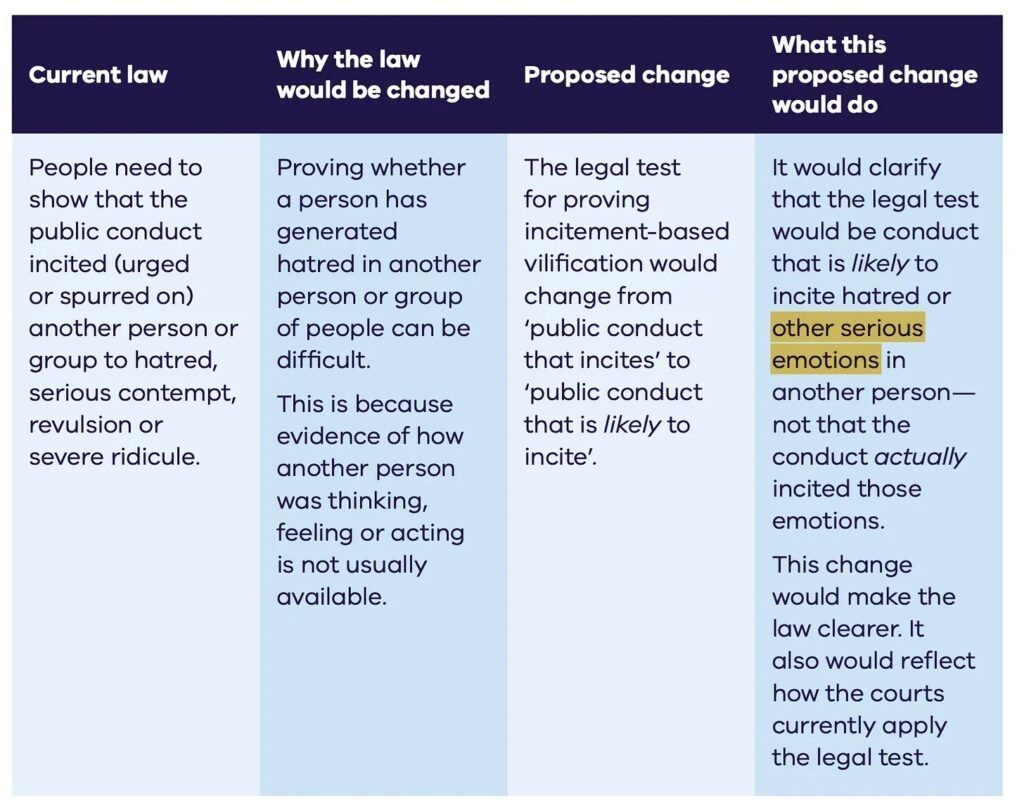
Source: Overview Paper – Proposed changes to anti-vilification laws
Breastfeeding advice a hate crime?
During parliamentary debate last year, Limbrick attempted to secure assurances from Victoria Attorney-General Jaclyn Symes that the new laws would not prevent Australians from speaking plainly on important issues.
For example, “Can the Attorney-General provide reassurances that the dictionary definition of ‘woman’ – that is, an adult human female – will not be considered hate speech under the proposed anti-vilification laws?” asked Limbrick.
“That is a bit of a stretch,” said Symes.
But is it?
A Victorian breastfeeding counsellor, Jasmine Sussex, is currently being taken to a Queensland tribunal over a vilification claim by trans-identified male Jennifer Buckley, after Sussex raised concerns online about biological males trying to chest-feed newborn babies.
This is the third complaint made by Buckley to various authorities, including the Queensland Human Rights Commission and the e-Safety Commissioner, resulting in Sussex being fired from her volunteer role at the Australian Breastfeeding Association, her social media posts being censored, and now legal action.
The difference under Victoria’s proposed laws is that Sussex could be liable for criminal prosecution and jail time for her proclamations of biological fact, which reportedly hurt Buckley’s feelings.
Principal lawyer at the Human Rights Law Alliance (HRLA) John Steenhof, who is representing Sussex, said in a statement that, “ordinary Australians like Jasmine Sussex should be free to speak openly about issues of public importance.”
“Vilification laws are easily weaponised to silence free speech and suppress opposing views on contentious social issues,” he warned.
This is a concern shared by Dr Rueben Kirkham of the Free Speech Union of Australia (FSU), who describes the proposed laws as “expansive” and “problematic.”
“The origins are Soviet — literally — which tells you a lot about what you need to know,” he said in an email.
Dr Kirkham highlighted a range of concerns including the potential for politicisation of the police force, which would be empowered to initiate prosecutions, the prospect that even “mildly offensive” speech could meet the threshold for legal action, and insufficient provisions for legal defence against accusations.
It is proposed that only conduct or speech engaged in for a “genuine” purpose in the public interest be protected from the scope of the anti-vilification laws, which would require an accused person to prove genuine intent.
“Imagine having to keep records to prove that every tweet is reasonable. We are appalled,“ said Dr Kirkham.
The FSU has created an online tool for people to make submissions to the Victorian Government’s consultation on the proposed anti-vilification laws.
Federal hate speech bill also in play
As Victoria works to extend and strengthen its anti-vilification laws, a federal hate speech bill is already moving through the Australian Parliament, targeting speech and conduct that recklessly incites violence against people because of their race, religion and other protected attributes.
The federal bill is less extreme than the laws proposed by the Victorian Government, and has drawn criticism from some special interest groups for not going far enough.
The Criminal Code Amendment (Hate Crimes) Bill 2024 will strengthen existing offences to reduce the fault element to ‘recklessness,’ will remove the “good faith” defence, will expand the list of prohibited hate symbols, and will create new criminal offences for threatening force or violence against targeted groups.
The Senate is currently conducting consultation on the bill, with submissions open until 7 November.
United Kingdom hate crime laws a taste of what’s to come?
In April of this year, Scotland passed laws making it a crime to “stir up hatred” against protected groups, with a maximum prison sentence of seven years.
Similarities between the Scottish laws and those proposed by the Victorian Government can offer a sense of what Victorians might expect: a large uptick in reported hate crimes, a moderate number of successful prosecutions, and an increased burden on the police force.
More than 7,000 hate incident complaints were reportedly made to the Scottish police in the first week after the hate crime laws came into effect. Ironically, many were in relation to an infamous 2020 speech by then First Minister Humza Yousaf in which he bemoaned the ‘whiteness’ of the leadership class in Scotland (a country in which 96% of the population is white), showing that vexatious complaints can go both ways.
While no action has been taken on a majority of anonymous and vexatious complaints, Police Scotland reports that between April and September, 468 hate crimes had progressed to some form of prosecutorial action. 42 cases resulted in conviction, while more than 80% of cases are still moving through the courts.
Aside from successful prosecutions, Scotland’s new hate crime laws have coincided with an upsurge in recorded hate crimes. In the six months since the laws came into effect, Police Scotland recorded 5,400 hate crimes, representing an increase of 63%.
Justice Secretary Angela Constance said that the increased number of recorded hate crimes “demonstrates that this legislation is required and needed to protect marginalised and vulnerable communities most at risk of racial hatred and prejudice.”
On the other hand, opposition justice spokesperson Sharon Dowey said that the increase in reports highlighted the strain that the new laws were having on Scotland’s “overstretched” police force, which includes hate crime training as well as attending to reports.
Arrests and prosecutions in Britain in the wake of racially charged protests and riots this year related to the stabbing of three children in Southport, and the related issue of mass immigration, offer insight into how hate speech laws may be applied in times of inflamed social tensions.
In response to the riots, the Starmer Government assigned specialist officers to investigate hundreds of social media posts suspected of “spreading hate and inciting violence.”
Law enforcers arrested hundreds and sent multiple people to jail under a hodgepodge of legal provisions including “stirring up racial hatred”, “sending false communications”, or causing public disorder, either on social media or at the protests.
Some of these cases involved outright calls to violence, while others said offensive things, inadvertently shared false information or were merely onlookers to riots, in the wrong place at the wrong time.
The Stark Naked Brief noted “bizarre inconsistencies” in the application of the subjectively worded hate speech laws, with some – like “keyboard warrior” Wayne O’Rourke, who was sentenced to three years in prison for “stirring up racial hatred” on social media – receiving longer prison time for hate speech and conduct than actual murderers.
Have Your Say
Consultation on the Victorian Government’s proposed hate speech laws is open until Friday, 11 October. Visit the Free Speech Union website to use their custom tool.
Consultation on the federal Criminal Code Amendment (Hate Crimes) Bill 2024 is open until Thursday, 7 November.
___
Republished with thanks to Dystopian Down Under. Image courtesy of Adobe.
4 Comments
Leave A Comment
Recent Articles:
8 October 2026
3.6 MINS
John Anderson warns that Australia’s decline is rooted in spiritual and cultural disintegration, calling for a recovery of Christian foundations, social cohesion and national purpose.
8 October 2026
1.6 MINS
A blackout at Australia’s $150 million Pre-COP climate summit in Fiji delivered an awkward lesson in energy reliability to delegates preaching the renewable transition.

8 October 2026
4.1 MINS
Aboriginal communities in Central Australia already know the gospel message. What they need now, Robyn Murray writes, is discipleship, encouragement and Christians willing to pray and participate.

8 October 2026
4.1 MINS
Italy honours St Francis of Assisi 800 years after his death, celebrating a saint whose devotion to Christ, radical simplicity and message of peace continue to shape generations.
8 October 2026
2.8 MINS
The MDBA’s case for further water buybacks rests on climate projections increasingly challenged by climate scientists, historical rainfall data and evidence of a greener Basin.

8 October 2026
4 MINS
Christ’s authority and concern is not limited to the four walls of the church. They extend to the life of the nation, and we are called to take up our part in seeking its righteousness.
7 October 2026
3.6 MINS
Victoria’s 18th March for the Babies will bring families together to peacefully affirm the value of every human life and call for a cultural change towards life.



Oh well, as long as the govt let me take my prescription meds with me when I go to prison I’ll fight for freedom- otherwise I’ll make sure my family will sue the govt for not treating me with respect while I die.
Islam is not ” the religion of peace “, of toleration, never has been , and, never will be ! Otherwise , there would be no wars in the Middle East amongst Moslem countries, or, against Israel, and, tell that lie to my Bosnian , Albanian and Montenegrin ancestors who were forced to flee their countries to be free . I am sorry my father brought me as a child to live in Australia in which there will be no Freedom of Speech or of Christian religion . I wish I could emigrate , but, I am too old and too sick. Will I be prosecuted for saying the Truth– that Investors are fleeing Victoria in droves because it is a bankrupt, failed Marxist , Woke State? God’s punishment will come on a Godless Australia.
Countess, I love your candor. Lets tell the truth at all times.
Thank you Rebekah for bringing us up to date on the new proposed anti vilification laws in Victoria.
The downhill decline is evident with these new laws and if passed would lead all down the slippery slope of endless court cases, fines and jail and increased hate and division- with no hope of peaceful living in Victoria.
I remember when the two courageous pastors Ps. Daniel Nalliah and Pastor Danny Scott fought against the anti vilification laws. It took years to solve with many Christians praying and supporting them financially. The two pastor faced charges because several radical Islamic men had sat in the audience and said they were offended by the message delivered (intended for a Christians audience), and the pastors and families received death threats through those years and had to move. God granted victory thanks to these two men facing the ‘lion’s den’ head on and many praying.
We are heading further down the slippery slope if these new laws are passed in Victoria though and much sustained prayer will be needed. We live in such heightened times of anti Christin thought, Anti Semitism and have many more living in Victoria with an Islamic or a or atheistic or Marxist background, plus many university students and youth who have been influenced by the media or radicalization programs.
May God in His mercy help turn back the tide.
Preparing for persecution is also vital.