



Joe Rogan Says ‘Jesus Makes More Sense’ Than the Big Bang
Joe Rogan has cast doubt on the Big Bang theory and declared he’s “sticking with Jesus” in a conversation about the origins of the universe.
Joe Rogan, host of the world’s most-listened-to podcast The Joe Rogan Experience is making headlines again — this time for challenging one of secularism’s most foundational beliefs.
During a wide-ranging discussion on faith, space, and the meaning of life with author and content creator Cody Tucker, Rogan argued that belief in the Big Bang requires more faith than belief in the resurrection of Jesus.
“It’s funny because people will be incredulous about the resurrection of Jesus Christ,” Rogan said, “but yet they’re convinced that the entire universe was smaller than the head of a pin and that for no reason… instantaneously became everything?”
“OK,” he concluded. “I’m sticking with Jesus on that one. Jesus makes more sense.”
Joe Rogan says the resurrection of Jesus Christ is more believable than the logic behind the Big Bang theory.
Rogan began asking rhetorical questions about the universe before quoting author Terence McKenna.
“The difference between science and religion is that science only asks… pic.twitter.com/f3c2U9MgD8
— Collin Rugg (@CollinRugg) May 12, 2025
The exchange began when Tucker asked who created the universe. Rogan challenged the assumption that the universe had a definitive beginning. He suggested that humans might be imposing their biological limitations — birth and death — onto cosmic theories, including the idea of the universe having a start.
“Wouldn’t it be crazy if there wasn’t something at one point in time?” Rogan asked. “That seems even crazier than there always has been something.”
He then cited late author and philosopher Terence McKenna, paraphrasing him with these words: “The difference between science and religion is that science only asks you for one miracle — the Big Bang.”
Rogan’s point appeared to be that if a miracle is required either way, secularists should be just as willing to question their foundational beliefs as people of faith.
Joe Rogan’s Growing Interest in Christianity
Though long known for his secular views — and once identifying as an atheist — Rogan’s outlook on faith has noticeably shifted in recent years. He attributes this change, in part, to the death of his grandfather. Seeing his lifeless body, he said, stirred in him a newfound belief in the existence of the soul.
“I had this feeling of understanding come across me,” he recalled in an episode last year, “and at that moment… I started considering a soul.”
“I started thinking how arrogant it is to assume that you know more than all these people [who] for thousands and thousands and thousands and thousands of years people have talked about souls.”
Faith in Christ was the topic of conversation in at least two other Rogan interviews in recent times.
In a January 2024 episode with Christian scholar Wesley Huff, Rogan was visibly moved after being presented with a replica of Papyrus 52 — believed to be among the oldest surviving fragments of the Gospel of John.
The passage references Jesus’ trial before Pontius Pilate, and Rogan responded with amazement: “Wow. That’s unbelievable. That’s so fascinating.”
An in another 2024 interview with NFL quarterback Aaron Rodgers, Rogan warned of the moral vacuum in modern society and stated bluntly, “We need Jesus.”
“As time rolls on, people are going to understand the need to have some sort of divine structure to things, some sort of belief in the sanctity of love and of truth, and a lot of that comes from religion,” Rogan said.
“A lot of people’s moral compass… has come from religion,” he added. “Unfortunately, a lot of very intelligent people dismiss all the positive aspects of religion because they think the stories are mere superstitious fairytales… That’s not necessarily true.”
Going further, Rogan expressed concern about the West’s increasing rejection of absolute truth, noting, “It’s a [messed] up world we live in… Jesus, if you’re thinking about coming back — now’s a good time.”
Joe Rogan and the Dissatisfaction with Secularism
While Rogan has stopped short of professing Christian faith, his recent remarks suggest a growing openness to the claims of Christianity.
His defence of the resurrection and criticism of atheistic cosmology are likely to resonate with believers and skeptics alike, particularly given the reach of his platform, which attracts millions of listeners.
Even the secular media has taken an interest in Rogan’s latest remarks, with News.com.au opining, “Many people have suggested the former self-described atheist is on a slow walk to becoming a Christian — and that view will only gain steam after Rogan’s comments” from the latest episode.
The Daily Mail also ran a piece on Rogan’s recent musings, calling his commentary about Jesus’ resurrection a “stunning admission”. The article went on to recall a similar conversation the podcaster had with musician Kid Rock last year:
Rogan asked where Kid Rock would go if he could travel back in time. The musician replied, “Jesus.”
When Rogan asked if he truly believed Jesus would be there, Kid Rock answered, “Absolutely. 1000 percent.” Pressed further, he said the reason was simple: “My faith.”
Rogan sat silently for a few seconds, staring at Kid Rock, before saying, “I mean, that’s a good answer.”
As dissatisfaction with secularism grows, Joe Rogan is among several influential commentators taking a fresh look at the Christian faith.
Elon Musk, Tucker Carlson and Russell Brand have all expressed varying degrees of interest in the Christian faith in recent times — Brand, in particular, now speaks openly about his faith in Christ on social media.
4 Comments
Leave A Comment
Recent Articles:

18 October 2026
2.7 MINS
Every season of life belongs to Christ, and we don't retire from discipleship as we grow older. In fact, our older years hold unique gifts for the younger generations.

17 October 2026
3.4 MINS
Seeking the face of God means surrender, laying aside our agenda and wants. Revival begins when we want God himself more than we want the outcome.

16 October 2026
2.6 MINS
Euthanasia accounted for 4% of all deaths in Belgium in 2025, with growing numbers involving people who were not terminally ill, dementia patients and psychiatric conditions.
16 October 2026
3.3 MINS
Jesus is calling us to love one another “just as I have loved you”. And if the Church does awaken to that agape (love), the world will see a great and powerful witness to Christ and his kingdom.
15 October 2026
3.6 MINS
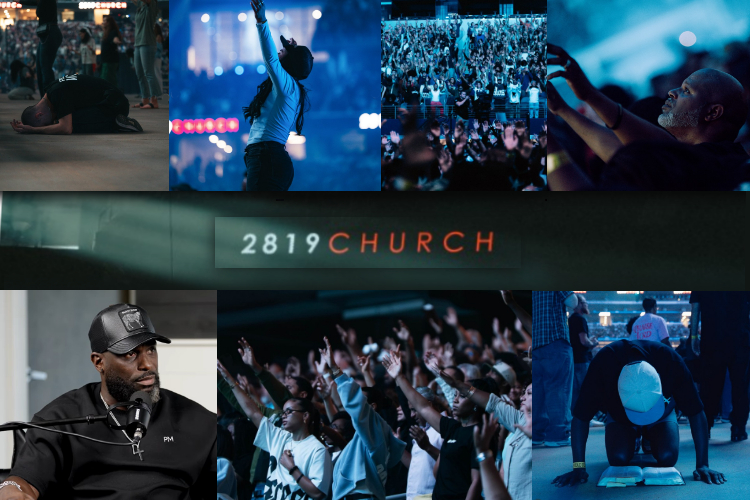
An 80,000-strong gathering in Texas signals a hunger for revival, as Pastor Philip Anthony Mitchell warns that Christian indifference could leave future generations without the faith.

15 October 2026
4.2 MINS
Many Australian Christians don’t know a single Aboriginal person. Robyn Murray argues that reconciliation begins with honest history, prayer and a shared life in Christ.

15 October 2026
7.2 MINS
A man’s death in a tiger enclosure sparks chilling online reactions, exposing a growing willingness to judge human worth by usefulness, behaviour and ideology.



Wow this is a really great bit of news. Joe is on a journey to Jesus!!!!!!!!!!!!!!
Joe Rogan doing God’s Work. So pleased to hearof the conversions of famous people in USA. It gives me hope for the future, especially with a new Popewith a sense of humour .
Here’s the start of the Wikipedia entry for Georges Lemaître: “Georges Henri Joseph Édouard Lemaître (/ləˈmɛtrə/ lə-MET-rə; French: [ʒɔʁʒ ləmɛːtʁ]; 17 July 1894 – 20 June 1966) was a Belgian Catholic priest, theoretical physicist, and mathematician who made major contributions to cosmology and astrophysics. He was the first to argue that the recession of galaxies is evidence of an expanding universe and to connect the observational Hubble–Lemaître law with the solution to the Einstein field equations in the general theory of relativity for a homogenous and isotropic universe. That work led Lemaître to propose what he called the “hypothesis of the primeval atom”, now regarded as the first formulation of the Big Bang theory of the origin of the universe.”
Conrad Hyers, in his “The Meaning of Creation: Genesis and Modern Science,” warned about comparing the Genesis creation texts too closely with science. Comparisons ordinarily should be of like kind: apples with apples and oranges with oranges. But comparing the Genesis creation texts with science is more like comparing apples with aardvarks or oranges with orangutans.
Anyway, the “Big Bang” has often been seen as a reconciliation of science and faith at least partly because it was proposed by a Catholic priest. Yet as a Catholic, I do not pin my belief in Christ on the acceptability of the Big Bang theory.
Addendum to earlier post: The Genesis creation texts have much to do with opposing polytheism and syncretism (the mixing of creeds or beliefs). They are not science texts and we should be careful not to make nonsense of non-science.