


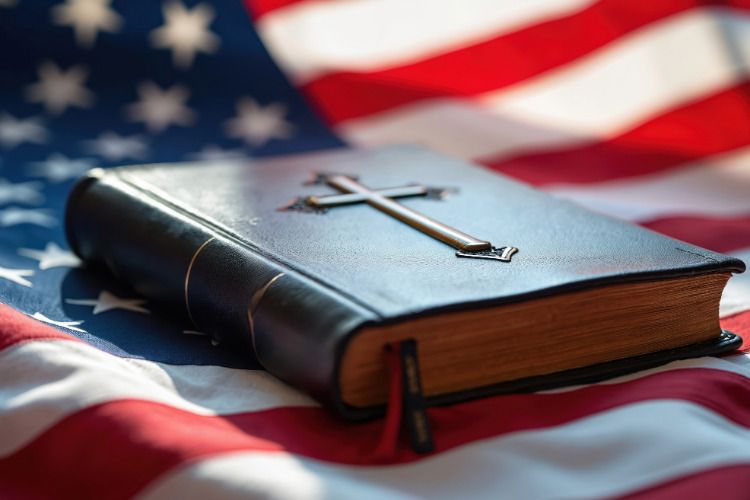
The Rise of Christian Nationalism as the Mainline Church’s Chief Villain
Walk into many mainline churches today, and you may hear less about Christ crucified and risen—and more about the perceived dangers of Christian nationalism. To be sure, some of these concerns reflect legitimate fears about confusing patriotism with discipleship or wielding faith as a tool of political power.
Yet in many contexts, this focus has grown so dominant that it risks eclipsing the Gospel itself. When the church builds its identity primarily around opposing a villain rather than proclaiming a Saviour, something essential is inevitably lost.
Some critiques of Christian nationalism are fair. They rightly warn against confusing patriotism with discipleship or elevating the nation above Christ. But what stands out in today’s mainline landscape is how the term has shifted. It’s no longer a cautionary label—it’s become the centrepiece of their moral vision.
Recent statements from United Methodist bishops, for example, denounce Christian nationalism alongside authoritarianism and political violence, noting that it fosters racism, xenophobia, tribalism, and misogyny (United Methodist Council of Bishops, 2024). Leaders in the Presbyterian Church (USA) have likewise described Christian nationalism as a threat to democracy and religious freedom and have linked it to white supremacy, misogyny, and anti-LGBTQ+ discrimination (Presbyterian Church [USA], 2025).
The Evangelical Lutheran Church in America has also joined campaigns opposing Christian nationalism, cautioning that it distorts Christian identity and contributes to racial and cultural injustice (Evangelical Lutheran Church in America, 2023). Sermons, denominational statements, and seminary conferences increasingly portray it as the root of numerous societal ills—and the primary threat the church must confront.
Blind to Progressivism’s Grasp
To be fair, many critiques of Christian nationalism are warranted. They rightly caution against blurring the line between patriotism and discipleship or placing love of country above allegiance to Christ. When nationalism co-opts the church, it can wrap the cross in the flag—substituting cultural pride for repentance and faith. Mainline leaders often recognise this danger with clarity and conviction.
What they rarely see—or refuse to see—is that progressivism can do the same thing. It, too, is a political philosophy with its own moral vision, seeking to capture religion and bend it to serve its political ends. Where nationalism tries to harness the church to advance the nation, progressivism tries to harness the church to advance its ideological causes.
Yet in many mainline churches, this danger goes unexamined. They speak as though politics only corrupts faith from the right, never from the left. But whenever the church becomes a mouthpiece for any political vision—whether nationalist or progressive—it stops being the church. It becomes just another institution trading eternal truth for cultural relevance.
Why the Near Obsession?
This near obsession didn’t appear out of nowhere. It traces back to the influence of Michel Foucault. Because he taught that truth claims are simply veiled bids for power, many mainline theologians trained in his wake came to see any confident or exclusive Christian belief as inherently oppressive.
In their eyes, Christianity is only “safe” when it renounces its authority claims and functions purely as a tool for social reform. Anything more than that—a faith that claims to speak with divine authority—is viewed with suspicion.
Foucault’s Philosophy: Deconstructing Truth, Morality, and Identity
Michel Foucault (1926–1984) rejected the idea that truth is something objective to be discovered. He argued instead that what we call “truth” is manufactured by those in power to preserve their dominance. Knowledge, he claimed, is never neutral; it’s shaped by institutional interests. He dismissed universal moral laws as nothing more than cultural inventions enforced by the powerful.
Foucault treated social institutions—churches, families, schools, even medicine—not as bearers of truth, but as systems of discipline and control. Categories like male and female, sane and insane, or right and wrong weren’t fixed realities to him but social constructs designed to sustain authority.
This outlook stands in stark opposition to the Christian vision of a God who reveals truth, gives moral law, and creates us in His image. Yet over time, these ideas seeped into mainline churches through their seminaries—subtly at first, then in a flood. Like termites hollowing out the beams of a house, Foucault’s scepticism about truth and morality quietly eroded the theological foundations that once sustained these institutions.
How Foucault’s Lens Made Christian Nationalism the Perfect Scapegoat
Within this framework of suspicion, Christian nationalism became the ideal villain. To many mainline leaders shaped by Foucault’s lens, it embodies everything they fear most: the use of Christian faith as a cover for cultural and political dominance.
It offers a simple, tidy explanation for complex problems. Political polarization, racial division, cultural decline—these are all flattened into a single cause: the lingering power of Christian moral norms, especially where they intersect with political conservatism.
A Substitute Gospel Without Repentance
This narrative also serves a strategic purpose. By defining themselves against Christian nationalism, many mainline leaders can claim moral credibility without upholding historic Christian doctrines.
It allows them to maintain a religious identity while rejecting the authority of Scripture. Instead of grounding righteousness in repentance and faith in Christ, they signal virtue by opposing what they portray as the church’s oppressive past. In effect, the fight against Christian nationalism becomes a substitute gospel—one that promises moral standing without personal conversion.
The Danger: Redefining Sin and Losing the Gospel
But here’s the danger: when Christian nationalism becomes the chief enemy, sin gets quietly redefined—not as rebellion against God, but as holding the wrong political loyalties.
The church’s prophetic voice shifts from calling all people to repent and believe, to shaming those who still hold historic Christian convictions. Instead of confronting the world’s rebellion, the church turns inward, rebuking its own faithful for believing too firmly. The result is a church that loses its Gospel clarity and mistakes ideological purity for holiness.
The Cost: Mission Replaced by Suspicion
This is why so many mainline leaders now speak more about dismantling Christian nationalism than about proclaiming Christ. Foucault’s logic taught them to see power where previous generations saw truth—and to tear down where previous generations sought to build up.
The gospel gets replaced by suspicion, and mission by the policing of ideological boundaries. When the church abandons the truth that sets people free, it inevitably settles for managing appearances. And what it loses in the process is nothing less than its calling: to proclaim Christ crucified and risen as the hope of the world.
The Way Forward: Recovering the Gospel as the Church’s Centre
The way forward isn’t to baptise politics—whether nationalist or anti-nationalist—but to recover the Gospel as the church’s defining centre.
The church must speak with courage, not suspicion. It must proclaim truth as revealed by God, not as constructed by power. And it must call people to repentance and faith in Christ, not to ideological conformity.
Only by returning to the authority of Scripture and the hope of the cross can the church regain its prophetic voice and fulfil its mission in a fractured world.
Returning to the Centre
The church was never called to save the world by finding the right villain to fight. It was called to proclaim a Saviour who already conquered sin and death. When we build our identity around opposing an enemy—whether nationalism or anything else—we trade the gospel for a cause, and causes can’t redeem souls.
Only Christ can. And when the church recovers Him as its centre, it will stop grasping for moral credibility in the eyes of the world and start shining again as what it was meant to be—a people set apart, not by politics, but by the cross.
This piece was adapted from my earlier article, How Foucault Hollowed Out Mainline Christianity — And Why We Must Return to Scripture.
___
References
Evangelical Lutheran Church in America. (2023). ELCA presiding bishop joins Christians Against Christian Nationalism campaign.
Foucault, M. (1977). Discipline and punish: The birth of the prison. Pantheon Books.
Foucault, M. (1978). The history of sexuality, Vol. 1: An introduction. Pantheon Books.
Noll, M. A. (1992). A history of Christianity in the United States and Canada. Eerdmans.
Orr, T. (2025, September 13). How Foucault Hollowed Out Mainline Christianity — And Why We Must Return to Scripture.
Presbyterian Church (U.S.A.). (2025, July 8). General Assembly committee publishes resource to help Presbyterians confront Christian nationalism.
Trueman, C. (2020). The rise and triumph of the modern self: Cultural amnesia, expressive individualism, and the road to sexual revolution. Crossway.
United Methodist Council of Bishops. (2024, September 19). Bishops denounce political violence, authoritarianism.
Wells, D. F. (1994). God in the wasteland: The reality of truth in a world of fading dreams. Eerdmans.
___
Image courtesy of Adobe.
3 Comments
Leave A Comment
Recent Articles:

27 October 2026
1.5 MINS
Labor’s Digital Duty of Care Bill threatens free speech, empowers covert online surveillance, and imposes potentially burdensome regulations on Australian businesses.

27 October 2026
10.3 MINS
As Tasmania and Western Australia consider conversion therapy bans, a former LGBT+ ministry leader warns of threats to religious freedom, personal choice and Christian discipleship.

27 October 2026
4.9 MINS
Nine Christians have been killed in a terrorist attack on a Jordanian church, prompting fierce condemnation, demands for justice and renewed concerns about religious persecution.

27 October 2026
3.6 MINS
For 25 years, the Mount Moriah Trust has supported struggling Christians across the Holy Land, bringing practical assistance, encouragement and hope to believers facing hardship and persecution.

27 October 2026
1.3 MINS
Moira Deeming’s re-election campaign has energised Family First supporters, raising $90,000 as the party prepares for a crucial Victorian election and a potential breakthrough.

27 October 2026
3.1 MINS
As the disciples discovered through a huge haul of fish, we can trust Jesus for a net-breaking, boat-sinking catch of people.
26 October 2026
4.5 MINS
OECD chief Mathias Cormann warns Australia is losing its competitive edge, as excessive regulation, housing pressures, immigration challenges and declining public trust threaten national prosperity.



Thank you for this neat contrast between the ways of man and the ways of the living God.
Man is ever striving to justify himself – with or without God – whereas God, with amazing patience, is ever suffering the rebelliousness of man, while constantly offering us the truth of the Gospel of grace in Jesus Christ.
And when man receives this Gospel, we receive the truth – which sets us free. Free in every way. So wonderful !
Foucault, even with just what is mentioned here, is obviously a marxist, bent on twisting the truth for his own agenda. And the agenda of marxists, an anti-christian belief, is to destroy the church, destroy the west with is christian roots, and Israel.
All christians need to understand that marxism is essentially a satanic cult and all marxism must therefore be automatically rejected.
Very incisive. Thank you for your clarity and perspective.