


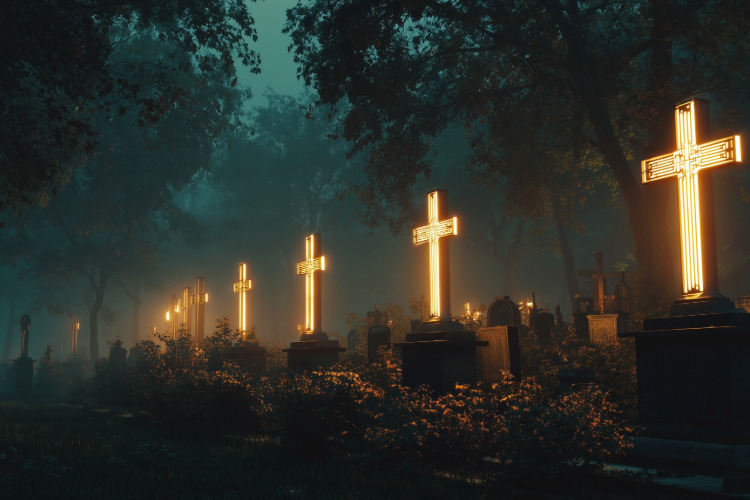
Towards a Redeemed Halloween: How Can Christians Take Back All Hallows’ Eve?
Christians tend to have one of two responses to Halloween.
The first is unquestioning acceptance and participation, and the second is aggressive repudiation. But few Christians realise just how deeply Christian Halloween’s historic and theological roots are—and how differently it looks today as opposed to when it was first observed.
In this article, I aim to provide some brief context—surveying the origins and development of the holiday—and suggest how Christians can observe it as what it historically is: a uniquely “Christian” festival.
Halloween’s Origins (Part 1): A Celtic New Year’s Feast of the Dead?
So what are Halloween’s origins?
Etymologically, the word Halloween (or Hallow-e’en / Hallow e’en) is a sixteenth-century Scottish contraction of “All Hallowen, Allhallowe’en, All Hallows even, etc.”—referring to “the evening before All-Hallows”. The noun form of hallow is from the Middle English halwe (“holy person, saint”), which is in turn from the Old English halga (which comes from the verb form of “hallow”—“to make holy, sanctify; to honour as holy, consecrate, ordain”).
It is often claimed—typically either by atheists eager to “taint” a supposedly Christian festival (as they often do with Christmas) or by Christians convinced of Halloween’s “satanic” origins—that All Hallows’ Eve (31 October), All Hallows’ Day (1 November), and All Souls’ Day (2 November) have their origins in the Celtic New Year and feast of the dead—a festival called Samhain.
The issue is that the historical evidence for such a festival—let alone for its influence on Christian traditions—is vanishingly thin.
(Indeed, specialists in Iron Age Britain are increasingly jettisoning “the concept of a unitary ethnic, linguistic, and cultural province inhabited by such people [the ancient Celts], and the term ‘Celtic’ itself had become controversial for ancient Europe” [Hutton, 70].)
In an influential article published in 2024, Professor Ronald Hutton—a historian specialising in British folklore, pre-Christian religion, and modern paganism—interrogated the evidence for Samhain and its connection with Halloween.
He concludes in terms that are unusually forceful for a peer-reviewed article:
“The argument for an ancient ‘pagan Celtic New Year’ and feast of the dead at that season was entirely the work of two very worthy and influential scholars writing over a hundred years ago, to which nothing of substance has been added since. On examination, the evidence for the New Year is all indirect, speculative, and inconclusive…
Evidence for the feast of the dead is pretty near non-existent. Neither idea has been conclusively disproved, and probably never will be: it is notoriously difficult to prove a negative in many areas of cultural history. Nevertheless, on the available evidence, it may be suggested that neither should find a place henceforth in publications on the Western European pre-Roman Iron Age … unless recognized as flimsy historical hypotheses, anchored in doubtful Victorian and Edwardian scholarship. Certainly, they should no longer be restated as proven fact.” (Hutton, 82–83).
The language Hutton uses to dismiss the evidence surrounding the Samhain New Year’s Festival is stinging: “indirect, speculative, and inconclusive”; “pretty near non-existent”; “flimsy historical hypotheses, anchored in doubtful… scholarship”.
As Nicholas Rogers, another eminent specialist, puts it, “… there is no hard evidence that Samhain was specifically devoted to the dead or to ancestor worship, despite claims to the contrary by some American folklorists, some of whom have presumed that the feast was devoted to Saman, god of the dead” (24).
The Influence of Paganism on Halloween
Indeed, two of the key scholars responsible for the popular notion of the Celtic New Year and feast of the dead—Sir James Frazer and Sir Edward Tylor—shared a “contempt for superstition and Catholicism, and extended it to a general desire to discredit religion, and especially Christianity, in modern society” (Hutton, 72).
For his part, Frazer believed that All Souls’ Day is “nothing but an old pagan feast of the death which the Christian, unable or unwilling to suppress, resolved from reasons of policy to connive at” (quoted in Hutton, 72), calling it “a concession to ineradicable paganism” (quoted in Hutton, 73).
Although they were formidable scholars, Frazer and Tylor were not impartial historians, seeking to understand the development of Celtic and Christian traditions in all their complexity.
They were committed to undermining and discrediting the Christian faith.
As Hutton notes, there is “not a single medieval record of churchmen either attempting to suppress a pagan feast of the dead in northern Europe by instituting All Saints’ Day or attempting to replace one by instituting All Souls’ Day” (Hutton, 76).
This is not to say that Christianity—with its festivals and practices at the time—simply floated in a cultural vacuum.
Indeed, most scholars recognise the influence that pre-existing—even pagan—rituals, calendars, and traditions had within medieval Christian cultures and societies. However, it is extremely difficult to trace such influence with any certainty—not least for particular rituals and festivals like Allhallowtide (the term used to describe All Hallows’ Eve, All Hallows’ Day, and All Souls’ Day together).
In fact, Hutton even suggests that “folk attitudes” (often repeated today) about the nature of the pagan customs that supposedly influenced Allhallowtide (for example, the notion of a “feast of the dead”) may have themselves been shaped retrospectively through the lens of longstanding Christian practices (Hutton, 79).
In other words, instead of pagan customs influencing a later Christian festival, it is at least plausible that our popular understanding of those early pagan rituals is influenced by the longstanding traditions associated with the Christian festival itself!
Halloween’s Origins (Part 2): The Development of a Christian Holiday
Even our historical understanding of the Christian festivals of All Saints’ (another term for All Hallows’) and All Souls’ Days is somewhat patchy.
That said, even with gaps in the record, several things are clear.
By the early medieval period, Western Christians were commemorating saints and martyrs on a fixed date (1 November). Similarly, they had developed a vigil the night before (31 October). And finally, by the end of the first millennium, they had added a day specifically devoted to praying for and remembering departed Christians (2 November).
Hutton identifies a few well-attested facts:
- By the seventh century AD, we have strong evidence for a range of annual “regional Christian traditions” that commemorated Christian martyrs. This “may have included saints in general”.
- For example, one such festival was apparently held in Rome on 13 May as early as AD 609 or 610. Another is recorded in a late sixth or early seventh-century German text—apparently taking place on the Sunday after Pentecost.
- Pope Gregory IV (827–844) is supposed to have been responsible for standardising the 1 November date for the Hallowtide feast for All Hallows’ Day. As Hutton notes, “there is no clear evidence as to why [the decision to impose the festival on the new date upon the entire empire] was made, and what influence, if any, regional initiatives […] contributed towards it”.
- The full-fledged adoption of the festival “by all branches of the Western Church” spread gradually—taking until the end of the eleventh century to establish itself universally.
- The pattern for the emergence and development of All Souls’ Day appears to have been similar to that for All Saints’/Hallows’ Day: “one of individual local initiatives which eventually grew into a standardized practice, although the feast of All Souls was never formally adopted or ordained by a Pope in the manner of All Saints. In either case, there is nothing Celtic in the geography of this process. The early local initiatives seem to have been mostly Germanic, although it may be anachronistic to use such terms, and it could be better to think instead of a unified Frankish Christian culture covering the later France and Germany and associated with a dynamic new Holy Roman Empire”.
Hence, from what we do know historically, the Hallowtide festivals of All Hallows’/Saints’ Eve, All Hallows’/Saints’ Day, and All Souls’ Day developed out of local Christian festivals to commemorate the martyrs and saints and later as an opportunity to intercede for the souls of the dead.
Hallowtide’s Catholic Character and Protestant Responses
Although Hallowtide does have a distinctly Roman Catholic nature, especially with its latter practices of intercessory prayer for the dead, All Saints’ has also been observed by Protestants—notably under Elizabeth I in England in the mid-sixteenth century, “as an occasion to celebrate the saints as outstanding Christians, not as semi-divine intercessors” (Rogers, 31).
Rituals for the festivals varied from period to period and from Catholic to Protestant, but the focus on honouring the dead—both martyred Christians and dead Saints and outstanding Christians—and celebrating Christ’s victory over death remained.
Similarly, the popular practice of trick or treating has its origins in Catholic “souling”—with “supplicants” moving “from door to door asking for food in return for a prayer for the dead” (Rogers, 32–34)—rather than pagan rituals (as is commonly believed).
Of course, in the view of most Protestants, the practice of praying for the dead has dubious theological support (especially when more closely connected with prayer for souls in purgatory), but it is far from pagan.
As Rogers notes, it is perhaps more appropriately characterised as “a ritual cycle of enforced charity by the labouring classes as winter set in”—and was only “often only nominally concerned” with the Catholic doctrine of purgatory:
“As such, it was but one of many possible occasions for door-to-door treating. There were other “doleing days” that could suit: Guy Fawkes Day (5 November); St. Clement’s Day (23 November); St. Catherine’s Day (25 November); St. Andrew’s Day (30 November); even St. Nicholas’s Day (6 December) and St. Thomas’s (21 December), just a few days before Christmas”.
While many Protestant denominations—including the Lutheran Church, Reformed Church, Anglican Communion, and Methodist Church (among others)—continue to recognise All Saints’, not all Reformers have been so favourable towards it.
Famously, the Puritans in England attempted to suppress celebrations of Christmas (including both religious and secular rituals) between 1644 and 1659—on the basis of its Roman Catholic origins and its associations with “excesses such as play-acting, gambling and dancing”.
The Puritans approached the Hallowtide festivals similarly, seeing them as a “betrayal of the Reformation” and too closely associated with Rome (Cressy, 48).
Hence, while many Protestants have chosen to continue to observe Hallowtide festivals, others have rejected them entirely. However, historically, this has had as much to do with its associations with Roman Catholicism as it has to do with its allegedly pagan or satanic origins.
Importantly, many of the modern superstitions (whether believed or not) around supernatural activity—the conviction that ghosts, spirits, and witches were more likely to be abroad at the time, for example—developed in the seventeenth and eighteenth centuries (Rogers, 35).
Such superstitions, then, are not necessarily evidence of pagan origins or influence.
They are merely wide-ranging and eclectic manifestations of various modern folk rituals associated with the festival.
For example, in England, rituals and folk beliefs associated with Guy Fawkes Night (or Bonfire Night) on 5 November closely resemble more modern Halloween traditions (including souling, fire rituals, and mischievous behaviour) (Rogers, 36–40).
Perhaps more significantly, it is also in more recent times (the seventeenth and eighteenth centuries) that a closer association—and an increasing belief in the historical association—between Halloween and Samhain itself has evolved (Rogers, 41–42).
This may explain the persistence of that association despite the lack of any firm historical evidence for it.
Redeeming Halloween
So how can (and should) Christians respond to Halloween today?
The occasion indisputably has Christian origins. Furthermore, claims by both internet atheists and some Christians that its foundations are irredeemably pagan or satanic are unfounded.
They reflect concerns with modern practices more than they do with the foundations of the holiday itself.
So, can All Hallows’ Eve (and the associated days) be redeemed?
I think so.
While much more could be said, let me make just two points.
Firstly, to those who insist that Halloween cannot be redeemed due to pagan influences, I would first point to the long Christian tradition of “plundering the Egyptians”—a term used to justify the absorption of what is good in the non-Christian world, so long as it aligns with Christian truth and practice.
According to Exodus 12:36, when the people of Israel departed Egypt:
“the LORD had given the people favour in the sight of the Egyptians, so that they let them have what they asked. Thus they plundered the Egyptians” (ESV).
Christians have long used this verse to justify the appropriation of a range of non-Christian wisdom and practices (from Greek philosophy to the modern scientific method to certain Christmas traditions) to be used for the glory of God.
The notion of “plundering” or “despoiling” the Egyptians has come to refer to taking what is good in the world—and what supports Christian truth—and using it for God’s glory.
For instance, Origen (AD 184/5–253) writing in his Homilies on Exodus, insists that pagan philosophies—while they are to be repudiated when they conflict with Christianity—can be appropriated by the people of God where there is value in them (Homily IV).
Similarly, Basil of Caesarea (AD 329–379), in his Address to Young Men on the Right Use of Greek Literature, teaches young believers to read pagan philosophy and literature—“in which truth appears as in a mirror” (Outline, II).
Neither of these early Church writers suggested that pagan writings and practices are simply to be discarded—thrown away in their entirety. All good things are from God and can be enjoyed and utilised—including good philosophy (and for our purposes, good festivals and harmless or enjoyable traditions).
Nor is there the sense in these early Christian writings that Christianity is tainted by its associations with pagan influences—where such influences align with Christian truth. Insofar as pagan wisdom, precedent, or practice is beneficial for the promotion of the Gospel, it can be utilised by Christians.
When Christianity and a false religion come into contact, the assumption is that the false religion will give way to the true one—but that which is true in the false religion can continue to be embraced by Christians.
This notion resonates with the writings of twentieth-century Christian author C. S. Lewis, who argued that where Christianity and paganism resemble one another (in philosophy or form), Christianity need not repudiate the resemblance.
Instead, he noted, when this happens, “so much the better for Paganism!”
It also aligns with the Apostle Paul’s approach on Mars Hill in Athens, where he drew on Greek philosophy and mythology to preach the Gospel (Acts 17:16–34 ESV).
Hence, Christians have long been comfortable “plundering from the Egyptians” to support the Kingdom.
Secondly, however, I think it is important to be thoughtfully redemptive about practices like Halloween and Christmas. We cannot use redemptive language as a flippant justification for the wholesale acceptance of worldly practices.
“Redemption” is not simply a rubber-stamp.
There is undoubtedly much about modern Halloween (as there is in modern Christmas and Easter festivities) that is incompatible with Christian faith and practice. Christians should avoid any practice that conflicts with our religion.
That much goes without saying.
Nonetheless, just because Christians cannot celebrate Halloween in the same way that the world celebrates it does not mean that we cannot commemorate it at all.
Just as Christians fiercely defend the heart of Christmas and Easter in the face of commercialised reimaginings, can we not redeem the heart of All Hallows’ Day as a day of remembrance and reflection for Christian martyrs and Christ’s victory over death?
I think we can.
By the grace of God, we can turn Halloween into a redemptive opportunity—by rediscovering its Christian roots and celebrating the triumph of Christ over death itself on the cross!
“Behold! I tell you a mystery. We shall not all sleep, but we shall all be changed, in a moment, in the twinkling of an eye, at the last trumpet. For the trumpet will sound, and the dead will be raised imperishable, and we shall be changed. For this perishable body must put on the imperishable, and this mortal body must put on immortality. When the perishable puts on the imperishable, and the mortal puts on immortality, then shall come to pass the saying that is written:
“Death is swallowed up in victory.”
“O death, where is your victory?
O death, where is your sting?”The sting of death is sin, and the power of sin is the law. But thanks be to God, who gives us the victory through our Lord Jesus Christ.
Therefore, my beloved brothers, be steadfast, immovable, always abounding in the work of the Lord, knowing that in the Lord your labor is not in vain.” (1 Corinthians 15:51–58 ESV)
___
Bibliography
- Basil of Caesarea, Address to Young Men on the Right Use of Greek Literature.
- David Cressy, “The Protestant Calendar and the Vocabulary of Celebration in Early Modern England,” Journal of British Studies 29 (1990): 31–52, https://doi.org/10.1086/385948, accessed 29 October 2025.
- Ronald Hutton, “The Celtic New Year and Feast of the Dead,” Folklore 135 (2024): 69–86, https://doi.org/10.1080/0015587X.2023.2282282, accessed 29 October 2025.
- C. S. Lewis, “Is Theology Poetry?” originally presented as a lecture to the Oxford Socratic Club in 1944. Republished in The Weight of Glory and Other Addresses (San Francisco, HarperOne: 2001).
- Origen of Alexandria, Homilies on Exodus.
- Nicholas Rogers, Halloween: From Pagan Ritual to Party Night, Proquest Ebook Central (Oxford, Oxford University Press: 2002), accessed 29 October 2025.
___
Image courtesy of Adobe.
29 Comments
Leave A Comment
Recent Articles:
19 October 2026
12.4 MINS
Greta Gerwig’s "Narnia: The Magician’s Nephew" trailer raises questions about C. S. Lewis’s Christian vision and the faithfulness of the new Netflix adaptation. Here are my initial impressions and concerns.

19 October 2026
3 MINS
Paul prayed that we would be awakened to a deeper revelation of the Father and who we are in Christ, so that we will make Jesus known to others more passionately.
18 October 2026
2.7 MINS
Every season of life belongs to Christ, and we don't retire from discipleship as we grow older. In fact, our older years hold unique gifts for the younger generations.
17 October 2026
3.4 MINS
Seeking the face of God means surrender, laying aside our agenda and wants. Revival begins when we want God himself more than we want the outcome.
16 October 2026
3.3 MINS
Jesus is calling us to love one another “just as I have loved you”. And if the Church does awaken to that agape (love), the world will see a great and powerful witness to Christ and his kingdom.
15 October 2026
3.6 MINS
An 80,000-strong gathering in Texas signals a hunger for revival, as Pastor Philip Anthony Mitchell warns that Christian indifference could leave future generations without the faith.

15 October 2026
4.2 MINS
Many Australian Christians don’t know a single Aboriginal person. Robyn Murray argues that reconciliation begins with honest history, prayer and a shared life in Christ.



A very well researched article Cody and very thought provoking. However, I am not sure I personally care about rescuing Halloween from its modern day paganism. Although, if any Church rescuing effort was successful, then that would be better than the situation at present.
Hi David, thanks for your comment. I completely understand the sentiment! As I said to Kevin below, this is not something Christians should bind one another’s consciousness over. As I see it, it is an opportunity—one that not every Christian needs to care about as much as everyone else.
It seems to me that you are trying to justify Halloween. Halloween celebrates dead people, dead bodies, skulls, skeletons, death and the devil.
Jesus is the opposite. He is the way, the truth and the life. John 14:6
Why would biblical Christians want to justify any practice based on the unbiblical practices of the corrupt Medieval Church?
Hi Judith, thanks for your comment. I think there is a slight misunderstanding here. I’ve replied more extensively to Kevin’s comment, which perhaps clarifies some stuff around the medieval Roman Catholicism.
To clarify further, I am not endorsing or justifying the modern rituals and celebrations associated with Halloween. What I am urging us to do is to discover the historical (and very Biblical) impulse behind the celebration. Halloween (as I show in the article) is a fundamentally Christian occasion. Sure, it has been perverted, but that is all the more reason to celebrate it as it should be celebrated (not as the world celebrates it).
As I see it, Allhallowtide is an opportunity to 1) commemorate those who have lost their lives for Christ’s sake, 2) pray for and encourage the persecuted church, 3) be encouraged by the faithful witness of exemplary Christians, and 4) celebrate Christ’s victory over death. All of these things are historically and Biblically justifiable. I don’t know (or care, really) precisely how Christians do that. But it seems to be a great opportunity to pray, meet, reflect, and push back against the forces of darkness and death.
Just some thoughts.
You’ve put a lot of work into this article Cody, but there is now way anyone can convince me that such a demonic celebration is redeemable. Every time I walk into a premises displaying all this stuff it’s all I can do not to rebuke its evil in Jesus name. We never had this rubbish in our country when I was growing up and it is so sad to see this stuff being pushed when half of Aussies don’t even remember our awesome God. Sorry mate but I HATE Halloween
Hi Shane, that is a very understandable sentiment—and thank you for your kind words. I replied to Kevin below with some additional thoughts and clarifications, which I think are also relevant to your comment.
I would just say, in brief, that I am hesitant to say that any day is irredeemable as every day is God’s and created for His glory. I am not suggesting that Christian join in the demonic celebrations. What I am suggesting is that we fight back against them by rediscovering the impulse behind the Christian celebration of All Hallows’. This seems like a better approach to me than 1) to opt out and leave the day to Satan, or 2) to thoughtlessly participate in what is a really evil set of practices.
In a way, the righteous hatred of what Halloween has become should spur us to fight back against it all the more fiercely.
That said, as I mentioned to Kevin, this is certainly not something Christians should bind each others’ consciences over!
11:21 1/11/2025
Dear Brother Cody,
I think i am
Aghast
While I AM knows all things
i am hardly knows anything
However
Whosever
May come
&
Whoever
Causes a little one to stumble
A millstone
Dear Brother
Please
Speak some words
Re:
Opening doors
To the spiritual powers
&
Principalities
&
Rulers of darkness
Thanks for the research and article Cody. The talk by Pastor Mark is very helpful as a background and stimulates thought. It’s good his church prays and uses the day to outreach using tracts and outreaching to show that Jesus lives and there is a Saviour who brings life. (One idea came to mind- the Jesus film or a film for children about Jesus could be shown on the Halloween night and games follow)
As a Pastor doing apologetics- he asks us to check our heart attitude. He does that so we can still be used by God to reach those who haven’t any living faith. (To us, as Christians we see the evil and dark world behind and it and spiritual activity and find it offensive and renounce it privately, but we can pray the enemy is bound, that families and children lose interest in these things and that they long to turn to God and His light instead and His word.)
We have to keep in mind the general public haven’t seen the light of Christ yet and they are not realising any evil lies behind some of the practises eg worship of the dead, dressing up as witches or focusing on darkness….We can keep praying the culture changes back to God and the Bible and that fewer celebrate this night of darkness and lose interest. Plus we can pray God sends weather changes to wash out the night celebrations of Halloween (God often answers these prayers e.g. This year Sydney has to cancel the ghost celebration night.) Prayer covering is definitely needed at this time so the enenmy can’t bring harm to homes or families or individuals.
A follow up or parallel article might be ‘How can Christians respond to Halloween and use it wisely, for outreach?’
Thanks so much for your thoughts, Gail.
A follow up article is certainly something I am considering as I think more deeply about this over the coming months.
REALLY Brilliant article Cody!!!!!!!!!!
Thanks, Warwick
I believe adopting pagan practices into Christian life is called SYNCRETISM. This has been going on since the resurrection and ascension of Christ. The Roman Kingdom as dreamt by Nebuchadnezzar has changed God’s words in 312 CE and protestant tradition based denominations have adopted these changes.
The book of Deuteronomy has much to say to God’s people about not adopting pagan ways and worship. I wonder if believers studied what God says about pagan worship whether they would be so willing to accommodate to our secular culture?
Romans 12 tells us not to be conformed to this world- to have the mind of Christ and to be led by His indwelling spirit .
Believers are called to be holy as He is holy. Christ said If you love Me keep my commandments . 1 John 5:3 defines love – this is the love of God that you keep Hia commandments and they are not grievous.
Would Christ dress up as a devil or a witch? Why not? Because He glorified His Father. Because Christ is Truth and Life – He died so we could have life in Him .
Just listen to the testimonies of converted witches and Satanists about celebrating Halloween.
Proverbs tells us that the fear of God is the beginning of wisdom. Does welcoming principalities and powers into your home and community express anything but familiarity with Darkness,,?
The children of Israel quickly refused to obey God’s commands Moses told them they would rebel and come under judgment and end up being scattered across the earth. Joshua urged them to choose life.
Christ draws us to Himself. He seals us with His Spirit who writes God’s word on our hearts and mind. He says His people are a peculiar people – not like others. He says His people are a royal priesthood, a kingdom of priests led by Him.
As for me and my house we will serve God, overcoming evil by doing good, keeping His commandments.
Thanks for your comment, Bev. Your concern around syncretism is a really important one, which is well worth raising.
It is important to recognise that syncretism necessarily involves some kind of compromise on the part of Christian truth. For example, the Bible teaches that there is one (Triune) God. Syncretism would be modifying this believe so as to affirm both a Triune God and pantheistic deities. This would be an example of syncretism in that Christian truth is being denied as a result of the adoption of a believe that is incompatible with Christian doctrine.
The question, then, is what are “pagan practices” (and, I would add, “pagan doctrines”)? Are they just anything that pagans happen to do or believe? Or are they practices and doctrines that are incompatible with Christian beliefs, such that a Christian affirming or practicing them would be compromising her faith? I would argue (and by what you have written and cited from Scripture, I suspect that you would agree) that it is the latter. Just because a pagan happens to do something (i.e., have a particular practice) or hold some belief (or celebrate a particular day) doesn’t mean that Christians have to avoid that practice or belief.
That would, of course, lead to absurdities!
To take one example, the Greek philosopher Aristotle argued for the existence of an “Unmoved Mover”—a prime mover or first cause of all motion. Aristotle was not a Christian, but he was correct (as far as it went) about the existence of an immaterial Cause behind the universe. Just because Aristotle held this philosophical conviction doesn’t mean that Christians should deny it. That would mean rejecting the Biblical doctrines that God is the immaterial First Cause of the universe—something all Christians accept.
The Apostle Paul was not above quoting Greek philosophers as he preached the Gospel (most notably on the Areopagus in Acts 17). As one scholar puts it, “Paul engages in critique of his audience with respect to superstition and idolatry by using Hellenistic philosophical tools and by hellenizing biblical traditions. In so doing, he demonstrates that his movements beliefs about God not only demonstrate it to be legitimate but even prove it to be a superior form of religion. The Christian movement embodies the philosophically elites ideals better and more consistently than do the Athenians” (Joshua W. Jipp, 2012, p. 576, emphasis in original).
Paul willingly appropriates pagan believes insofar as they agree with and/or support and/or can be used to build a case for the Gospel. This is not syncretism. It is plundering the Egyptians.
That is also what I am suggesting with Halloween.
Should we dress up as witches or demons and celebrate death and sin? Of course not! That would be syncretistic.
But is it wrong to try to redeem a particular day for Christian prayer, celebration, and reflection? I don’t think so. As I have noted a few times, every day is God’s day. Just because pagans use a day to practice paganism doesn’t mean we can’t use that same day to worship God and proclaim Christ.
I hope that makes some sense.
For Catholics I November was the Day of All Saints , a Holy Day of Obligation, which means everybody was expected to attend Mass to worship God , to give thanks and remember the saints eg St Michael, St George, the Christian martyrs, etc. 2 November was The Day of the Dead when we went to the cemetery to tidy the tombs of our ancestors and friends and place flowers on their graves and say a prayer for their souls. There was no dressing up in weird costumes, or children knocking on doors to get sweets, no pumpkins, seances and Ouija Boards were evil, sinful (against the 10 Commandments ). My teenage daughters were persuaded to play with a Ouija Board by another girl to try to raise the spirit of their deceased father. They told me they raised an evil spirit and got frightened out of their wits , so decided to never to use a Ouija Board again !
I disapprove of Halloween. I see no good in any of it. A pagan , especially Mexican thing, which reminds me of horrible murder and cannibalism.
Thanks for your thoughts! As I note in the article, “Halloween” is simply a corruption of “All Hallows’ Eve” (31 October: also called All Saints’ Day)—which was the vigil before All Saints’ Day (also called All Hallows’ Day). The name and day Halloween itself is not the problem. It is what it has become.
wow such a great article. Wouldn’t it be great for the churches in our towns to put on a festival for families, food games, prayer, and to also have a day of prayer for those saints who have died too, like Charlie Kirk, and others who have passed recently. Thanks for the great article.
Thanks, Alyse. This is great. I was talking with some young guys at church on Sunday about what it would look like for Christians to celebrate Allhallowtide Christianly.
Time for family and prayer is always great. I think Charlie Kirk’s murder also brings the spotlight back onto a Christian festival designed to commemorate martyrs of the faith.
Dear valued Daily Declaration readers and commenters:
We want to make you aware that a recent series of comments on this article were found to be part of a coordinated campaign by a single individual using multiple accounts. Those comments weren’t representative of genuine discussion and have now been removed.
We take the integrity of our comment sections seriously and we’re committed to making sure the comments sections of our articles stay respectful, constructive, and in line with our commenting policy: https://dailydeclaration.org.au/comments/.
We appreciate your vigilance, engagement, and support!
— The Daily Declaration Team