


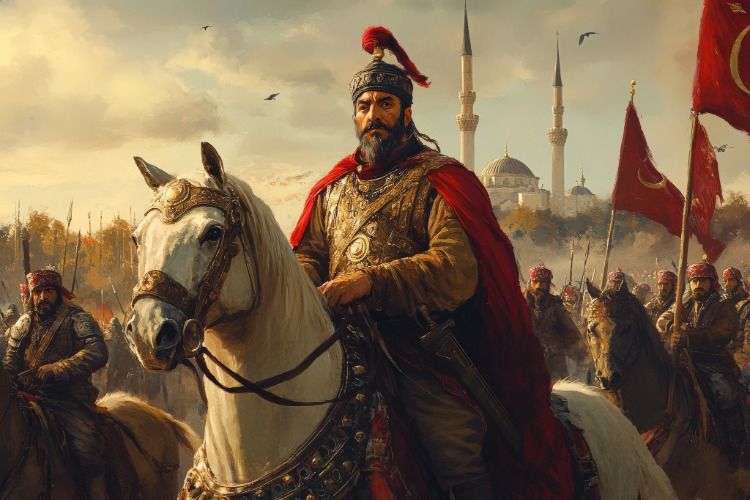
Is Islam a Colonialist Religion?
It’s not popular to say this out loud, but it needs to be said: Islam has a colonial past, and it’s a past we’ve largely chosen to forget — or, worse, sanitise.
We live in an era where “colonialism” is a word synonymous with Western guilt, empire, and exploitation. But what if history reveals that Islam itself operated for centuries with colonial ambitions, rooted not only in geopolitical power but theological conviction?
When examined closely, Islamic history shows striking parallels to what we now call religious imperialism: military expansion, cultural erasure, subjugation of indigenous faiths, slavery, and economic exploitation — all justified in the name of religion.
The Theological Engine of Submission and Expansion
From its inception, Islam presented itself not merely as a religion of personal transformation but as a comprehensive political order that demanded obedience. The very term Islam derives from the root word aslama, meaning “to submit” — and this was not simply submission to God in a spiritual sense, but also submission to the political authority of Muhammad and later the caliphs. As Raymond Ibrahim (2018) notes, Muhammad was not primarily a preacher or theologian in the mould of Jesus or the Buddha; he was a warlord, a legislator, and a conqueror whose success was measured by political control.
The Qur’an contains explicit instructions for this kind of expansion. One of the most referenced verses in this context is Qur’an 9:29, which commands Muslims to “fight those who do not believe in Allah” among the People of the Book (i.e., Christians and Jews), until they submit, pay the jizya (a tax), and feel themselves subdued. This is not simply religious exhortation — it is divine sanction for domination. Early Islamic conquests, then, were not aberrations of a few radicals but fulfilment of what the Qur’an and Hadith explicitly called for: the extension of Islamic rule.
Conquest as Sacred Duty: Islam’s Imperial Expansion
Within 100 years of Muhammad’s death in 632 CE, Muslim armies had conquered three-quarters of the known Christian world. Regions like Egypt, Syria, Palestine, North Africa, and parts of modern-day Turkey were once thriving Christian communities—the heart of early Christianity. These were not backwater regions. Alexandria, Antioch, and Jerusalem were among the five major centers of Christianity, alongside Rome and Constantinople. By the 8th century, most of these were under Muslim rule. As Lewis (1990) observes, “Most of the new [Muslim] domains were wrested from Christendom… All this left a deep sense of loss and a deep terror” (p. 10).
Muslim chroniclers didn’t hide the religious motivation. Whether Arabs, Berbers, Turks, or Tatars, the driving force was not nationalism but jihad — armed struggle for the sake of spreading Islamic governance. Conquest was seen as a religious obligation. The rulers called themselves Amir al-Mu’minin (Commander of the Faithful), not kings or emperors. It was a sacralised imperialism, where state and mosque were inseparable, and political expansion was tantamount to religious victory.
Cultural Erasure and Dhimmitude: The Cost of Conquest
Colonialism is not just about conquering land — it’s about reshaping identities, erasing indigenous cultures, and imposing a new order. This was precisely the experience of Christians and Jews under Islamic rule. Non-Muslims became dhimmis, protected people in theory, but in practice often oppressed minorities who lived under heavy legal, economic, and social burdens. They paid the jizya tax, were banned from bearing arms, riding horses, repairing churches, proselytising, or even mourning their dead in public (Ibrahim, 2018). Open expressions of faith could result in imprisonment or death.
Examples abound. In the 11th century, the Fatimid Caliph al-Hakim bi-Amr Allah ordered the destruction of 30,000 churches in Egypt and Syria in one year alone (Al-Maqrizi, as cited in Vryonis, 1971). Even well after the initial conquests, cultural and religious suppression persisted. This was not tolerance in any meaningful sense—it was structured humiliation and control. And it continued for centuries. The Ottoman Empire, often hailed by modern academics for its supposed pluralism, institutionalised millet systems that kept non-Muslims legally inferior and perpetually vulnerable.
The Forgotten Slave Trade: Islamic Exploitation of Europeans
Slavery is perhaps the most glaring example of Islamic colonialism — and also the least discussed. While Western involvement in the Atlantic slave trade rightly provokes moral scrutiny, Islamic slavery preceded it and lasted longer. From the 8th through the 19th centuries, Muslims enslaved millions of people, including white Europeans, Africans, and Asians. According to historian Robert Davis (2003), an estimated 1 to 1.25 million Europeans were enslaved by Barbary pirates alone between 1500 and 1800. These were not isolated incidents. Muslim slave raids reached as far as Iceland, Ireland, and Russia.
Even the fledgling United States had to confront this reality. The Barbary Wars (1801–1815), America’s first international conflict, were fought against North African Muslim states that justified piracy and slavery using Islamic law. When Jefferson asked why they attacked Americans unprovoked, the Tripolitan ambassador cited the Qur’an, declaring it a Muslim’s duty to wage war against those who did not submit (Jefferson, 1786/1950). This wasn’t aberrant behaviour. It was textbook jihad—religiously justified expansion through violence and enslavement.
The Crusades in Context: A Defensive Response
The Crusades are often used to depict Christianity as equally imperialistic. But this ignores the context: they were launched after nearly four centuries of Islamic expansion into Christian lands. Pope Urban II’s call to arms in 1095 came in response to widespread atrocities, particularly in Asia Minor where the Seljuk Turks had overrun Byzantine territories, desecrated churches, and massacred Christian communities (Vryonis, 1971). The First Crusade was not a campaign of colonial ambition, but of desperate cultural and religious preservation.
Far from being proto-colonialists, Crusaders believed they were liberating ancient Christian lands. Cities like Jerusalem, Antioch, and Edessa had been Christian for centuries before falling under Muslim rule. While the Crusades included atrocities (as nearly all medieval wars did), they were reactions to centuries of Islamic aggression, not unprovoked invasions. Ironically, the only wars modern people remember are the few initiated by Christians—because they disrupt the dominant narrative of Christian guilt and Muslim victimhood.
Why This History Matters Today
This is not just an academic debate. The consequences of forgetting Islam’s colonial past are visible today. European nations that once fought to preserve their cultures from Islamic domination now welcome mass immigration without any historical memory of conflict. Meanwhile, modern Islamic revivalists draw inspiration from past glories of conquest. Groups like ISIS aren’t distorting Islamic history — they’re echoing it. As Ibrahim (2018) points out, “Every time the rationale of these various groups is jihad. It’s the same rationale used for 14 centuries” (p. 245).
In universities and media, postcolonial narratives have painted Islam as the religion of the oppressed, never the oppressor. Scholars like John Esposito (2005) have actively downplayed Islamic aggression, describing the centuries before the Crusades as an era of “peaceful coexistence.” But such revisionism does more harm than good. It robs victims of Islamic conquest of their voice, and it blinds modern policymakers to the ideological continuity between Islam’s past and its more militant expressions today.
Conclusion: Colonialism Beyond the West
If we are going to have honest conversations about empire, power, and historical injustice, then we must expand our lens. Colonialism was not invented in Europe. It is a human impulse, and religious systems have often served as its justification. Islam’s historical record — conquest, slavery, suppression of indigenous cultures — is undeniably colonial. This doesn’t mean all Muslims today support such ideas. But it does mean we should stop pretending Islam’s past was morally superior to the West’s.
Facing this history does not require hostility toward Muslims. It requires integrity. It means applying the same critical standards to all civilisations — Western, Eastern, and Islamic alike. Only then can we build interfaith dialogue that isn’t based on denial, but on truth. And truth, though sometimes uncomfortable, is the beginning of peace.
References
Belloc, H. (1938). The great heresies. London: Sheed & Ward.
Davis, R. C. (2003). Christian slaves, Muslim masters: White slavery in the Mediterranean, the Barbary Coast, and Italy, 1500–1800. Palgrave Macmillan.
Esposito, J. L. (2005). Islam: The straight path (3rd ed.). Oxford University Press.
Ibrahim, R. (2018). Sword and scimitar: Fourteen centuries of war between Islam and the West. Da Capo Press.
Jefferson, T. (1950). The papers of Thomas Jefferson (Vol. 9). Princeton University Press. (Original work published 1786)
Lewis, B. (1990). “The roots of Muslim rage“. The Atlantic, 266(3), 47–60.
Vryonis, S. (1971). The decline of medieval Hellenism in Asia Minor and the process of Islamization from the eleventh through the fifteenth century. University of California Press.
___
Republished with thanks to Dr Tim Orr. Image via Adobe.
8 Comments
Leave A Comment
Recent Articles:

27 October 2026
1.5 MINS
Labor’s Digital Duty of Care Bill threatens free speech, empowers covert online surveillance, and imposes potentially burdensome regulations on Australian businesses.
27 October 2026
10.3 MINS
As Tasmania and Western Australia consider conversion therapy bans, a former LGBT+ ministry leader warns of threats to religious freedom, personal choice and Christian discipleship.

27 October 2026
4.9 MINS
Nine Christians have been killed in a terrorist attack on a Jordanian church, prompting fierce condemnation, demands for justice and renewed concerns about religious persecution.
27 October 2026
3.6 MINS
For 25 years, the Mount Moriah Trust has supported struggling Christians across the Holy Land, bringing practical assistance, encouragement and hope to believers facing hardship and persecution.

27 October 2026
1.3 MINS
Moira Deeming’s re-election campaign has energised Family First supporters, raising $90,000 as the party prepares for a crucial Victorian election and a potential breakthrough.
27 October 2026
3.1 MINS
As the disciples discovered through a huge haul of fish, we can trust Jesus for a net-breaking, boat-sinking catch of people.
26 October 2026
4.5 MINS
OECD chief Mathias Cormann warns Australia is losing its competitive edge, as excessive regulation, housing pressures, immigration challenges and declining public trust threaten national prosperity.



What a history lesson !
Excellent Article! Wake up Australia!
Masked Marchers shouting hate to Israel and Australia, lighting fires and throwing rocks at police should be stopped asap. Assimilate into Australian culture or leave !
A lovely precise of a long and often hideously brutal history. Fascinating and alarming current narratives seek to hide this truth and its implications. as Ibrahim states in a recent interview, “who let the lion in?” we are the ones to blame thinking we could have peaceful coexistence with an incompatible culture.
A great article which speaks the Truth- Islam a colonial Power involved in slavery , etc. It’s easy to brainwash school children and university students that the Crusades were “evil ” and that we bear the guilt by banning World History from being taught. Before approx. 750 AD Anatolia (now Turkiye ) was Christian . As persecution spread people sheltered in the caves of Cappodocia. The Middle East, North Africa and what is now Azerbaijan were Christian . Azerbaijan was the Christian kingdom of Albania. For nearly 1, 300 years its Udi people named their sons with names like Mohammed while practising their Christian religion in secret. I was privileged to attend one of their ancient services. St George is highly respected. As half Albanian I had tears silently streaming down my face. I was welcomed by the congregation and photographed with them whose Leader does research at the university. They live in peace in today’s secular Moslem country of Azerbaijan which is friends with the Vatican and has donated money to restore a catacomb and St Paul’s church in Rome . As well , Azerbaijan has donated land to build a 2nd Catholic church in Baku, the capital. It is friends with Italy, Norway and Israel. Radical Islamists are arrested, while in Australia we have imported ISIS brides and have imams preaching Hate. No wonder we’ve had the Bondi Massacre !
The religion of Islam is founded on violence and oppression and lies. For example, Dr Jay Smith has demonstrated, convincingly, I think, that there was no such place as Mecca in the 7th Century when Mohammed was supposed to have been there, there was no such person that fits the claims made for the Prophet Mohammed, and the Quoran, the supposedle divinely delivered and pristine word of ‘Allah’ (actually, a local moon god at the time of the beginning of Islam – hence the crescent symbol – was not even a historical document. If you don’t believe me, check out his YouTube talks on these matters where he shares evidence collected over decades of debates (some of them entailing violence towards him), and research into this subject.
The religion of Islam is founded on violence and oppression and lies. For example, Dr Jay Smith has demonstrated, convincingly, I think, that there was no such place as Mecca in the 7th Century when Mohammed was supposed to have been there, there was no such person that fits the claims made for the Prophet Mohammed, and the Quoran, the supposedly divinely delivered and pristine word of ‘Allah’ (actually, a local moon god at the time of the beginning of Islam – hence the crescent symbol) – was not even a historical document. If you don’t believe me, check out his YouTube talks on these matters where he shares evidence collected over decades of debates (some of them entailing violence towards him), and research into this subject.
Great article Tim!!!!