


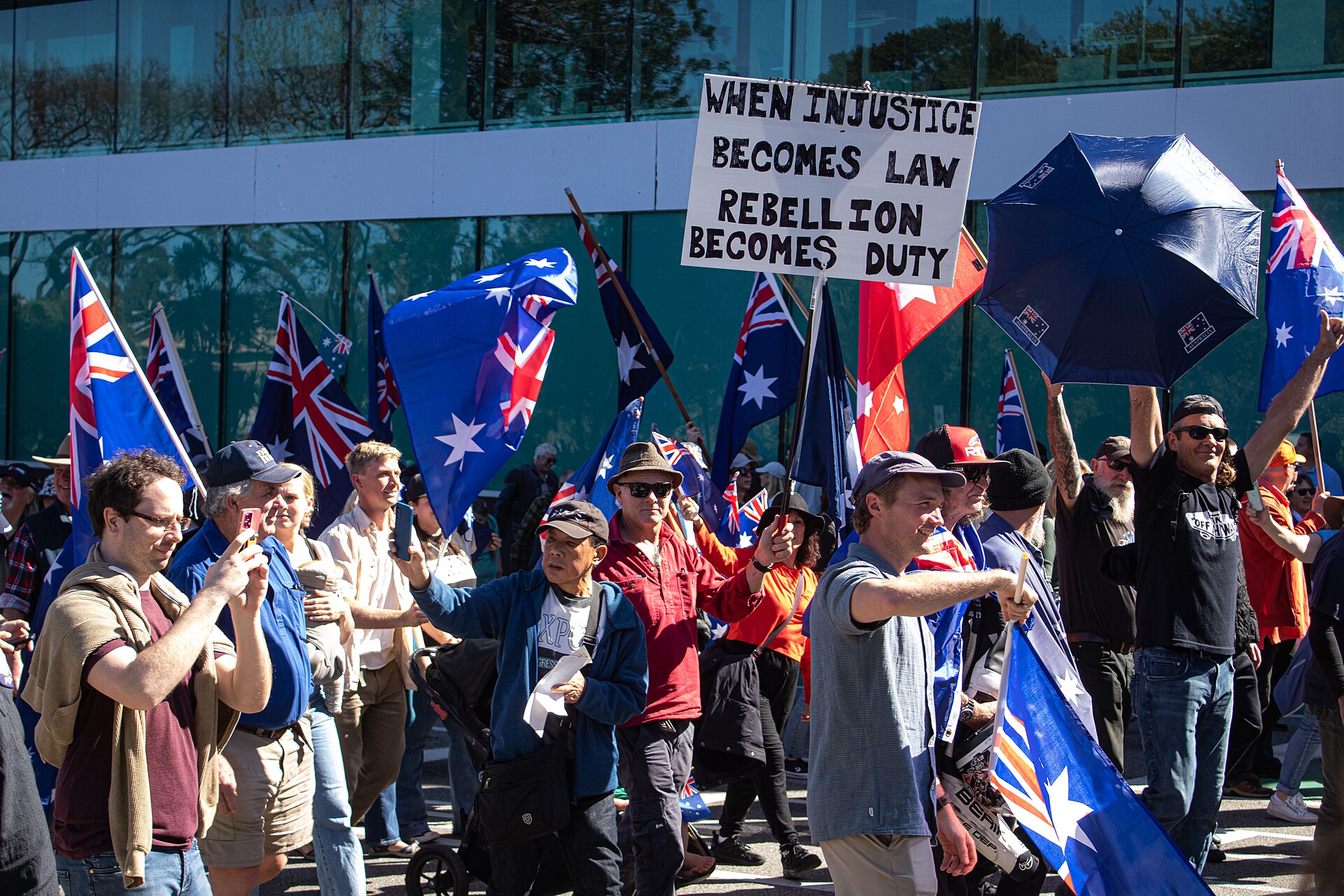
The Freedom to Protest — An Australian Perspective
Voices that must not be silenced — and the boundaries that keep them free. A discussion from an Australian perspective.
The Freedom to Protest
Protest is as old as democracy itself. From the agoras of ancient Athens to the streets of modern capitals, the right to gather, speak, and dissent has been the beating pulse of free societies. It is how citizens hold power to account, how injustice is named aloud, and how the arc of history — so painfully, so slowly — bends toward something better.
Australia is no exception to this tradition. From the Eureka Stockade to the Wave Hill walk-off, and even the climate strikes of recent years, Australians have never been a people content to stay silent when it matters.
In an era of growing political polarisation, of governments that sometimes mistake order for justice, the impulse to curtail protest is real and persistent. Laws are tightened. Permits are demanded. Crowds are dispersed. And yet the core principle endures: the right to assemble, to speak, and to be heard is not a privilege granted by the powerful — it is a right that belongs to the people.
“Free expression is not a decoration on democracy. It is its load-bearing wall.”
Free expression is not merely a legal technicality. It is the mechanism by which minorities check majorities, by which uncomfortable truths reach comfortable ears, by which citizens participate not just at the ballot box but in the daily life of a republic. To suppress protest is not to preserve order — it is to hollow out the democracy such order is supposed to protect.
Some examples of why we need the right to protest and free expression can be seen in recent events. The current Iranian regime has murdered upwards of 50,000 of its own citizens for simply protesting the Islamic dictatorship and repressive regime.
Nel and I were in Hong Kong when China suppressed the Hong Kong democracy protests in 2019; the protestors I talked with were all Christians wanting a free life. It was heartbreaking to witness the suppression of freedom.
While I disagree with many of the protest issues used as examples in this article, I do defend the right of peaceful protest and free expression. It means that I am able to protest bad laws, or on behalf of life issues, as a Christian.
“I may not agree with what you say, but I will defend to the death your right to say it.”
— Voltaire
Why the right to protest is non-negotiable
Throughout history, the movements we now celebrate were, in their time, controversial, disruptive, even illegal. The suffragettes were arrested. Civil rights marchers were beaten. Anti-war protesters were tear-gassed. In each case, official power insisted on silence — and in each case, history often vindicated the voices that refused to stay quiet.
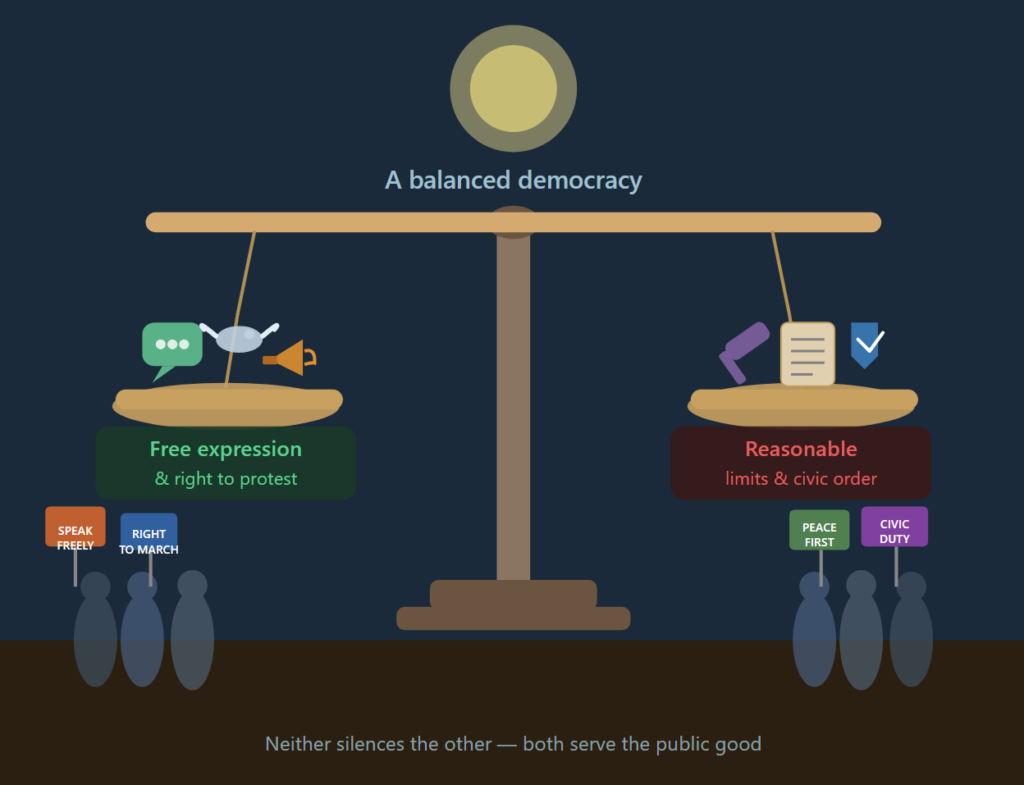
A democracy that only tolerates agreeable speech is no democracy at all. The test of free expression has always been its protection of the unpopular view, the inconvenient truth, the righteous grievance. Governments do not need protection from criticism. Citizens do not need protection from ideas. Open debate, however uncomfortable, is far safer than its absence.
Australian perspective — A proud tradition of dissent
Australia’s history is inseparable from its protest movements. The Eureka Stockade in 1854 was a nationally significant protest that predates Federation.
In 1966, Gurindji stockmen led by Vincent Lingiari walked off Wave Hill station to demand not just better working conditions but the return of their traditional land — a seven-year act of protest that seeded the modern Aboriginal land rights movement and culminated in Gough Whitlam famously pouring soil into Lingiari’s hands in 1975.
The campaign to save Tasmania’s Franklin River in the early 1980s, led by a young Bob Brown, drew more than 6,000 people to a remote riverside town and saw over 1,200 arrested. It became a watershed moment for Australian environmentalism and helped sweep a federal election.
International law is clear on this. The Universal Declaration of Human Rights, the International Covenant on Civil and Political Rights, and the constitutional frameworks of liberal democracies worldwide enshrine the freedoms of assembly, association, and expression. These are not aspirational ideals — they are enforceable rights. And yet rights, to be durable, must also be responsible. This is where the harder conversation begins.
Universal Declaration of Human Rights (Australia is a signatory)
ARTICLE 18
Everyone has the right to freedom of thought, conscience and religion; this right includes freedom to change his religion or belief, and freedom, either alone or in community with others and in public or private, to manifest his religion or belief in teaching, practice, worship and observance.ARTICLE 19
Everyone has the right to freedom of opinion and expression; this right includes freedom to hold opinions without interference and to seek, receive and impart information and ideas through any media and regardless of frontiers.
The Australian legal landscape: a freedom without a right
Many Australians are surprised to discover that, unlike the United States or Germany, the Australian Constitution contains no express guarantee of freedom of speech. What exists instead is an implied freedom of political communication — a structural limit on government power rather than a personal right conferred on individuals. This distinction matters enormously in practice.
The implied freedom was established by the High Court in two landmark 1992 cases — Nationwide News Pty Ltd v Wills and Australian Capital Television v Commonwealth — on the basis that a functioning representative democracy cannot operate without free communication about political matters.
The Court held that laws which impermissibly burden political communication are constitutionally invalid. However, as confirmed in Comcare v Banerji (2019), this is not the same as a personal right to say whatever one wishes. Parliament may restrict political speech so long as the restriction is reasonably adapted to a legitimate purpose compatible with Australia’s system of representative government.
Australian perspective — The tightening of protest laws
Over the past decade, state and territory governments across Australia have steadily expanded restrictions on protest activity. Most states have introduced laws imposing heavy fines — in some cases up to $22,000 — or imprisonment for unauthorised protests on roads, bridges, ports, and infrastructure.
Queensland made expanded police search powers permanent in 2025. Western Australia adopted similar measures in 2024. South Australia’s laws allow the Attorney-General to designate public precincts where sweeping police powers apply.
In late 2025, New South Wales passed some of the most far-reaching restrictions, including legislation that allows police to ban public assemblies for up to three months following a terrorism declaration. The laws were passed in the wake of the Bondi Beach mass shooting in December 2025.
Critics — including UN Special Rapporteurs and Palestinian, Jewish, and Indigenous legal groups — challenged aspects of the legislation as disproportionate, with some arguing that emergency powers risk becoming a permanent curtailment of ordinary protest rights. The Australian Human Rights Commission has consistently stated that anti-protest laws must be proportionate, targeted at individual unlawful behaviour, and not used to disperse peaceful crowds wholesale.
We have been subject to minor violence and threats, including death threats, while participating in ‘Bring The Hostages Home’ vigils with the local Jewish community, and also while leading a Never Again Is Now rally at Parliament House in South Australia. These acts, which were perpetrated by the pro-Palestine mob, go far beyond any reasonable protests. The fact that these were unchecked and not correctly policed is very troubling.
On the other hand, restrictions can lead to disastrous side effects. A current example is Canadian Bill C-9: ‘An Act to amend the Criminal Code (hate propaganda, hate crime and access to religious or cultural places)’, which could potentially lead to quoting the Bible as being outlawed as hate speech.
With these issues in mind, let’s look at the limits on protest and free expression.
Where rights meet responsibility: the five limits
The freedom to protest is broad but not boundless. Democratic societies have long recognised that expressive rights must coexist with the safety, dignity, and freedom of others. This is not a contradiction — it is the very condition that makes rights meaningful. I have listed five limits, in particular, defining the outer edge of legitimate protest.
1 – No incitement to violence
Speech that deliberately stirs others to commit violence is not protected expression — it is an act in itself. The line between impassioned rhetoric and incitement is real, and courts in every democracy have drawn it. In Australia, this principle is reflected in federal and state criminal law, as well as in Article 20(2) of the ICCPR, to which Australia is a signatory, which requires that advocacy of hatred constituting incitement to violence be prohibited by law. Words designed to set a crowd against a person or group cross from protest into harm.
2 – No violence
The power of protest lies in its moral authority — the willingness to stand and be counted, to absorb opposition, and to persuade. Violence surrenders that authority. It shifts the story from the cause to the conduct and hands critics the only argument they need. The Australian Human Rights Commission has been explicit: police may disperse a protest in rare cases where it incites violence, but force should generally not be used against unlawful but non-violent protesters. Peaceful protest is not a tactical suggestion; it is a principled requirement.
3 – No defamation/libel — truth is mandatory
Free expression carries with it an obligation of honesty. Protest built on fabrications — false accusations, invented crimes, deliberate misrepresentation — is not free speech exercised; it is a weapon deployed against individuals. Australia’s defamation law, already among the world’s most plaintiff-friendly, exists precisely to protect the innocent from the megaphone of motivated falsehood. Notably, in Lange v ABC (1997), the High Court confirmed that even the implied freedom of political communication does not automatically provide a defence to defamation — truth and responsible conduct remain requirements.
4 – No property damage
The right to protest does not extend to the destruction of what others have built, own, or depend upon. Damaging property alienates potential allies, undermines the message, and imposes tangible costs on people who may have nothing to do with the grievance being expressed. Australian law is unambiguous on this: acts of vandalism or destruction during protest are criminal, regardless of the sincerity or justice of the underlying cause. Restraint is not weakness — it is discipline in service of the cause.
5 – No unlawful obstruction
Protest must not weaponise inconvenience against uninvolved people. Blocking roads, shutting down ports, or besieging private businesses does not advance democratic dialogue — it coerces. This is an area of genuine and live tension in Australia, where climate activists and others have adopted roadblocking as a deliberate tactic. The community response has been sharply divided, and legislatures in most states have responded with heavy penalties. There is a meaningful difference between the disruption inherent in a march and the systematic obstruction of ordinary life. The former is protected; the latter is not.
The balance democracy must strike
These five limits are not a concession to authoritarianism. They are the framework that allows protest to remain a legitimate and powerful force in democratic life. Without them, protest risks becoming a tool of intimidation — the loudest and most aggressive voices displacing the most reasoned ones. With them, the right to protest is preserved for everyone: the minority, the majority, the powerful, and the powerless alike.
The corollary is equally important: governments that invoke these limits selectively — that treat them as pretexts to silence inconvenient voices rather than genuine protections of public order — betray the democratic compact.
The Australian Human Rights Commission has put it clearly: penalties for unlawful protest behaviour must be reasonable and proportionate, discretion must be properly guided by law, and lawmakers should take positive steps to promote, not just restrict, protest rights.
“The answer to speech you despise is more speech — not silence, not suppression, not the machinery of the state turned against a citizen’s voice.”
Please watch Rowan Atkinson (Mr Bean) addressing the issue of free expression:
Democracies are noisiest when they are healthiest. The marches, the placards, the chants, the sit-ins — these are not signs of a society in crisis. They are signs of a society that still believes change is possible, that power can be questioned, that justice can be demanded and eventually delivered. The day the streets fall silent by compulsion rather than contentment is the day something essential has been lost.
A call for responsibility on all sides
To protesters: your cause is almost certainly better served by discipline than destruction. The history of successful movements in Australia — from opposing abortion to standing for traditional marriage to saving the Franklin — is overwhelmingly a history of moral coherence. Of people who held the line of nonviolence even when provoked, who told the truth even when fiction might have been more convenient, who understood that the method of protest is itself a message.
To governments — federal, state, and territory: your obligation is not to a silence you find comfortable, but to a democracy you have sworn to uphold. The Australia Institute’s research consistently finds that most Australians support federal legislation to protect the right to protest. When a NSW Police Minister declares she does not want to see protests on the streets “from anybody”, she is not speaking for the democratic tradition — she is speaking against it. Facilitate protest, tolerate its discomfort, and restrict it only where the law genuinely requires.
And to all of us, as citizens: free expression is not a possession we inherit and keep in a drawer. It is a practice — one that requires active defence, constant use, and thoughtful exercise. Use your voice. Defend others’ right to use theirs. And when speech becomes violence, say so clearly — because that distinction, held firm by everyone, is what keeps the right to protest alive. Australia’s greatest social advances came when people took to the streets. The freedom to do so must never be taken for granted.
Australian Christians: We are subject to Governmental authorities; however, unlike in biblical times, we live in a representative democracy, and thus the Government is accountable to the people via the Australian Constitution and the ballot box. It is more than reasonable for Christians to protest as part of our freedom of expression.
In summary, Australian Christians should not be afraid to protest and use free expression on important issues. Further, we must use the freedom of expression to boldly proclaim the Gospel of the Kingdom. I think it is a matter of use it or lose it.
___
The arguments in this article draw on the Universal Declaration of Human Rights (1948), the International Covenant on Civil and Political Rights (1966), and Australian constitutional jurisprudence including Nationwide News Pty Ltd v Wills [1992], Australian Capital Television v Commonwealth [1992], Lange v Australian Broadcasting Corporation [1997], and Comcare v Banerji [2019]. Information on contemporary Australian protest law draws on reporting from the Australian Human Rights Commission, the Australia Institute, Amnesty International Australia, and public legislative records as at April 2026.
___
Image courtesy of Wikimedia Commons.
11 Comments
Leave A Comment
Recent Articles:

27 October 2026
1.5 MINS
Labor’s Digital Duty of Care Bill threatens free speech, empowers covert online surveillance, and imposes potentially burdensome regulations on Australian businesses.
27 October 2026
10.3 MINS
As Tasmania and Western Australia consider conversion therapy bans, a former LGBT+ ministry leader warns of threats to religious freedom, personal choice and Christian discipleship.

27 October 2026
4.9 MINS
Nine Christians have been killed in a terrorist attack on a Jordanian church, prompting fierce condemnation, demands for justice and renewed concerns about religious persecution.
27 October 2026
3.6 MINS
For 25 years, the Mount Moriah Trust has supported struggling Christians across the Holy Land, bringing practical assistance, encouragement and hope to believers facing hardship and persecution.

27 October 2026
1.3 MINS
Moira Deeming’s re-election campaign has energised Family First supporters, raising $90,000 as the party prepares for a crucial Victorian election and a potential breakthrough.
27 October 2026
3.1 MINS
As the disciples discovered through a huge haul of fish, we can trust Jesus for a net-breaking, boat-sinking catch of people.

26 October 2026
4.5 MINS
OECD chief Mathias Cormann warns Australia is losing its competitive edge, as excessive regulation, housing pressures, immigration challenges and declining public trust threaten national prosperity.



Very comprehensive,,thankyou
Thanks Sue. It’s a difficult subject.
Very comprehensive and well argued article!!!!
Thanks mate.
Thank you Kym, for a well written essay, and the acknowledgment that Christians should be using their voice often and loudly to bring attention to injustice and unrighteousness.
The passing of current marriage laws and abortion laws speak of a church that is uninformed or passive when we should have been actively speaking
Thanks Stan. Exactly – we MUST use our voice for righteousness and the vulnerable.
A brilliant article about a tricky subject.
Yes, very difficult to find a good balance. Hopefully my the five limits are taken on board.
I totally agree a very balanced article
Thankyou Kym for a very timely, thought provoking, and compellingly argued article on a confusing subject. Anyone who has been churched long enough has sometimes felt the Romans 13 guilt of being admonished to be compliant, long suffering and unpolitical; and other times the chiding for being silent when we should be society’s warning siren. God grant us the wisdom to match scenarios to appropriate responses!
And …….. how ingenious and articulate is Mr Bean !!! What a legend!!
Romans 13 is not a total capitulation to a godless authority.
Paul does not write his directives from the relative freedom we in the west have.
He writes as a first-century citizen residing within the Roman Empire, not as one who lives within our Democratic government.
The apostle writes these directives to Christians who reside in the capital of the Empire, and we see his courage when he restricts and defines the authority of the world’s superpower.
The fact that he writes these directives concerning how Christians are obliged to relate to those in human government indicates that ministers of the gospel are obligated to provide preaching that imitates this prophetic teaching concerning cultural-social-political-moral-ethical issues.
We live in a representative democracy, which means the government is answerable to us, the people (taxpaying citizens), via the constitution, the ballot box, and the judiciary.
This changes everything!