


The Evangelical University Taking Israel Seriously
While evangelicals rally politically behind Israel, few schools teach why. The King’s University builds Jewish studies, anti-supersessionist theology, and antisemitism scholarship into its academic core.
Evangelical Christians are said to be Israel’s most ardent supporters among religious groups in the United States. With some notable exceptions, however, comparatively few evangelical colleges and universities have taken seriously the study of Judaism, Jewish history, antisemitism, and Israel itself as part of their academic fabric.
Evangelicals love Israel politically, devotionally, and at prophecy conferences. They have been far less willing to engage with Israel theologically and intellectually in ways that seriously shape the education their students receive. When an evangelical university seeks to do exactly that—and does it well—it warrants attention. The King’s University in Southlake, Texas, is one such place.
Not content merely to sign statements of solidarity or sponsor occasional trips to Israel, The King’s University has integrated programmes, courses, and theological convictions that embed Israel, Judaism, Jewish-Christian relations, and even antisemitism into the academic mission of the school.
Political support, however, can always remain shallow, reactive, or contingent upon circumstance. What The King’s University is trying to build, however, goes deeper. The school is attempting to place Christian concern for the Jewish people on both an institutional and theological footing.
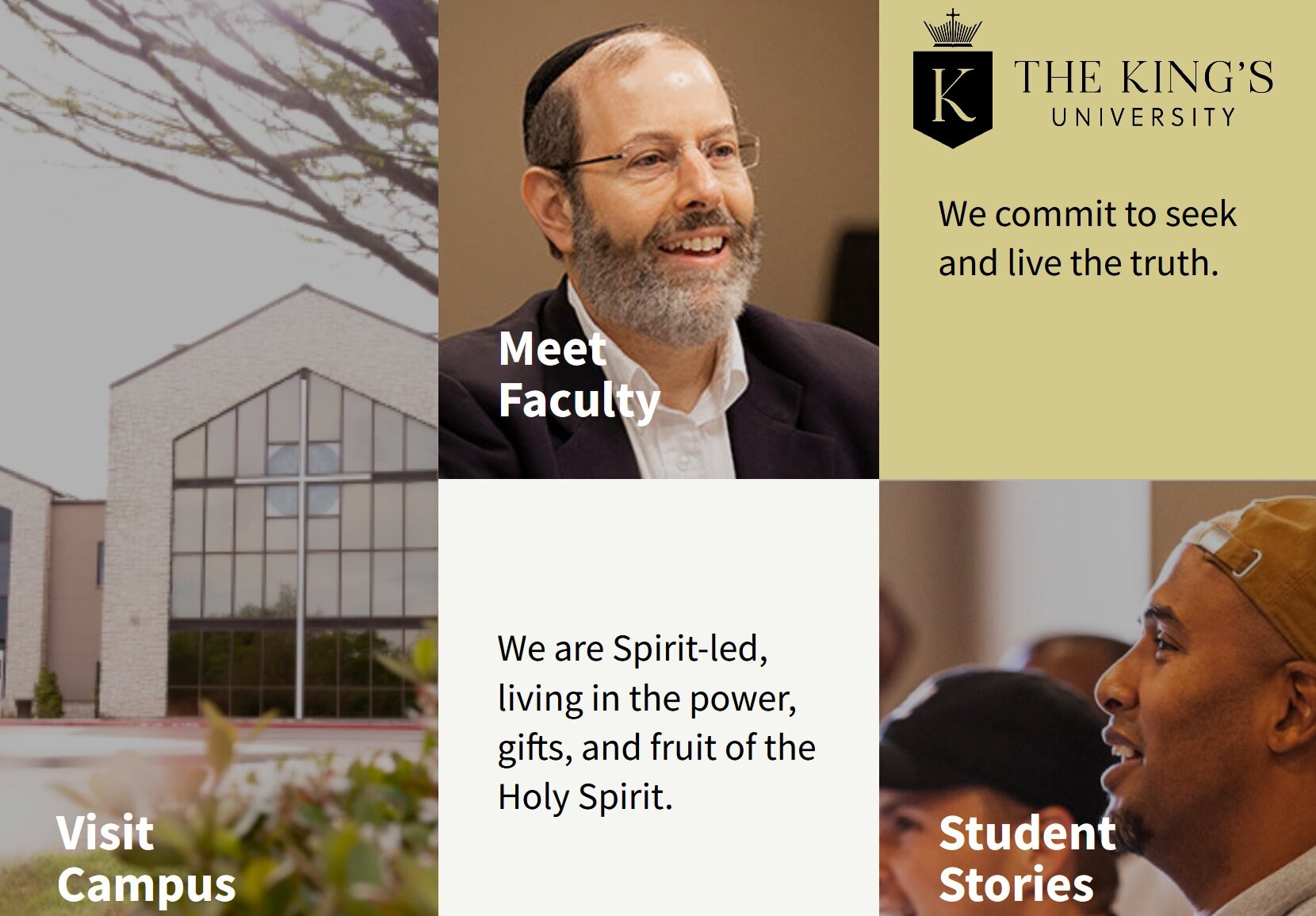
Describing itself as “Accredited. Spirit-filled. Evangelical.” The King’s University has carved out an extensive Messianic Jewish Studies programme within that identity. The purpose of that programme, according to the school’s literature, is to prepare both Messianic Jewish leaders and Christian leaders who can serve as “culturally sensitive bridges” between the Church and the Jewish people.
Built into what is now the school’s Messianic Jewish Studies programme (established in 2007 at the vision of The King’s University founder Jack Hayford) is a Cambridge-trained New Testament scholar and Jewish-studies expert as its rabbi. But perhaps most important of all to understand about the university’s theological statement is its stance on replacement theology as it pertains to the Jewish people. Rabbi David Rudolph heads up that programme these days.
In view of the present continuity between Israel and the Jewish people, God did not disown Israel in the arrival of Jesus. Quite the contrary, the theological appendix to the school’s prayer of entreaty openly denounces substitution theology and declares that the Jewish people still stand in relation to God through the eternal covenant He made with Abraham, and that God’s gifts and call to Israel are without repentance.
The school therefore interprets Israel’s calling as being still ongoing: the Jewish people have a unique covenantal identity and vocation, and God has further plans for them in His plan of salvation. Put succinctly, at King’s, the Jews are still Jews. They do not cease to be Jews because they are incorporated into the Messiah, nor has the Church replaced Israel in God’s plan as His chosen people to whom the covenant promises were made.
Israel Begins With Theology
Christian support for Israel is vulnerable to becoming political long before it gets theological. Debate tends to turn quickly to topics like elections, settlements, Gaza, American foreign policy, or the decision-making of the current Israeli government. Those questions are important, but they flow downstream from a theological question. Before Christians debate what they think about Israeli policy, they need to ask what they believe about the Jewish people.
A lot rides on how Christians answer that question, which is why The King’s University addresses it directly in its formal theological statement, The Church and the Jewish People. In this document, the university articulates Christianity’s profound indebtedness to the Jewish people, rejects supersessionism, and affirms that God’s gifts and calling to Israel remain irrevocable.
It also states frankly that Christian history is marked by hostility towards Jews, and Christian theology has sometimes been used to marginalise and persecute them. That self-reflection, combined with affirmation, gives this statement more moral weight than political declaration would.
It matters that this theological clarification comes before political affirmation, because Christian love for Jews is not the same thing as a theology that affirms their continuing covenantal role. Anti-supersessionism is not a requirement for being friendably disposed towards Jews.
Quite the opposite: philosemitism can and does exist within explicitly supersessionist theological frameworks. That is part of what makes The King’s University statement interesting. In it, they try to move beyond friendly feelings towards Jews to develop a post-supersessionist theology that takes Jewish continuity into account.
To be clear, this does not imply that supersessionism leads directly to antisemitism. Christian antisemitism has arisen in interaction with a wide variety of social, political, economic, racial, and theological factors that varied dramatically over time and place.
Supersessionism nevertheless eradicates the Jewish people’s continuing corporate election and vocation from the narrative of redemption in Christian theology. This can allow more room for living Jews to be marginalised. It does not necessarily lead to hostility, but allowed for Jewish displacement and marginalisation for many centuries.
Importantly, the university’s theological statement also recognises Jewish self-determination and historic ties between the Jewish people and the land of Israel. They affirm Jewish sovereignty in the State of Israel while acknowledging room for debate (as any responsible institution should) about the policies of any particular Israeli administration.
Affirming Jewish self-determination is not the same thing as saying Israeli political leaders cannot do anything wrong. It does not mean, however, embracing the belief that God’s chosen people are irrelevant to his redemptive plan. It does not mean that we view the church as having replaced Israel and thereby blotting the Jewish people off the theological map. Far from it. To believe that God has a people called Israel today is NOT to subscribe to Christian supersessionism.
The Question Beneath the Politics
Which brings me to explain why this matters for evangelical Christianity. Support for Israel tends to overlap with political conservatism among Christians, and that overlap has led to real and important alliances. My concern is that such alliances are not necessarily eternal.
Political coalitions shift, generations pass, and foreign-policy agendas evolve. If our support for Israel and identification with the Jewish people hinges chiefly on Republican administrations in Washington, then we will struggle to sustain that solidarity when politicians change. Solidarity with Jews will ebb like the administrations that prop it up.
The answer lies much closer to home than partisan politics or end-times prophecy. Christianity wasn’t just Jewish in the way that Christianity happened to emerge from Judaism. Rather, Jesus was a Jewish man; the apostles were Jewish men; the Church in its infancy was Jewish; and Christianity received Scripture from Israel. The Jewish people are woven into the story of Christianity more fundamentally than that.
Which is why Paul’s analogy in Romans 11 becomes so pointed when he addresses Gentile Christians. Describing the Gentiles as branches of a cultivated olive tree, Paul instructs us not to “boast against the branches.” Such language is careful not merely because Christians were once Jewish. Paul tells Christians who are Gentiles that we do not sustain the root — we are sustained by the root. In that passage, Paul puts Gentile Christianity in its place.
Universities declare their convictions in many ways, but nowhere more meaningfully than in their curricula. Universities can easily pass a resolution or express solidarity with Israel when she faces international pressure. Universities can hardly teach anything unless they have built courses, degree programmes, faculty competencies, and academic expectations around those interests. Curriculum gives texture and discipline to professed convictions.
That’s why The King’s curriculum deserves attention. Students do not encounter Israel merely as an occasional topic within otherwise generic biblical courses. Instead, they’ll study antisemitism, the Holocaust, Jewish history, Judaism, the land and modern State of Israel, Jewish-Christian relations, and the Jewish context of the New Testament.
Courses cover current issues of antisemitism, such as anti-Zionism and its connection to anti-Jewish hatred, enabling students to understand the difference between legitimate criticism of Israel and efforts to destroy Jewish collective rights.
One doesn’t have to take a course inventory to appreciate what matters about all this. What matters most is that King’s curriculum presumes that Christians should learn about Judaism as Judaism rather than reading about Jews only in Christian Scripture. It presumes that Christians should understand the history of antisemitism, including churches’ contributions to it. It also presumes that students should approach Israel historically, politically, and theologically.
If Christians want to take a public stance in defence of Jewish dignity, opposition to antisemitism, and affirmation of Jewish national self-determination, they ought to know what they are defending and why. That means knowing Jewish history, Zionism, Christian antisemitism, what Judaism actually teaches, and the facts and history of the Israeli-Palestinian conflict.
To take a public stance on these issues also means knowing how to tell the difference between legitimate political criticism and antisemitic political rhetoric. Christian Zionism without education is helpless to make those distinctions or to engage genuine criticism.
A Degree Devoted to Antisemitism
Maybe the most obvious sign of the university’s commitment comes in the form of its Master of Practical Theology concentration in Antisemitism and Jewish Advocacy. Most Christian institutions of higher education don’t have anything like it.
The fact that King’s does indicates an institutional belief that antisemitism is serious enough to warrant advanced study at the graduate level. Moreover, it implies a belief that Christian opposition to antisemitism ought to create trained leaders rather than simply firing off occasional public statements.
Students in the programme learn about antisemitism historically, theologically, and as it exists in public life today. They study the Holocaust. They learn about modern antisemitism, Jewish-Christian relations, and how to combat antisemitism in both the Church and wider culture.
These subjects are paired with the study of the history of Judaism, the Jewish people, Christian Zionism, and the land and State of Israel. Antisemitism isn’t treated as some aberrational hatred in need only of correction. It is a problem that future church leaders need historical knowledge, theological understanding, and skills in public engagement to address.
This point is crucial because so much historic Christian antisemitism was sustained not just by brutish racial hatred but by theology. For centuries, interpretations of scripture that cast the Jewish people as rejected, cursed, obsolete, or otherwise surpassed by Christianity furnished Christians with theological categories through which social contempt could bloom.
To reject antisemitism, Christians may need to change both their attitudes towards Jews and the theological frameworks that once made Jewish marginalisation seem blessedly natural. It seems King’s understands the relationship between the two.
More Than Being “Pro-Israel”
Asking theological questions also means that affirmation is not the end of thinking about these issues. Christian commitment to the eternal significance of the Jewish people does not require uncritically accepting every decision made by the Israeli government as just, wise, or above criticism.
Christians should still be able to criticise Israeli policies while fighting antisemitism and affirming Jewish national self-determination. Serious attention to this topic should help Christians sort out those categories, not conflate them.
Whether evangelical colleges and universities are currently “pro-Israel” is not the only interesting question to me. The more important question is whether evangelical colleges and universities have a theology that explains why Jewish people matter in light of Christ’s coming.
If they do not have such a theology, then whatever solidarity Christians feel towards Jews now will fade when politics change, when older generations die off, or when theological trends move in different directions. If they do have such a theology, then concern for the Jewish people will stop being optional or peripheral in Christian education.
The King’s University is putting their theological money where their mouth is by making concern for Jews a permanent part of their university. They have taken what might otherwise be just rhetoric and put it into degrees, course offerings, theological explanations, and organisational budgets.
Ultimately, whether or not evangelicals are friends with Jews will not be measured by how loudly Christians speak up for Israel when it is politically popular to do so. Friends will be demonstrated by whether or not Christian theology can still remember and explain who the Jewish people are when doing so is no longer politically convenient.
___
Image courtesy of Adobe.
3 Comments
Leave A Comment
Recent Articles:

17 October 2026
3.4 MINS
Seeking the face of God means surrender, laying aside our agenda and wants. Revival begins when we want God himself more than we want the outcome.

16 October 2026
4 MINS
A desperate Victorian Labor Party is peddling taxpayer-funded abortions as free “healthcare”. In a shameless attempt to stay in power, they're willing to do anything — including killing the unborn and forcing taxpayers to pay for it.

16 October 2026
4 MINS
Katie Zacharia’s first days as White House Press Secretary have sparked fierce media criticism, but her remarkable testimony of surviving an abortion attempt tells a deeper story.

16 October 2026
3.4 MINS
Australia’s proposed digital duty of care laws promise greater online safety and increased user control by switching off algorithms, but critics warn they could give ministers sweeping powers to restrict lawful content and threaten free speech.
A Million Women Movement Marks Second Anniversary: “Look What the Lord Has Done! Ishtar Has Fallen!”

16 October 2026
2.8 MINS
Two years after A Million Women gathered in Washington for ten hours of prayer and fasting, organisers point to victories they believe reflect God’s answers to intercession.

16 October 2026
2.6 MINS
Euthanasia accounted for 4% of all deaths in Belgium in 2025, with growing numbers involving people who were not terminally ill, dementia patients and psychiatric conditions.

16 October 2026
5.2 MINS
Christa Pike’s botched execution has sparked outrage across America, but critics argue that the same concern for human dignity is denied to abortion survivors.



Thank you, a well written article
You are very welcome, Sue.
Good to read an essay about the importance of loving God’s chosen race.
Stated simplistically, as Jesus was a Jew, my love for him naturally flows on to his bloodline family.