


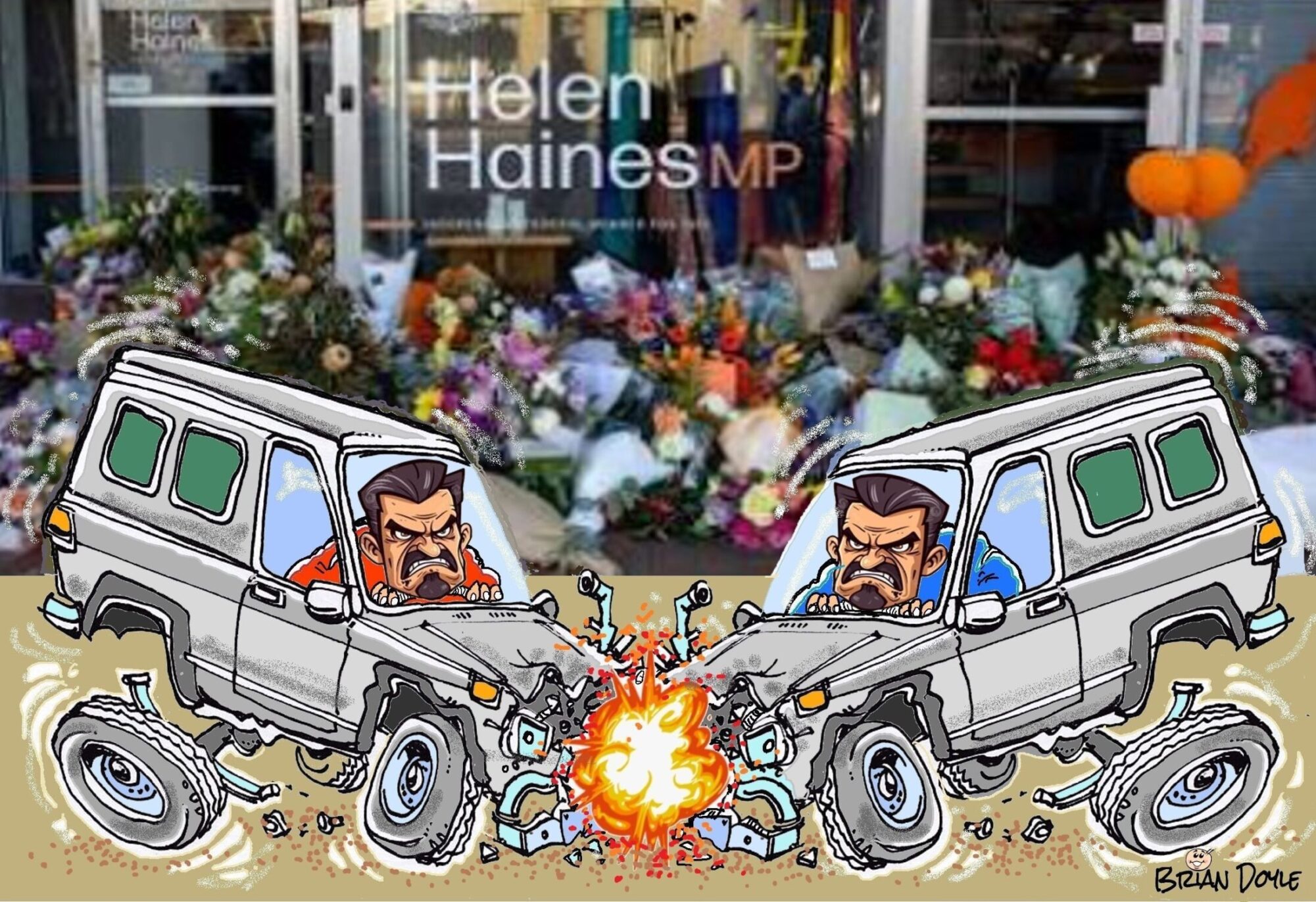
How Did Disagreement Become So Violent?
Without a moral authority above ourselves, we risk turning our political convictions into absolute truths — and our opponents into obstacles to be destroyed.
How is it that the world in which we live has suddenly become so vicious?
Surely I’m not the only one who has noticed.
Public debate has become more hostile, and people are frighteningly willing to intimidate, threaten, or even kill those with whom they disagree.
How did this happen?
Our politicians have lately taken to blaming the “algorithm”. If you listen to government ministers, the single greatest problem in the West today is the ubiquitous algorithm that is destroying everything.
No matter that no-one can properly explain what the algorithm is, who controls it or what should be done about it — other than more government control, naturally.
But could there be other factors influencing the West’s sudden descent into societal chaos?
Here’s an explanation I have a great deal of time for, because I think it’s one of the most logical.
Having rejected the Christian worldview that helped shape Western civilisation, people are increasingly turning to ideologies that promise to both explain and save the world.
Ironically, the opposite is happening. People are mis-understanding the world and then behaving in ways that threaten to destroy it.
When Ideology Replaces Christian Humility
Christianity begins with a humbling proposition: human beings are made in the image of God, but they are also fallen, flawed and capable of evil.
Nobody is perfectly righteous. Nobody is beyond temptation. And no human being possesses the wisdom or moral purity to exercise unlimited power over everyone else.
That understanding places limits on our ambitions. It reminds us that our opponents, however wrong we believe them to be, possess the same fundamental human dignity as we do.
Ideology often begins by removing those limits.
It offers a theory explaining what is wrong with the world, identifies the people responsible, and promises a path to redemption.
There are the oppressed and the oppressors, the enlightened and the ignorant, the revolutionaries and the reactionaries.
And if you happen to stand on the right side of history, you can begin to believe that almost anything you do in pursuit of your cause is justified.
This is where the trouble starts.
When your opponent is merely mistaken, you can debate him.
When you believe he represents evil, debate begins to look like appeasement, and compromise becomes betrayal.
In such an environment, violence can easily be recast as a moral duty.
History is littered with examples.
The French Revolution promised liberty but descended into the Terror.
Communism promised a classless paradise but produced regimes responsible for mass murder.
Nazism offered national renewal by defining entire categories of human beings as enemies to be eliminated.
Different ideologies, different targets, remarkably similar moral logic: the promised utopia is so important that the destruction of those standing in its way becomes acceptable.
Of course, Christianity has itself been invoked to justify violence, and religious people are no less capable of hypocrisy or cruelty.
The Christian worldview does not automatically make people virtuous.
But where the Christian worldview is taken seriously, it places significant moral restraints on the mob — the dignity of every person, the reality of human sin, the obligation to love one’s neighbour and the warning against human arrogance.
Remove those restraints, and something must take their place.
How Utopian Dreams Justify Violence
Increasingly, having rejected Christianity, we are living in an age of moral certainty.
People are encouraged to see themselves not simply as citizens with competing interests, but as soldiers in an existential struggle between good and evil.
Social media amplifies the hostility, political leaders exploit it, and activists discover that outrage attracts attention, while moderation rarely goes viral.
Each side becomes more convinced that the other is not merely wrong, but dangerous.
And because everyone believes they are fighting for the good, everyone finds it easier to excuse the bad.
The irony is that many modern ideologies promise liberation from oppression while creating new justifications for persecuting those who disagree.
They promise a more compassionate world while teaching people to despise their neighbours.
Perhaps the answer is not to abandon conviction, but to recover humility: the recognition that no political movement is perfectly righteous, no human being is free from moral error, and no promised earthly paradise justifies treating other people as disposable.
A society needs more than competing visions of utopia. It needs a shared understanding of what we must never do to one another, even when we are convinced we are right.
Christianity offers one such foundation.
Rejecting it does not make violence inevitable. But if we discard the moral limits outlined in the Christian worldview without replacing them with anything equally capable of restraining our ambitions, we should not be surprised when our politics becomes a struggle not merely to win, but to destroy.
___
Republished with thanks to The James Macpherson Report. Image courtesy of Wikimedia Commons.
3 Comments
Leave A Comment
Recent Articles:
13 November 2026
3.5 MINS
Joe Rogan has questioned why progressive ideology is infiltrating Christian churches, exposing how political slogans are filling the spiritual vacuum left by declining religious belief.

13 November 2026
4.4 MINS
A sobering new study reveals that two-thirds of American Christians fail a basic Bible knowledge test, exposing a crisis of biblical literacy within the Church.
13 November 2026
3.5 MINS
Historian Christopher Dawson argued that religion is the spiritual foundation of civilisation. As Christianity retreats from public life, his warnings about cultural decline deserve renewed attention.
13 November 2026
9.1 MINS
Understanding Islam requires more than interfaith goodwill. Examining its theology, political ambitions, migration and Western alliances, we require vigilance without abandoning Christian compassion.

12 November 2026
3.9 MINS
Two free tools promise to transform Christian voting in Australia, helping believers identify pro-life candidates, understand preferential voting and rank every candidate with confidence. Let us vote well in the upcoming elections.
12 November 2026
3.9 MINS
Victoria’s Presbyterian Church has condemned Labor’s promise of free abortions, with Moderator Rev Dr John Wilson urging political leaders to protect unborn children and support mothers.
12 November 2026
2.2 MINS
Jess Wilson’s swift embrace of Labor’s taxpayer-funded abortion promise raises serious questions about the Victorian Liberals’ commitment to principle, unborn life and political courage.



This is the new Normal when people have grown up without the influence of the Christian Church—-life then becomes cheap and the compassionate State excuses violence and murder ( except against politicians )because now there are no boundaries or real punishment in our 2-tiered Justice System if you are one of the angry , aggrieved people who hates our culture , society and wants to destroy it and anyone who supports it .
Australian Society was very different in my childhood and youth. There was great pride in being Australian. In 1951 every child received a medal to commemorate Federation. For Queen Elizabeth’s coronation in 1953 we all received a copy of the New Testament. (Note:–none has been issued by Charles III). Every Army School Cadet and Army recruit was issued with the Gospels, so, we knew violence and murder were Sins against God ( Sin , a word deleted by today’s modern society. )
Really insightful article!!!!!
Thanks James…got it right again.