


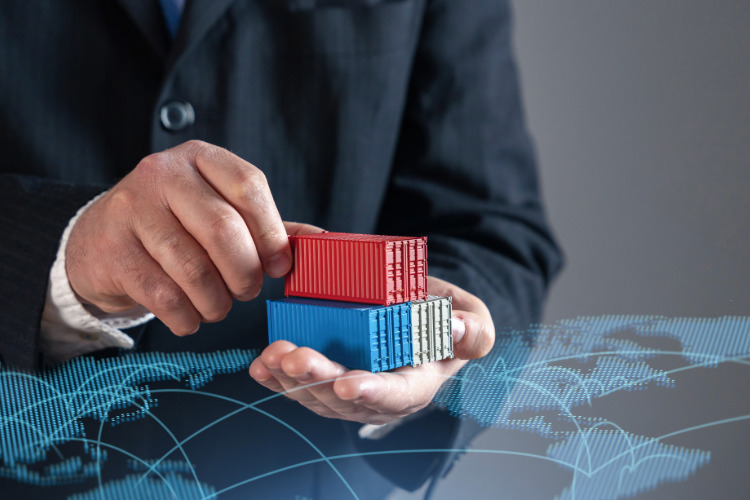
Is Weaponised Interdependence Today’s ‘Nuclear Deterrence’?
Globalisation promised peace through interdependence, but great powers now weaponise trade, technology and finance. As tensions rise between China, Russia and the United States, economic ties risk becoming tools of deterrence — or destruction.
After the end of the Soviet era, Western nations and multinationals built an interdependent global economy on top of U.S.-centred infrastructure and a rules-based international trade and commerce system.
This globalisation made nations heavily interdependent.
Communications: Consider how most of the world’s internet traffic passes through the town of Ashburn, Virginia, a major hub for data centres.
The international payments system: This system, on which trade and investment operate, came together using the U.S. dollar for international transactions carried out under the Belgium-based SWIFT financial messaging network.
Critical technologies: These include high-level computer chips for AI and rare earths that are universally used in modern machines and electronics.
Energy: Energy extraction and processing require highly specialised technologies. In energy, the United States is self-reliant, Russia is a huge exporter, China is a huge importer.
Each of these systems can be understood as its own “stack” of interconnected complexes of related technologies and services that reinforce one another, for example, buying into the world wide web means buying into the U.S.-initiated e-commerce system.
Then there are interconnected markets: China’s rapid climb to become the world’s second largest economy relied on exports into American and European markets.
Globalisation’s Legacy
Globalisation built a world vastly different from that of the Cold War era, when the communist bloc largely operated independently of the rest of the world. Many believed that globalisation’s interdependence would incorporate the old communist bloc into an ordered, prosperous, peaceful world.
Instead, globalisation’s legacy is a world where interdependence is being weaponised to gain geopolitical advantage.
Beijing used subsidies and import regulations to dominate world manufacturing, in defiance of the rules-based order. Then it undertook one of the biggest military buildups in history, becoming increasingly belligerent towards Taiwan, nations bordering the South China Sea which it claims, and, recently, Japan.
Then, Russian President Vladimir Putin’s war on Ukraine abruptly ended Europe’s longest period of peace since World War II.
Now, Russia is learning how interdependence can be weaponised against it. War has brought sanctions and Ukrainian attacks on its vital oil and gas infrastructure; the freezing of its overseas assets; and the loss of access to critical technologies and equipment to keep its industries functioning. Its economy is being battered.
Russia’s state-owned monopoly rail company RZD is over $US50 billion ($A71.2 billion) in debt, while the civilian airline fleet cannot access parts needed for its U.S.-manufactured airliners. Businesses large and small are facing crippling debt.
This is on top of Russia’s “mincemeat” grinding casualties of between 800,000 and 1.2 million troops on Ukrainian battlefields.
The lessons could not be lost on Xi Jinping as he eyes Taiwan.
The U.S. understands how to leverage strategic interdependence, and Chinese leaders have learned its strengths and weaknesses.
Just as Beijing took strategic control of the world’s processing and supply of rare earths and critical minerals, it aims to achieve global domination in other key technologies. If Taiwan were seized, this could give China huge leverage over the production of key computer chips. The most sophisticated semiconductors are produced by only a few U.S., Taiwanese, Japanese and South Korean companies.
However, attacking Taiwan would risk a wider war with the U.S., Japan and other regional states, interdiction of China’s vulnerable sea lanes that deliver oil, coal, iron ore and a host of raw materials that feed China’s industries, and loss of major overseas markets and revenue that keep its economy growing.
China’s economy is already suffering under the weight of a deflating property market, and the combined debts of the Beijing Government, state-owned enterprises and regional governments. It has high unemployment among youth, with many disillusioned with the Chinese Communist Party (CCP).
Fundamentally, the CCP’s legitimacy relies on delivering ongoing economic growth to its citizens.
On top of all this, America’s allies – including Australia, the EU, Canada and Ukraine – are having to deal with a mercurial U.S. President who treats his country’s long-term alliances as unimportant, and believes that what matters in international affairs is the same as the way he ran his family business, “the art of the deal”.
Interdependence as Deterrence
In today’s turbulent world, there is an “unpredictable interplay” of raw power politics.
As nations weaponise interdependence, the connecting fabric of the global economy is being rewoven according to this new logic, creating a world based more on offence and defence than on common commercial interest.
Strategic interdependence won’t necessarily prevent regional proxy wars on the periphery, like Iran’s proxies (Hamas and Hezbollah) attacking Israel. However, the sudden, devastating economic consequences that would ensue from a serious conflict between major powers may deter such nations from risking a superpower conflagration.
Just as in the Cold War, nuclear weapons deterred nations from such wars because a nuclear war risked “mutually assured destruction”, today a war between great powers would risk “mutually assured economic destruction”.
The challenge for democracies is to forge a new encompassing architecture that ensures their supplies of strategic stacks of technologies and protects those stacks from being captured and leveraged by hostile states.
Australia is particularly vulnerable. It lacks political and institutional awareness for the new turbulent world, has a tiny military and has allowed the strategic industries it needs to resist hostile power blackmail to be emasculated. These include shipbuilding, motor vehicle manufacturing, heavy engineering and electronics.
Sadly, Australia is hardly aware of the architecture it needs to protect its sovereignty.
___
Republished with thanks to News Weekly. Image courtesy of Adobe.
One Comment
Leave A Comment
Recent Articles:
13 October 2026
2.6 MINS
Allegra Spender’s proposed bill reignites debate over discrimination protections, religious freedom and the right of faith-based schools to uphold their beliefs and values.

13 October 2026
5.5 MINS
Stephen Baldwin’s journey from drug addiction to sobriety, Christian faith and family life reveals how surrender, daily discipline and renewed hope transformed his life.

13 October 2026
2.1 MINS
Victoria’s assisted dying deaths have surged by 300 per cent since legalisation, while a disturbing case involving a patient’s partner raises urgent questions about safeguards.

13 October 2026
1.8 MINS
Australia faces mounting geopolitical, economic and defence threats, but its political leaders lack the statesmanship, bold vision and decisive communication needed to prepare the nation.
12 October 2026
3.1 MINS
The proposed livestream of Nidal Hasan’s execution has reignited debate over justice, deterrence and public accountability, with critics comparing American justice to ISIS propaganda.
12 October 2026
3.7 MINS
An EU court case over baptismal records could pit data protection laws against religious freedom, raising serious questions about whether governments can compel churches to erase sacramental history.
9 October 2026
5 MINS
During a recent dialogue between high profile legal experts, a top Australian constitutional law expert was asked if Australia should have a Bill of Rights. His answer may surprise you.



China is very smart. It gets cheap oil from Iran, but, what if war disrupts their supply and interferes with their trade with Russia , Africa , Asia and Europe ? The Panama Canal is old , too narrow and needs repairs, so, they are building their own Canal to bridge the Atlantic to access Russia’s Pacific coast. This will give them security not just for oil, gas and trade , but, for supplies in time of war. Our World is now very dangerous, especially if Iran develops its own Nuclear Bombs which won’t take long. It has no regard for human lives. It has a large supply of ballistic missiles with which it wants to destroy Israel and it claims it can now hit cities on the East Coast of USA (New York , Washington , etc ) .A bluff ? I worry for my US relatives. President Trump is in a quandary because the Gulf States where the USA has bases refuse to allow US planes to fly over their land or sea. Israel has no choice if it wants to survive– at some point it will have to fight to the death. 50 years of Labor and LNP Govts. have had their heads in the sand and worrying about LGBT Rights, etc ,while the rest of the World was modernising , innovating and China was becoming powerful militarily. We are completely unprepared and the USA is not dominant like it was in the Cold War era. I will not vote for more of the same with Labor, LNP or Greens.