


Born Alive. Will Canberra Act?
Nation First reports on an Australian politician’s bid to guarantee equal care for babies born alive after abortions, and the Liberal leadership’s chance to stop Parliament burying the issue again.
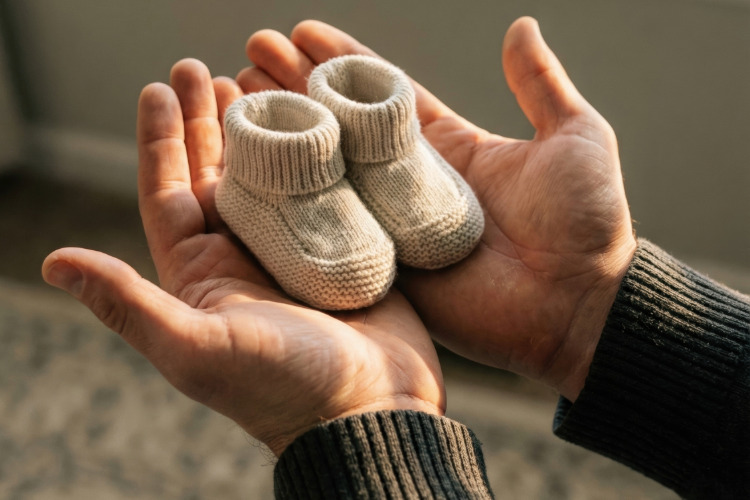
Yesterday, thousands of tiny baby booties covered part of the lawn outside Parliament House. They represented innocent lives lost in hospitals and clinics across Australia when babies are born alive following an abortion attempt and simply left to die.
Meanwhile, inside the parliament, National Party politician and Member for Wide Bay Llew O’Brien was preparing to introduce the Human Rights (Children Born Alive Protection) Bill 2026. The myriad of booties parked at the doorstep of the nation’s power elite will make for a striking image. The more important question is what happens after the cameras leave and Parliament returns to its usual business.
- Tomorrow, Llew O’Brien MP is introducing a bill into the Australian Parliament requiring proper care for every child born alive.
- The bill protects mothers and does not require futile medical treatment.
- Australian laws and clinical guidelines differ depending on where a child is born.
- Official records confirm these births occur, while revealing little about the care provided.
- Angus Taylor must support a proper debate and vote instead of allowing the bill to disappear.
Llew O’Brien’s Children Born Alive Protection Bill addresses something so basic that it should barely need saying. When a child is born alive, that child is a person and a patient. The child should be assessed and given the same medically appropriate care as any other newborn in the same condition.
Australians will continue to argue about abortion. Those arguments can be bitter and, at times, deeply personal. This bill addresses what happens when an abortion fails and a live birth occurs. When that happens, there is a living child in the room, breathing, moving, and entirely dependent upon the adults around him or her.
The intention that existed before the birth cannot be allowed to determine the care provided afterwards.
A Bill That Disappeared Before
I first took this issue into Federal Parliament in 2021, when I was the Member for Dawson. I drafted and introduced the original Human Rights (Children Born Alive Protection) Bill because I could not accept that a newborn child might receive different treatment simply because the birth followed an abortion.
I can still remember standing in the House and telling Parliament that the law needed to be fixed. Lives needed to be protected, and Australians needed honest information about what was happening.
My bill was never defeated.
That would at least have required MPs to put their names to a decision. Instead, the allotted debate time expired. The bill was adjourned, never brought back for a final vote, and eventually lapsed when Parliament was dissolved.
That is how Parliament often disposes of an uncomfortable private Member’s bill. There is no dramatic showdown and no division for voters to examine later. The clock runs out, the paperwork gathers dust, and everyone moves on.
I know that process because I watched it happen to my own bill.
Five years later, Llew O’Brien is trying again. He deserves more than a few polite speeches from colleagues before his bill is pushed to the bottom of the parliamentary pile.
A Postcode Shouldn’t Decide a Child’s Care
The need for a national law begins with the mess we’re currently in. A child’s treatment can depend upon which state or territory he or she happens to be born in.
New South Wales law expressly requires medically appropriate care for a person born after a termination. South Australia also has statutory protections. Queensland relies largely upon clinical guidelines and the judgement of those involved.
The Northern Territory position is particularly troubling. Its clinical guideline says a child born alive should be handled gently, kept warm, and may be held by the family. Yet the same document instructs staff not to provide life-sustaining treatment, specifically listing measures such as oxygen, intravenous lines, and gastric tubes.
There will, of course, be cases where aggressive treatment would be futile or cruel. Doctors make difficult decisions about premature and seriously ill newborns every day. Those decisions should be based upon the individual child’s gestation, weight, diagnosis, and prospects, rather than the fact that somebody previously intended the pregnancy to end.
A postcode should not decide whether that assessment takes place.
What the Records Show — and Don’t
Official records show that live births following terminations are not some imaginary scenario invented for a culture-war argument. A Queensland parliamentary answer recorded 207 such live births between 2018 and 2022. Every single one of them was later recorded as a neonatal death.
The public records tell us that they were born alive and later died, but generally do not tell us what happened in between. Was each child examined? Was treatment considered? Was pain relief provided? Was the child kept warm and comforted? How long did the child live?
Those are ordinary questions. Any parent would ask them if the child involved were their own.
The lack of clear reporting leaves the public trying to piece together a profoundly serious issue from tables, definitions, and occasional parliamentary answers. A child can appear in one set of records as a live birth and another as a neonatal death, while almost nothing is disclosed about the care provided during that child’s short life.
Llew O’Brien’s bill would establish a clear national duty. It would recognise a child born alive as a person, require appropriate medical care, and introduce national reporting so Australians can finally see what is happening. It also protects mothers from prosecution.
The bill is directed at the professional medical duty owed to a child after birth. It is not an attempt to drag estwhile mothers before the courts. Nor does it order doctors to continue pointless treatment regardless of prognosis. The proposed standard is the care that would be considered appropriate for another newborn of the same gestation, weight, diagnosis, and condition.
Where survival is possible, treatment should be offered. Where it is impossible, the child should receive warmth, pain and symptom relief, human contact, and compassionate palliative care. Leaving a child without either treatment or comfort cannot be dressed up as medicine.
One objection raised whenever this issue reaches Parliament is that existing medical duties already cover these cases. If that is so, making the duty clear and consistent across Australia should hardly be controversial.
There may be arguments over drafting, penalties, or the interaction between federal and state laws. Parliament deals with such questions all the time. Bills can be examined by committees, witnesses can give evidence, and amendments can be proposed.
What should not happen is another disappearance.
A Test of Leadership for Angus Taylor
That brings us to Angus Taylor.
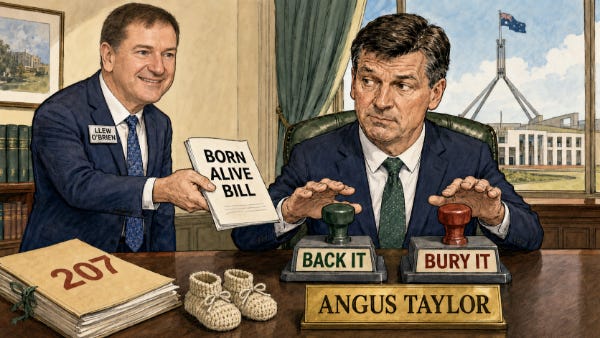
The Opposition Leader cannot pass Llew’s private Member’s bill by himself but his public support would still carry enormous weight. It would give Coalition MPs confidence to support the measure and tell parliamentary managers that the bill must receive more than a token appearance on the agenda.
When a leader stays silent, nervous backbenchers notice. So do the people who decide which bills receive time and which are left to expire.
At the time of writing, I have seen no public commitment from Angus Taylor to back Llew O’Brien’s bill. This is despite Taylor using his first address as Liberal leader to criticise the “politics of convenience” and speak about leadership grounded in “courage and conviction”. This is where those words meet an actual decision.
I spent more than a decade inside the Liberal National Party and the federal Coalition. I know how the routine works. Before an election, conservative and Christian voters are reminded that Labor and the Greens would be worse. Once the election is over, protecting unborn life becomes too sensitive, too divisive, or simply too inconvenient. Pro-life Australians are expected to remain loyal while receiving very little in return.
The proof is in the pudding. Queensland’s LNP government has already imposed a restriction preventing abortion-law changes from being debated during this parliamentary term. Every one of the 50 LNP MPs present supported it. That is a miserable message to voters who believed electing an LNP government might at least allow these matters to be discussed.
There are good people within the Coalition who have consistently stood up for life. Llew O’Brien is one of them. Matt Canavan and Alex Antic have also shown that they are prepared to speak when silence would be safer for their careers.
They should not have to carry every fight while the party leadership studies the ceiling.
Political parties do not own anyone’s vote. Pro-life support is not inherited property, automatically transferred to the Coalition at every election, because the alternatives are worse. Votes have to be earned.
Angus Taylor now has an opportunity to show pro-life Australians what sort of leader he intends to be. He can publicly support Llew’s bill, encourage Coalition MPs to vote for it, and insist that Parliament holds a proper debate followed by a recorded vote.
The bill may still face resistance. Labor, the Greens, and sections of the medical and abortion lobby will almost certainly object. Some Coalition MPs may want nothing to do with it. So be it. That is why Parliament has debates and votes.
Tomorrow, the baby booties outside Parliament House will remind MPs of children most Australians have never heard about. Inside, Llew O’Brien will place the issue before them again.
Five years ago, my bill received some parliamentary time and then disappeared. Kind words were no substitute for a vote then, and they will not be enough now.
Parliament knows how to make difficult bills vanish. I have seen it happen. This time, every MP should be made to put their vote on the record.
___
Republished with thanks to Nation First. Image courtesy of Adobe.
One Comment
Leave A Comment
Recent Articles:

25 October 2026
4 MINS
Prayer is active partnership with God, and he is awakening his body to prayer, not by might or by power, but by his Spirit.

24 October 2026
3.3 MINS
When we ask God, "What is in my hand?", and see our possessions, money and time as seed that God asks us to sow, life becomes simpler.

23 October 2026
6.8 MINS
Hillsong UNITED’s Joel Houston reflects on fame, faith and the burden of ministry, questioning performative Christianity as he seeks a more authentic walk with God.
23 October 2026
13.1 MINS
Tasmania’s proposed conversion practices legislation raises serious questions about religious freedom, pastoral care and whether Christians can freely pray with those seeking to live according to their faith.
23 October 2026
7.7 MINS
Melbourne Catholic Archbishop Peter Comensoli has spoken out clearly against the deadly promises by both major parties in Victoria ahead of the election, drawing a comparison between abortion and capital punishment.
23 October 2026
3.1 MINS
As Western societies grow more hostile, could abandoning Christianity’s moral foundations be contributing to the rise of ideological extremism, political intolerance and violence?

23 October 2026
5.1 MINS
France’s escalating riots expose the dangers of political extremism, antisemitism and radical alliances, offering America a stark warning about the future of Western democracy.



Thank you George for informing us on obstacles to this Bill, pray the grass roots speak strongly to every MP including Angus Taylor