


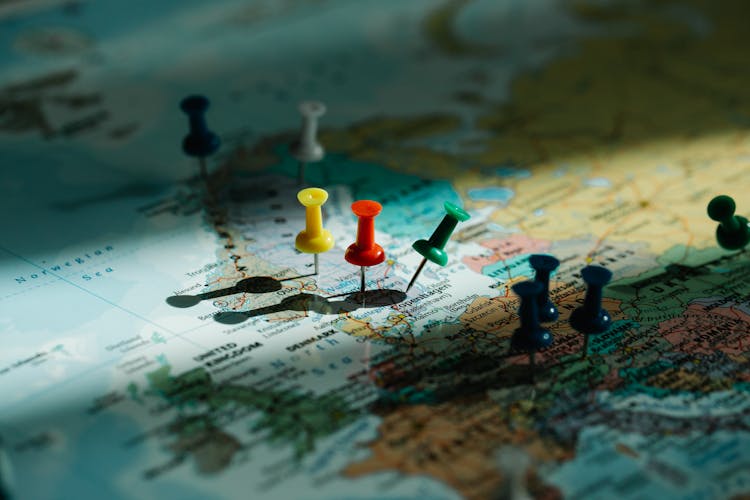
Facing Up to Strategic Realities: Warnings from Europe
Britain’s new chief of the general staff, General Sir Roly Walker, has warned that his country and NATO have three years to prepare for war against an “axis of upheaval” as Russia, China, North Korea, and Iran increasingly work together.
He said it did not matter how the war in Ukraine ended. Either way, Russia would emerge “very, very dangerous” and “wanting some form of retribution for what we have done to help”.
His warning is the gravest from any serving military chief in recent years and follows similar warnings from one of his predecessors, General Sir Patrick Sanders; from Germany’s Defence Minister, Boris Pistorius, who in January said that NATO should expect an attack on a member state within five to eight years; and from Danish Defence Minister Troels Lund Poulsen, who noted in February that Russia would likely be in a position to test Article 5 and NATO solidarity within three to five years. (NATO’s Article 5 provides that if a NATO member is attacked, it will be considered an attack on all members, and all will assist the member under attack).
Globally, there are indications of the world being in a pre-war era, with Putin’s grinding attack on Ukraine, the destabilising influence of Iran and its proxies in the Middle East and, most challenging for Australia, China’s growing military strength and belligerence.
This does not mean that a major war in Europe, the Middle East or East Asia is inevitable. Rather, it is a warning. As The Australian’s foreign editor, Greg Sheridan, has noted, history demonstrates that almost every time there has been a major arms buildup by hostile states, it has led to war.
Historically, Western democracies have been notoriously shortsighted in recognising threats from hostile nations and slow to build strong military responses to those threats.
NATO in Europe and the U.S. Alliance in the Pacific, along with nuclear weapons superiority, maintained a “long peace” from the end of World War II until the end of the Soviet empire. Conflicts were restricted to proxy wars rather than superpower conflagrations.
Then, following the fall of Soviet communism (1989-92), a naive belief set in in the West that deep economic globalisation, unregulated markets and privatisation would see old totalitarian states like Russia and China evolve into liberal democracies and abide by a rules-based global order.
Instead, Russia is now ruled by a totalitarian, unreformed KGB officer, while under the totalitarian rule of the Chinese Communist Party, China adopted Western capitalism on steroids to achieve near superpower status with the goal of hegemony in the Asia-Pacific region.
NATO and Russia
In response to Russia’s attack on Ukraine, this year, NATO defence expenditure will reach 2 per cent of its members’ average gross domestic product (GDP). The last time that happened was in 1993.
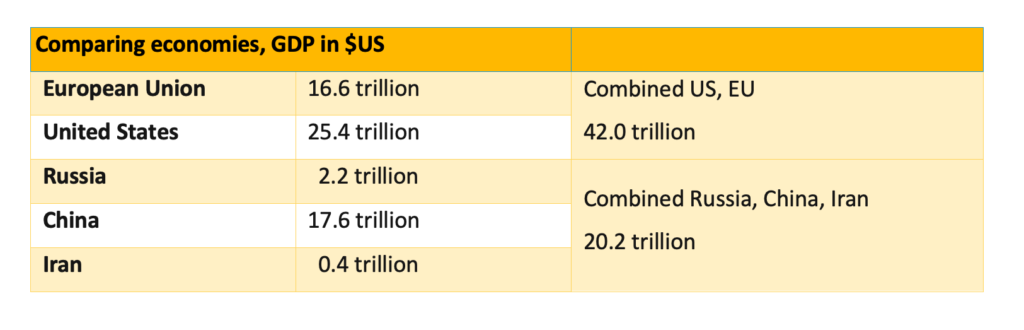
Source: World Bank
Indicative of the loss of their defence industries, Western countries are struggling to maintain supplies of munitions to Ukraine in what has become an industrial war, down to which side can manufacture the most weapons and ammunition to survive the longest.
Earlier this year, Sweden’s former prime minister (1991-94), Carl Bildt, wrote a speculative warning as to the consequences of not stopping Putin in Ukraine. Bildt said that Putin “stubbornly refuses to accept that we now live in the age of nation-states … Instead, he fantasises about recreating the Russian Empire.”
“He wants Ukraine to be demilitarised, meaning subjected to Russian military and security control of its territory; and he wants ‘denazification’, meaning Ukraine would be put under Russian political control. In other words, Russia would absorb Ukraine so that the latter ceases to exist as an independent nation-state.”
Given the brutal mass atrocities of Putin’s invading army that have already been seen, more atrocities could be expected if Ukrainian forces were routed. Although European governments’ responses are difficult to predict, Bildt said: “They most certainly would not be aimed at securing peace with Russia. Far more likely is an even wider and more prolonged conflict, where the outcome would ultimately be decided by Europe’s economic and industrial strength, irrespective of changing U.S. attitudes.”
While European Union defence industries have fallen behind, the EU has a far bigger economy than Russia, with the great potential to expand weapons and ammunition production, which is just beginning.
However, the cost in lives of a major war in Europe would be enormous.
Already, there are signs of a slow-burn conflict. Russia is instrumentalising illegal migrants into Europe, providing them guidance, routes and supplies, as part of a ruthless form of hybrid warfare to destabilise the EU.
In recent years, acts of sabotage have shaken Europe, as intelligence services reveal an increase in Russia’s probing efforts into defence industries, sea cables and crucial infrastructure. Increasingly, the safety of European air traffic and shipping is being threatened by Russian attempts to jam GPS navigation systems.
Over the past decade, there have been assassinations of Putin’s opponents living in exile in Europe. Recently, there was an attempt on the life of Armin Papperger, chief executive of Rheinmetall, one of Germany’s largest arms manufacturers, which is providing support for Ukraine.
There are ongoing heavy Russian social-media propaganda campaigns into Europe against Ukraine.
The Fund for Support and Protection of the Rights of Compatriots Living Abroad (Pravfond), founded in 2012 by Russian presidential decree and backed by the Russian Ministry of Foreign Affairs, has provided millions of euros for propaganda websites, paid for the legal defence of a convicted arms trafficker and an assassin, and has employed former intelligence officers as the directors of its operations in European countries. Pravfond is now subject to European sanctions.
If the next U.S. president and the European Union nations significantly boost supplies of advanced weaponry to Ukraine, Putin may settle for the territory he holds. That could make Ukraine ineligible to join NATO, as a condition for NATO membership is that a state must be able to control its own borders.
Or, if the West runs short of munitions and if war fatigue sets in, Putin may set out to devastate Ukraine. That would destabilise Europe with millions more refugees and give Putin the confidence then to expand his Russian empire even further.
The Middle East
Israel’s protracted conflict with Hamas should be viewed in the context of Iran’s arming and training of its proxy forces – Hezbollah in Lebanon, Hamas in Gaza, the Houthis in Yemen and other forces in Syria and Iraq – to amass forces capable of destroying Israel.
Iran has been supplying all its proxy forces with increasingly sophisticated drones, cruise missiles and ballistic missiles, and training their military into professional armies and to build their own weapons.
Should Iran gain nuclear weapons to counterbalance Israel’s nuclear force, and it and its proxies at the same time gain overwhelming superiority in other forms of sophisticated missiles, then Tehran and its allies could have the capability to overwhelm Israel’s defences with massive missile attacks, causing huge destruction.
China
Chinese President Xi Jinping has made clear Beijing’s ambition to use the economic power China has gained over 35 years of enormous economic growth, thanks to massive Western investment and technology transfer, to achieve hegemony over its region of the world and beyond.
It is pursuing all means of influence – diplomatic, investment (for example, the Belt and Road Initiative), hybrid warfare and military coercion. It has greatly expanded and modernised its military, built islands on shallow reefs in the South China Sea for military bases, it militarily provokes Taiwan constantly, and has gained port access in numerous countries.
A primary objective is to incorporate Taiwan as a province of China, as it has done with Hong Kong. This would give Beijing an added prize. Taiwan produces 90 per cent of the world’s most advanced semiconductors, mostly through the Taiwan Semiconductor Manufacturing Company Ltd (TSMC), the world’s largest producer and a major Apple and Nvidia supplier.
Controlling this market would give Beijing an enormous geopolitical stranglehold over the world. TSMC is spending billions on new production plants around the world, including $US65 billion ($A100 billion) on three plants in Arizona, in the U.S. But replicating Taiwan’s model in the United States is proving to be a challenge for reasons as diverse as differing approaches to labour rights and demands on workers.
However, Xi’s ambitions face serious problems.
First, China’s gross national debt (national government, local government, household and corporate debt) is over 300 per cent of China’s economy. This is very high compared with other the emerging economies and a huge burden on China’s economy. Carrying as much as $US11 trillion in off-the-books debt, local governments built industrial districts, resorts, transit systems and housing projects, including many that failed.
China’s housing market was for decades the linchpin of Chinese growth. But today, consumer confidence is low and a lot of housing demand has already been met after a decades-long building spree.
Second, making matters worse, China’s population has peaked and is ageing.
Beijing’s brutally imposed one-child policy restrictions were reversed in 2021. Women are now being encouraged to have more children, but to little effect. In 2022, the number of births in China hit a record low of 9.56 million, the first time the number had dipped below 10 million since the late 1940s, according to China Daily.
Indeed, after four extraordinary decades in which China’s population swelled from 660 million to 1.4 billion, in 2022, China’s population declined for the first time since the Great Famine of 1959-61.
Although the one-child policy is not the sole reason for the current economic woes, its legacy will make it exceptionally hard for China to escape demographic doom. By 2080, it is predicted that China’s elderly population will overtake its working-age population.
As soon as the mid-2030s, the economic burden of China’s aging population will diminish Beijing’s ability to project its military power. Hence, the danger period for a Beijing attack on Taiwan is between now and the mid 2030s.
Third, Beijing’s military options for taking Taiwan risk a prolonged military conflict that could seriously damage China’s economy. These options include a blockade of Taiwan, seizing control of one of Taiwan’s many islands, bombardment of Taiwan, a comprehensive invasion of Formosa (the main Island of Taiwan), or a lightning commando raid to take out Taiwan’s government and capture key government buildings, airports and ports.
No doubt Beijing is observing closely how Russia’s expected quick takeover of Ukraine has bogged down into a long, bloody and costly war of attrition.
Fourth, unlike during the Cold War, China is now heavily integrated into the world economy. Anything short of a quick military takeover of Taiwan could be disastrous for China’s trade and its economy.
Given all these risks, Xi Jinping’s preferred option may well be coercion and economic blackmail below the threshold of war: that is, squeeze rather than seize Taiwan.
To that end, for years, the Chinese military has been ramping up aggressive activities – such as flying into Taiwan’s air-defence identification zone and barrelling across the centre line of the Taiwan Strait – designed to exhaust Taiwan’s military, reduce its physical space and create a sense that the island is unable to defend itself.
Disinformation, cyberattacks, cutting of Taiwan’s undersea cables 27 times in five years and efforts to isolate Taiwan diplomatically have been the centre of this campaign. These are just some of the grey-zone attacks being used to intimidate and undermine Taiwan.
If Taiwan can resist economic blackmail and other forms of hybrid-warfare coercion by China, if Taiwan, the U.S. and its allies can keep the price of aggression high, while also reassuring Beijing that inaction won’t simply result in Taiwanese independence – which no Chinese government will accept – then perhaps Xi will decide that tolerating an awkward status quo isn’t as costly as militarily trying to take Taiwan.
Australia’s Vulnerabilities
___
Republished with thanks to News Weekly. Image courtesy of Lara Jameson, Pexels.
Recent Articles:
14 October 2026
6.7 MINS
A national poll challenges claims that pro-life Australians are extremists, revealing broad support for abortion restrictions, protections for unborn babies and safeguards for vulnerable women.

14 October 2026
2.8 MINS
Queensland recorded 1,082 assisted suicide and euthanasia deaths in 2025–26, as the review board called for consultation on potentially widening eligibility criteria.
14 October 2026
5.5 MINS
As Christianity fades from public life, Marxism or Communism offers a substitute faith built on oppression, liberation and political salvation — but at what cost?
14 October 2026
5.3 MINS
Marco Rubio’s Athens speech celebrates the Greek, Roman and Christian foundations of Western civilisation, warning that cultural self-loathing and radical ideologies threaten its future.

14 October 2026
2.8 MINS
Australia needs a courageous Church that never separates courage from Christian love — the courage of Peter and John, who, when ordered to cease speaking about Jesus, responded: “We can't stop.”
13 October 2026
2.6 MINS
Allegra Spender’s proposed bill reignites debate over discrimination protections, religious freedom and the right of faith-based schools to uphold their beliefs and values.

13 October 2026
3.9 MINS
Tasmania’s proposed conversion practices law raises serious concerns for churches, parents and faith-based schools, with broad definitions, severe penalties and uncertain protections for religious freedom.


