


Unilateral Recognition of a Palestinian State Violates International Law and the UN Charter
We need to address a pressing issue regarding the Two-State Solution and Israel’s right to exist in law. Calls for unilateral recognition of a Palestinian state are increasing in diplomatic circles.
However, such recognition not only undermines peace negotiations between Israel and the Palestinians, but it also directly contravenes the UN Charter and the framework of international law established through the San Remo Resolution and subsequent binding treaties.
Let’s look at the legal state of Israel in international law.
1. The Legal Foundation: San Remo 1920
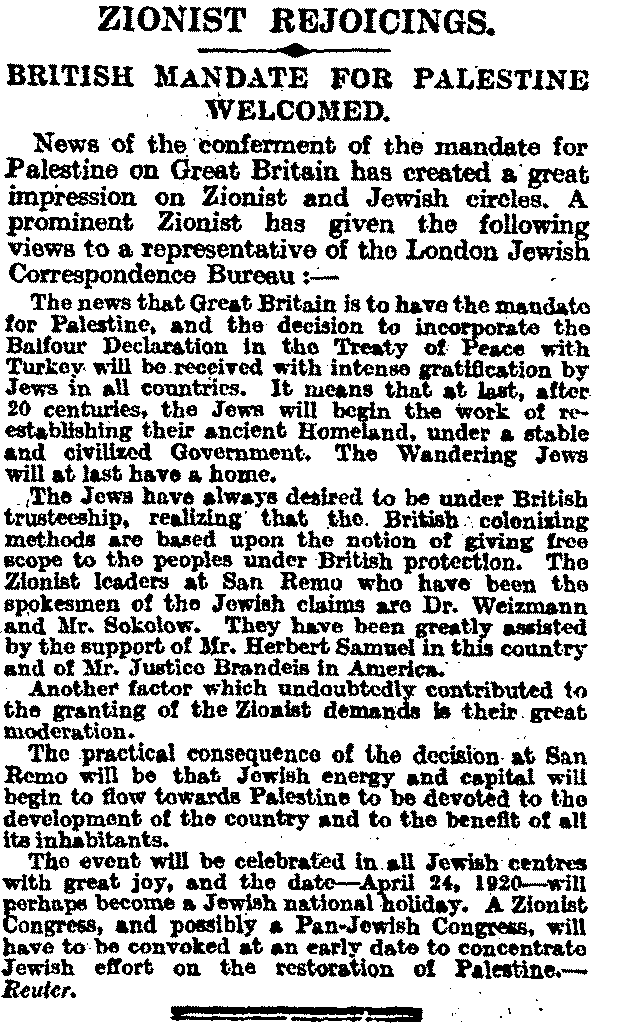
“Zionist Rejoicings. British Mandate For Palestine Welcomed”, The Times, Monday, 26 April 1920, following conclusion of the conference.
The modern legal status of the land between the Jordan River and the Mediterranean Sea traces back to the San Remo Conference of April 1920, convened by the Allied Powers after World War I. At San Remo, the former Ottoman territories were apportioned under the Mandate system of the League of Nations.
Note: The Palestinians cry ‘from the river to the sea, Palestine will be free’ as a dog whistle for the destruction of all Jews and Israel. Yet the reality is that, in law, that land is all Israel.
The San Remo Resolution incorporated the Balfour Declaration (1917) and gave international legal effect to the establishment of a national home for the Jewish people in Palestine. Article 6 of the Palestine Mandate (1922), confirmed by the League of Nations, instructed the Mandatory Power (Britain) to:
“Facilitate Jewish immigration and encourage close settlement by Jews on the land, including State lands and waste lands not required for public purposes.”
Crucially, no part of the Mandate distinguished between “West Bank” and “Israel proper.” The territory allocated for the Jewish homeland included all land west of the Jordan River—that is, the area now falsely claimed for a Palestinian state.
2. Continuity of Legal Rights Under the UN Charter
When the League of Nations was dissolved in 1946, its legal obligations did not vanish. Article 80 of the UN Charter—sometimes called the “Palestine Article”—explicitly preserved the rights granted under existing mandates:
“Nothing in this Chapter shall be construed to alter in any manner the rights whatsoever of any states or peoples or the terms of existing international instruments…”
This means that the Jewish people’s territorial rights defined under the San Remo Resolution and the Mandate for Palestine remain valid under international law and protected by the UN Charter itself.
3. The Illegality of Unilateral Recognition
Under international law, statehood must be based on lawful sovereignty and effective control. The Palestinian Authority (PA) does not meet these criteria, it lacks unified governance, defined borders, and the capacity to fulfil international obligations.
More importantly, unilateral recognition by other states bypasses the principle of mutual consent enshrined in UN Security Council Resolutions 242 (1967) and 338 (1973), which affirm that the conflict’s resolution must be achieved through negotiations, not imposed solutions.
By unilaterally recognising a Palestinian state within Israel’s legally defined territory, states would be:
- Violating Article 2(4) of the UN Charter, which prohibits actions that undermine the territorial integrity or political independence of another state.
- Undermining the binding international instruments (San Remo, the Mandate, Article 80) that recognise the land between the Jordan River and the Mediterranean as part of the Jewish national home.
4. Reaffirmation by Later Treaties
The rights first established at San Remo were reaffirmed in several subsequent international agreements:
- The Treaty of Sèvres (1920) and the Treaty of Lausanne (1923) confirmed the disposition of former Ottoman territories.
- The Anglo-American Convention on Palestine (1924), signed and ratified by the United States, gave the Mandate full force in American law.
- The UN Charter (1945) perpetuated all existing rights of peoples and states under the League of Nations system.
None of these instruments has ever been legally superseded or revoked. Therefore, the Jewish people’s right to sovereignty in all of Mandatory Palestine west of the Jordan River remains intact under international law.
5. Conclusion: Upholding the Rule of Law
Unilateral recognition of a Palestinian state is not an act of justice, but a breach of the very international legal order that created the modern Middle East. The San Remo framework and the UN Charter together affirm that the Jewish people hold legitimate and enduring rights to their ancestral homeland.
Any move to recognise a Palestinian state outside a negotiated agreement with Israel not only undermines peace, but it also violates the UN Charter, contradicts binding treaties, and erodes the foundational principles of international law.
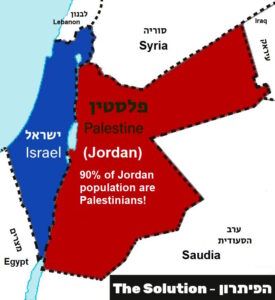
I leave the following quote for your consideration as the basis of a pragmatic solution:
“The truth is that Jordan is Palestine and Palestine is Jordan”
— King Hussein I of Jordan in a newspaper interview, 26 November 1981
___
Image courtesy of Adobe.
7 Comments
Leave A Comment
Recent Articles:

20 October 2026
4.9 MINS
James McAuley’s legacy reaches far beyond Australia’s Catholic hymnals. Poet, convert and cultural warrior, he defended beauty, truth and faith in an age of changing values.

20 October 2026
4.9 MINS
A federal investigation has exposed how America’s biggest banks shut out conservative and Christian clients, relying on subjective reputation risks and controversial ideological watchdogs.

19 October 2026
12.4 MINS
Greta Gerwig’s "Narnia: The Magician’s Nephew" trailer raises questions about C. S. Lewis’s Christian vision and the faithfulness of the new Netflix adaptation. Here are my initial impressions and concerns.

16 October 2026
4 MINS
A desperate Victorian Labor Party is peddling taxpayer-funded abortions as free “healthcare”. In a shameless attempt to stay in power, they're willing to do anything — including killing the unborn and forcing taxpayers to pay for it.

16 October 2026
4 MINS
Katie Zacharia’s first days as White House Press Secretary have sparked fierce media criticism, but her remarkable testimony of surviving an abortion attempt tells a deeper story.

16 October 2026
3.4 MINS
Australia’s proposed digital duty of care laws promise greater online safety and increased user control by switching off algorithms, but critics warn they could give ministers sweeping powers to restrict lawful content and threaten free speech.

16 October 2026
5.2 MINS
Christa Pike’s botched execution has sparked outrage across America, but critics argue that the same concern for human dignity is denied to abortion survivors.



Kevin, I think you need a rethink. I think 3C Church has got it right,
750,000 Palestinians were forcibly removed from over 500 villages in what was known as The Palestinian war
15,000 Palestinians were killed .
The Palestinian people as well as Jews . are equally indigenous to this Land . The UN allocated the West Bank to Palestinians and Gaza to Egypt in 1949, however since 1967 , both have been controlled by Israel.
Israeli Settlements ,declared illegal by the UN , now occupy 22% of the West Bank.
There will never be Peace in the Middle East , without a 2-State Solution , which the overwhelming majority on UN member countries support
Okay, lets stop the lies; they are bad for your soul.
Here is the truth.
1. 750,000 Arabs moved in 1948 when 5 Arab nations attacked the new country of Israel.
The vast majority moved because the Arab leaders told them the war would be over in weeks and Israel would be destroyed.
FYI had the Arab nations prevailed, it would be called Jordan.
The Palestinian identity is a fiction created by the KGB and Yasser Arafat in 1964. Prior it meant Jewish.
2. Arab invaders were killed as were many Jews defending their land.
3. The UN allocations were GA resolutions, which are not law unless all parties agree, which they did not.
Further the UN was contradicting the earlier actual laws.
4. Again Israel settle in Area C (post Oslo agreements, which have failed miserably). Lookup area A, B, and C.
The 2SS is functionally dead.
You cannot negotiate peace with someone who kill you. – Golda Meir
Finally, as for indigeneity… Everyone screams Israel stole the land, but here’s the truth: Jordan, Lebanon, Syria, Egypt, and Israel all formed around the same time, carved from the Ottoman Empire’s ruins.
After World War One, Britain gave us Jordan in 1946. France split Lebanon in 1943, Syria 1946. Egypt broke British chains in 1922. Israel? 1948. No ancient kingdoms—just colonial borders. All these states, same origin story.
But only Israel, tied to 3,000 years of Jewish history—temples, coins, scrolls—gets branded coloniser. Why? It’s not history’s fault.
It’s the Islamic rejection of any Jewish sovereignty, rooted in ideologies that erase Jewish presence, even as end-time narratives justify wiping them out.
If everyone’s a colonial kid, why’s only Israel illegitimate? Think about that.
This is worth watching/reading… Have you heard that Israel “occupies” the West Bank?
But have you ever asked yourself whether that’s true? Or even what it means?
Eugene Kontorovich, professor of law at George Mason University, dives into these questions and uncovers some surprising answers.
https://www.youtube.com/watch?v=wu1rkvwzshE
Transscript: How many times have you heard that Israel “occupies” the West Bank?
Probably more times than you can count.
But have you ever asked yourself whether it’s true? Or even what it means?
Let’s do so now in the most objective way possible; that is, in the way that all territorial questions everywhere else in the world are resolved.
To do this, we must look at the law.
But first, we need a little history.
Up until 100 years ago, the areas now called Israel, the West Bank, Gaza, and all the countries around them—were part of the Ottoman Empire, which ruled over a vast area and many peoples. Neither the Jews nor those Arabs we now call Palestinians had a state, though the Jews had a nationalist movement calling for one.
Everything changed after World War I. The Ottomans fought on the losing side with Germany. By end of the war in 1918, their empire had disintegrated, leaving the British and French in control of much of its territory.
In earlier times, the victors would likely have kept this land as colonies for themselves. But there was a new spirit of democracy in the air. The allies—including the British, French, and Americans—agreed that the former Ottoman lands should be allowed to become independent nation-states.
After the war, the nations of the world created the League of Nations, a precursor to the United Nations. Meeting in San Remo, Italy in 1920, they set up what was known as “the Mandate system.” The colonies of the defeated powers—Germany and the Ottoman Empire—were converted into distinct geopolitical entities, which became the countries now known as Iraq, Lebanon, Syria, and Jordan.
None of this is controversial.
There was one other Mandate issued—the Mandate for Palestine. “Palestine” was merely a geographic label—the name the Romans gave the Jewish Kingdom of Judea after they conquered it. There was nothing exclusively Arab about it.
The Mandate provided that Palestine would become a “national home” for the Jewish people. There was a simple reason for this: the League recognized that Jews were the indigenous people of the area.
All the mandatory territories in the Middle East transitioned to statehood in the 30s and 40s, with Israel the last to do so, declaring independence in May 1948.
So, now we get to the legal stuff.
What were the borders of the State of Israel when it declared independence?
International law has a simple and universally applicable rule for determining borders. It’s called the Uti Possidetis Juris principle (lawyers love Latin phrases). The rule provides that when a new country is created, its borders match the borders of the previous geopolitical entity in that territory.
For example, the borders of Ukraine, Latvia, and Azerbaijan are exactly what they were when they were parts of the Soviet Union.
Other considerations, such as demographics, are not taken into account—because without a simple, easily-applied rule, a new country’s borders would never be settled—a recipe for permanent conflict.
Applying this rule to Israel means that it had sovereign claims to all of Jerusalem, Judea and Samaria, and Gaza because those were its borders according to the Mandate of Palestine.
To be sure, the United Nations proposed a resolution in 1947 with different borders and a much smaller area for a Jewish state. But that resolution was a non-binding recommendation. Nothing more. It did not have the force of law.
We know what happened next.
Upon declaring independence, Israel was immediately invaded by five Arab armies, seeking to destroy it.
Israel survived, but Jordan managed to seize parts of Jerusalem, as well as Judea and Samaria, which it dubbed “the West Bank.” All the Jews living in these areas were expelled—or, to use a contemporary term, ethnically cleansed.
Here we need to introduce another key principle of international law: a war of aggression cannot be used to change another country’s borders.
Israel and Jordan signed an armistice agreement in 1949—an agreement to temporarily stop fighting. This truce had no legal effect on borders.
When Israel liberated these territories in 1967 during the Six-Day War, it was retaking its own land. You can’t “occupy” land that belongs to you.
So where are we now?
In 1994 the Palestinian Authority was established as part of the Oslo Accords. Israel didn’t have to agree to this, but it did. While not being a sovereign state, the PA operates independently of Israel. The PA, not Israel, governs the lives of Palestinians living in the West Bank.
Israel has offered the Palestinians a fully independent state on several occasions. Each time the Palestinians have rejected the offer, something no other national independence movement in modern times has done.
Whether or not it makes sense for Israel to renew such offers is an open question. But it is under no legal obligation to do so.
I’m Eugene Kontorovich, professor of law at George Mason University, for Prager University.