



Brrrr! Is Australia Entering a Demographic Winter?
Australia’s birth rate has sunk to record lows, raising fears of a demographic winter. Experts warn inaction now risks long-term economic, social, and population decline.
The last time Australia produced enough babies to guarantee the population would replace itself was 50 years ago.
In 1975, the fertility rate (TFR) was 2.1 children per woman. Since then, it has declined nearly every year.
The Australian Bureau of Statistics reported in September last year that the total fertility rate for 2024 was 1.48. But figures released earlier this month in the 2025 Population Statement from the government’s own Centre for Population forecast that the TFR for 2025 will slip even further, to 1.42.
This didn’t worry Treasurer Jim Chalmers unduly. He merely observed that: “While higher than many of our international counterparts, birth rates in Australia are expected to fall to a record low in 2025–26.”
Former Treasurer Peter Costello responded by asking why the government is turning a blind eye to the looming demographic crisis.
“Is our government worried that the fertility rate is at an all-time low? Is our government worried that we’re heading to a situation where we’ll have more people dying than being born in Australia?” he asked in an interview with the ABC.
“Is that the kind of society which will feel healthy about itself? I think our government’s got to put this back on the agenda. It’s got to say that this is an issue. It’s got to talk about it.”
Back in the 2002 budget, Costello handed out $3000 baby bonuses and pleaded with Australians to have “one for mum, one for dad and one for the country”.
He is very proud of what happened next. There was a substantial uptick in the birth rate, he said, with a number of women having that third child for the country. However, the program was extraordinarily expensive and was abolished in 2014.
“The thing that worries me the most is having led the world on this issue 20 years ago, we’ve had governments, successive governments, that have just sat on their hands, let it slip off the agenda… And that’s now baked in,” he told the ABC.
“If you turn the fertility rate around tomorrow, it wouldn’t have any effect in producing adults for 20 or 30 years. I think the government’s got to get serious about this, and it’s got to talk about it.”
A report last year by e61, a non-profit, non-partisan economic research institute based in Sydney, explained that “The decline in fertility has been driven by three factors: later parenthood, a decline in the number of children per mother, and an increase in the share of women not having children.”
The growth in childlessness is striking. The proportion of couples without children rose from 29 per cent in 1976 to 39 per cent in 2021.
This means that couples who do have children need to have more to compensate. This implies a third, fourth or fifth child – which will be a bridge too far for most couples.
A global problem
Australia is not a special case, as Dr Chalmers pointed out. Across the world, fertility rates are sliding below replacement level.
The “population bomb” which terrified governments in the 1970s has turned into a global population bust. Israel is the only developed, Western-aligned country with fertility rate above replacement – about 2.8 children per woman.
And Africa is the only continent in which the population is replacing itself. Its TFR is about 3.9. In sub-Saharan Africa, according to the World Bank, the TFR is about 4.3. It will be exploding with young people while the rest of the world enters a demographic winter.
Back to Australia. Why are women having so few children?
According to the Centre for Population, “The decline in the TFR has been driven by lower fertility rates among women aged under 30. This is part of a broader trend of delaying parenthood, with many people choosing to have children later in life.
“However, this delay is not being fully offset by higher fertility rates at older ages. Many women who start families later have fewer children overall, either by choice or by circumstance. As a result, overall fertility rates have declined.”
(One bright spot in these bleak figures is that the TFR for Aboriginals and Torres Strait Islanders is increasing. Their TFR was 2.13 in 2024, and First Nations children accounted for 8.6 per cent of all registered births.)
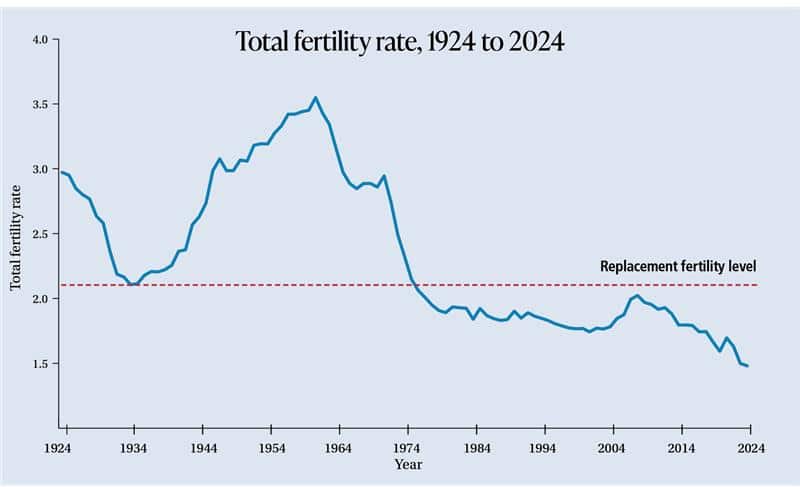
Information based on the data from the Australian Bureau of Statistics. (Registered birth between 1924 to 2024).
The Centre for Population believes that the TFR will bounce back to 1.6 by about 2031, but that is an assumption – perhaps an heroic assumption – rather than a forecast.
Its 2022 report actually said a decline to a TFR of 1.22 by 2036 was possible. It called this a “a low fertility scenario” – and four years on, it is looking more like realism than pessimism.
The ultra-low fertility club
Australia’s downward trajectory is in sync with other developed countries. In Canada, for instance, the TFR has fallen to a record low of 1.25. This puts Canadians in what demographers call the “ultra-low fertility” club – a TFR below 1.3.
The implications of ultra-low fertility are sobering, if not downright scary. Theoretically, if the TFR is 1.3, the population will halve in 45 years. To maintain Australia’s population and productivity, the gap would have to be filled with migrants – which is politically and socially risky.
The government ought to be doing everything it can to avoid what demographers call the “low fertility trap” – when a country enters a death spiral in which it becomes impossible for fertility to rise.
It works like this. Fewer births in the past leads to fewer mothers in the future.
As small families become the social norm, the ideal family size shrinks even further. The one-child family is normalised. And then the younger generation’s willingness to have children declines because couples feel that they can’t afford children.
Dr Ali Virgili, of the e61 research group, told The Catholic Weekly in an email that Australia’s “demographic structure, social norms, policy settings, and migration patterns” are very different from ultra-low fertility countries like Korea, Japan or Ukraine.
However, he said, “Recent trends suggest that Australia is moving in the same direction.”
What to avoid: China
To have a look at what this death spiral looks like, consider China. According to figures released this week, the birth rate there is the lowest since the Communists took power in 1949.
China’s demographic statistics are opaque, but it appears that its TFR is hovering just above 1.0. The implications –as Xi Jinping and his colleagues know well – are dire.
Fewer young men to be recruited as soldiers; fewer workers to pay taxes; more unproductive old people to be supported by the workers’ taxes. China’s economy could collapse.
So, after decades of promoting a one-child policy with policies as draconian as forced abortions, China is desperately trying to get women to have more children.
It abolished the one-child policy; it abolished a two-child policy. It now has a three-child policy. The latest pro-natalist gimmick is a 13 per cent sales tax on condoms and contraceptives, while child care, matchmaking, and eldercare will be tax-free.
The government is showing signs of desperation. Last year it announced its own version of Costello’s baby bonus – a tax-free payment of $770 each year for each child under three.
Provincial governments are experimenting with their own initiatives. In some, the BBC has reported, officials have rung women to ask about their menstrual cycles and whether they plan to have children.
Some are offering discounts on IVF procedures. Some are offering newlyweds extra days of paid leave to encourage marriages.
“Past attempts by the country’s communist government to reverse slumping fertility rates through policies encouraging couples to have more children have not worked,” wrote American demographer Dudley L. Poston Jr, in The Conversation.
“I do not expect these new moves to have much, if any, effect on reversing the fertility rate decline.”
Although Australia and China are vastly different societies, China’s dismal record in promoting a pro-child culture offers a sobering challenge for Australia. If financial incentives don’t work, what will?
According to Dr Virgili, the population panorama in Australia is unlikely to change.
“Based on historical trends in the TFR, we expect the decline will continue, although the pace may slow,” he said.
Our research at e61 Institute highlights several key factors increasingly shaping fertility decisions, particularly for younger women: housing affordability, the cost of raising children, career considerations, and access to quality childcare. These pressures have become increasingly important in decisions to have a child in recent years and show no signs of easing.”
As the demographic winter tightens its grip on the country, Peter Costello’s demand becomes urgent: “Our government’s got to put this back on the agenda. It’s got to say that this is an issue. It’s got to talk about it.”
___
Republished with thanks to The Catholic Weekly. Image courtesy of Adobe.
4 Comments
Leave A Comment
Recent Articles:

11 October 2026
2.6 MINS
Jesus offers us intimate friendship, which produces great joy as we walk closely with him.

10 October 2026
4.1 MINS
When Jesus rebuked the Laodicean church, this was not a sign of his lack of love, but proof of it and how greatly he longs to reward and bless us. He is knocking — will we answer?
9 October 2026
5 MINS
During a recent dialogue between high profile legal experts, a top Australian constitutional law expert was asked if Australia should have a Bill of Rights. His answer may surprise you.

9 October 2026
1.3 MINS
Season 6 of The Chosen is releasing next month, and until 15 November, your church has the opportunity to host a free pre-release screening of Episode 1. Here's how.

9 October 2026
1.8 MINS
Pen Power Australia has been busy confronting antisemitism and double standards, lodging letters, pursuing accountability and celebrating several important wins along the way.

9 October 2026
3.3 MINS
New South Wales healthcare workers who object to abortion and voluntary assisted dying face growing pressure, raising serious questions about conscience rights, employment and moral injury.

9 October 2026
2.9 MINS
God is intensely relational, and he puts us into a community of believers so we can use our gifts in service of Christ's body.



My experience –being an Only Child is no fun .
Very comprehensive article.
But I guess the most important takeaway – financial incentives don’t work.
Which is why we need immigration. And being the lucky country – we’re just lucky we live in a country people want to move to.
I believe a big part of the ‘infertility’ problem is abortion. Between 90000 and 100000 abortions a year in Australia. Is that statistic being considered. I can’t believe the lament about declining birth rates while pushing abortion. What a disgrace
In the meantime the Muslims have big families.