


Solutions to Australia’s Self-Inflicted Energy Crisis
How could Australia be suffering a double energy crisis when the nation exports several times more energy than it consumes and far more than the United States, which has no energy crisis? Looking to the US, what needs to be done to ensure Australia’s energy security?
Australia has had a decade of warnings of a possible energy crisis, so one might have expected Prime Minister Anthony Albanese, in his three-minute-17-second address to the nation on April 1, to report on Australia’s serious lack of oil and fertiliser security; our soaring electricity prices destroying the nation’s manufacturing and other businesses; the nation’s poor resilience capabilities in the face of external threats; and our miserable lack of any defence muscle.
All these concerns are being laid bare by the oil crisis in the Persian Gulf, specifically in the Strait of Hormuz, through which flows 20 per cent of the world’s oil and much of Australia’s oil.
One might have expected the PM to announce urgent short-term plans to overcome our liquid fuel shortages, priority rationing of fuel, and medium-term plans to make the nation more self-sufficient in liquid fuels, given that Australia imports 80-90 per cent of its oil over long, vulnerable supply chains. Instead, there were only meagre measures to mitigate high fuel prices, Australians being asked to rely more on public transport and work more from home.
The Australian’s foreign editor, Greg Sheridan, quipped that the PM’s address “was no Gettysburg Address; more Dame Edna on a bad night”. The only subsequent helpful government announcement was that it will bargain our energy exports for continued oil shipments to our shores.
Very little, very late.
Diesel Dependence
Australia’s vast distances between cities, from farms to supermarkets and from mines to ports mean the country runs on diesel, petrol and aviation fuel. According to a senior farm leader to whom News Weekly spoke, chronic regional diesel and petrol shortages are happening when most farmers have not yet stocked up on fuel and fertilisers as they are still assessing the prospects for the next planting season. If fuel supplies are not stabilised, food prices will rise sharply, he warned.
Diesel-powered locomotives deliver coal to power stations to generate most of the nation’s electricity. Without diesel, electricity supply is threatened. Doubling the price of diesel forces up transport costs, which impacts the nation’s huge fleet of trucks transporting goods across the country. The resulting costs-push inflation will affect every sector of the economy, driving up interest rates. Businesses and those with mortgages will be hit hard.
Fossil Fuel Dependence
The industries that built Australia relied on cheap brown and black coal. Yet, as Australia earned huge returns from its vast mineral and energy exports, tens of billions of dollars have been invested to stake the nation’s future on renewables – wind farms, solar farms, subsidies for household solar panels and batteries, and vast new transmission infrastructure.
What have we got from these massive investments? Despite the hype about big increases in the capacity of renewable energy, and short periods when renewables contribute significant inputs to the electricity grid, the overall amount of power delivered has been minute. In the end, it is not capacity that counts, but delivery of reliable constant power to the grid.
Minister Chris Bowen’s Federal Department of Climate Change, Energy, Environment and Water (DCCEEW) annually publishes data showing the Total Australian Energy Flows. Figure 1 (below) shows the sources of all energy consumed in Australia (electricity, transport, industries, etc.) for 2023-24:
• Five per cent only came from solar and wind.
• Four per cent from hydro, wood, biofuels and biogases, and bagasse (fibre from crushed sugar cane burned to power sugar mills).
• Ninety-one per cent from fossil fuels (coal, gas, liquid fuels).
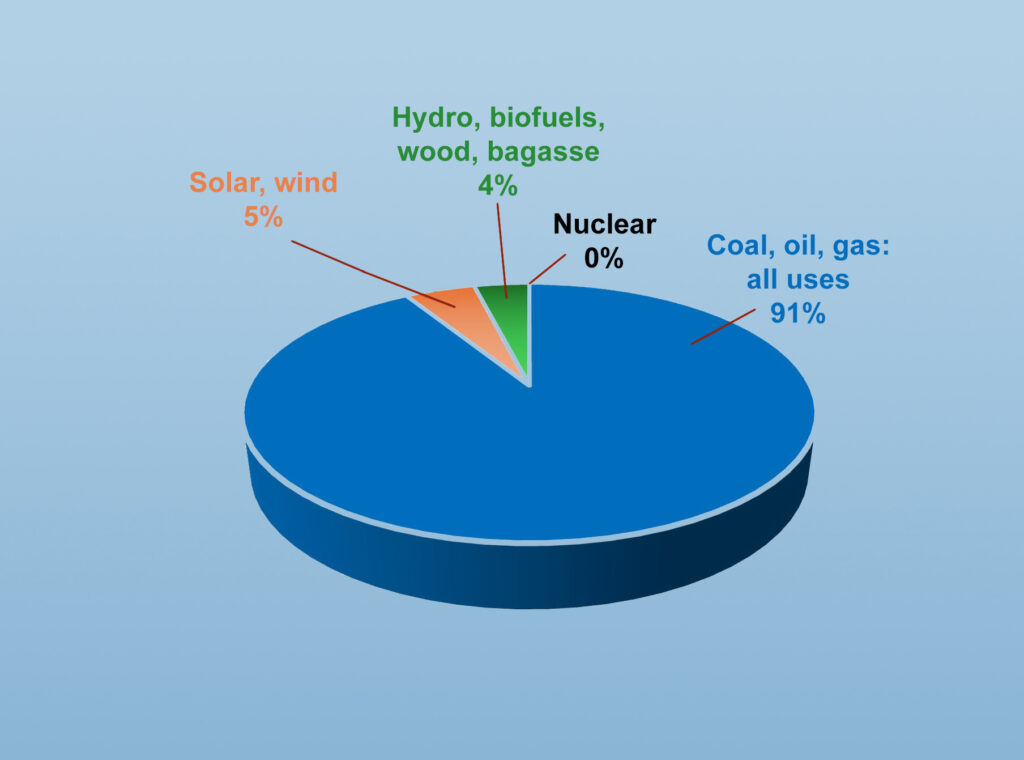
Figure 1. Australian energy use by type, 2023-24
Sources: Australian Energy Flows 2023-24, DCCEEW, Petajoules
Uranium: Energy Account, Australia, ABS
Two Crises Despite Huge Exports
Paradoxically, boasting 14 per cent of the world’s coal, 32 per cent of the world’s uranium and huge gas reserves, Australia is a huge energy exporter at the same time that it is experiencing energy crises.
Figure 2 (below) shows that, while Australia produces and uses 4,157 petajoules of energy of many types, and imports and uses 2,302 petajoules of mostly liquid fuels annually, the nation exports a whopping 18,018 petajoules of coal, gas, condensate oil and uranium.
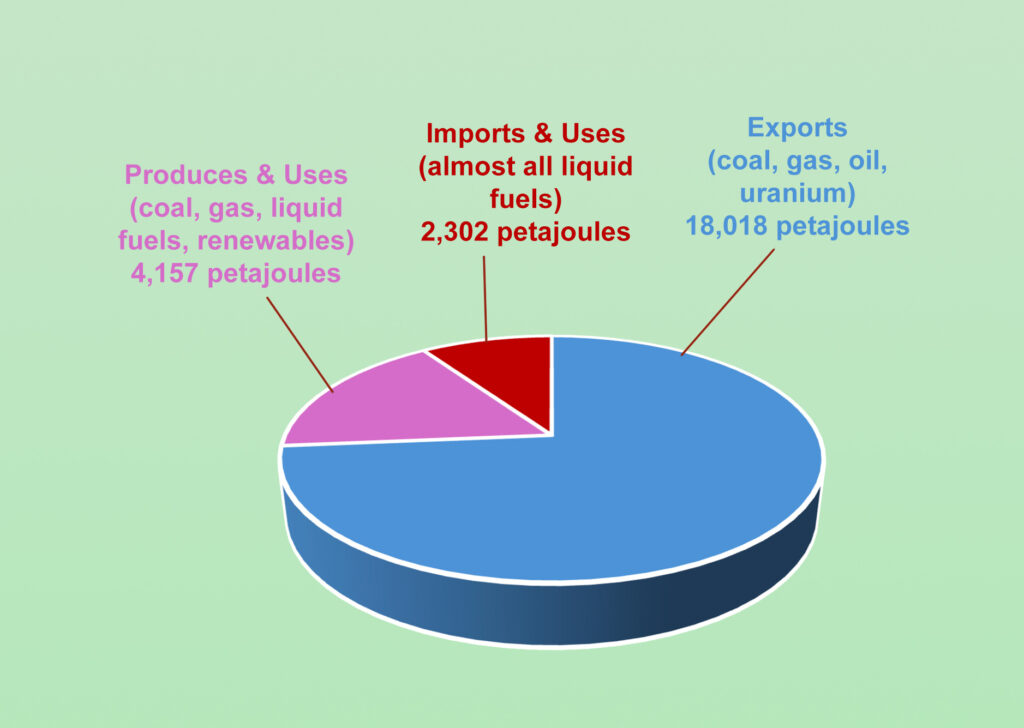
Figure 2. What Australia Produces & Uses, Imports & Uses, and Exports (Petajoules), 2023-24
Source: DCEEW and ABS data on uranium production
To put that in perspective, Table 1 (below) shows that Australia’s net energy exports are 15,698 petajoules, 13 times America’s net exports of 1,204 petajoules.
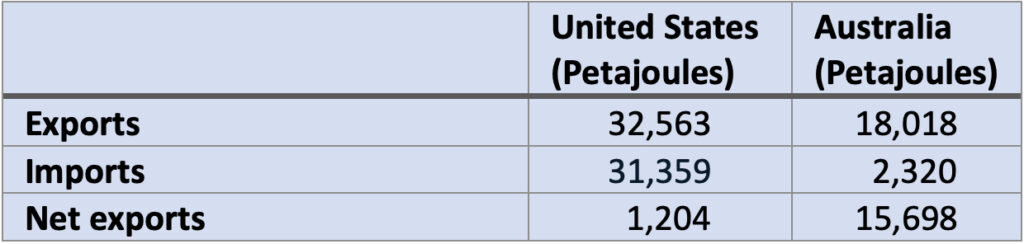
Table 1: U.S. vs Australian Energy Imports and Exports
Source: “U.S. energy facts explained”, U.S. Energy Information Administration
Question: How is it that the U.S. has no energy crisis while Australia confronts two energy crises?
First, Australia is facing a potentially chronic shortage of liquid fuels as the world recoils from Iran’s closure of the Persian Gulf, while federal and state governments have imposed restrictions on exploration for new oil and/or gas fields.
Australia has conventional gas and oil deposits, and extensive unconventional energy deposits (mainly shale oil), yet to be explored for commercial viability. However, since 2012, investment in exploration has collapsed 80 per cent as governments pursued renewables and imposed restrictions on fossil fuels.
The NSW Government announced a 77 per cent reduction in land available for gas exploration in 2021, and banned offshore oil and gas exploration and mining in 2024. In Victoria, then premier Daniel Andrews used a combination of legislative bans, narrowed scientific parameters, and geographic exploration exclusions to effectively pre-determine that the state did not have gas reserves sufficient for its long-term needs.
Second, Australia faces electricity shortages and rising prices that are crippling businesses as coal-fired power stations close. The Australian Energy Market Operator has repeatedly warned of looming electricity reliability “gaps” in Australia’s eastern states due to these closures, renewable project delays and rising demand, as the nation relentlessly pursues net zero emissions by 2050.
Demand for all forms of energy is rising with the growing population, and the massive AI boom. Bloomberg reported that by 2025, energy-hungry data centres had expanded 5.8 times globally since 2018 and almost three times since ChatGPT was introduced in 2022.
Learn From the U.S.
After about 60 years of being a net energy importer, the U.S. became a net exporter in 2019.
Both Republican and Democrat Presidents since George W. Bush Jnr have expanded energy production. The primary driver was technological advances in horizontal drilling and hydraulic fracturing (fracking) that unlocked massive tight oil and shale gas reserves.
In addition, U.S. tech giants are now investing in nuclear power to embrace AI. President Donald Trump recently signed a $US40 billion partnership agreement with Japan to build next-generation, small modular nuclear reactors (SMRs).
Shortsightedly, Australia’s federal and state governments have banned the domestic use of the nation’s vast uranium resources.
What Policies Are Needed?
Immediately:
• Prioritise farmers, road transport, ports, essential services and diesel locomotive trains hauling coal to power stations, and ration fuel if necessary.
• Use Australia’s gas exports as a bargaining chip to keep liquid fuels arriving from overseas refineries.
• Announce incentives for oil and gas exploration, and to convert cars from petrol and diesel to gas.
• Beg the U.S. to supply Australia with fuel before Trump curtails exports.
In the medium term:
• Restore World War II fuel-storage depots and build large new storages across the country.
• Spend the necessary billions to restore, and build new, oil refineries capable of handling all grades of crude oil.
• Make Australia liquid-fuel self-sufficient by bringing in the U.S. shale-oil and gas extraction technology that delivered energy self-sufficiency to the U.S.
• Repeal federal and state prohibitions on nuclear power.
A data table on Australia’s energy flows is available here.
___
Republished with thanks to News Weekly. Image courtesy of Adobe.
4 Comments
Leave A Comment
Recent Articles:

13 October 2026
2.6 MINS
Allegra Spender’s proposed bill reignites debate over discrimination protections, religious freedom and the right of faith-based schools to uphold their beliefs and values.

13 October 2026
3.9 MINS
Tasmania’s proposed conversion practices law raises serious concerns for churches, parents and faith-based schools, with broad definitions, severe penalties and uncertain protections for religious freedom.

13 October 2026
2.1 MINS
Victoria’s assisted dying deaths have surged by 300 per cent since legalisation, while a disturbing case involving a patient’s partner raises urgent questions about safeguards.

13 October 2026
1.8 MINS
Australia faces mounting geopolitical, economic and defence threats, but its political leaders lack the statesmanship, bold vision and decisive communication needed to prepare the nation.

13 October 2026
2.8 MINS
The church in Ephesus had so much going for it. Yet despite their hard work, perseverance, endurance, and discernment, there was something deeply wrong: they had left their first love.

12 October 2026
4.6 MINS
Learn how journalists use loaded language, selective quotes and misleading headlines to shape public opinion, using a controversial report about James and Joanna Howe as a case study.

12 October 2026
3.1 MINS
The proposed livestream of Nidal Hasan’s execution has reignited debate over justice, deterrence and public accountability, with critics comparing American justice to ISIS propaganda.



For 50 years Australia has been on a path to suicide. How cheap are we selling our Gas in return for buying Oil at a high Mark Up? All
I’ve seen is $20 million wasted on stupid Ads and now Geelong has burnt. Sabotage ? Time to go cap in hand to President Trump or this country will come to a crashing STOP !
Nuclear power will resolve a lot of these issues.
We must start down this track now or it will be too late to keep Australia’s economy viable.
Yes! I agree! Nuclear is a must! It’s clean and reliable! Many Nations have changed to Nuclear energy, and it’s a must for Australia too!
What about the cost of infrastructure build, and decommissioning of nuclear? How about the safety? Embodied energy? Safety? Development timeframes. Lets see a comparison with coal, oil and gas.