


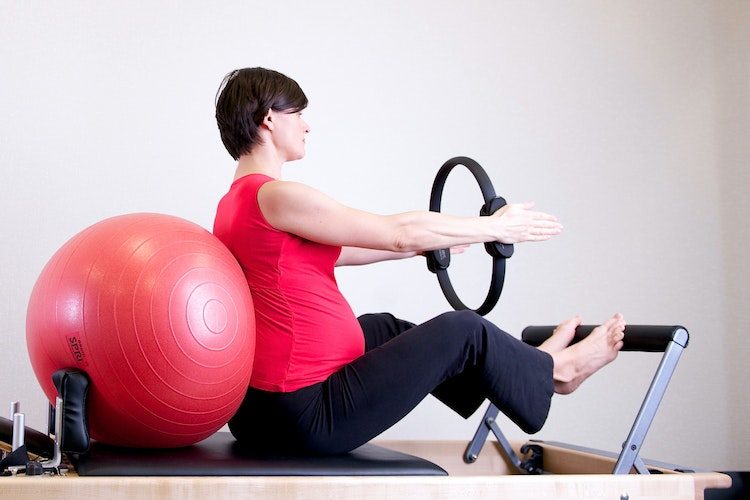
‘People Who Can Become Pregnant’: The Corruption of Language
Governmental bodies that enforce phrases which suggest that men can become pregnant, are forcing everyone to accept transgender ideology, a warped view of reality.
The overturning of Roe v. Wade sent shockwaves around the world and saw pro-choice advocates in Australia stage protests demanding greater protections for abortion access.
This is despite the fact Australia has some of the most liberal abortion laws in the world, including exclusion zones that make it illegal to pray or offer support within 150 metres of clinics in most states.
Freebies
The Australian Capital Territory government recently announced it will be offering free abortions for women who are up to 16 weeks pregnant, from the middle of 2023.
While efforts to strengthen abortion access may not be surprising, a striking feature of the media reports surrounding them has been the use of “inclusive language” to refer to pregnant women.
The ACT Government described the commitment to invest $4.6 million over four years as its “latest action” to “protect the rights of women and people who can become pregnant.”
When commenting on the announcement, the acting nurse unit manager of the ACT Marie Stopes International clinic was reported as saying:
“[Abortion] is essential to the health of women and all pregnant people — even accessing contraception should be made much easier than it is and that will help prevent unwanted pregnancies.”
This “doublespeak” seeks to normalise the idea that there is a separate category of people who are somehow distinct from biological women but can still become pregnant.
Unreality
Language works as a form of communication because we have agreed upon definitions for words and can be assured people will grasp the meaning we intend. As such, it is no small matter when the commonly held definitions of words begin to change in an effort to normalise ways of life that have traditionally been viewed as disordered.
A linguistic shift that makes it acceptable to talk about women and “people who can become pregnant” as two separate entities, changes the way people perceive reality. If the statement goes unchallenged, the reader has accepted this new category of “pregnant people”, and may even begin to use the term themselves because they are afraid of causing offence.
The obsession with pronouns also demonstrates how much people believe in the power of language. They use a change in words to help them undergo a change in identity.
Prideful Control Freaks
In his insightful book The Day Is Now Far Spent, Robert Cardinal Sarah argues that modern man mistrusts any form of dependence and desires to be in control of everything that happens to him. As a result, “the idea of receiving our nature as man and women from a Creator-God becomes humiliating and alienating.” (p. 153)
According to this ideology, “it is up to each person… to construct freely his gender, his sexual identity.” (p. 160)
The use of the term “pregnant people”, therefore, is only a small part of a larger project to redefine the nature of humanity itself. The Church speaks out against this movement because, as Cardinal Sarah writes, the Church is the “guardian of human nature” (p. 159). This is the essentially important fact that many outside the Church fail to grasp.
The Church’s “rules” in the areas of sexuality and the sanctity of human life all come from the understanding that human beings have been created male and female in the image and likeness of God — each possessing an immortal soul. These rules were not invented by the Church, but were communicated to humanity by the Creator of our human nature Himself.
Issues such as abortion, euthanasia and radical gender ideology are merely the symptoms of a larger problem — the confusion which results when we lose sight of God. For as is succinctly expressed in Vatican II’s Gaudium et Spes: “When God is forgotten… the creature itself grows unintelligible.”
However, while humanity is in the process of trying to reinvent itself, God has already told us who we are. We are the beloved sons and daughters He died to save.
The Church must not forsake its mission as the “defender of human nature” by bowing to the dictates of inclusive language. For as G.K. Chesterton once brilliantly observed:
“We do not want, as the newspapers say, a church that will move with the world.
We want a church that will move the world.”
___
By Andrew Murphy
Originally published at Family Life International.
Photo by Jessica Monte.
Recent Articles:

3 October 2026
3.7 MINS
The Church is called to be counter-cultural not to be merely contrarian, but because we love God and people. In this world, that will mean going against culture that is contrary to God.
2 October 2026
2.6 MINS
NSW Libertarian Gemma Noiosi is challenging taxpayer-funded activist events, arguing government grants should not bankroll controversial projects or private cultural ventures.
2 October 2026
11.6 MINS
New evidence challenges prevailing assumptions about adolescent sexuality and gender medicine, urging parents, clinicians and Christian leaders to prioritise honest inquiry, careful care and scientific integrity.
2 October 2026
4.3 MINS
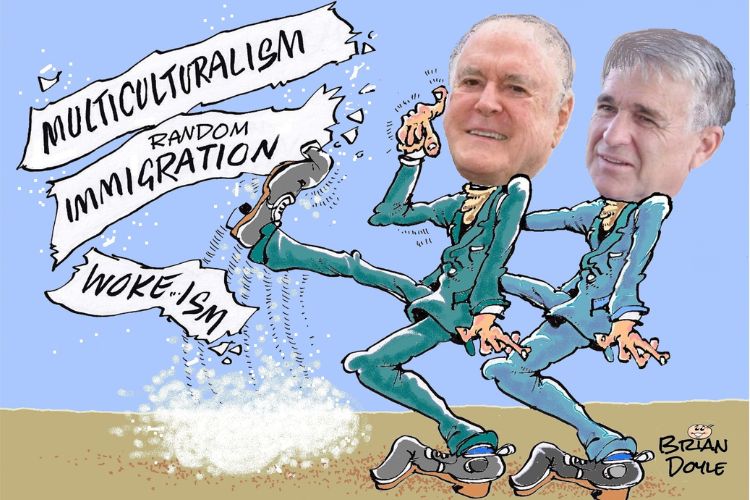
John Cleese’s views on multiculturalism, Christianity and criticism are resurfacing, offering a provocative challenge to assumptions about immigration, cultural identity and the West’s Christian foundations.
2 October 2026
3.4 MINS
New research highlights the strong links between active Christian faith, marital happiness, sexual satisfaction, family stability and the formation of future generations.

2 October 2026
5.2 MINS
Rising male unemployment, loneliness, pornography use and fatherlessness are compounding one another, raising serious questions about men’s wellbeing, family stability and the future of Western society.
2 October 2026
3.3 MINS
The Lord wants us to pray from a place of faith and resting in him. We can't awaken the Church, but he can — and he wants to do just that.


