


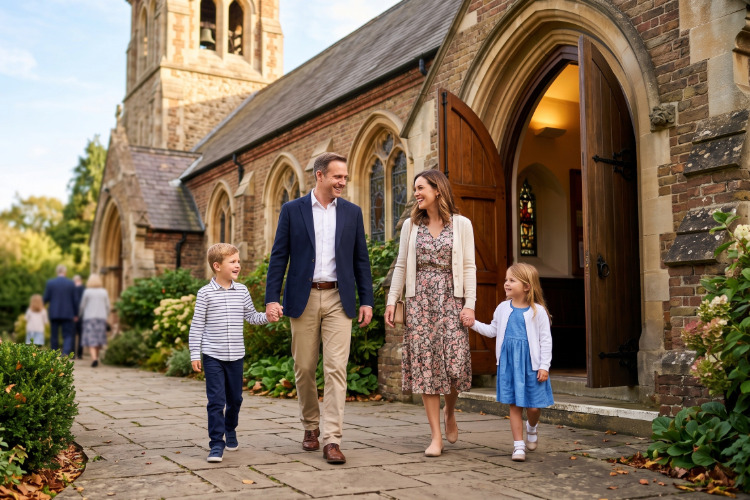
Report: Churchgoing Couples Have Highest Rate of Marital Satisfaction
Fresh research highlights the strong links between active Christian faith, marital happiness, sexual satisfaction, family stability and the formation of future generations.
New data compiled by the Institute for Family Studies (IFS) further confirms what researchers have found to be true for decades — that married couples who regularly practice their Christian faith are happier, have more children, divorce less, and experience more fulfilling intimacy than their non-religious, secular peers.
The report, released on Friday, found that churchgoing Catholic and Protestant couples “enjoy the happiest marriages in America,” with 79% of Catholics and 74% of Protestants reporting being “very happily married” compared to 66% of non-religious couples.
Faithful Couples Report Stronger Marriages
IFS noted that although the marriage rate in the US has fallen considerably in recent decades (even among Christians, with Catholic weddings plunging by 74% since 1970), “the believers who remain are more likely to enjoy strong, stable families,” with churchgoing Catholics and Protestants marrying more, having more children, and divorcing less than their secular peers. In general, churchgoers are 39% more likely to be married than non-churchgoers.
Christian couples who believe that marriage is indissoluble “have 1.85 higher odds of being happily married,” IFS reported.
This happiness appears to be tied closely with sexual satisfaction. IFS further found that a strong majority of churchgoing couples (62%) report having sex at least once a week, whereas only 48% of secular couples say the same. In addition, practising Christian couples “have 1.42 times higher odds of being sexually satisfied than husbands and wives who are not religiously active.” The report points out that churchgoing couples are bucking the national trend of a sex recession, with only 37% of the general population reporting having sex weekly.
Pornography Remains a Challenge for Christian Couples
Still, the IFS report found that a sizable portion of practising Christian couples appear to be struggling with the same challenge that has gripped the wider culture since the rise of the internet: unlimited, easily accessible smut. Fully one quarter of men who attend church twice a month or more say that they consume pornography monthly or more (although secular married men reported a higher rate of porn consumption at 35%).
The authors further state that the most “striking” finding in their research was that both churchgoing and nominal Catholic couples “consistently report lower perceived stability than Protestants” and secular couples in their marriages, despite the fact that Catholics reported higher rates of marital satisfaction and lower rates of divorce than Protestant and non-religious couples.
The report speculates that one reason behind this could be that because Catholics hold sex to be sacred, they also have higher expectations and lower moral tolerance for spouses who fall into porn consumption. “It is possible that issues related to pornography lead Catholic spouses to question their marital stability without necessarily leaving the marriage,” the authors surmise.
Despite these challenges, the new IFS report serves as yet more proof that regular church attendance and religious practice translate to more marriages, higher marriage quality and satisfaction, and more children in a wider culture that is struggling with social isolation, mental health problems, and cratering marriage and birth rates.
“The conventional wisdom holds that religious faith is an obstacle to a happy marriage and a good sex life,” IFS Senior Fellow and Director of the Get Married Initiative Brad Wilcox stated following the report’s release.
“Our research finds the opposite. No set of Americans are happier in their marriages, or more sexually satisfied, than men and women who regularly attend church. The norms, networks, and values of religious communities deepen the ties that bind, a rare gift in a digital age that is increasingly atomistic.”
Four Ways Churches Can Strengthen Marriage And Family
So how can Christians foster and promote healthy marriages in their communities? Wilcox and the report’s other authors, Richard Dell’Isola, Grant Bailey, and Jane Lankes Smith, detail four key recommendations.
- “Foster an active faith life.” Active faith guards “against threats such as pornography use, infidelity, and other strains — from money to parenting — on marriage. This entails attending church regularly, praying often, and consideration of joining an organisation or small group that fosters “spiritual nourishment through personal discipleship and community.”
- “Practice intentional marriage discernment.” The authors advise that during dating, “it is worth gauging alignment on the things that matter most: faith, morality, family roles, and more. … Skipping this kind of discernment risks building a strong emotional or physical attachment on a foundation of unresolved differences — one that becomes far harder to walk away from later.”
- “Support families at the parish level.” The IFS report found that only about half of churchgoing parents “report receiving even ‘some help’ from their church community. … Clergy and lay leaders should look for ways to offer programming, small groups, and simple respite that nurture these families’ faith and strengthen their sense of communion.”
- “Form adolescents and young adults for marriage.” “Catholic and Protestant leaders alike should recognise that the roots of a strong marriage are planted long before a couple ever meets — in the formation of the whole person during adolescence and young adulthood,” the authors emphasise. “[P]arishes, Catholic and Protestant schools, campus apostolates, and ministries … shape young people’s values and character well before dating or marriage begins. Investing early in this kind of formation is not a departure from strengthening marriage and family life; it is one of the most promising ways to secure it.”
___
Republished with thanks to The Washington Stand. Image courtesy of Adobe.
Recent Articles:
22 October 2026
2.9 MINS
Victoria Labor’s promise to fund free abortions has drawn a forceful response from Presbyterian leaders, raising profound questions about unborn life, government priorities and Australia’s moral direction.

22 October 2026
4.7 MINS
Western Australia’s proposed anti-discrimination overhaul has sparked warnings from Christian leaders that religious freedom, parental choice and faith-based schools’ ability to uphold their beliefs are at risk.

22 October 2026
2.9 MINS
An Israeli political candidate claiming a remarkable biblical identity has sparked questions about false messiahs, the Antichrist and how Christians should interpret prophecy.
22 October 2026
2.8 MINS
31 October is a historic day of reformation and revival. This end of month, let's gather together on this day which holds deep wells of revival, and ask God to do it again.

21 October 2026
3.9 MINS
Evangeline Lilly walked away from Hollywood to pursue a deeper purpose. Today, her Christian faith, humanitarian calling and passion for human creativity shape her next chapter.

21 October 2026
7.9 MINS
A collection of sobering reflections on Western civilisation’s decline, the loss of Christian foundations and the dangers of cultural complacency, ending with a message of enduring Christian hope.

21 October 2026
3.4 MINS
If we want to avoid being compliant — even unintentionally — with ungodly ideas, we need to feed our souls with food that is in accord with God’s reality.


