


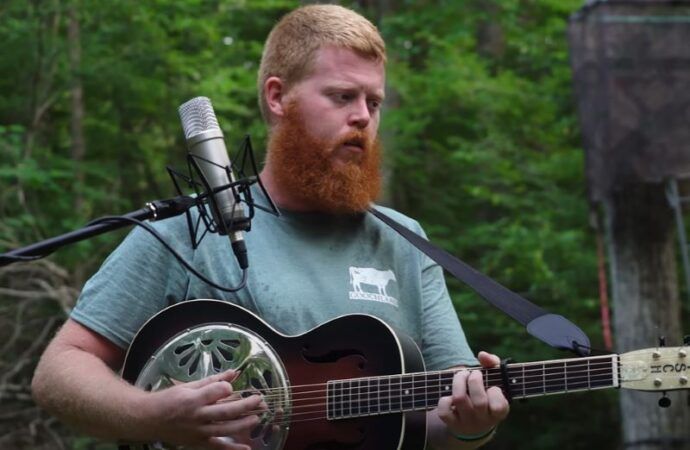
Farmer and Former Factory Worker Oliver Anthony Finds Overnight Fame
At the start of August, Oliver Anthony was unknown. Now his hit song ‘Rich Men North of Richmond’ is everywhere. What can account for his sudden stardom?
Two weeks ago, Oliver Anthony was a blue-collar worker from Farmville, Virginia, living on a 90-acre farm with his three dogs, a man unknown to the world.
Today, his song “Rich Men North of Richmond” is at the top of the global music charts. A backyard recording of his “blue collar anthem,” as it’s been dubbed, has now been viewed tens of millions of times across social media.
According to the Morning Wire podcast, recently eight of the top 15 songs on iTunes were by Anthony, even though most of them were recorded on his phone.
But still at the top is Anthony’s first viral hit, the chorus lamenting:
It’s a damn shame what the world’s gotten to
For people like me and people like you
Wish I could just wake up and it not be true
But it is, oh, it is
Livin’ in the new world
With an old soul…
Before you read on, if you haven’t listened to his song yet, do yourself a favour (but mind the occasionally colourful language):
Oliver Anthony’s rather unexpected month began when an account on X, formerly Twitter, posted his song, simply captioned with the word “Banger.”
The account owner was Chase Steely, a southern culture enthusiast, who had heard Anthony’s song on a YouTube channel that promotes homegrown Appalachian music.
Soon, country star John Rich, podcaster Joe Rogan, and many other large accounts had shared the song — and the rest, as they say, is history.
As reported by Morning Wire, Anthony began writing songs just two years ago during a difficult period of his life when, as he explains it, he “wasted a lot of nights getting high and getting drunk.”
A Genuine Musical Talent
The instant popularity of his song has set many tongues wagging.
According to some cynics, it all seems a little astroturfed, as though Oliver Anthony had friends in the industry or connections with conservative influencers. As yet, however, this appears to be a conspiracy in search of a theory.
Occam’s razor — and the fascinating comments sections on social media — suggest that his song is popular simply because it is authentic and easy to relate to, particularly for American working men, who increasingly feel like strangers in their own country.
There is no doubt that Oliver Anthony has genuine musical talent. His voice is raw and captivating. When he sings about his heartfelt grievances, the grief is audible, even slightly uncomfortable.
On the surface, “Rich Men North of Richmond” is a country song. But it’s also a misfit in a genre that has been homogenised and commercialised. Anthony wears no cowboy hat or designer jeans to convince you he’s from the country. You know he is from his unkempt beard, his ever-practical wood chair, and his dog sitting faithfully nearby.
A Political Song or a Folk Song?
Predictably, the corporate press started crafting hit pieces against the singer and his song almost immediately. Rolling Stone was the first out of the blocks, whining that “Right-Wing Influencers Just Found Their Favorite New Country Song.”
Actually, before his meteoric rise to fame, Oliver Anthony described himself as “dead center” politically, complaining that both Republicans and Democrats “serve the same master.”
There’s also the song’s lyrical contents to consider, which are politically all over the place.
While Anthony voices populist complaints about runaway inflation and an aloof political class, he also mourns for “folks in the street [who] ain’t got nothin’ to eat,” pitiably low wages, and a mental crisis — all traditionally liberal talking points.
His ballad raises other concerns shared by establishment conservatives and even anarchist libertarians, such as high taxes, “the obese milkin’ welfare,” and politicians who “just wanna have total control.”
There’s even a veiled reference to the puzzling Jeffrey Epstein saga.
While “Rich Men North of Richmond” is a song with political themes, it doesn’t have a particularly cohesive political message. It is, as commentator Michael Knowles notes, “a stew of lamenting about the political order.”
It’s not your average country song. In fact, it isn’t even really a country song. Again, to quote Knowles, it’s a folk song — an “anthem of a crippled America.”
But it’s one that resonates. It’s a man calling out from the woods in the middle of nowhere, as Knowles says, with a wail that’s finally been heard.
The establishment can mock it. The industry can try to ignore it. Critics and cynics can claim it isn’t relevant, or acceptable, or genuine, or worth hearing.
But it is, oh, it is.
___
Originally published at Intellectual Takeout.
One Comment
Leave A Comment
Recent Articles:
23 October 2026
13.1 MINS
Tasmania’s proposed conversion practices legislation raises serious questions about religious freedom, pastoral care and whether Christians can freely pray with those seeking to live according to their faith.

23 October 2026
7.7 MINS
Melbourne Catholic Archbishop Peter Comensoli has spoken out clearly against the deadly promises by both major parties in Victoria ahead of the election, drawing a comparison between abortion and capital punishment.
23 October 2026
3.1 MINS
As Western societies grow more hostile, could abandoning Christianity’s moral foundations be contributing to the rise of ideological extremism, political intolerance and violence?

23 October 2026
5.1 MINS
France’s escalating riots expose the dangers of political extremism, antisemitism and radical alliances, offering America a stark warning about the future of Western democracy.

22 October 2026
2.9 MINS
Victoria Labor’s promise to fund free abortions has drawn a forceful response from Presbyterian leaders, raising profound questions about unborn life, government priorities and Australia’s moral direction.

22 October 2026
4.7 MINS
Western Australia’s proposed anti-discrimination overhaul has sparked warnings from Christian leaders that religious freedom, parental choice and faith-based schools’ ability to uphold their beliefs are at risk.

22 October 2026
5 MINS
Queensland’s newly released abortion statistics reveal the scale of the state’s abortion toll, prompting renewed calls for political accountability, protection of unborn life and an end to parliamentary silence.



It’s a true cry of the heart, and one the “Rich Men North of Richmond” on both sides of politics need to take heed of, because the way it’s gone viral shows that it’s the true cry of Middle America’s heart.