Clear thinking on the ethics of killing.
It is a sad thing to say, but far too few Western church leaders of all stripes are willing to speak out on the vital moral and cultural issues of the day. There are, of course, notable exceptions to this, but regrettably, Australia is in the same boat. Consider the horrific plan by Victorian Labor to basically force taxpayers to pay for baby-killing. I wrote that up at the time here.
For the most part, few if any church leaders called this out. But then just the other day, I saw this online Herald Sun post:
‘Culture of death’: Melbourne Archbishop compares abortion to capital punishment.
The Catholic Archbishop of Melbourne has slammed Victoria’s major parties for backing taxpayer-funded abortion, warning Australia harbours a hidden “culture of death”.
The piece is behind a paywall, so that is all I could see of it — but that was sufficient. I am glad that Archbishop Peter Andrew Comensoli has spoken out on the abortion issue. Noted pro-lifer Joanna Howe has praised him for doing this, when so many others are silent on it:
The uniparty just made free murder an election promise and finally a prominent church leader has exposed this as the evil this is. Thank-you to the Archbishop for his strong words in today’s Herald Sun. Free baby murder should never be an election commitment. A line has now been crossed. Killing babies should never be a cynical ploy to get votes. I disagree with all the media commentators saying abortion shouldn’t be an election issue. Of course it should…
I say a hearty amen to that. I just found this piece on his website with this title: “Who will stand for the least among us?” I assume it is the same that appeared in the HS. It goes like this:
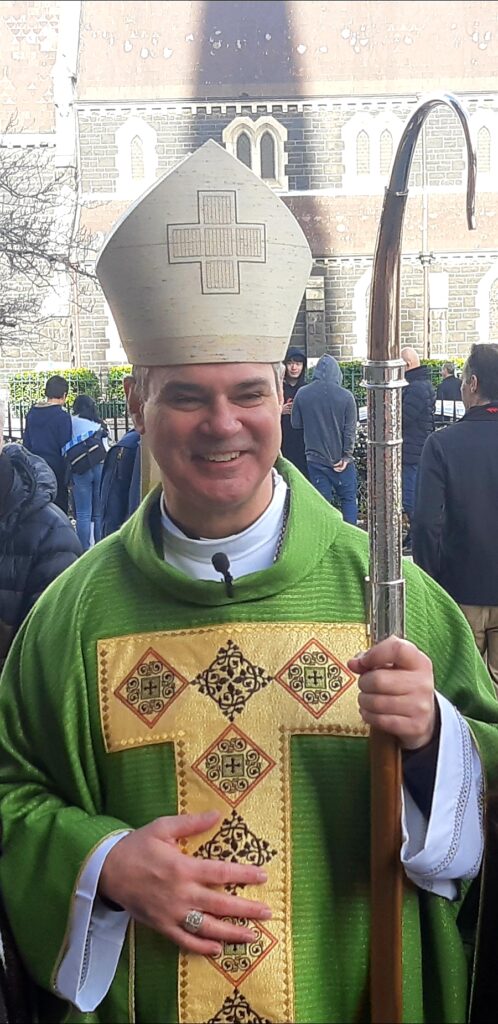
Archbishop Peter Comensoli
Australians were rightly horrified by the announced livestream execution of a convicted mass murderer. While US authorities have seen sense and cancelled the livestream, they still plan to execute the man. This isn’t the only execution to grab our attention recently. The failed execution of another prisoner in the US has shown there is no neat, ‘dignified’ way to take someone’s life, despite the promises of advocates.
To many Australians, this culture of death seems foreign to us. The truth, however, is that the taking of lives does occur here. The termination of the unborn at one end of life and the terminally ill at the other end is just as brutal and should be just as shocking. But, like capital punishment, the reality of these deaths is often hidden from us.
In the past week, the Labor Party proudly announced that, if reelected, Victorian taxpayers would cover the full cost of abortions for expectant mothers in Victoria. The Liberal/ National Coalition swiftly confirmed they would follow suit.
Last year, Victoria made so-called ‘Voluntary Assisted Dying’ easier to access. Despite advocate promises about ‘dying with dignity’, it’s not hard to find accounts of patients whose attempts to end their life using VAD have not been quick or easy or painless. Australian authorities don’t often publish this sort of data, so this reality is largely hidden from us.
But do we hold in our mind and heart the stark reality of what is occurring when human lives are deliberately ended? Each person is unique and unrepeatable; made in the image and likeness of God, with inherent dignity and infinite worth that is never lost. Sadly, this is too often ignored.
Australia rightly recognised decades ago that it could no longer justify capital punishment, if it ever could. We have the means to safely incarcerate convicted criminals for the rest of their lives if necessary.
How then can we justify ending the lives of the unborn, whatever the reason given? Do we not have the means to support the least among us and their mothers? And with the sick and the terminally ill, don’t we have the means to support them fully with love, compassion and medical care, to the end? Will politicians who advocate to fully fund one ‘choice’ also advocate to fully fund the alternatives?
Sadly, no major political party — Labor, Liberal, National — or the Greens or One Nation is offering to really turn back the tide on this culture of death. True, no candidate or political party can ever solve every issue or be a perfect representative. When casting our votes in November we will need to weigh up the full range of issues and policies before us to decide who would best serve the common good — or least harm it. Let us pray that those we choose will govern wisely and prudently, upholding the good of all, especially the least among us.
Again, great stuff to call out our moral midgets in Parliament. However, in the eyes of some theologians and ethicists, it seems he may be guilty of muddying the waters here when he claims that abortion is wrong AND so is the death penalty. Catholics especially will often hold to what is known as the “seamless garment” argument: that to be consistent pro-lifers, we must oppose all types of killing, including just war and capital punishment.
I have dealt with that (in my view) flawed argument here.
My very short reply to the Archbishop is this: He is quite right to oppose abortion, but quite wrong to compare it to capital punishment. Here is the crucial difference:
- Abortion is the unjust killing of an innocent human being.
- The death penalty is the just killing of a guilty person.
Moreover, while Catholic social teaching has always opposed abortion, it has NOT always opposed the death penalty.
But let me tease all this out a bit further. And this is territory I have often covered before. As to morally licit types of killing, there are three which Scripture permits: capital punishment, self-defence, and just war.
Abortion and Catholicism
It is easy enough to show the consistent pro-life position of the Catholic Church when it comes to things like abortion and euthanasia. Simply grabbing the Catechism of the Catholic Church (I have the 1994, St Paul’s edition) and offering a few representative quotes is straightforward enough.
On abortion, we have this, for example:
2270 Human life must be respected and protected absolutely from the moment of conception. From the first moment of his existence, a human being must be recognised as having the rights of a person — among which is the inviolable right of every innocent being to life.
“Before I formed you in the womb I knew you, and before you were born I consecrated you.”
“My frame was not hidden from you, when I was being made in secret, intricately wrought in the depths of the earth.”
2271 Since the first century the Church has affirmed the moral evil of every procured abortion. This teaching has not changed and remains unchangeable. Direct abortion, that is to say, abortion willed either as an end or a means, is gravely contrary to the moral law:
“You shall not kill the embryo by abortion and shall not cause the newborn to perish.”
“God, the Lord of life, has entrusted to men the noble mission of safeguarding life, and men must carry it out in a manner worthy of themselves. Life must be protected with the utmost care from the moment of conception: abortion and infanticide are abominable crimes.”
And here is part of what it says about euthanasia:
2276 Those whose lives are diminished or weakened deserve special respect. Sick or handicapped persons should be helped to lead lives as normal as possible.
2277 Whatever its motives and means, direct euthanasia consists in putting an end to the lives of handicapped, sick, or dying persons. It is morally unacceptable.
Thus an act or omission which, of itself or by intention, causes death in order to eliminate suffering constitutes a murder gravely contrary to the dignity of the human person and to the respect due to the living God, his Creator. The error of judgment into which one can fall in good faith does not change the nature of this murderous act, which must always be forbidden and excluded.
Capital punishment and Catholicism
Of late, some Popes and Catholic leaders have moved away from support for the death penalty, including the Archbishop referenced above. But this is not the whole of Catholic social teaching. Consider some ambiguity on this as found in the Catholic Catechism:
2266 Preserving the common good of society requires rendering the aggressor unable to inflict harm. For this reason, the traditional teaching of the Church has acknowledged as well-founded the right and duty of legitimate public authority to punish malefactors by means of penalties commensurate with the gravity of the crime, not excluding, in cases of extreme gravity, the death penalty…
The primary effect of punishment is to redress the disorder caused by the offense…
2267 If bloodless means are sufficient to defend human lives against an aggressor and to protect public order and the safety of persons, public authority should limit itself to such means, because they better correspond to the concrete conditions of the common good and are more in conformity with the dignity of the human person.
So it admits that the death penalty was long seen by the Church as being acceptable under certain circumstances, but non-lethal means of punishment may be preferable. However, changes have occurred. John Paul II had been quite influential in the development of the Catholic position on capital punishment, and by 2018, we had a new revision of this section, approved by Pope Francis. It reads:
2266 The efforts of the state to curb the spread of behavior harmful to people’s rights and to the basic rules of civil society correspond to the requirement of safeguarding the common good. Legitimate public authority has the right and the duty to inflict punishment proportionate to the gravity of the offense. Punishment has the primary aim of redressing the disorder introduced by the offense. When it is willingly accepted by the guilty party, it assumes the value of expiation. Punishment then, in addition to defending public order and protecting people’s safety, has a medicinal purpose: as far as possible, it must contribute to the correction of the guilty party.
2267 Recourse to the death penalty on the part of legitimate authority, following a fair trial, was long considered an appropriate response to the gravity of certain crimes and an acceptable, albeit extreme, means of safeguarding the common good. Today, however, there is an increasing awareness that the dignity of the person is not lost even after the commission of very serious crimes. In addition, a new understanding has emerged of the significance of penal sanctions imposed by the state. Lastly, more effective systems of detention have been developed, which ensure the due protection of citizens but, at the same time, do not definitively deprive the guilty of the possibility of redemption. Consequently, the Church teaches, in the light of the Gospel, that “the death penalty is inadmissible because it is an attack on the inviolability and dignity of the person”, and she works with determination for its abolition worldwide.
Needless to say, much debate has arisen about all this, with some Catholic teachers still making the case for the morality — and biblical basis — of the death penalty, while others want to see it banned altogether. Pope Leo XIV is in the latter camp.
I should point out that I am not Catholic, but Protestant, so I am just looking in as an outsider at their debate on this. As to my own position, I do still uphold the long-standing argument that capital punishment, self-defence and just war are all biblically acceptable. All up, I have written a number of detailed articles already on the death penalty. See these 27 pieces, for example.
So I differ with the Archbishop on this matter. I am, however, very thankful that he has made a strong call against the Labor Government’s immoral election promise. Many more church leaders should have done the same. Where are all the watchmen on the wall when you need them?
___
Republished with thanks to CultureWatch. Image courtesy of Adobe.





Archbishop Peter Comensoli Speaks Up Against Political Promises of Free Abortions
23 October 2026
7.7 MINS
Clear thinking on the ethics of killing.
It is a sad thing to say, but far too few Western church leaders of all stripes are willing to speak out on the vital moral and cultural issues of the day. There are, of course, notable exceptions to this, but regrettably, Australia is in the same boat. Consider the horrific plan by Victorian Labor to basically force taxpayers to pay for baby-killing. I wrote that up at the time here.
For the most part, few if any church leaders called this out. But then just the other day, I saw this online Herald Sun post:
The piece is behind a paywall, so that is all I could see of it — but that was sufficient. I am glad that Archbishop Peter Andrew Comensoli has spoken out on the abortion issue. Noted pro-lifer Joanna Howe has praised him for doing this, when so many others are silent on it:
I say a hearty amen to that. I just found this piece on his website with this title: “Who will stand for the least among us?” I assume it is the same that appeared in the HS. It goes like this:
Archbishop Peter Comensoli
Again, great stuff to call out our moral midgets in Parliament. However, in the eyes of some theologians and ethicists, it seems he may be guilty of muddying the waters here when he claims that abortion is wrong AND so is the death penalty. Catholics especially will often hold to what is known as the “seamless garment” argument: that to be consistent pro-lifers, we must oppose all types of killing, including just war and capital punishment.
I have dealt with that (in my view) flawed argument here.
My very short reply to the Archbishop is this: He is quite right to oppose abortion, but quite wrong to compare it to capital punishment. Here is the crucial difference:
Moreover, while Catholic social teaching has always opposed abortion, it has NOT always opposed the death penalty.
But let me tease all this out a bit further. And this is territory I have often covered before. As to morally licit types of killing, there are three which Scripture permits: capital punishment, self-defence, and just war.
Abortion and Catholicism
It is easy enough to show the consistent pro-life position of the Catholic Church when it comes to things like abortion and euthanasia. Simply grabbing the Catechism of the Catholic Church (I have the 1994, St Paul’s edition) and offering a few representative quotes is straightforward enough.
On abortion, we have this, for example:
And here is part of what it says about euthanasia:
Capital punishment and Catholicism
Of late, some Popes and Catholic leaders have moved away from support for the death penalty, including the Archbishop referenced above. But this is not the whole of Catholic social teaching. Consider some ambiguity on this as found in the Catholic Catechism:
So it admits that the death penalty was long seen by the Church as being acceptable under certain circumstances, but non-lethal means of punishment may be preferable. However, changes have occurred. John Paul II had been quite influential in the development of the Catholic position on capital punishment, and by 2018, we had a new revision of this section, approved by Pope Francis. It reads:
Needless to say, much debate has arisen about all this, with some Catholic teachers still making the case for the morality — and biblical basis — of the death penalty, while others want to see it banned altogether. Pope Leo XIV is in the latter camp.
I should point out that I am not Catholic, but Protestant, so I am just looking in as an outsider at their debate on this. As to my own position, I do still uphold the long-standing argument that capital punishment, self-defence and just war are all biblically acceptable. All up, I have written a number of detailed articles already on the death penalty. See these 27 pieces, for example.
So I differ with the Archbishop on this matter. I am, however, very thankful that he has made a strong call against the Labor Government’s immoral election promise. Many more church leaders should have done the same. Where are all the watchmen on the wall when you need them?
___
Republished with thanks to CultureWatch. Image courtesy of Adobe.
About the Author: Bill Muehlenberg
Australia / COMMENTARY / Euthanasia / Life / Politics
SHARE >
We need your help. The continued existence of the Daily Declaration depends on the generosity of readers like you. Donate now. The Daily Declaration is committed to keeping our site free of advertising so we can stay independent and continue to stand for the truth.
Fake news and censorship make the work of the Canberra Declaration and our Christian news site the Daily Declaration more important than ever. Take a stand for family, faith, freedom, life, and truth. Support us as we shine a light in the darkness. Donate now.
Recent Articles:
“I Never Wanted to Feed That Beast”: Joel Houston on Fame, Faith and Stepping Away
23 October 2026
6.8 MINS
Hillsong UNITED’s Joel Houston reflects on fame, faith and the burden of ministry, questioning performative Christianity as he seeks a more authentic walk with God.
How the LGBTIQ+ Taliban are Targeting Children
23 October 2026
13.1 MINS
Tasmania’s proposed conversion practices legislation raises serious questions about religious freedom, pastoral care and whether Christians can freely pray with those seeking to live according to their faith.
How Did Disagreement Become So Violent?
23 October 2026
3.1 MINS
As Western societies grow more hostile, could abandoning Christianity’s moral foundations be contributing to the rise of ideological extremism, political intolerance and violence?
BLM-Style French Riots Offer Cautionary Tale
23 October 2026
5.1 MINS
France’s escalating riots expose the dangers of political extremism, antisemitism and radical alliances, offering America a stark warning about the future of Western democracy.
Day 23: Awakening to the One Who Is Worthy of It All
23 October 2026
3.1 MINS
The one who is worthy of it all is awakening his Church to be captivated by him, so that we will honour one another and share his gospel with humility and courage.
Victorian Labor Promises Free Abortions
22 October 2026
2.9 MINS
Victoria Labor’s promise to fund free abortions has drawn a forceful response from Presbyterian leaders, raising profound questions about unborn life, government priorities and Australia’s moral direction.
WA’s Equal Opportunity Act Rewrite Sparks Religious Freedom Fears
22 October 2026
4.7 MINS
Western Australia’s proposed anti-discrimination overhaul has sparked warnings from Christian leaders that religious freedom, parental choice and faith-based schools’ ability to uphold their beliefs are at risk.
Use your voice today to protect
Faith · Family · Freedom · Life
MOST POPULAR
ABOUT
The Daily Declaration is an Australian Christian news site dedicated to providing a voice for Christian values in the public square. Our vision is to see the revitalisation of our Judeo-Christian values for the common good. We are non-profit, independent, crowdfunded, and provide Christian news for a growing audience across Australia, Asia, and the South Pacific. The opinions of our contributors do not necessarily reflect the views of The Daily Declaration. Read More.
MOST COMMENTS
GOOD NEWS
HALL OF FAME
BROWSE TOPICS
BROWSE GENRES