



France’s “Pfizer Amendment” Could Turn mRNA Critics Into Criminals
By Sonia Elijah
In France, a new law was passed with virtually no debate that would see citizens jailed for up to three years for criticising mRNA treatments.
On Wednesday, February 14th a highly controversial law was pushed through the National Assembly in France, potentially turning a critic of mRNA treatment into a criminal. The draconian law, which was quietly passed with virtually no debate, could throw anyone who advises against the use of therapeutic or prophylactic treatment (including experimental mRNA gene therapy) into prison for up to three years and pay a hefty fine of 45,000 euros.
A screenshot of the law “aimed at strengthening the fight against sectarian excesses” can be viewed below.
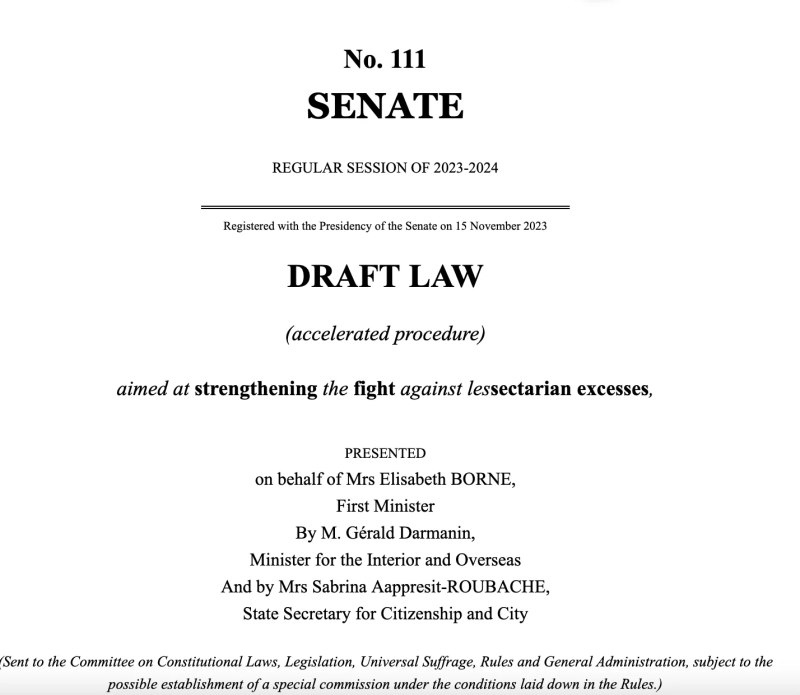
The bill was initially proposed in 2022 following a report from (Miviludes) the Interministerial Mission for Vigilance and Fight Against Sectarian Abuses. It is the inclusion of the creation of an offense to punish ‘provocation to abandonment or abstention of care’ that has sparked such fierce controversy.
The French government’s alleged reasoning for this measure is that they hope it will help convict pseudo-therapists and protect victims of sectarian abuses.
Tkp, a blog for science and politics, reported on the bombshell news, with a particular focus on Article 4 of the new law. The report reads “It was a hard-fought issue, but the Macron regime ultimately got its way. Article 4 is central to the new law, which was first deleted but then reinstated. This creates a new criminal offense and criminalizes the “request to stop or refrain from therapeutic or prophylactic medical treatment” as well as “the request to use practices that are presented as therapeutic or prophylactic.” This means that any resistance to mRNA treatment (and other corporate medical methods) can be criminalized in the future.’
An English translation of Article 4, which comes under the heading of “Protecting health” can be read below.
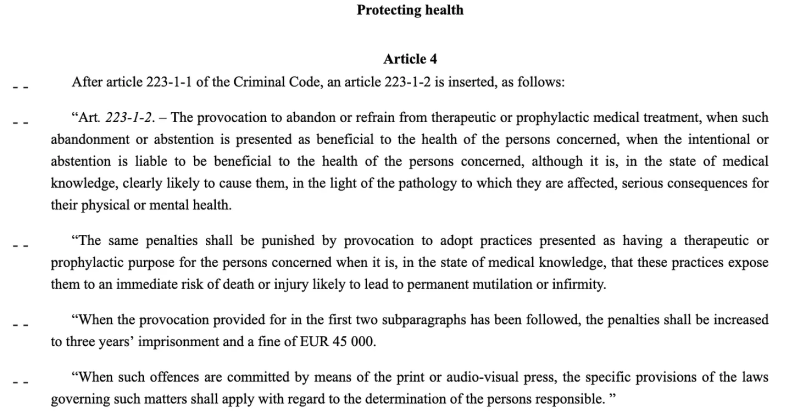
Initially, the French government failed to pass this new law but after some careful rewording it was adopted with 151 votes to 73, virtually without debate.
The French parliamentary correspondence reported: ‘Brigitte Liso has therefore tabled an amendment to restore — and reword — Article 4. Although the rapporteur emphasized that the offense is not fulfilled “if proof of the person’s free and informed consent is provided,” she also made it clear that the new wording introduces an additional dimension in the context of the protection of whistleblowers. The aim of the law of December 9, 2016 on transparency, combating corruption and modernizing economic life was. An objective reiterated in the text of the amendment, according to which “information reported or disclosed by a whistleblower under the conditions set out in Article 6” of the previously cited law “does not constitute provocation” within the meaning of Article 4 of the present bill.’
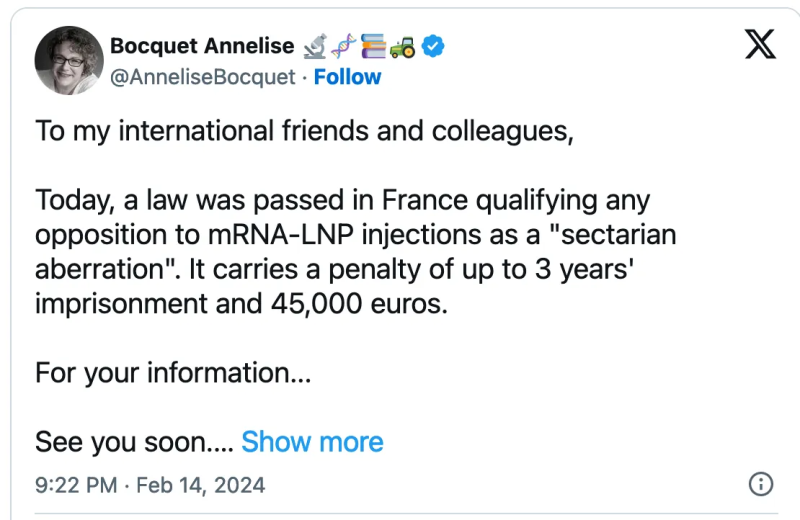
On the very day the new law was pushed through France’s National Assembly, critics of it took to social media to voice their concerns, such as biologist, Annelise Bocquet.
Political Philosopher, David Thunder, wrote, ‘So sad to see that the repression of medical dissent under what critics are calling the “Pfizer article” has been passed by the French Parliament. This is anti-science and is pushing France ever further in the direction of totalitarianism. Even France’s Conseil d’Etat condemned the law as a disproportionate and unjustified attack on freedom to express dissenting scientific and medical opinions.’
Florian Philippot, the party leader of “Les Patriots,” a Le Pen splinter, called Article 4, the “Pfizer amendment.”
As a reminder, it was Emmanuel Macron’s government that introduced the medical apartheid system of vaccine passports in the summer of 2021, forcing anyone wanting to visit a cinema, shop, or restaurant to show proof of their Covid-19 vaccination status or a recent negative test.
It was also Macron who caused an uproar when he stated in an interview with Le Parisien “I am not about pissing off the French people… But as for the non-vaccinated, I really want to piss them off. And we will continue to do this, to the end. This is the strategy.”
However, in the future, when another pandemic is announced, the strategy would have moved on from “pissing off” the non-vaccinated in France, to potentially imprisoning them.
___
Republished with thanks to Brownstone Institute via the author’s Substack.
Recent Articles:

12 October 2026
3.1 MINS
The proposed livestream of Nidal Hasan’s execution has reignited debate over justice, deterrence and public accountability, with critics comparing American justice to ISIS propaganda.
12 October 2026
3.7 MINS
An EU court case over baptismal records could pit data protection laws against religious freedom, raising serious questions about whether governments can compel churches to erase sacramental history.
9 October 2026
5 MINS
During a recent dialogue between high profile legal experts, a top Australian constitutional law expert was asked if Australia should have a Bill of Rights. His answer may surprise you.

9 October 2026
3.3 MINS
New South Wales healthcare workers who object to abortion and voluntary assisted dying face growing pressure, raising serious questions about conscience rights, employment and moral injury.
8 October 2026
3.6 MINS
John Anderson warns that Australia’s decline is rooted in spiritual and cultural disintegration, calling for a recovery of Christian foundations, social cohesion and national purpose.

8 October 2026
1.6 MINS
A blackout at Australia’s $150 million Pre-COP climate summit in Fiji delivered an awkward lesson in energy reliability to delegates preaching the renewable transition.

8 October 2026
4.1 MINS
Italy honours St Francis of Assisi 800 years after his death, celebrating a saint whose devotion to Christ, radical simplicity and message of peace continue to shape generations.


