



Is the Domestic Market the Real ‘Pot of Gold’ for Farmers After All?
An increasing number of farmers and agricultural bodies are complaining that the promised bonanza from free trade giving them greater access to global markets is not happening. They point to rapidly rising food imports undermining Australian farmers in their own domestic market.
These complaints are credible, according to recent data from the Organisation for Economic Cooperation and Development (OECD) and the Food and Agricultural Organisation (FAO). The OECD/FAO Agricultural Outlook 2024-2033 shows that Australia’s balance of trade in agriculture has fallen sharply since 2017, declining from $US28.3 billion to $US10.1 billion in 2024. It is expected to deteriorate further, then stagnate at around $US9 billion annually over the next decade.
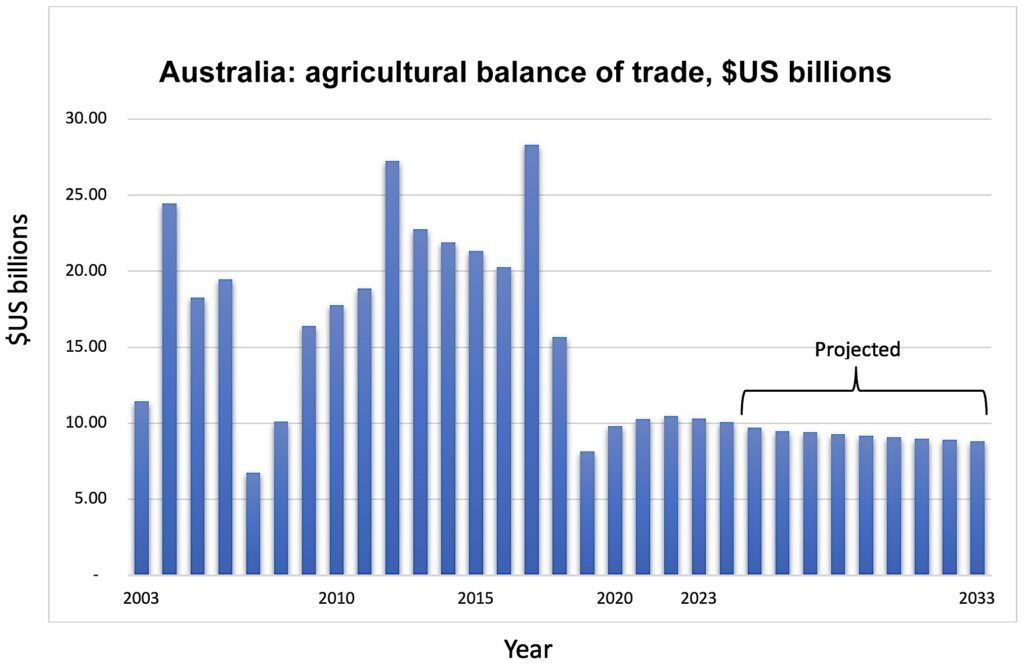
Source: OECD-FAO Agricultural Outlook 2024-2033, pg. 67. Data here.
This data indicates that either Australian agricultural exports are declining, or that food imports are rising, or a combination of both is happening.
That makes it important to answer this question: given the gross value of Australian agricultural output is, in U.S.-dollar terms, $US60 to $US70 billion annually ($A80 to $A90 billion, based on exchange rates over recent years), is it really true that Australia exports 70 per cent of its agricultural product when net rural exports appear to be dropping to below $US10 billion a year?
Dodgy Statistic
The Promised ‘Pot of Gold’
It appears that Australia’s agricultural policies have been based on false assumptions – the relative unimportance of the domestic market to farmers, and the misplaced faith in the rest of the world moving to a level playing field in agricultural trade.
The big question is: “Have the decades of farm policies led to expansion or contraction of the 50-plus farm sectors across agriculture?”
In the absence of any government agencies providing a comprehensive, clear answer to this question, here are some production volume considerations based on ABS historical data and from various peak bodies. It is useful to compare changes in industry production volumes over time with Australia’s growing population.
Some industries have increased production. Wheat and coarse grains have increased moderately above Australia’s population growth since 1975. There have been moderate to large increases in horticulture, chicken meat, oilseeds, pulses, forestry and cotton since about 1990.
Others have stagnated. Sugarcane and dairy expanded for a time with major investment, but production declined in both sectors after deregulation in the early 2000s. Nor has rice kept pace with population growth. Wine grape production largely stagnated after 2001.
Some industries have gone backwards. The cattle herd was 30.2 million in 2024, which was 2.6 million under its 1975 peak of 32.8 million. Australia’s population has increased about 94 per cent over that time. The sheep flock (mainly the wool flock) has dropped dramatically since its 1989-90 peak of 170 million, down to 79.1 million in 2024, which is 90 million below its peak.
The problem for the farm sector is that nowhere can farmers find a clear picture of the overall state of agricultural production, as the major government organisations responsible for agriculture, along with the NFF and Cairns Group, are more concerned with endlessly extolling the virtues of policies to boost farm exports.
Issues Unresolved
A recent DAFF Snapshot of Australian Agriculture 2024 still claims that 72 per cent of agricultural product was being exported based on a 3-year average over 2017–18 to 2019–20.
However, the Snapshot fine print under Figure 7 on the value of exports, admits that “export values are measured at the border and so include processing of some commodities beyond the farm gate (for example, wine from grapes and cheese from milk)”. Does this mean that ABARES/DAFF figures are still comparing “apples and oranges”, i.e. calculating the percent of agriculture exported by putting processed export products, like the value of cheese (processed milk) exports, over the total farmgate value of raw milk?
Another example is the 2023 report from an “Inquiry into food security in Australia”, by the House of Representatives Standing Committee on Agriculture. It declared that Australia is one of the most food secure countries in the world … exporting around 70 per cent of agricultural production”. At the same time, it cited ABARES data showing food exports in 2016–17 were 33 per cent of indicative food production, that is, exports here were 33 per cent of total production as measured at the farm gate, which is the correct way to statistically compare like with like.
It seems the inquiry report was making contrary statements – that farmers export 70 per cent, and that farmers export 33 per cent. Which is it?
Questions Demanding Answers
Decades of agriculture and trade policies have been based on:
● An apparent misconception, that 70-80 per cent of agriculture is exports when multiple studies and national-accounts data obfuscate the fact that the farmers’ primary market is the domestic market.
● The failed belief that agricultural free trade on a level playing field was inevitable, when most major food-producing nations value food security far above free trade.
● The National Competition Policy of deregulating farm industries, that stripped farmers of their collective bargaining arrangements, along with free trade policies, have overall left Aussie farmers:
– Still unable to expand access to foreign markets that continue to be heavily protected.
– Being undermined by imported foods that are often dumped into the Australian market.
– At the mercy of the supermarket duopoly, megamerchant and port monopolies dictating farmgate prices.There are important questions that Australian government agencies and peak farm bodies need to answer. Indeed, farmers, their peak bodies and the National Party should be asking these questions:
● Where are the historical volume production data for each farm sector, so that each sector can assess whether they are expanding or contracting?
● How much are food imports impacting each farm sector?
● What is the percentage of each agricultural product being exported, by farm sector and for agriculture as a whole, as measured at the farmgate?
● How can Australia’s level of food security be assessed, and farm policies for agriculture be targeted, without knowing the true percentage of agriculture exported, and the relative importance of the domestic market?
● What different policies are needed for farm sectors that are primarily export-oriented and those that primarily sell into the domestic market?
● Finally, when will clear, transparent data and reports be produced by ABARES and DAFF for Australian farmers and policymakers, based on the above questions that are fundamental to the future of agriculture and Australia’s food security?
___
Republished with thanks to News Weekly. Image courtesy of Adobe.
One Comment
Leave A Comment
Recent Articles:

19 October 2026
6.7 MINS
Europe’s escalating unrest raises urgent questions about immigration, national identity, secularism and the decline of Christian influence, prompting calls for repentance, prayer and renewed leadership.

19 October 2026
7 MINS
Western Australia’s euthanasia deaths have surged, prompting calls for an urgent inquiry amid concerns about doctor shopping, waived safeguards, limited palliative care and proposed legal expansion.

19 October 2026
12.4 MINS
Greta Gerwig’s "Narnia: The Magician’s Nephew" trailer raises questions about C. S. Lewis’s Christian vision and the faithfulness of the new Netflix adaptation. Here are my initial impressions and concerns.

19 October 2026
2.7 MINS
The UK Greens’ vote to define Zionism as racism has exposed deep divisions within the party, raising questions about its future leadership and political direction.

19 October 2026
3.3 MINS
Discover why dads make a unique difference in their children’s lives, and how the Dads4Kids Fun Camp creates lasting memories through adventure, connection and fun.

19 October 2026
3 MINS
Paul prayed that we would be awakened to a deeper revelation of the Father and who we are in Christ, so that we will make Jesus known to others more passionately.

18 October 2026
2.7 MINS
Every season of life belongs to Christ, and we don't retire from discipleship as we grow older. In fact, our older years hold unique gifts for the younger generations.



Such a complete and worthy evaluation of the data available, Patrick Byrne. You are to be congratulated. Sadly the NFF which is supposed to represent farmers is so out of touch with the great majority of its constituents, all it is likely to do is haughtily dismiss your contribution in its entirety. That means the National Party is likely to follow suit.