


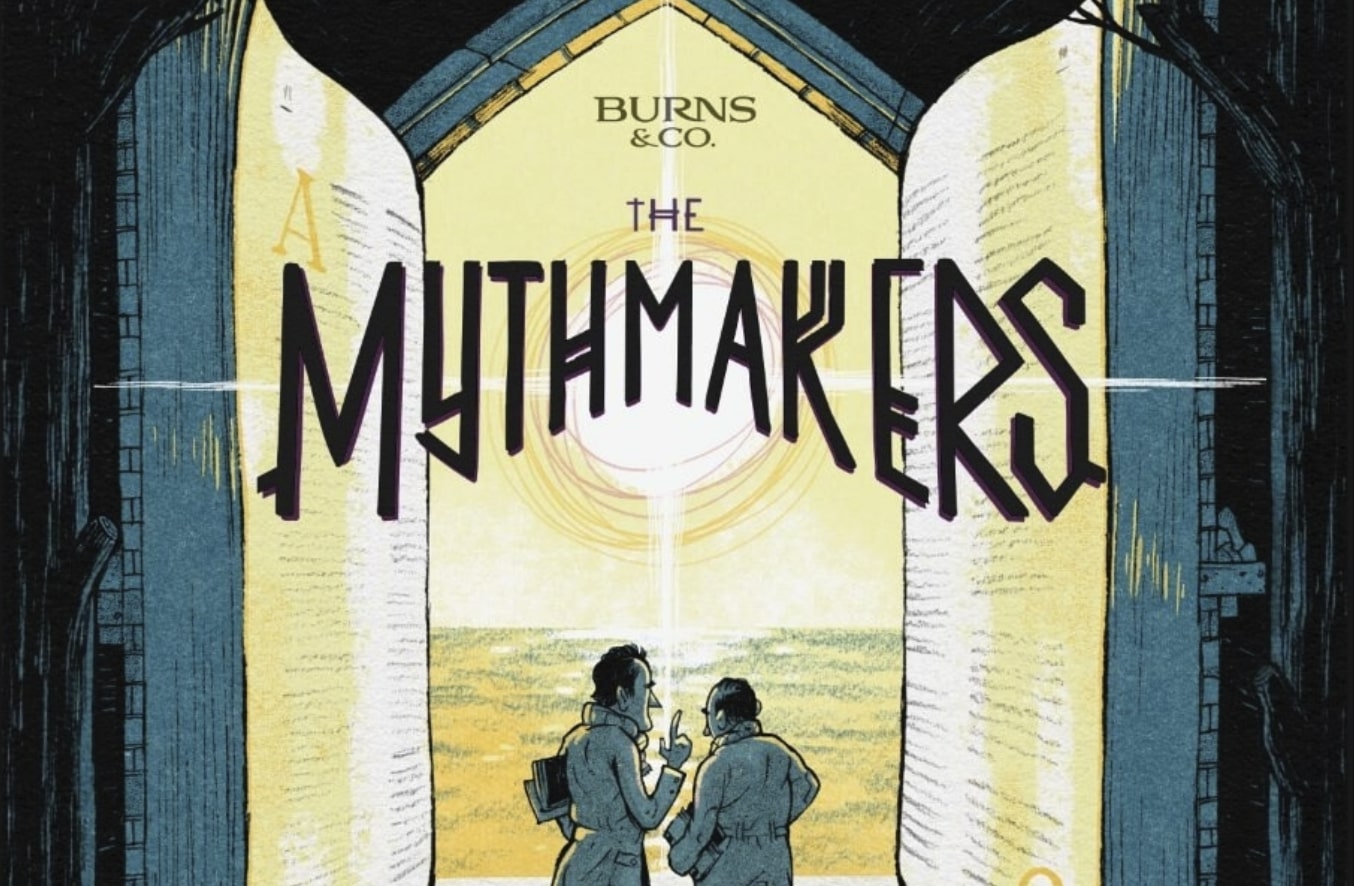
Mythmakers: Upcoming Film Reveals the Untold Friendship Behind Narnia and Lord of the Rings
Discover the untold friendship behind Narnia and Middle-earth in Mythmakers, an upcoming animated film exploring C.S. Lewis and J.R.R. Tolkien’s transformative bond, faith, and literary genius—coming soon from Burns & Co.
A forthcoming animated feature film promises to bring the intriguing friendship of two of the English-speaking world’s favourite authors into the spotlight—exploring the close relationship between C. S. Lewis and J. R. R. Tolkien.
Based on the graphic novel by New York Times bestselling author John Hendrix, Mythmakers will be produced by Burns & Co.—an American production company whose director Aaron Burns has worked closely with the Kendrick brothers on films including War Room (2015) and The Forge (2024) and directed several of his own features, including Birthright Outlaw (2023) and Beyond the Mask (2015).
You can watch the trailer for Beyond the Mask below:
Speaking with Collier in July this year, Burns said:
“C.S. Lewis and J.R.R. Tolkien’s works have inspired me for as long as I can remember. When I read John Hendrix’s The Mythmakers, I immediately knew that Burns & Co. needed to adapt it into an animated film as special as the book. John’s words and images literally leap off the page, so I can’t wait to capture his creativity and craft a timeless film that families can enjoy for years to come.”
Although a release date has not yet been announced for the project, the film is likely intended to coincide with the upcoming releases of Netflix’s new Narnia film series (2026)—directed by Greta Gerwig (Barbie, Little Women)—and Peter Jackson’s anticipated new The Lord of the Rings instalment, The Hunt for Gollum (2027).
The fictional worlds of Narnia and Middle-earth—the respective creations of Oxford scholars C. S. Lewis and J. R. R. Tolkien—are recognised by critics and audiences alike as among the most brilliant and timeless fantasy creations of all time. But few people realise just how closely the two worlds are connected—or rather, how well the two worlds’ creators knew one another.
Tolkien and Lewis: Their Fellowship
Clive Staples (C. S.) Lewis—or “Jack”, as his friends knew him—met John Ronald Reuel (J. R. R.) Tolkien—or “Tollers”—met at a faculty meeting at Merton College, Oxford University, in 1926. According to his own letters and his later reflections, Jack was still a somewhat conflicted atheist at the time.
Despite having significantly different temperaments and backgrounds, Lewis and Tolkien soon became fast friends—bonding over their common love for the world of myth and fantasy.
In fact, Tollers—and another Christian friend of Lewis’s, Hugo Dyson—played an important role in Jack’s conversion to Christianity during a “memorable” late-night/early-morning conversation while walking around “Addison’s Walk” at Magdalen College, Oxford, where the three discussed “metaphor and myth” and the Christian faith.
Just days later, Lewis would write to his friend Arthur Greeves that he had “just passed on from believing in God to definitely believing in Christ — in Christianity. […] My long night talk with Dyson and Tolkien had a good deal to do with it.”
Although Lewis never embraced Tolkien’s Roman Catholicism, the two were further united in their common Christian faith.
Writing in his autobiography Surprised by Joy (1955), C. S. Lewis reflected humorously on the pair’s religious differences:
“At my first coming into the world I had been (implicitly) warned never to trust a Papist [Roman Catholic], and at my first coming into the English Faculty (explicitly) never to trust a philologist. Tolkien was both.”
Tolkien, Lewis, and the wider literary group they were a part of—known as the “Inklings”—which literary scholars and historians recognise as having exerted an enormous impact not only on English literature, but on the wider imagination of the West.
To quote scholars Carol and Philip Zeleski:
“By the time the last Inkling passed away on the eve of the twenty-first century, the group had altered, in large or small measure, the course of imaginative literature (fantasy, allegory, mythopoeic tales), Christian theology and philosophy, comparative mythology, and the scholarly study of the Beowulf author, of Dante, Spenser, Milton, courtly love, fairy tale, and epic; and drawing as much from their scholarship as from their experience of a catastrophic century, they had fashioned a new narrative of hope amid the ruins of war, industrialization, cultural disintegration, skepticism, and anomie.”
The Legacy of Lewis and Tolkien
Both Lewis and Tolkien were “lovers of logos (the ordering power of words) and mythos (the regenerative power of story)”, according to Zaleski and Zaleski. And the numerical impact of their stories and other writings is a testament to that power.
Lewis’s The Chronicles of Narnia has sold between 100 and 120 million copies and has been translated into forty-seven different languages—“baptising the imaginations” of millions of children by introducing them to Christian truth in story form and the person of Jesus in the Lion Aslan. It was also adapted into film in the early 2000s, grossing over $1.5 billion USD.
When Lewis’s non-fiction is taken into account—including bestsellers like The Screwtape Letters (1942), Mere Christianity (1952), and many other literary and theological classics—some estimates put the total number of his books sold at 200 million. Millions of his works continue to sell annually.
For its part, Tolkien’s masterful The Lord of the Rings trilogy has become among the best-selling works of all time—having sold 150 million copies and now immortalised in the cinematic epics that are Peter Jackson’s The Lord of the Rings (this year ranked as the greatest films of the twenty-first century by The Australian newspaper).
The Hobbit is not far behind, selling some 100 million copies and making it to the big screen as the biggest-budget film trilogy of all time (with a combined budget of $745 million USD).
The little-known friendship between Jack and Tollers—a relationship that supported the creation of the greatest pieces of twentieth-century literature—is the story that Burns & Co. are setting out to communicate in Mythmakers. In doing so, they may introduce for the first time an entire generation to the faith and imagination of two of the great Christian thinkers and authors.
Image courtesy of Burns & Co.
3 Comments
Leave A Comment
Recent Articles:
27 November 2026
3.3 MINS
A newly released documentary celebrates the remarkable life and legacy of Rev Fred Nile, featuring tributes from political leaders, friends and those who worked alongside him.

27 November 2026
2.6 MINS
Pope Francis’s claims of meeting Satan three times have reportedly sparked a full-blown PR crisis in Hell, threatening centuries of carefully cultivated disbelief.

27 November 2026
2.1 MINS
Christian leaders, political allies and former opponents have paid tribute to Reverend Fred Nile, honouring his faith, moral conviction and decades of public service.

26 November 2026
2.9 MINS
Major Christian organisations and hundreds of Australian leaders have united to condemn antisemitism, support Jewish Australians and pledge practical action through a landmark national declaration.

26 November 2026
3.7 MINS
The Trump administration has launched a dedicated clinic for vaccine injury patients, promising better medical care, expanded research and stronger protections for doctors reporting suspected injuries.

26 November 2026
2.3 MINS
The expansion of marriage beyond traditional boundaries raises important questions about love, lust and moral responsibility, as new forms of multi-partner relationships gain legal recognition.

26 November 2026
4 MINS
Drawing on centuries of Habsburg family history, Eduard Habsburg presents a Christian vision of marriage, parenthood and prayer as foundations for lasting happiness.




C.S Lewis didn’t believe the Genesis account was literal, he didn’t believe the Bible was all of Gods Word.
His books are full of pagan mythical creatures from Greek, Norse and Irish pagan mythology.
How can these books be considered Christian.
Here is something on C.S Lewis’s occult connections. Listen to this and then say how Christian his books are.
https://youtu.be/M-eX3uvZkO0?si=J-jAQMohLkSyIkQw
Dear valued Daily Declaration readers and commenters:
We want to make you aware that a recent series of comments on this article were found to be part of a coordinated campaign by a single individual using multiple accounts. Those comments weren’t representative of genuine discussion and have now been removed.
We take the integrity of our comment sections seriously and we’re committed to making sure the comments sections of our articles stay respectful, constructive, and in line with our commenting policy: https://dailydeclaration.org.au/comments/.
We appreciate your vigilance, engagement, and support.
God bless,
The Daily Declaration Team