


How Much Nonsense Can A Nation Absorb?
After years of telling Australians that black is white, up is down and common sense is extremism, the political class is about to find out where the public’s breaking point is.
Australia’s political elites are playing a dangerous game.
For years, they have been asking ordinary Australians to accept ideas that would have caused previous generations to check whether someone had accidentally left the gas on.
A series of propositions the majority regard as self-evidently untrue, divisive, or disconnected from everyday reality.
Our betters assure us that their maddening ideas are signs of progress.
Worse, they insist that any resistance on our part would be nothing but a sign of ignorance.
And most dangerously, they tell us that disagreement with them would be wicked.
But the cultural shaking we are right now living through is not because Australians are incapable of change. This country has adapted to enormous social, economic and cultural transformations throughout its history.
The problem is that change is easiest when it aligns with common sense and lived experience. It becomes much harder when the population is expected to deny what they can plainly see.
And, increasingly, there is a growing gap between what Australians are told to believe and what many actually believe.
That gap is becoming a threat to social cohesion.
Biological Unreality
Take the debate over sex and gender.
For thousands of years, humanity had muddled through with the understanding that men were men and women were women.
Then, almost overnight, we were informed that this was no longer true.
Not because science had discovered something new. But because activists had changed the definitions.
Words that once described objective realities were suddenly reclassified as subjective feelings.
What is a woman has become a theological question.
A One Nation Senator was publicly mocked, just last week, for daring to use the term “biological woman”.
Bureaucrats in the Office of the Minister for Women (no less) derided him.
“What does that even mean? How ridiculous!”
Australians have been instructed that a man can become a woman and that questioning this proposition is evidence of bigotry.
And we have all been told, in no uncertain terms, to nod along.
The remarkable thing is not that people disagree. The remarkable thing is that our elites seem genuinely surprised that people disagree.
Entire bureaucracies, corporate policies and legislative frameworks have been built around the concept that sex and gender are fluid.
Language itself has been redefined — not to describe reality, but in a bid to reshape reality.
The United Nations famously tweeted:
Trans women are women
Trans women are women
Trans women are women
Trans women are women
Trans women are women
Trans women are women
… as if saying it would make it so.
Words that once had clear meanings are now treated as flexible concepts subject to ideological interpretation.
Australia’s Sex Discrimination Commissioner Anna Cody just last week insisted that, under the law, men identifying as women could potentially be pregnant.
The country responded with howls of laughter.
But Dr Anna Cody responded by doubling down… penning a lengthy column for The Australian in an attempt to educate us on the new reality.
Because, of course, the problem was not that her position made no sense. The problem was our stubborn refusal to go along with her nonsense.
When governments and institutions attempt to enforce ideological conformity on matters that large sections of the population regard as obvious facts, frustration inevitably follows.
You can force people to repeat a lie.
And you certainly cannot force people to believe a lie.
And yet that is exactly what our elites are attempting to do when it comes to sex and gender.
Multiple Identities
Then there is the question of national identity.
Australia used to have one flag.
Now every government building looks like it’s hosting a miniature United Nations summit.
When did we vote on this? Were we even asked?
We are told that displaying three flags promotes unity.
Which is an interesting theory.
It’s a little like claiming that dividing a family inheritance three ways demonstrates togetherness.
Most Australians instinctively understand that national symbols are supposed to unite people under a common identity.
Instead, we increasingly emphasise racial categories and ancestral distinctions.
The public is told this is inclusion.
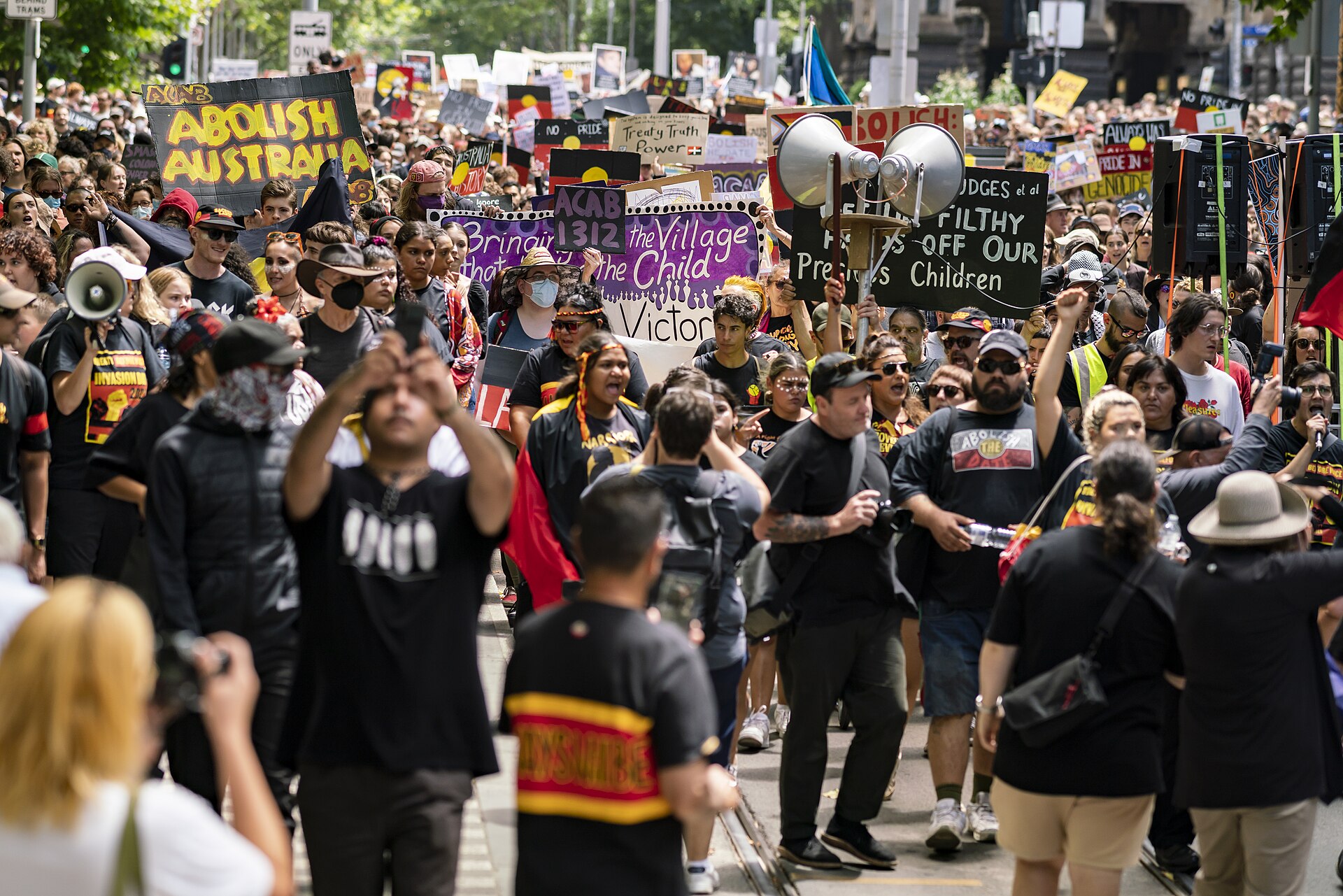
Yet many Australians look at the arrangement — whereby the Australian flag is flown alongside the Aboriginal and Torres Strait Islander flags — and see something quite different.
They see a nation being divided into racial categories and encouraged to think of itself as a collection of distinct groups.
Political leaders continually call this inclusion, which invites only head scratching from average Australians.
That disagreement goes to the heart of the social cohesion challenge.
Oppressive
The same dynamic applies to the way Australians are encouraged to view their history.
Every public event now begins with a ritual reminder that most of us are standing on somebody else’s land.
The overwhelming majority of Australians are now routinely informed that their country was built on stolen land.
That we are settlers. Invaders. Occupiers.
The slogan “Always was, always will be Aboriginal land” is repeated so often that it has become the national anthem’s unofficial opening act.
Three men who booed this message on Anzac Day were found guilty in court this week of “offensive behaviour”.
It’s strange that the offence is to be offended by being called a stranger in your own country.
Australians acknowledge the hardships experienced by Indigenous communities and recognise that mistakes were made throughout the nation’s history.
We also believe Australia’s story is larger than its mistakes.
We see a country that has built one of the world’s most successful, prosperous and peaceful societies. We are proud of its institutions, freedoms and achievements.
But when every national occasion is accompanied by a reminder of historical guilt, many begin to wonder whether we are expected to celebrate our country or apologise for it.
Eventually, people stop listening.
Or worse, they start listening.
A society cannot remain cohesive if it loses confidence in its own legitimacy.
Net Zero, Zilch
The same tension exists in the climate debate.
Australians have been informed that unless we completely transform our economy, redesign our energy system and pay more for virtually everything, the planet is doomed.
The fact that Australia produces roughly one per cent of global emissions is treated as an inconvenient detail.
It’s the equivalent of being told your garden hose is responsible for a flood in Bangladesh.
Nevertheless, households are expected to absorb rising costs while being assured that salvation is just one more subsidy away.
Coal miners lose jobs.
Manufacturers face higher energy prices.
Families struggle with power bills.
And politicians congratulate themselves for their courage.
Nothing says leadership quite like making life more expensive while posing for photographs beside a wind turbine.
Of course, none of these issues would be nearly as inflammatory if disagreement remained acceptable. But we are told it is not.
Question climate change policies and you are labelled a “denier”, a “dullard” and a “dunce”. Or worse.
Question gender ideology, and you are labelled a transphobe.
Question race-based policies, and you are labelled a racist.
The labels vary. But the pattern and purpose remain the same.
The objective is not to win the argument. The objective is to make the argument impossible.
Because once disagreement becomes a moral crime, there is no need to persuade anyone.
You simply shame them into silence.
Breaking Point
The problem is that silenced opinions do not disappear.
They accumulate.
Like steam inside a pressure cooker.
When dissent becomes taboo, frustration does not disappear. It simply goes underground.
And history is full of examples of what happens when governments mistake silence for agreement.
Australia remains an extraordinary country.
Our institutions are stable. Our people are tolerant. Our society is remarkably peaceful.
But social cohesion is not indestructible.
It depends upon shared truths, shared symbols and a shared understanding of reality.
Every time our elites insist that division is unity, that biology is a feeling, that patriotism is guilt, or that scepticism is hate, they stretch that social fabric a little further.
Perhaps they believe the elastic will never snap.
Perhaps they assume ordinary Australians will continue smiling politely while being told that black is white, up is down, and common sense is a form of extremism.
Maybe they’re right.
Political elites seem to believe they are leading the nation toward a more enlightened future.
But if they continue demanding that citizens accept ideas many regard as implausible, divisive or disconnected from reality, they risk discovering that public patience has limits.
And history suggests that when those limits are reached, the backlash can arrive much faster than anyone expects.
My hot tip… brace for impact.
___
Republished with thanks to The James Macpherson Report. Image courtesy of Wikimedia Commons.
3 Comments
Leave A Comment
Recent Articles:

7 October 2026
3.6 MINS
Victoria’s 18th March for the Babies will bring families together to peacefully affirm the value of every human life and call for a cultural change towards life.
7 October 2026
1.5 MINS
Across the Middle East, North Africa and Anatolia, Christianity once shaped entire civilisations. Could Britain’s Christian heritage likewise become a memory rather than a reality?

7 October 2026
4.6 MINS
Medicine was created to heal and preserve life. Yet abortion, euthanasia and gender medicine increasingly redefine death and destruction as care, leaving the vulnerable dangerously exposed.
7 October 2026
3.7 MINS
Christians have their differences. But those differences should not, and need not, result in us being disconnected from each other in the one body of Christ.
6 October 2026
3.4 MINS
Christians cannot afford to let headlines and social media shape their view of Israel. Scripture provides a foundation for understanding Israel, God’s promises and our response.

6 October 2026
6.7 MINS
Fresh revelations about the foiled FlyDubai terror plot expose the attacker’s alleged extremist history, while a courageous pilot’s actions prevented an unthinkable catastrophe.
6 October 2026
6.2 MINS
Britain’s grooming gang scandal exposes a devastating failure to protect vulnerable children, raising urgent questions about political correctness, accountability, immigration and the loss of moral courage.



Well said James, that’s the way I feel, as a Christian I stand for Faith, Family and Freedom, and more important for Truth, we’ve been lied and they want us submissive, I don’t swallow the pill, I don’t have a voice than can be heard, but that’s why I support people than can do it on my behalf, like you. I’ve been told by some other believers that there’s nothing I can do, but there’s a lot I can do, starting by praying, and supporting those who can be heard. God bless you.
A brilliant commentary of present day Australia. Very sad truth.
Thank you James. It is a nonsensical time in history. If only we had stayed with the Bible as the source of all truth, with God’s laws and guidelines clearly laid out incluing the ten commandments, to love God first…To love each other and to establish families where parents nurture children and teach them God’s ways and watch over them for good. It is so upside down and wrong (criminal?) to ask parents to entrust their children to state and Federal Govt value system that champions LGBT, abortion, euthanasia. If only the Australian Consititution was still followed and the orginal value system instated in 1901.